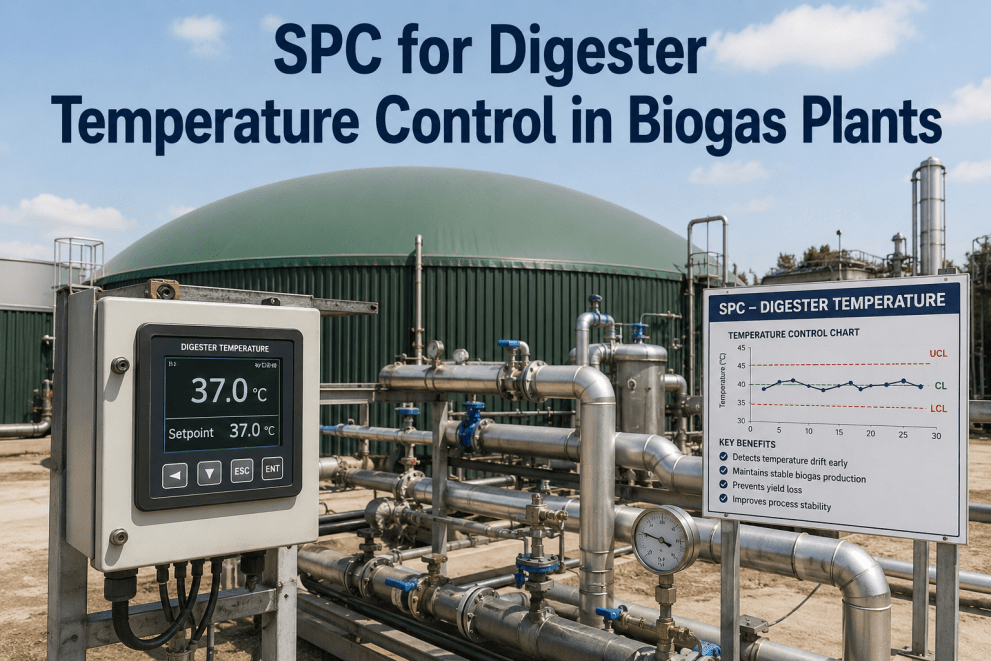
Digester heating is the single largest internal energy consumer in any biogas plant — accounting for 40–55% of total thermal self-consumption and 15–25% of gross energy output in typical U.S. facilities. Plants that have deployed iFactory's thermal optimization platform report 18–28% reductions in digester heating energy consumption with no reduction — and in most cases a measurable increase — in specific methane yield per ton of feedstock.Book a demo
Why Digester Temperature Stability Is the Highest-Impact Variable in Biogas Yield Performance
The microbial community that drives anaerobic digestion — the methanogenic archaea and the syntrophic bacteria that support them — operates within a temperature window that is significantly narrower than most biogas plant heating control systems are designed to maintain.The temperature optimization problem is therefore not simply "keep the digester at 37°C." It is "keep every cubic meter of the digester volume at 37°C ± 0.3°C, 24 hours per day, 365 days per year, while using the minimum possible thermal energy to achieve that stability."
- 2–4°C temperature band around target setpoint — continuous microbial stress cycling
- Heating energy waste from overshoot cycling — heat applied above actual requirement
- 3–8% methane yield reduction per 1°C swing, accumulating across all cycles
- Heat exchanger fouling detected only when heating capacity visibly degrades
- Insulation degradation unnoticed until thermal imaging audit reveals cold spots
- Feedstock heating demand unmanaged — cold substrate shocks the digester every feeding cycle
- ±0.3°C temperature control precision — stable microbial environment maximizes yield
- Heating energy matched to actual thermal demand — no overshoot, no waste
- Specific methane yield increased 6–12% through elimination of temperature-stress cycles
- Heat exchanger performance trended continuously — cleaning scheduled at optimal intervals
- Insulation integrity monitored via surface temperature array — repairs prioritized by heat loss rate
- Feedstock preheating integrated with digestate heat recovery — cold substrate shocks eliminated
The Five Temperature Zones That Determine Digester Heating Performance and Yield
Digester heating optimization requires managing five distinct temperature zones within the biogas plant — each with its own measurement requirements, control dynamics, and impact on methane yield.
Four Heat Management Strategies for Optimized Digester Temperature Control
Effective digester heating optimization requires a coordinated set of strategies that address heat generation, heat delivery, heat retention, and heat recovery simultaneously. iFactory's thermal optimization module integrates all four into a single automated control framework — with each strategy monitored and adjusted continuously based on real-time temperature and flow data.
Integrated Heat Flow Management: From Feedstock Entry to Digestate Discharge
The thermal energy that enters a biogas plant through CHP fuel combustion, heat recovery, or backup boiler operation follows a flow path from heat source to heat sink that passes through multiple stages — each with its own efficiency, control requirement, and optimization opportunity.
Measurable Impact: Digester Heating Optimization Results from Deployed Facilities
Digester Heating Optimization Measures: Impact and Implementation Priority
The selection and sequencing of heating optimization measures should be driven by each facility's specific thermal system configuration, feedstock characteristics, and climate conditions. The table below ranks the most common measures by their combined impact on energy reduction and yield improvement, based on data from iFactory deployments across U.S. biogas facilities processing agricultural, food waste, and wastewater feedstocks. Book a demo to receive a facility-specific thermal optimization assessment.
| Optimization Measure | Energy Reduction | Yield Impact | Implementation Priority | Typical Payback |
|---|---|---|---|---|
| Precision PID temperature control | 8–15% | +4–8% methane yield | Critical | 1–3 months |
| Digestate-to-feedstock heat recovery | 12–22% | +2–4% methane yield | Critical | 6–14 months |
| Insulation audit and repair program | 8–15% of losses | Neutral | High | 4–12 months |
| CHP heat recovery optimization | 15–25% of demand | Neutral | High | 3–8 months |
| Heat exchanger performance trending | 5–12% | +1–3% methane yield | High | 2–6 months |
| Thermal storage buffer installation | 8–18% | +1–2% methane yield | Medium | 12–24 months |
| Variable temperature operation by season | 6–12% | Neutral to +2% | Medium | 1–4 months |
| Gas upgrading compressor heat recovery | 5–10% of demand | Neutral | Standard | 12–24 months |
Expert Perspective: Why Digester Heating Optimization Is the Highest-ROI Investment in Biogas Operations
I have managed biogas plant operations for 14 years across six facilities in the upper Midwest and Great Lakes regions — and I have never seen a single operational change deliver the combined energy savings and yield improvement that precision temperature control produces. The reason is structural: digester heating is both the largest energy consumer and the most yield-sensitive process variable in the plant, and it has historically been managed with the least precision. We operated for years with a 3°C deadband around the target temperature, accepting the daily temperature swing as normal. When we deployed iFactory's precision control module and reduced that deadband to 0.3°C, the first thing we noticed was not the energy savings — it was that the gas production trace flattened. .Book a demo
Frequently Asked Questions: Digester Heating Optimization
The target control precision for optimal methane yield is ±0.3°C at every point in the active digester volume — not just at the thermocouple location. This level of precision requires three elements that most biogas plants do not currently deploy. First, a vertical thermocouple array at 3–5 depth levels in each digester zone to measure the actual temperature gradient rather than the boundary layer temperature near the heating element. Second, a PID (proportional-integral-derivative) control algorithm that anticipates heat loss from feedstock additions, ambient temperature changes, and diurnal variation
iFactory's thermal analytics module correlates temperature data with three additional process parameters to distinguish normal operational variation from early-stage process upset signals. The primary correlation is temperature against volatile fatty acid concentration — a rising VFA trend combined with a temperature deviation of more than 0.5°C from setpoint is a confirmed early warning of process instability, requiring corrective action. The secondary correlation is temperature against gas production rate and methane content — a temperature deviation that occurs without an accompanying change in gas production is likely a harmless transient, while a deviation that is followed by a 3–6 hour lagged decline in methane content is a confirmed yield-impacting event.Book a demo
Yes — iFactory's thermal optimization module is designed to be hardware-agnostic and integrates with all common digester heating configurations. For facilities using external heat exchangers with a recirculation loop, iFactory connects to the existing temperature sensors, flow meters, and control valves — adding a vertical thermocouple array in the digester for true bulk temperature measurement and a PID controller upgrade for the recirculation pump and control valve. For facilities using internal pipe coils, the same approach applies with the addition of surface temperature monitoring on the digester wall adjacent to the coil attachment points — detecting coil fouling or scaling that reduces heat transfer efficiency before it affects digester temperature.
Variable temperature operation allows the digester target temperature to shift within a defined seasonal band — typically 1–2°C lower in winter and 1–2°C higher in summer — to reduce heating energy demand during cold months and take advantage of higher ambient temperatures during warm months without active heating. The concept is based on the observation that the optimal temperature for methanogenic activity is not a single fixed point but a range of approximately 2–3°C for mesophilic digesters, within which the methanogens are metabolically active at near-peak rates.
For a mid-size U.S. biogas facility with 1–2 digesters, existing SCADA infrastructure, and a standard external heat exchanger heating configuration, a full digester thermal optimization deployment runs $45,000–$85,000 over an 8–12 week implementation timeline. The cost covers temperature sensor array installation in each digester zone ($6,000–$14,000 per digester), PID controller integration and control logic configuration ($12,000–$22,000), heat exchanger performance trending and delta-T monitoring setup ($8,000–$14,000), heat recovery system integration and optimization logic ($10,000–$18,000), thermal dashboard creation and alert rule development ($5,000–$10,000), and training and commissioning including operator onboarding and 30-day supervised operation ($4,000–$7,000). For facilities that already operate iFactory's energy intelligence platform, the thermal optimization module is typically deployed in 4–6 weeks because the data connectivity and platform infrastructure are already in place. Ongoing platform subscription ranges from $12,000–$20,000 annually including all software updates, thermal model maintenance, and support. The investment is typically recovered within 3–6 months through combined energy savings and methane yield improvement — with the precision temperature control upgrade alone often recovering its full cost within the first quarter through yield increase. Book a demo to receive a facility-specific thermal optimization assessment with projected ROI based on your plant's current operating data.
Conclusion: Stability Is Yield, and Precision Is Profit
The relationship between digester temperature stability and methane yield is not a theoretical relationship — it is a measurable, repeatable, economically significant correlation that exists in every biogas plant regardless of feedstock type, digester configuration, or climate zone. .
iFactory's digester heating optimization platform provides the continuous temperature monitoring, precision control automation, heat exchanger performance trending, insulation integrity tracking, and heat recovery optimization that most biogas plants lack Book a demo to see how iFactory's thermal optimization platform can transform your digester's energy and yield performance.