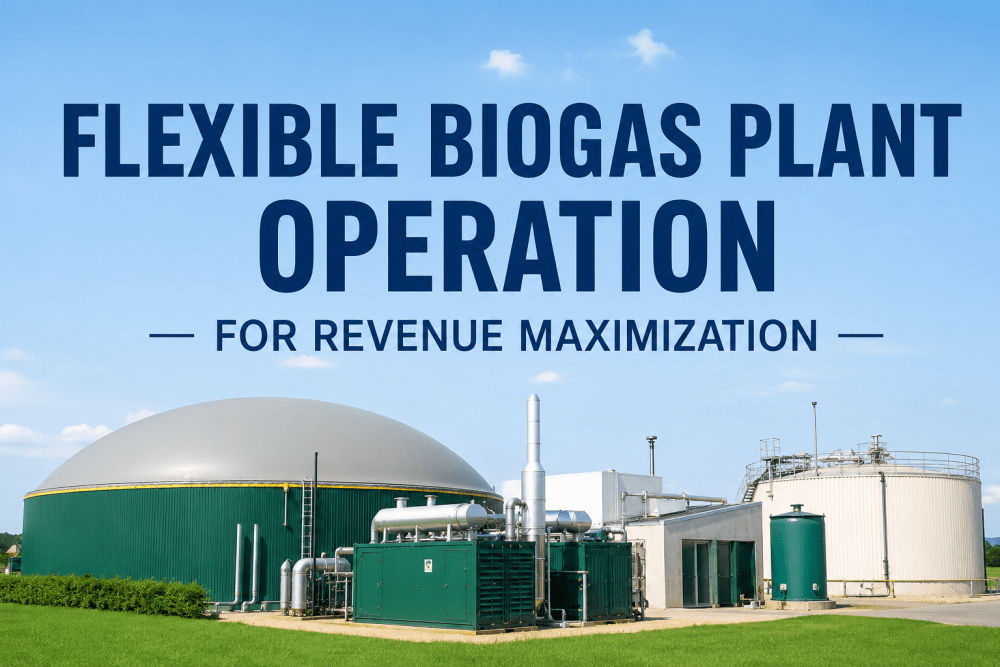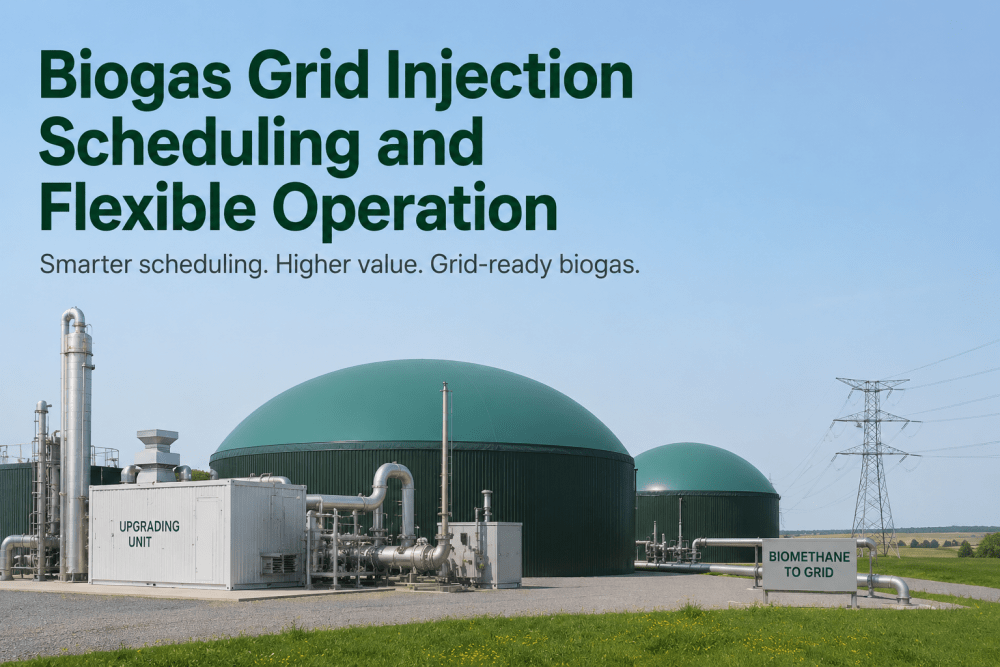
Grid injection scheduling has become the highest-impact variable in biogas plant profitability. Natural gas prices fluctuate hourly in deregulated markets, pipeline injection capacity varies with seasonal demand, and grid operators increasingly call on biomethane plants for demand response and balancing services. Yet most biogas plants still operate on a fixed produce-and-inject model — running digesters at a constant rate regardless of grid conditions and injecting all available gas at whatever price the day-ahead market delivers.
Is Your Grid Injection Schedule Leaving Revenue on the Table?
iFactory's flexible injection scheduling platform coordinates gas storage, CHP operation, and pipeline injection timing to capture peak prices while protecting base load contract commitments — no additional production capacity required.
Why Flexible Grid Injection Scheduling Is Critical for Biogas Revenue
The revenue model for grid-connected biogas plants has shifted dramatically in the past five years. Fixed-price feed-in tariffs are being phased out in favor of market-based pricing, exposing biomethane producers to the same hourly price volatility that natural gas traders have managed for decades. In deregulated markets such as PJM, NYISO, and CAISO, natural gas prices at major hubs can swing by 30 to 60 percent within a single day — creating a $3 to $6 per MMBtu spread between peak and off-peak periods that represents pure margin opportunity for plants that can time their injections strategically. Yet most biogas plants inject gas at a constant rate around the clock, effectively selling their entire production at the volume-weighted average price rather than capturing peak premiums. Planning teams that book a demo of iFactory's flexible injection scheduler consistently discover that their gas storage capacity — even modest buffer volumes — can capture 60 to 80 percent of the available peak price premium without any change to digester throughput.
| Market Period | Typical Price Range ($/MMBtu) | Duration (Hours/Day) | Injection Strategy | Revenue Impact |
|---|---|---|---|---|
| Off-Peak (Night / Weekend) | $2.10 – $3.50 | 10–14 hours | Storage fill / CHP diversion | Base load coverage |
| Shoulder (Morning / Evening) | $3.50 – $5.00 | 6–8 hours | Moderate injection + storage balance | Contract compliance zone |
| Peak (Midday / Evening Peak) | $5.00 – $8.00+ | 4–6 hours | Max injection from storage + production | Highest margin capture |
| Grid Emergency / Demand Response | $8.00 – $15.00+ | 1–4 hours (event-based) | Emergency injection or CHP switch | Premium event revenue |
Production-Storage Balancing: The Core of Flexible Injection
Every flexible injection strategy depends on the plant's ability to decouple gas production from pipeline injection — storing gas when prices are low and injecting stored gas when prices are high. iFactory's scheduling engine resolves these variables into a single optimized injection plan that updates every hour based on the latest price forecast, storage level, and production trend. Production planners who book a demo consistently cite the production-storage balancing visualization as the single feature that transforms their understanding of what their plant's flexibility is worth.
Peak Price Capture and Demand Response Strategies
Maximizing revenue from flexible grid injection requires a portfolio of strategies that the platform deploys based on current market conditions, storage status, and contract obligations. The most valuable capability is not any single strategy but the platform's ability to switch between them automatically as conditions change — injecting at peak rates during high-price windows, diverting to CHP when power prices beat gas prices, and building storage during off-peak periods for future peak capture. Planning teams that book a demo typically discover that their plant has 2-3x more flexible injection capacity than they estimated — the constraint was not storage but scheduling intelligence.
Peak Price Injection Capture
The platform schedules maximum injection during forecasted peak price windows, drawing from both live production and stored gas. Typical capture rate: 70-85% of available peak premium with adequate storage capacity.
Demand Response Participation
Grid operators pay premium rates for voluntary load reduction during system emergencies. The platform manages DR event participation automatically — reducing injection or switching to CHP — and documents compliance for settlement.
CHP-Gas Price Arbitrage
When power prices exceed gas prices on an equivalent energy basis, the platform diverts gas to CHP generation instead of injection. The decision model accounts for CHP efficiency, O&M costs, and grid export value.
Seasonal Storage Management
In markets with significant seasonal price spreads, the platform manages multi-month storage strategies — building inventory during summer low-price periods for winter peak injection when prices can be 3-5x higher.
The day-ahead schedule is the primary revenue optimization window. iFactory combines next-day price forecasts from hub indices (Henry Hub, TETCO M2, SoCal Citygate) with storage levels, production forecast, and contract obligations to generate an hourly injection plan that maximizes revenue while maintaining compliance.
- Hourly injection rate schedule aligned with day-ahead price curve
- Storage utilization plan — building or drawing based on price forecast
- CHP diversion windows identified when power vs gas spread favors on-site generation
- Contract compliance check against minimum daily and monthly volumes
- Automated schedule submission to pipeline operator or scheduling tool
Intraday gas markets operate in hourly and locational increments, with prices updated every 30 to 60 minutes. iFactory monitors intraday price feeds and automatically adjusts the injection schedule when the actual price deviates from the day-ahead forecast by more than a configurable threshold — typically $0.50/MMBtu.
- Real-time price feed integration with major hub indices
- Automatic schedule adjustment on threshold price deviation
- Storage buffer management for intraday capture opportunities
- CHP switch recommendation when intraday power prices spike
- Hourly P&L tracking showing actual vs scheduled revenue
Grid emergencies and demand response events create the highest-value injection opportunities — and the tightest response windows. When a DR event is called or a pipeline constraint creates a local price spike, the platform recalculates the optimal response within minutes and pushes the updated schedule to the plant control system.
- Automated demand response event detection and response calculation
- Emergency injection rate scheduling (storage draw at maximum capacity)
- CHP curtailment or full-switch recommendation for DR compliance
- Event documentation for DR settlement and contract verification
- Post-event storage replenishment plan for the following price cycle
In markets with pronounced seasonal spreads — winter gas typically trading 40-80% above summer prices in the northeastern U.S. — seasonal storage management can generate more revenue than all hourly optimization combined. The platform models multi-month storage strategies against historical price curves and current forward curves.
- Forward curve integration for 6-12 month price planning
- Seasonal storage injection/withdrawal calendar optimization
- Summer injection rate vs winter withdrawal margin calculation
- Contract overlap management — seasonal storage vs base load obligations
- ROI modeling for storage capacity expansion based on captured arbitrage
Integration with Gas Storage and CHP Infrastructure
Flexible injection scheduling relies on three physical assets: gas storage capacity, CHP generation capability, and pipeline interconnection capacity. Most biogas plants already possess all three, but their operating schedules are typically managed independently — the storage system on a pressure controller, the CHP on a maintenance calendar, and the injection valve on a fixed flow setpoint. The storage level determines how much buffer is available for peak capture, the CHP provides a diversion path when injection is suboptimal, and the pipeline meter and compressor station execute the scheduled injection rate. Plant engineers who book a demo consistently find that their existing infrastructure is capable of significantly more flexible operation than current control strategies allow.
Your Plant's Most Valuable Asset Is Not Production — It Is Flexibility
The biogas plants that capture peak prices, participate in demand response programs, and protect base load contract margins are not necessarily the largest producers or the best-funded operations.What has been missing is the scheduling intelligence to coordinate these assets in real time against constantly changing market prices. For planning teams looking to increase plant revenue without increasing feedstock volume or capital expenditure, flexible injection scheduling is the highest-lever opportunity available — and the reason more plant operators book a demo is that the revenue improvement is measurable in the first billing cycle, not the first budget cycle.
Biogas Grid Injection Scheduling — Frequently Asked Questions
Turn Your Gas Storage into a Revenue Engine with iFactory AI
iFactory's flexible injection scheduling platform coordinates production forecasting, storage management, CHP diversion, and pipeline injection into a single real-time optimization engine — delivering 15-25% revenue lift without adding production capacity. Trusted by biomethane plant operators in deregulated markets across North America.