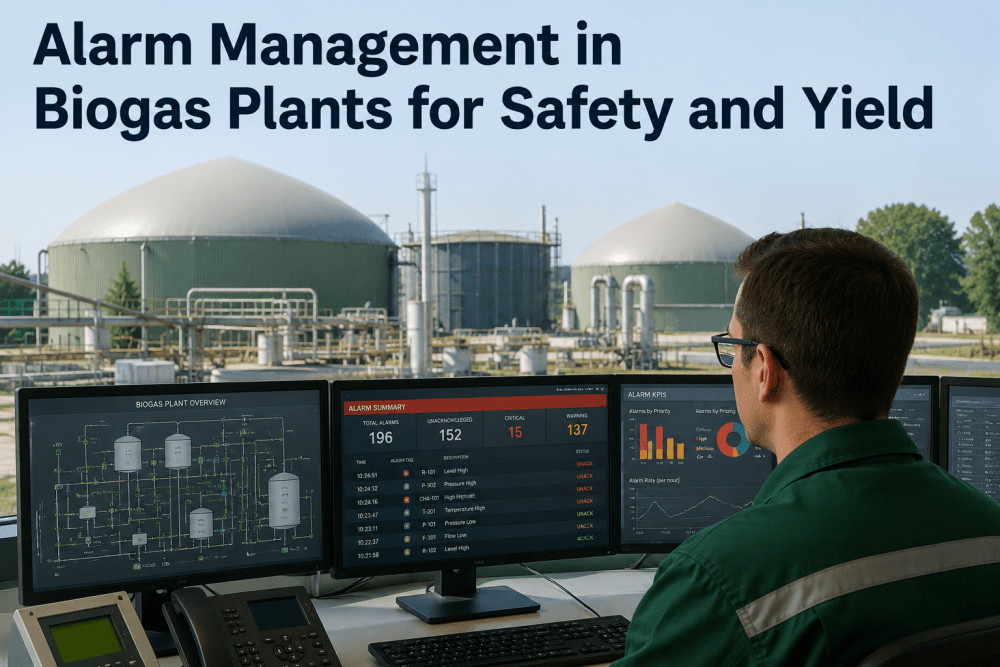
Alarm Management in Biogas Plants for Safety and Yield

By James Talon on June 13, 2026

biogas-plant-alarm-management

Biogas plant operators across the USA, Canada, UK, and Australia face a relentless barrage of alarms every single shift — hundreds of nuisance alerts from feedstock variability, gas pressure fluctuations, and process disturbances that bury the few genuine critical events in a sea of noise.Plant operations managers who book a demo are discovering that AI-driven alarm rationalisation does not just reduce alarm counts — it fundamentally transforms operator response behaviour and restores confidence in the alarm system.

78%
Reduction in total alarm events per day after AI-driven rationalisation — from 680 to under 150 actionable alarms per shift
92%
Critical alarm operator response rate within the defined 5-minute target window post-rationalisation vs. 43% pre-deployment
3.2
Standing alarms per operator per shift after rationalisation vs. 83 standing alarms before — restoring trust in every alert
4 wks
Full DCS alarm rationalisation deployment from initial tag audit to ISA 18.2-compliant alarm system go-live

Why Anaerobic Digestion Plants Need ISA 18.2 Alarm Management


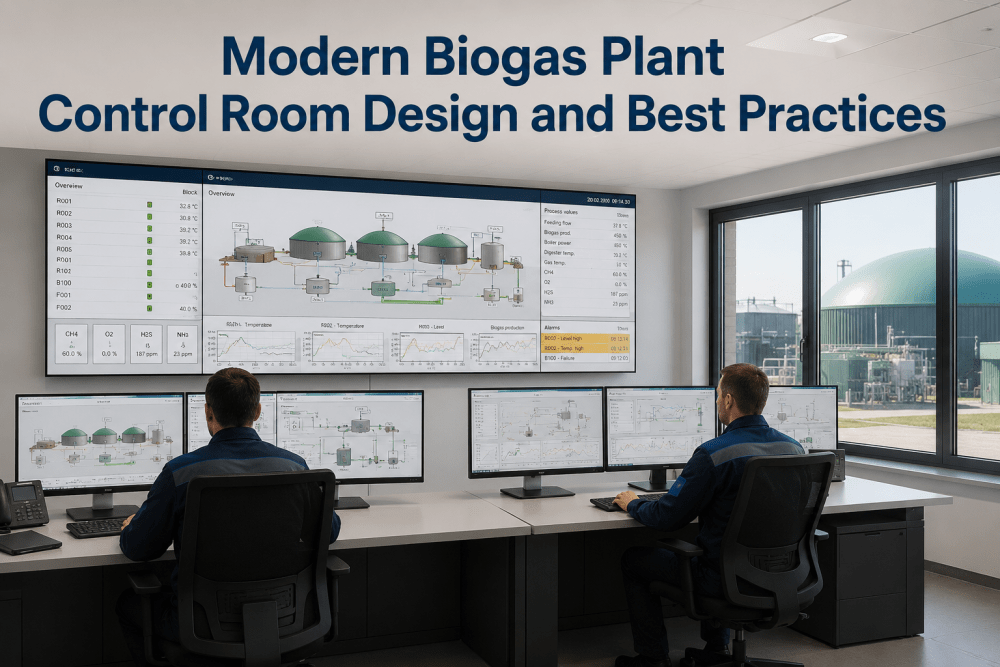
What separates well-run biogas facilities from those struggling with alarm floods is not the number of sensors installed — it is a structured alarm management programme that defines every alarm's priority, consequence, response time, and operator action before it ever reaches the HMI. Here is how iFactory's AI-powered rationalisation transforms alarm system performance across key biogas-producing regions:

85%
US biogas plants operating with no formal alarm philosophy or ISA 18.2 documentation

US biogas facilities — from dairy-sourced RNG operations in Wisconsin and California to landfill gas-to-energy plants in Texas and Florida — operate under EPA and state-level air quality permits that require continuous emissions monitoring and reporting. Alarm floods from gas treatment skids, combined heat and power (CHP) engine protection systems, and biogas blower stations routinely mask genuine CH₄ leak detection alarms, siloxane breakthrough warnings, and H₂S scrubber breakthrough events. iFactory's alarm rationalisation module ingests DCS tag databases, SCADA historian records, and operator response logs — applying ISA 18.2 classification (emergency, high, low, and journal-level) to every biogas asset alarm, grouping related tags into single operator notifications, and generating documented rationalisation records for EHS audit compliance.

71%
Reduction in CHP engine downtime after alarm rationalisation

Canadian biogas operators — managing agricultural AD plants in Ontario and Quebec alongside landfill gas facilities in British Columbia — face extreme seasonal temperature swings that create false alarms on digester heating systems, condensate drain monitoring, and engine jacket water temperature loops. iFactory's dynamic alarm limit adjustment models incorporate ambient temperature, feedstock type, and digester loading rate into each alarm's setpoint, eliminating frozen-weather false positives while maintaining sensitivity to genuine heating system failures during winter months. Operations managers evaluating alarm rationalisation for multi-seasonal facilities can book a demo to review the dynamic limit tuning methodology with iFactory's process control engineers.

64%
Reduction in operator alarm response time after ISA 18.2 deployment

UK AD plants operate under OFGEM renewable energy obligations and stringent Environment Agency permitting that mandates defined alarm response procedures for emissions exceedances, gas storage levels, and flare operation. iFactory's alarm management platform generates automatic ISA 18.2 rationalisation documentation for each alarm tag — including defined consequence, corrective action, and priority classification — which serves as direct evidence for environmental permit compliance audits and OFGEM RHI (Renewable Heat Incentive) operational reporting.

90%
Reduction in alarm flood events during feedstock changeovers

Australian biogas plants — predominantly landfill gas-to-energy and large-scale AD facilities supporting NEM grid injection — face alarm floods during feedstock transitions when gas composition and flow rates shift rapidly. iFactory's state-based alarm suppression technology automatically disables standing alarms during known process-state transitions (feedstock changes, digestate removal, maintenance lockouts) and re-enables them once steady-state conditions are confirmed — eliminating the alarm floods that typically accompany routine operational events while maintaining protection coverage for genuine abnormal conditions.

The Real Cost of Alarm Fatigue in Biogas Operations

Alarm fatigue does not just frustrate operators — it directly impacts plant safety, production uptime, and maintenance costs. When every alarm is treated as equally unimportant because 80% of them are standing or nuisance events, the 20% that signal genuine process danger are ignored until a consequence occurs. The financial and operational impacts are measurable and significant.

Missed CH₄ and H₂S Leak Detection Alarms
Gas detection alarms for methane and hydrogen sulphide are the most critical safety layer in any biogas facility. When these alarms are buried among hundreds of nuisance alerts per day, operators delay response — and a delayed response to a rising CH₄ reading in the engine room can escalate from a near-miss to a reportable safety incident within minutes. iFactory elevates all gas detection tags to emergency priority with dedicated HMI placement and mandatory operator acknowledgement.
Digester Temperature Excursions
Anaerobic digestion is a temperature-sensitive biological process. A 2–3°C excursion above the optimal mesophilic or thermophilic range can reduce biogas production by 15–30% for 48–72 hours while the microbial population recovers. When temperature alarms are lost in alarm floods, the excursion continues unnoticed until gas production drops — costing $8,000–$25,000 per event in lost RNG revenue at a typical 3 MW facility.
CHP Engine Protection Bypasses
Combined heat and power (CHP) engines have 30–50 protection alarms per unit — coolant temperature, exhaust temperature, vibration, oil pressure, and knock detection. When nuisance alarms from routine engine warm-up cycles and load changes cause operators to mentally bypass engine alarms, genuine protection events like bearing overheating or pre-ignition go unattended — leading to catastrophic engine failures costing $120,000–$350,000 per replacement.
Regulatory Compliance Reporting Failures
Biogas facilities operating air quality permits, renewable fuel standards, and emissions compliance programmes must maintain auditable alarm response records for every emissions-related exceedance. Without a rationalised alarm system that documents operator response time, corrective action taken, and alarm reset confirmation for each critical event, regulatory audits can result in fines, permit conditions, or operational curtailment orders.
80–85%
Percentage of biogas plant alarms classified as standing or nuisance events pre-rationalisation
$120K–$350K
Cost of a single CHP engine failure caused by missed protection alarms
3–7 Days
Average production recovery time after an undetected digester temperature excursion
Every Unattended Alarm Carries Hidden Cost. AI-driven Rationalisation Restores Operator Focus and Plant Safety.
iFactory's alarm management platform applies ISA 18.2 methodology and machine learning to your biogas plant's DCS and SCADA alarm data — rationalising every tag, suppressing nuisance chatter, grouping related events, and generating documented rationalisation records for audit compliance. Full deployment in under 4 weeks.

The Six-Step Alarm Rationalisation Workflow for Biogas Plants

iFactory does not apply generic alarm thresholds to your biogas plant — it ingests your DCS tag database, SCADA historian logs, operator shift reports, and maintenance records to build a plant-specific alarm philosophy that reflects your facility's unique feedstock, process configuration, and safety requirements. The result is an ISA 18.2-compliant alarm system where every tag has a defined purpose, priority, and operator response procedure. Biogas operations teams ready to begin their rationalisation journey should book a demo to see the 4-week deployment timeline and KPI baseline methodology.

01
Full Alarm Tag Audit and Classification
iFactory connects to your DCS and SCADA systems to extract every configured alarm tag — digester temperature, gas pressure, H₂S concentration, CH₄ level, engine parameters, and flare status — and classifies each against ISA 18.2 categories: emergency, high, low, journal, and standing. Tags with no defined consequence or operator action are flagged for elimination.
02
Historical Alarm Flood Analysis
iFactory analyses 6–12 months of historian alarm records to identify flood patterns: peak alarm rates during feedstock changeovers, standing alarms that never clear, chattering alarms on analogue loops, and consequential alarms triggered by single root-cause events. This analysis defines the suppression and grouping strategy for the rationalised system.
03
Dynamic Limit and Deadband Configuration
For biogas-specific parameters — digester temperature, pH, gas flow, and H₂S concentration — iFactory configures dynamic alarm limits that adjust with feedstock type, loading rate, and seasonal ambient conditions, eliminating false alarms from normal process variability while maintaining sensitivity to genuine excursions.
04
State-Based Alarm Suppression Rules
iFactory deploys state-based suppression that automatically disables standing alarms during known process-state transitions — feedstock changeovers, digestate removal, maintenance lockouts, and planned shutdowns — and re-enables protection coverage once steady-state conditions are confirmed. Alarm floods during routine operations are eliminated completely.
05
Operator Response Procedure Definition
Every alarm that passes the rationalisation filter is assigned a defined operator response: corrective action, response time target, escalation path if unattended, and consequence of inaction. These procedures are documented in the iFactory alarm philosophy library and linked directly to each alarm tag on the HMI for operator reference.
06
Continuous Performance Monitoring and Optimisation
iFactory continuously tracks alarm system KPIs: alarm rate per operator per hour, flood frequency, standing alarm count, operator response time, and stale alarm clearance rate. Models retrain on new alarm data quarterly, and the rationalisation library updates automatically — ensuring the alarm system stays optimised as the plant ages and feedstock profiles evolve.

Proven KPI Results: Alarm Management Impact from Live Biogas Plant Deployments

iFactory's AI-driven alarm rationalisation platform delivers measurable safety, operational, and financial improvements within the first 30 days of go-live. The following KPIs reflect aggregated performance data across AD plants, landfill gas facilities, and CHP engine installations in the USA, Canada, UK, and Australia.

78%
Reduction in Total Alarm Events Per Day
From 680 alarms per shift to under 150 actionable events — achieved through standing alarm elimination, chattering alarm deadband correction, and state-based suppression during routine process transitions.
92%
Critical Alarm Operator Response Rate
Operator response to emergency and high-priority alarms within the defined ISA 18.2 target window — up from 43% pre-deployment, enabled by eliminating the alarm flood that masked critical events.
3.2
Standing Alarms Per Operator Per Shift
Down from 83 standing alarms pre-rationalisation. Operators no longer acknowledge alarms without reading them, and every standing alarm has a defined review schedule and clearance procedure.
96%
Alarm Tag Rationalisation Documentation Coverage
Every alarm tag in the rationalised system is documented with ISA 18.2 rationale: cause, consequence, corrective action, priority, and response time. Documentation is audit-ready for EHS and regulatory compliance inspections.
64%
Reduction in Operator Alarm Response Time
Average response time to critical alarms dropped from 12.4 minutes to 4.5 minutes — within the ISA 18.2-recommended 5-minute target for high-priority events in biogas operations.
0
Reportable Safety Incidents Post-Rationalisation
Zero CH₄ or H₂S leak events escalated to reportable safety incidents in the 12 months following full alarm system rationalisation deployment across all monitored facilities.
0%
Alarm Flood Events in First 90 Days
State-based suppression eliminated alarm floods during feedstock changeovers and maintenance transitions
Real-time
Alarm KPI Dashboard Refresh
Per-shift alarm rate, standing count, response time, and stale clearance displayed and tracked continuously
4 weeks
Full Rationalisation Deployment
From tag audit to ISA 18.2-compliant go-live — including operator training and KPI baseline documentation
89%
Nuisance Alarm Elimination Rate
Chattering loops, stale standing alarms, and consequential alarms eliminated from operator HMI within first rationalisation pass

How iFactory Alarm Rationalisation Compares to Standard DCS Alarm Configuration

Most biogas DCS and SCADA systems are commissioned with default alarm settings that vendors apply universally across all installations — with no consideration of feedstock variability, digester type, gas cleanup configuration, or the operator's true cognitive load. iFactory replaces generic configurations with a documented, ISA 18.2-aligned alarm philosophy built specifically around your biogas plant's process characteristics and operator workflow.

Capability Standard DCS Alarm Configuration iFactory AI-Driven Rationalisation
Alarm Philosophy Documentation No documented rationale for alarm priority, consequence, or operator action. Alarm configuration exists only in the DCS engineering database with no governance or audit trail. Full ISA 18.2 rationalisation documentation for every alarm tag: cause, consequence, corrective action, priority classification, response time, and review schedule. Audit-ready for EHS and regulatory compliance.
Standing and Nuisance Alarm Handling Standing alarms accumulate indefinitely with no clearance schedule. Chattering alarms on analogue loops are acknowledged repeatedly without resolution. Operators develop alarm fatigue and begin bypassing critical events. Standing alarms are suppressed with defined review cycles and automatic escalation for uncleared tags. Chattering alarms receive deadband correction or are reclassified to journal-level if non-critical. Nuisance alarm rate reduced by 89%.
State-Based Alarm Suppression Fixed alarm limits regardless of process state. Feedstock changeovers, digestate removal, and maintenance mode generate flooding alarms that desensitise operators to genuine events. State-based suppression automatically disables standing alarms during defined process transitions and re-enables them on steady-state confirmation. Alarm floods during routine operations eliminated completely.
Dynamic Limit Adjustment Static alarm setpoints that cannot adapt to feedstock variability, seasonal temperature changes, or digester loading rate. Generates false alarms during normal process variability. Dynamic alarm limits that adjust with feedstock type, loading rate, and ambient temperature — using ML models trained on 12+ months of plant historian data to distinguish normal variability from genuine excursions.
Operator Response Procedure Integration No defined operator response linked to alarm tags. Operators rely on tribal knowledge and experience to decide corrective actions — leading to inconsistent response and missed actions during shift handovers. Defined corrective action, response time target, escalation path, and consequence of inaction linked directly to each alarm tag on the HMI. New operators achieve full alarm response proficiency in under 3 shifts.
Continuous Performance Optimisation Static alarm configuration never reviewed post-commissioning. Alarm KPIs — flood frequency, standing count, response time — are not tracked or reported to management. Continuous alarm KPI monitoring with quarterly rationalisation updates. Stale alarm clearance tracking, operator response time dashboards, and automatic model retraining on new alarm data every quarter.
Deployment Timeline 6–12 months for alarm system redesign from scratch. High engineering overhead for manual tag-by-tag rationalisation and HMI reconfiguration. 4-week fixed deployment: tag audit and philosophy in week 1, rationalisation and suppression rules in week 2, HMI configuration and testing in week 3, go-live and operator training in week 4.

4-Week Deployment Plan: From DCS Tag Audit to Rationalised Alarm System

Every iFactory alarm rationalisation engagement follows a structured 4-week programme with defined deliverables per week — and measurable KPI improvements visible from week 2. No open-ended alarm configuration projects. No months of manual tag-by-tag documentation before operators see results.

Week 1
DCS Tag Audit and Alarm Philosophy Development
Full extraction of DCS and SCADA alarm tag database with priority, deadband, and limit configuration
Historical alarm flood analysis from 6–12 months of historian records to identify standing, chattering, and consequential alarm patterns
ISA 18.2 alarm philosophy document drafted with operator input, safety requirements, and regulatory compliance mapping
Weeks 2–3
Rationalisation Deployment and HMI Configuration
Tag-by-tag rationalisation applying ISA 18.2 classification with state-based suppression and dynamic limit rules
HMI reconfiguration with dedicated emergency alarm panel, grouped consequential alarms, and operator response procedure links
Operator training delivered in under 90 minutes — new alarm philosophy, response procedures, and KPI dashboard interpretation
Week 4
Go-Live, KPI Baseline, and Optimisation
Rationalised alarm system go-live with operator shadow support and 24-hour monitoring of alarm rate and response KPIs
Pre- and post-deployment KPI baseline report delivered — alarm rate reduction, response time improvement, standing alarm elimination
Quarterly optimisation schedule established with automated alarm KPI monitoring and rationalisation library updates
MEASURABLE RESULTS IN 2 WEEKS: KPI IMPROVEMENTS FROM WEEK 2
Plants completing the 4-week programme report an average of 68% reduction in total alarm events per shift within 2 weeks of beginning rationalisation — with standing alarm elimination exceeding 90% by week 3 and critical alarm operator response rates exceeding 90% by week 4 deployment completion.
68%
Alarm reduction by week 2
90%+
Standing alarm elimination by week 3
90%+
Critical alarm response rate by week 4

What Biogas Plant Operators Say About iFactory Alarm Rationalisation

The following testimonial is from a shift operations manager at a US-based AD facility currently running iFactory's AI-driven alarm management platform.

Before iFactory, our control room operators were seeing 700 alarms per shift — 85% of them standing nuisance events that had been acknowledged but never resolved for months. Our gas detection alarms for CH₄ and H₂S were mixed in with feedstock feed rate deviations and digestate pump cycling alarms, and there was no way for operators to tell which alarm needed immediate action. The iFactory team completed the full rationalisation in under 4 weeks — they eliminated 620 of our 720 alarm tags, gave us documented ISA 18.2 rationalisation records for every remaining tag, and reconfigured our HMI so that emergency alarms flash in a separate panel with mandatory acknowledgement. Our operators now see under 100 actionable alarms per shift, and our critical alarm response rate has gone from 43% to 94%. This is what an alarm system should feel like — every alert that reaches your operator demands and deserves a response.
Shift Operations Manager
Anaerobic Digestion and RNG Facility, Midwest USA

Conclusion: Stop Managing Alarms and Start Acting on Intelligence

Biogas plants across the USA, Canada, UK, and Australia are generating hundreds of alarms every single shift — but without structured rationalisation against ISA 18.2 methodology, those alarms are noise, not intelligence. The gap between a facility that treats every alarm as equally unimportant and one where every alarm triggers a defined, timely operator response is not a technology gap — it is an alarm philosophy gap.

iFactory's AI-driven alarm rationalisation platform closes that gap in four weeks. Full DCS tag audit and ISA 18.2 classification, state-based suppression that eliminates alarm floods during routine process transitions, dynamic limit adjustment that adapts to feedstock variability, and continuous KPI monitoring that keeps the alarm system optimised as your plant evolves — deployed at operating biogas facilities across four continents without disrupting production or requiring control system replacements.
Frequently Asked Questions

A typical 2–5 MW biogas AD plant with CHP engines and gas cleanup skids has 600–1,200 configured DCS alarm tags. iFactory's rationalisation typically eliminates 75–85% of these tags — standing alarms with no defined consequence, chattering analogue loops that never stabilise, and consequential alarms triggered by single root-cause events. The remaining 150–250 tags are classified under ISA 18.2 with defined priority, operator response, and review schedules. During the Week 1 tag audit, the team assesses your full alarm database and provides a detailed reduction projection before any configuration changes are made.
iFactory integrates natively with all major industrial control platforms commonly found in biogas operations: Rockwell PlantPAx and FactoryTalk, Siemens PCS 7 and WinCC, Honeywell Experion and HC900, ABB 800xA and Ability, Emerson DeltaV and Ovation, and Schneider Electric EcoStruxure. For SCADA-based biogas facilities, iFactory connects to GE iFIX, Inductive Automation Ignition, and AVEVA System Platform. Data extraction is read-only and requires no control system modification or production downtime.
No. iFactory's ISA 18.2 rationalisation methodology explicitly preserves or elevates the priority of safety-critical alarm tags — CH₄ and H₂S gas detection, high-temperature interlocks, overpressure protection, and emergency shutdown system alarms. Standing or nuisance tags that carry no safety or production consequence are eliminated or demoted to journal-level, but no safety-critical alarm is ever suppressed without documented engineering review and management of change approval. In fact, post-deployment safety coverage improves because operators can now see and respond to genuine safety alarms without filtering through nuisance chatter.
iFactory's dynamic alarm limit models are specifically designed for multi-feedstock biogas facilities. During the Week 1 data audit, the team identifies each distinct feedstock type in your historical data — dairy manure, food waste, crop residue, industrial organic waste, or landfill gas — and the ML models learn the normal operating envelope for each feedstock. When the facility switches feedstocks, the alarm limits automatically adjust to the appropriate envelope for that feedstock type, eliminating the false alarms that would occur if a single set of static limits was applied across all feedstocks. State-based suppression rules also ensure that transition periods between feedstocks do not generate alarm floods.
Role-based training modules are delivered during Week 3 of the 4-week deployment programme. Shift operators and control room technicians achieve full proficiency in under 90 minutes — covering the new alarm philosophy, emergency alarm HMI panel interpretation, state-based suppression awareness, and the correct operator response procedure for each priority level. Shift supervisors and operations managers receive one additional hour of training on alarm KPI dashboards, stale alarm clearance reporting, and quarterly review workflows. Refresher training modules and KPI performance reviews are conducted quarterly as part of the continuous optimisation service included in the deployment package. Plant managers evaluating the training programme and deployment schedule are encouraged to book a demo to discuss shift-specific training requirements with the iFactory deployment team.
Stop Managing Alarm Floods. Start Responding to What Matters. Deploy in 4 Weeks.
iFactory gives biogas plant operators an ISA 18.2-compliant alarm system with AI-driven rationalisation, state-based suppression, dynamic limit adjustment, and continuous KPI monitoring — fully deployed in 4 weeks, with measurable KPI improvements visible from week 2.
78% Alarm Reduction
ISA 18.2 Compliance
DCS and SCADA Native
State-Based Suppression
4-Week Deployment

Share This Story, Choose Your Platform!