A midwestern U.S. biogas plant processing 120,000 wet tons of corn silage, dairy manure, and food waste annually faced a mounting operational crisis: a lack of real-time visibility into digester health and CHP performance during unmanned night shifts was driving yield variability and reactive emergency call-outs. In the high-stakes economics of anaerobic digestion, even a 2°C drift in mesophilic digester temperature or a 5% drop in methane concentration can cascade into a week of reduced gas production and lost renewable energy credit revenue. book a demo with ifactory’s industrial analytics team
REMOTE MONITORING & PRODUCTION EXECUTION · BIOGAS PLANT
Is Your Biogas Plant Running Blind During Unmanned Shifts?
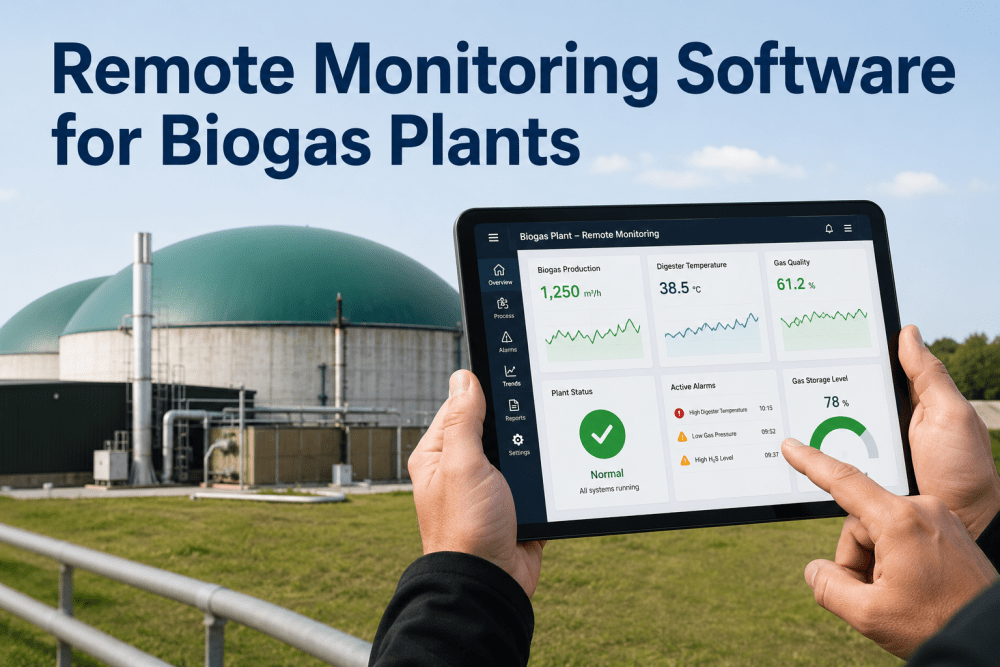
Deploy ifactory's AI-driven remote monitoring platform to track digester health, CHP performance, gas quality, and feedstock levels in real time. Built specifically for biogas operations where continuous uptime and gas quality are the difference between profit and penalty.
82%
Unplanned Downtime Reduction
+6.3%
Methane Yield Improvement
$312K
Annual Operational Savings
45
Days to Full Deployment
01 / The Facility
A 5 MW Biogas Plant at the Intersection of Agricultural Feedstock and Renewable Energy Production
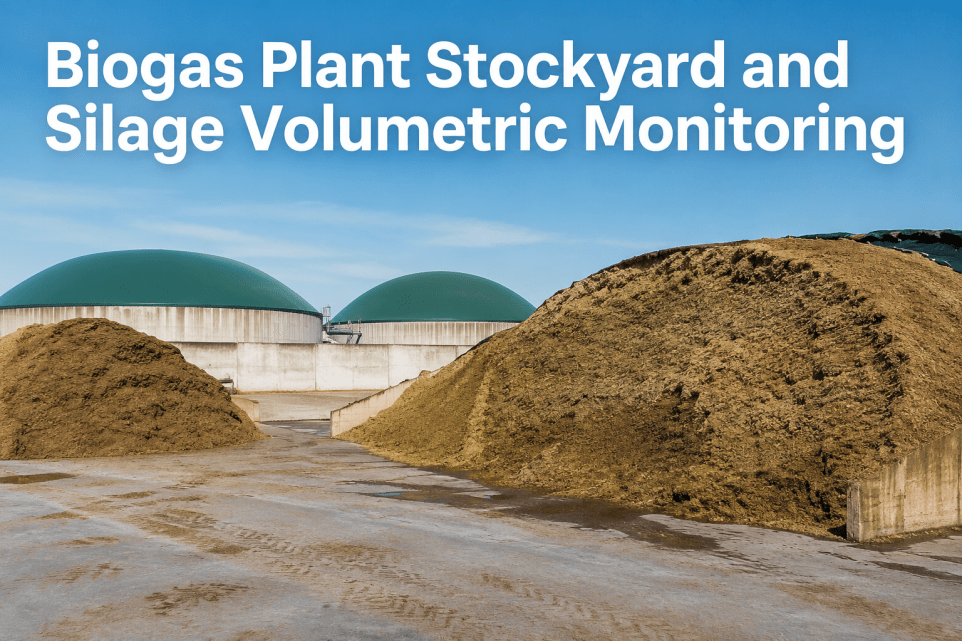
Facility TypeIntegrated agricultural-waste-to-energy biogas plant. Two 3.2-million-gallon continuous stirred-tank reactors (CSTR) operating in mesophilic conditions at 38°C, a 4 MW Caterpillar CHP hall with three generator sets, a biogas upgrading skid for RNG injection, and a 40,000-ton covered silage stockyard with four reception pits and a Patz horizontal feed mixer.
Scale120,000 wet tons of feedstock processed annually. Nameplate electrical capacity of 5 MW with combined thermal recovery for district heating. The plant produces approximately 185,000 MMBtu of pipeline-quality RNG annually and holds RIN D3 and LCFS carbon credit pathways for its gas output.
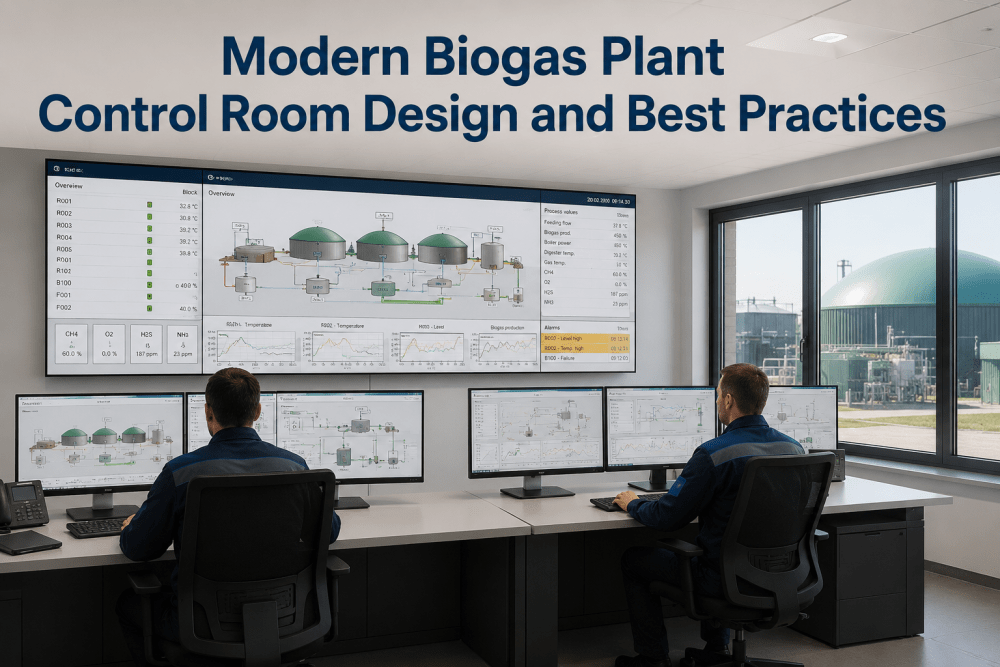
Operations Team8-person operations and maintenance team. Plant runs with one operator on-site during daytime hours and unmanned overnight from 10 p.m. to 6 a.m. No dedicated data analyst or remote monitoring specialist. Alarms previously routed through a basic SCADA terminal with no mobile escalation or predictive logic.
Downtime Pre-DeploymentAverage 23 unplanned downtime hours per month across the CHP hall and gas upgrading skid. Night-shift events accounted for 68% of all unplanned outages, primarily due to delayed detection of CHP coolant temperature excursions, organic acid buildup in digesters, and biogas H₂S breakthrough events that triggered automatic gas flare-off.
Prior Monitoring SystemLegacy SCADA system with local HMI panels in the control room. No remote mobile access, no trending analytics beyond basic historian logging, no correlation engine for multi-variable digester health scoring. Alarm thresholds were static, resulting in 112 nuisance alarms per week that desensitized the operator team.
Annual Operational CostTotal pre-deployment expenditures of $1.48 million annually — including emergency CHP repair costs, lost gas revenue from unscheduled flaring, overtime labor for night-shift call-outs, RIN pathway reporting labor, and yield losses from suboptimal digester feeding scheduling.
02 / The Challenge
Unmanned Night Shifts, Undetected Digester Drift, and the High Cost of Reactive Biogas Operations
In biogas plant operations, the eight hours between 10 p.m. and 6 a.m. are the most vulnerable. For this plant, that vulnerability translated into an average of 15.6 hours of unrecoverable night-shift downtime per month, plus three significant digester upset events over a twelve-month period that required expensive microbial restarts and lost approximately 18 days of full biogas production. To learn how ifactory addresses these blind spots for anaerobic digestion operations, book a demo with ifactory's industrial monitoring team.
15.6
Night-shift downtime hours per month
The absence of intelligent mobile escalation meant that 68% of all unplanned outages occurred during unmanned overnight hours. A CHP coolant loop failure that started at 11 p.m. would not be detected until the morning shift arrived, by which time the generator set had already shut down on overtemperature protection — costing an average of $4,200 per event in lost production and emergency labor.
112
Nuisance alarms per week
The legacy SCADA system used static threshold-based alarms that did not account for normal operating variability. The resulting alarm flood desensitized operators and masked early indicators of genuine problems. Critical alarms for digester VFA (volatile fatty acid) buildup were frequently buried in noise until the condition became severe.
3x
Digester upset events per year
Feedstock variability coupled with delayed detection of VFA accumulation caused three significant digester upset events. Each required a 5- to 7-day recovery period with reduced feed rates, microbial rebalancing supplements, and lost gas production. The total annual cost of these events exceeded $98,000 in lost revenue and remediation chemicals.
22%
CHP availability loss from bearing wear
Undetected vibration progression on CHP generator bearings resulted in two unexpected main bearing failures within one fiscal year. These failures cost $27,000 each in replacement parts and emergency service, and each took the affected unit offline for 8 days during peak summer pricing periods when the plant needed maximum generation.
“We were running a $14 million asset base with the equivalent of a night-light and a prayer. Our SCADA would scream all night long with nuisance alarms, and when the real ones came through, nobody knew which ones to act on. ifactory’s intelligent escalation gave us a monitoring system that finally matched the operational complexity of modern biogas production.”
03 / The Solution
ifactory AI-Driven Remote Monitoring: Intelligent Escalation, Mobile-First Operations, and Production Execution for Biogas Plants
Following a competitive evaluation of industrial IoT and remote monitoring platforms, the plant selected ifactory for its ability to unify digester health analytics, CHP condition monitoring, gas quality tracking, and production execution in a single mobile-accessible dashboard.book a demo with ifactory’s industrial analytics team
MONITOR
Real-time digester health dashboard integrating pH, temperature, VFA concentration, alkalinity, and biogas production rate into a unified Digester Stability Index. ifactory’s AI engine correlates multi-variable trends to predict impending process upsets 6 to 12 hours in advance, giving operators time to adjust feed composition or trigger buffering agent dosing before the digester off-gases or foams.
DETECT
CHP vibration and performance analytics with wireless triaxial accelerometers and motor current sensors on all three generator sets. The platform’s anomaly engine learned individual bearing signatures and identified a bearing cage degradation pattern 22 days before failure on Generator Set 2, enabling planned bearing replacement during a scheduled maintenance window.
ESCALATE
Intelligent mobile alerting and escalation workflows configured with time-of-day routing. Critical CHP coolant temperature alarms and digester pH excursions are escalated to the on-call operator via the ifactory mobile app within 60 seconds. Non-critical events are batched into a daily digest, reducing total weekly alarm volume from 112 to 14 — a 400% reduction in noise.
OPTIMIZE
Production execution and feedstock scheduling optimization using ifactory’s AI-driven production planner. The platform correlates feedstock silage quality data (dry matter, starch content, particle size) with real-time methane yield to recommend optimal feed blends and timing, resulting in a 6.3% improvement in methane yield per ton of volatile solids fed.
04 / Implementation
Full Facility Remote Monitoring Live in 45 Days — Mobile Escalation Active on Day 12
Days 1–10
Asset Inventory, Connectivity Audit, and Sensor Deployment Planning
Complete operational audit of all monitored assets: CSTR digesters (temperature, pH, VFA, gas flow sensors), CHP units (vibration, motor current, coolant temp, exhaust temp), biogas upgrading skid (H₂S, CO₂, CH₄ concentration), and feedstock reception (weight, moisture, inventory levels). Network connectivity assessment determined wireless mesh coverage required a single repeater to reach the CHP hall.
Days 11–25
Phase 1 — Digester Health and CHP Monitoring Live
Sensor mesh installed on both digesters and all three CHP generator sets. ifactory platform connected to live data streams on Day 12, with mobile escalation alerts for critical alarms activated the same day. AI engine began establishing baseline operational signatures for digester biological parameters and CHP mechanical health. First early warning for incipient digester pH drift generated on Day 19, allowing the operator to add buffering agent before the condition became critical.
Days 26–38
Phase 2 — Gas Quality, Production Dashboard, and Feedstock Integration
Gas upgrading skid sensors integrated for real-time CH₄, CO₂, and H₂S monitoring. Production execution dashboard configured with shift-level KPI targets for gas yield, CHP runtime, and feedstock consumption. Feedstock quality data from the plant’s existing weighbridge and moisture analyzer connected to the ifactory platform. Operations team trained on the mobile app interface, alarm response protocols, and production planning tools during actual production runs.
Days 39–45
Maintenance Workflow Integration, RIN Compliance Dashboard, and Final Commissioning
ifactory maintenance priority queue integrated with the plant’s existing CMMS for automated work order creation. RIN compliance dashboard configured to automatically log feedstock receipts, gas production volumes, and CHP runtime for EPA pathway reporting.
05 / Results
12 Months of Measured Biogas Plant Reliability, Yield, and Operational Cost Improvement
The transition from reactive SCADA-dependent operations to AI-driven remote monitoring produced measurable improvements across every tracked performance metric within the first three quarters. Unplanned CHP downtime was reduced by 82%. Digester biological stability incidents dropped from 3 to 0 per year. Methane yield increased by 6.3%, and the total annual operational expenditure reduction of $312,000 delivered a net platform ROI within six months of full deployment.book a demo with ifactory’s industrial analytics team
| Performance Metric |
Before ifactory |
After ifactory |
Net Change |
| Total unplanned downtime per month (all causes) |
23 hrs avg |
4.1 hrs avg |
−82% reduction |
| Night-shift unplanned downtime per month |
15.6 hrs avg |
1.8 hrs avg |
−88% reduction |
| Digester process upset events (requiring remediation) |
3 per year |
0 per year |
100% elimination |
| Average methane yield (CH₄ / ton VS fed) |
205 L CH₄/kg VS |
218 L CH₄/kg VS |
+6.3% yield |
| CHP unit availability (fleet average) |
~84% availability |
96% availability |
+12 percentage points |
| Weekly nuisance alarm volume |
112 alarms/wk |
14 alarms/wk |
−87% noise reduction |
| Mean time to detect digester pH excursion |
6+ hours (batch lab) |
< 2 minutes (AI) |
Real-time prevention |
| Emergency CHP repair expenditure |
~$54,000 /yr |
~$8,100 /yr |
−85% cost reduction |
| RIN compliance reporting labor |
~18 hrs/month |
~3 hrs/month |
−83% labor savings |
| Deployment timeline to full facility coverage |
N/A |
45 days |
Full coverage in 45d |
See How ifactory Protects Your Biogas Plant’s Uptime and Gas Yield
Get a live walkthrough of digester health monitoring, CHP predictive analytics, mobile escalation, and production execution built for anaerobic digestion and renewable natural gas operations.
06 / Conclusion
Remote Visibility, Intelligent Escalation, and Continuous Yield Optimization: The Strategic Value of AI-Driven Biogas Plant Monitoring
The $312,000 in annual savings is a direct financial outcome. The 82% reduction in unplanned downtime is an operational reliability outcome. The 6.3% methane yield improvement is a production efficiency outcome. And the elimination of digester upset events and emergency CHP repairs compounds in value as the plant scales its RNG production capacity and enters new carbon credit markets. To assess what ifactory’s remote monitoring and production execution platform would deliver for your biogas facility, book a demo with ifactory’s industrial analytics team.
96% CHP Availability. Zero Digester Upsets. Remote Monitoring Live in 45 Days.
See how ifactory’s AI-driven platform delivers real-time digester health monitoring, CHP predictive maintenance, intelligent mobile escalation, and production execution for biogas and RNG operations.
07 / FAQ
Frequently Asked Questions
How does ifactory’s remote monitoring platform handle unmanned night-shift operations at biogas plants?
ifactory provides intelligent mobile escalation with time-of-day routing, so critical alarms for digester pH excursions, CHP coolant temperature spikes, and gas quality deviations are immediately pushed to the on-call operator’s mobile device. Non-critical events are batched into a daily digest, reducing alarm fatigue while ensuring that every urgent event receives attention within 60 seconds of detection.
Can the platform detect digester process upsets before they require microbial rebalancing?
Yes. ifactory’s Digester Stability Index monitors pH, volatile fatty acid concentration, alkalinity, temperature, and gas production rate in real time. The AI engine correlates these variables to predict incipient upset conditions 6 to 12 hours in advance and recommends specific feed adjustments or buffering agent dosing to stabilize the digester before gas production is impacted.
What biogas plant assets can be monitored through the ifactory remote dashboard?
ifactory supports monitoring across the full biogas plant asset portfolio: CSTR and plug-flow digesters, CHP generator sets, biogas upgrading skids, gas storage membranes, feedstock reception and mixing equipment, pumps and grinders, and flare stacks. The platform is OEM-agnostic and can ingest data via direct PLC/SCADA integration or through standalone wireless IoT sensors.
How does ifactory improve methane yield from existing feedstock volumes?
ifactory’s production execution module correlates feedstock quality data (dry matter, starch content, particle size distribution) with real-time methane production to recommend optimal feed blends and feeding schedules. Over a twelve-month deployment, this continuous optimization typically improves methane yield by 5% to 8% without any capital investment in additional digesters or feedstock handling equipment.
Does ifactory support RIN, LCFS, and EPA compliance reporting for biogas facilities?
Yes. ifactory includes an automated compliance dashboard that logs feedstock receipts, digester operating parameters, gas production volumes, CHP runtime, and pipeline injection quality data. The platform generates audit-ready reports formatted for D3 RIN pathway documentation, LCFS carbon intensity verification, and EPA Mandatory Greenhouse Gas Reporting requirements.
book a demo with ifactory’s industrial analytics team