Biogas plant production planning is a complex balancing act that most facility managers still manage through spreadsheets, tribal knowledge, and reactive adjustments week to week. Feedstock must be sourced, scheduled, and quality-checked before it reaches the digester. Dosing rates must align with biological processing capacity and gas production targets. CHP run-hours must be planned around maintenance windows, gas storage levels, and power export agreements. And every decision across these domains directly impacts plant margin. An integrated production planning approach replaces this fragmented landscape with a unified operational view that protects profitability across all planning horizons — from weekly feedstock procurement to quarterly gas contract commitments.book a demo
Is Your Production Planning Still Living in Spreadsheets?
Integrate feedstock procurement, digester dosing schedules, CHP run planning, and gas contract management into one intelligent planning platform designed for biogas operations.
Why Most Biogas Plants Struggle to Build an Integrated Production Plan
The core challenge in biogas production planning is the diversity of variables that must be reconciled across different operational horizons. Feedstock procurement operates on a weekly-to-monthly cycle influenced by commodity markets and seasonal availability. Digester dosing decisions are driven by biological retention times and microbial population dynamics measured in hours and days. CHP run-hour planning must balance gas storage capacity with maintenance schedules and power price fluctuations. Historically, these planning domains lived in silos: feedstock managed in supplier spreadsheets, dosing tracked on clipboards in the digester hall, CHP logged in the SCADA historian, and contracts filed in emailed PDFs. This fragmentation creates "The Planning Gap," where data exists but alignment is missing. iFactory solves this by providing the single source of truth that connects all four planning domains into a unified operational model. For planning teams looking to close this gap, book a demo to see how a unified platform replaces disconnected spreadsheets with integrated intelligence.
Feedstock Procurement Planning
Core Focus: Supply Reliability. Plan feedstock sourcing across multiple suppliers, manage delivery schedules, track quality variability — moisture content, total solids, VS — and optimize inventory against storage capacity and pricing.
Digester Dosing Optimization
Core Focus: Biological Stability. Plan organic loading rates, feeding frequency, and co-digestion ratios to maximize gas yield while maintaining process stability. Balance biological capacity against production targets across all digesters.
CHP & Gas Utilization Planning
Core Focus: Energy Revenue. Schedule CHP run-hours around maintenance windows, gas storage capacity, and grid export commitments. Maximize revenue from power sales while protecting engine availability.
Gas Contract Compliance
Core Focus: Margin Protection. Align production planning with pipeline injection contracts, composition guarantees, and take-or-pay obligations. Avoid penalty exposure by ensuring gas quality and flow commitments are always met.
"We were running our biogas plant on four disconnected spreadsheets — one for feedstock, one for dosing, one for CHP maintenance, and one for our gas contract. Every month we spent three days reconciling them to build a single production plan. iFactory gave us a unified platform where our feedstock planner, digester operator, and CHP technician all work from the same data set. We have reduced planning overhead by 80% and increased our gas contract compliance from 87% to 99% in the first four months."
The Planning Matrix: Reconciling Feedstock, Biology, and Energy Markets
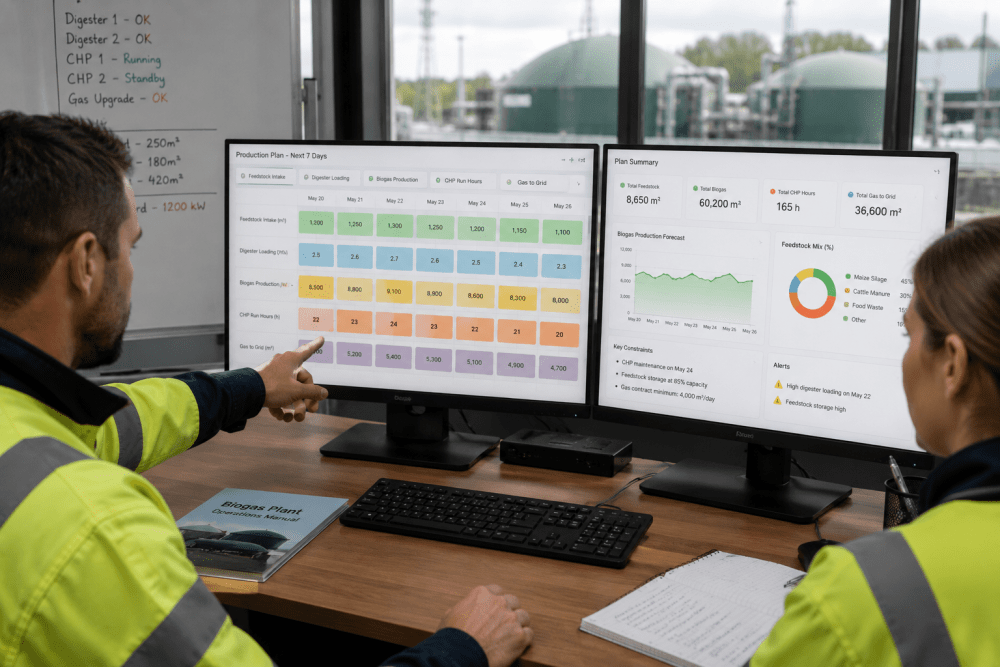
Each planning domain in a biogas plant operates on a different cycle and is governed by different constraints. Feedstock planning is driven by supply markets and storage. Gas contracts introduce fixed obligations that bind them all together. iFactory's integrated planning model allows you to manage these domains independently while seeing their cross-domain impacts in real time. Production planners who book a demo consistently find that visualizing these interdependencies is the key to unlocking hidden margin in their operations.
| Planning Dimension | Feedstock | Digester Dosing | CHP & Gas | iFactory Integration |
|---|---|---|---|---|
| Primary Driver | Supply Availability | Biological Stability | Energy Revenue | Unified Margin View |
| Key Metric | tons delivered / day | OLR kg VS/m3/day | CHP uptime % | EBITDA / MWh |
| Planning Window | 4 – 8 weeks | 2 – 4 weeks | 1 – 7 days | Rolling 13-week |
| Data Sources | Supplier portals + weighbridge | SCADA + lab analysis | Gas analyzers + grid API | Unified data lake |
| Risk Exposure | Price volatility | Process instability | Grid penalties | Integrated hedging |
| Decision Frequency | Weekly | Per shift | Daily | Continuous optimization |
How iFactory Delivers Integrated Production Planning for Biogas Plants
Most planning tools in the biogas industry are point solutions — a feedstock tracker here, a CHP scheduler there — that do not communicate with each other. iFactory is a unified operations platform that connects every planning domain into a single intelligence layer. We do not just track gas contract compliance; we provide early warnings when planned production will fall short, giving your team time to adjust before penalties accrue. This is the level of cross-domain visibility that planning teams discover when they book a demo and see their entire operation through a single pane of glass.
Phased Integration: From Fragmented Planning to Unified Production Execution
Moving from spreadsheet-based planning to an integrated platform does not happen overnight. It requires a structured progression that builds data integrity across each planning domain while keeping the plant running. iFactory's implementation team follows a proven three-phase roadmap aligned with your plant's specific operational maturity. If you are unsure where your plant sits on this curve, book a demo for a structured assessment of your current planning gaps and a tailored rollout roadmap.
Visibility & The Data Foundation
Replace disconnected spreadsheets with a centralized digital record for feedstock receipts, digester dosing logs, CHP run-hours, and contract deliveries. Establish a single source of truth that every planner and operator accesses. Timeline: 6–10 weeks.
Integration & Cross-Domain Optimization
Connect feedstock, dosing, CHP, and contract data into a unified planning model. Enable what-if scenario analysis — adjust feedstock mix and see the impact on gas yield, CHP run-hours, and contract compliance in real time. Timeline: 8–12 weeks.
Excellence & Predictive Planning Automation
Deploy AI-driven planning recommendations that optimize feedstock procurement, dosing schedules, and CHP maintenance windows against margin targets automatically. Achieve a fully integrated, continuously optimizing planning operation. Timeline: Ongoing.
The Future of Biogas Production Planning Is Integrated and Data-Driven
The transition from fragmented spreadsheets and siloed planning domains to an integrated, cross-domain planning platform represents a fundamental shift in how biogas plants manage production execution. By connecting feedstock procurement, digester dosing, CHP utilization, and gas contract compliance into a single intelligence layer, integrated planning eliminates the misalignment that has historically eroded margin and increased operational risk. For planning teams pursuing world-class production scheduling, the path forward is clear — and the reason more plant managers book a demo is that they recognize that integrated planning is no longer a technology upgrade — it is a competitive and financial necessity.
Biogas Plant Production Planning — Frequently Asked Questions
What is biogas production planning and why is it different from other manufacturing?
Biogas production planning must reconcile a living biological process with commodity feedstock markets and energy price fluctuations — constraints that discrete manufacturing does not face. The planning window is driven by hydraulic retention time (typically 20–60 days), meaning decisions made today affect gas production weeks later, unlike a factory where production adjustments show results in minutes or hours.
How do I balance feedstock supply with digester capacity?
The key is maintaining a consistent organic loading rate (OLR) within the digester's optimal range. iFactory's planning model tracks feedstock inventory, quality parameters, and delivery schedules against each digester's processing capacity. When feedstock quality drops or delivery volumes change, the platform recommends adjustments to co-digestion ratios or feeding frequency to maintain biological stability.
How far ahead should I plan CHP maintenance to avoid gas grid penalties?
CHP maintenance should be planned with at least four weeks of visibility into gas production forecasts and contract obligations. iFactory's integrated planner shows your projected gas balance across the maintenance window and automatically suggests alternate run schedules or gas storage strategies to ensure contract compliance is never compromised by planned downtime.
Does the platform handle gas contract compliance including composition requirements?
Yes. The platform tracks both volumetric flow obligations and gas quality specifications — methane content, H2S levels, Wobbe index — against your pipeline or offtake agreements. Automated alerts notify the planning team when projected production or composition drifts outside contract parameters, providing days or weeks of lead time to adjust operations rather than discovering a violation at month-end.
Is this planning platform suitable for a single-digester plant or only large multi-digester facilities?
The platform is designed to scale from single-digester operations to multi-site portfolios. Smaller plants benefit most from the margin protection that integrated planning provides — even a single CHP outage or feedstock shortage can wipe out a month of profitability, and the platform provides the visibility needed to avoid those events entirely.
Stop Planning in Silos. Start Optimizing Across Every Domain.
iFactory's unified production planning platform connects feedstock procurement, digester dosing, CHP utilization, and gas contract compliance — purpose-built for the complexity of biogas plant operations.