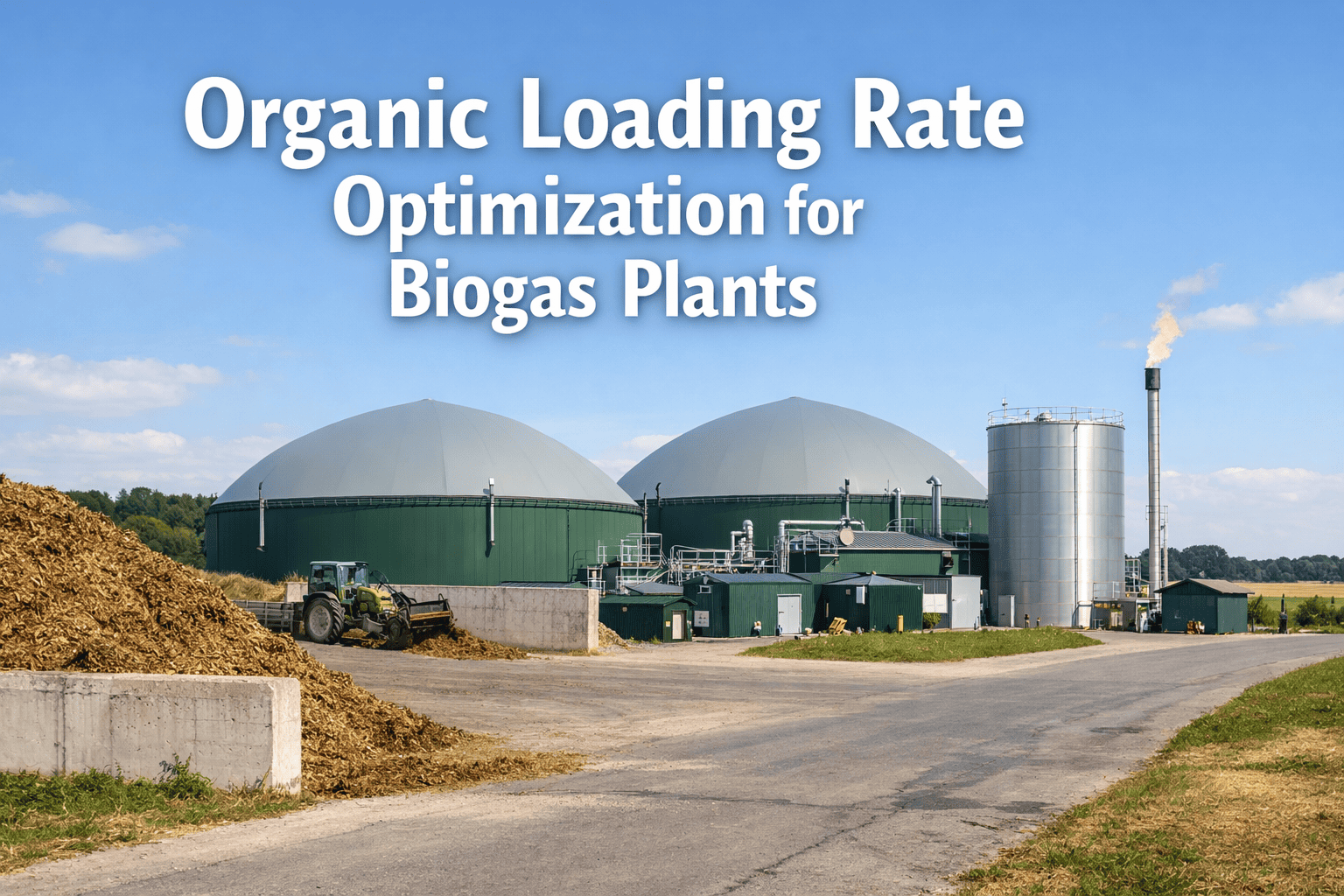
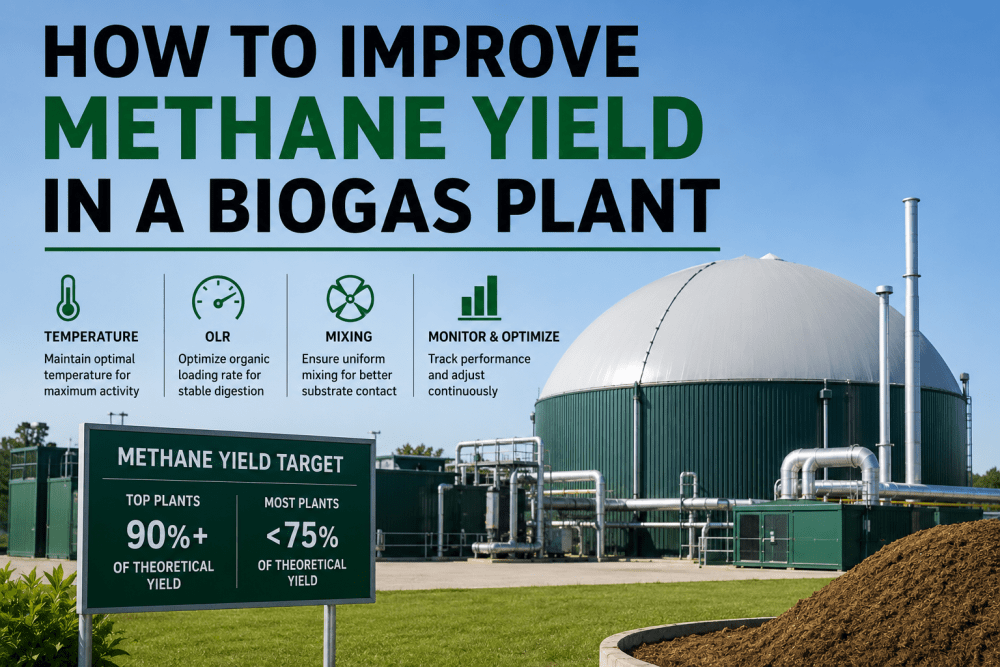
Every biogas plant operator faces the same challenge: how to squeeze the highest methane yield from available organic waste without crashing the digester. In 2026, the answer is no longer trial-and-error feeding or static recipes held over from last season. Data-driven feedstock optimization, combining precise C:N ratio management, intelligent organic loading rate (OLR) control, and AI-assisted blend prediction, is separating high-performing plants from those bleeding revenue through underutilized capacity. This guide breaks down the strategies that are delivering measurable results across farm-scale, industrial, and municipal AD operations worldwide. If your current blend is based on guesswork rather than data, book a free feedstock optimization demo to see exactly how much additional methane your existing substrates could produce.
How to Increase Biogas Production from Anaerobic Digestion
Biogas output is a direct function of what goes into the digester and how well the microbial ecosystem can convert it. Operators who treat feedstock selection as a strategic lever, rather than a logistics afterthought, consistently outperform those relying on whatever substrate happens to be available. Three interconnected factors govern production volume: the biodegradability of the organic matter, the nutrient balance supporting microbial health, and the rate at which material is introduced.
I
Substrate Biodegradability
Not all volatile solids are created equal. Food waste (350-500 mL CH4/gVS) delivers far more methane per gram than wheat straw (180-280 mL CH4/gVS) because fats and simple carbohydrates break down faster than lignocellulose. Pre-treatment methods like thermal hydrolysis or enzymatic processing can boost the accessible fraction of stubborn feedstocks by 30-230%, making previously marginal substrates economically viable.
II
Nutrient Balance (C:N Ratio)
Anaerobic microorganisms consume carbon 25-30 times faster than nitrogen. When the C:N ratio falls outside the 20-30:1 sweet spot, problems cascade: too much nitrogen triggers ammonia toxicity above 3,000 mg/L, while excess carbon starves microbial growth. Co-digestion is the most practical tool for hitting this target by blending complementary substrates.
III
Loading Rate Precision
Organic loading rate (OLR) controls the daily volume of volatile solids per cubic meter of digester capacity. Wet AD systems typically sustain 2-4 kg VS/m3/day. Exceeding this threshold causes volatile fatty acid (VFA) accumulation, pH crashes, and the cascading failure that operators dread. AI-driven monitoring now enables dynamic adjustment in real time rather than fixed daily schedules.
Want to identify where your plant is leaving methane on the table? Our optimization audit pinpoints the feedstock changes that deliver the fastest production gains.
Best C:N Ratio for Maximum Methane Yield
The carbon-to-nitrogen ratio is the single most referenced parameter in anaerobic digestion literature for good reason: it directly determines whether your microbial community thrives or collapses. Research consistently places the optimal window between 20:1 and 30:1, with 25:1 producing the most stable results under mesophilic conditions (35-40 degrees C). Under thermophilic conditions (50-60 degrees C), a slightly higher ratio around 30:1 compensates for increased ammonia volatilization. If you are running multiple substrates and struggling to maintain a stable ratio, schedule a demo of our automated C:N ratio tracking and alerting system to see how real-time monitoring eliminates the guesswork.
Below 15:1
Ammonia Toxicity Zone
Excess nitrogen converts to ammonia (NH3), inhibiting methanogens. Free ammonia above 150-300 mg/L at mesophilic temperatures causes measurable production loss. Common with poultry manure or slaughterhouse waste fed alone.
15:1 - 19:1
Marginal Stability
System operates but with elevated VFA risk and ammonia stress. Suitable only with robust alkalinity buffering. Typical of food waste mono-digestion, which is why co-digestion with carbon-rich material is standard practice.
20:1 - 30:1
Optimal Production Window
Balanced nutrient supply supports full microbial community health. VFA production and consumption remain in equilibrium. pH self-stabilizes between 6.8-7.4. Maximum methane yield per gram VS input is achieved consistently in this range.
31:1 - 50:1
Nitrogen Limitation
Microbial populations grow slowly due to nitrogen scarcity. Carbon accumulates as undigested material in the digestate. Hydraulic retention times must increase to compensate, reducing throughput and revenue per m3 of capacity.
Above 50:1
Severe Imbalance
Straw, wood chips, and other high-carbon substrates fed alone result in extremely slow decomposition. Methane yields drop below 50% of theoretical potential. Pre-treatment and nitrogen-rich co-substrates are essential.
Co-Digestion Feedstock Recipes: Proven Blends That Work
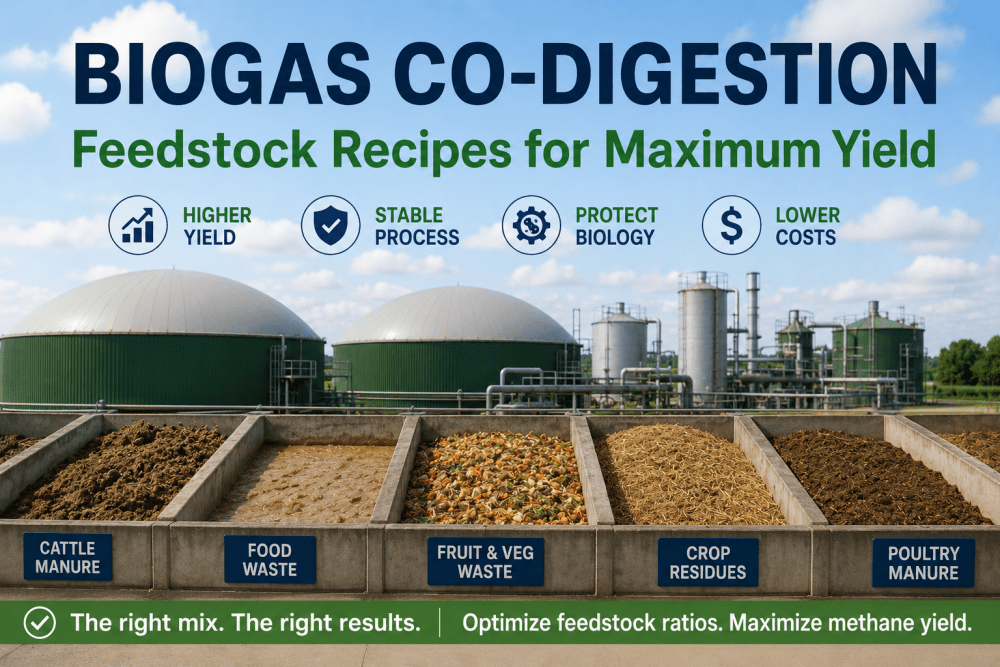
Co-digestion is not just about hitting a C:N target; it is about creating synergistic conditions where the combined methane output exceeds what either substrate would produce alone. The right blend provides balanced nutrients, dilutes inhibitory compounds, improves buffering capacity, and introduces diverse organic fractions that support a broader microbial community. Below are substrate combinations with documented yield improvements from peer-reviewed research and commercial operations.
+35-50%
Dairy Manure + Food Waste
Blend: 70:30 (VS basis)
Manure provides alkalinity buffering and trace nutrients while food waste contributes high-energy fats and carbohydrates. The combined C:N ratio typically lands near 22-25:1, ideal for mesophilic digestion.
+25-40%
Corn Stover + Swine Manure
Blend: 30:70 (VS basis)
Swine manure supplies nitrogen and moisture to balance the high-carbon stover. Manure also provides the microbial inoculum that accelerates cellulose hydrolysis, the rate-limiting step for crop residues.
+60%
Potato Waste + Beet Leaf
Blend: 60:40 (weight basis)
Potato waste (C:N 35:1) is carbon-rich but lacks nitrogen. Beet leaves (C:N 14:1) compensate precisely, creating a balanced feedstock that has shown 60% higher methane yield than potato mono-digestion in controlled studies.
+100%
Algal Sludge + Waste Paper
Blend: 50:50 (VS basis)
Algal sludge is nitrogen-dense but difficult to digest alone. Adding waste paper doubles the methane production rate by providing readily degradable carbon and reducing ammonia inhibition through C:N ratio adjustment to 20-25:1.
+30-45%
Sewage Sludge + Grease Trap Waste
Blend: 85:15 (VS basis)
Fats, oils, and grease (FOG) have the highest theoretical methane potential of any common substrate. At 15% VS addition to sewage sludge, FOG dramatically boosts gas output without causing LCFA inhibition that occurs at higher concentrations.
Need a custom co-digestion recipe for your available substrates? Our blend calculator models optimal ratios for your specific feedstock mix and shows projected methane yield gains before you change a single feed parameter.
How to Prevent Digester Failure from Overloading
Digester failure from organic overloading is the most expensive mistake in biogas operations. Recovery can take weeks to months, during which gas production drops to near zero and revenue disappears. Prevention comes down to monitoring the right indicators and adjusting feed rates before the tipping point is reached.
AI and Machine Learning in Biogas Plant Optimization
The 2025-2026 period has seen AI move from research papers into production biogas plants. Machine learning models trained on thousands of biochemical methane potential (BMP) assays and full-scale operational datasets can now predict how a new feedstock will perform before a single gram enters the digester. This eliminates the weeks of lab testing that previously delayed recipe changes and helps operators respond to feedstock availability shifts in days rather than months. Operators ready to move beyond spreadsheet-based recipe management can Get Support to access AI-driven blend recommendations that adapt to your digester conditions and substrate inventory in real time.
Before AI Integration
Fixed recipes reviewed quarterly at best
BMP lab tests take 30-60 days per substrate
Process upsets detected after production loss
Operator intuition drives feedstock decisions
No visibility into substrate interaction effects
50-65%
of theoretical methane potential captured
With AI-Driven Management
Dynamic recipes updated daily from sensor data
AI predicts methane potential from composition data
Anomaly detection flags issues within minutes
Data-driven models optimize blend ratios automatically
Synergistic and antagonistic interactions quantified
80-90%
of theoretical methane potential achieved consistently
Stop Guessing, Start Optimizing Your Feedstock Mix
Every day your digester runs on an unoptimized recipe is revenue left in the digestate. Our platform combines real-time C:N tracking, dynamic OLR management, and AI-powered blend prediction to help you consistently hit 80%+ of theoretical methane potential from your available substrates.
Feedstock Pre-Treatment Methods That Boost Gas Output
When the available feedstock is dominated by lignocellulosic material like straw, corn stover, or woody residues, pre-treatment becomes the unlock that turns a marginal substrate into a productive one. The rigid polymer structure of cellulose, hemicellulose, and lignin resists microbial attack, but targeted disruption can dramatically increase the accessible surface area for hydrolytic enzymes.
High-pressure steam breaks hydrogen bonds in cellulose and solubilizes hemicellulose. Widely adopted at municipal wastewater plants processing sewage sludge. Capital-intensive but proven at scale with payback periods of 3-5 years on large facilities.
Swells cellulose fibers and dissolves lignin, dramatically increasing enzyme access. NaOH at 4-6% concentration on corn straw has shown methane yields of 317 mL/gVS with improved process stability. Low capital cost but requires chemical handling infrastructure.
Commercial cellulase and hemicellulase cocktails pre-digest structural carbohydrates at ambient temperatures. Lower energy input than thermal methods. Often combined with alkaline pre-treatment for maximum effect on crop residues.
Milling, grinding, or extrusion increases surface-area-to-volume ratio. Most effective on fibrous materials where particle size directly limits hydrolysis rate. Often the first step in a multi-stage pre-treatment chain.
Wondering which pre-treatment makes economic sense for your feedstock? Our engineers can model the cost-benefit of each approach against your current gas output and substrate mix.
Feedstock Reference Data: C:N Ratios, VS Content, and Methane Potential
Having reliable reference data for common substrates is the foundation of any blend calculation. The values below represent ranges from published literature and commercial BMP testing, but operators should always verify with site-specific analysis since composition varies significantly by source, season, and handling conditions.
Turn Your Feedstock Data Into Higher Gas Revenue
Your digester capacity is fixed. Your feedstock recipe is the variable. Our platform ingests your substrate analysis data, models co-digestion scenarios against your available inventory, and recommends the blend that maximizes methane yield per cubic meter of capacity every single day.
Frequently Asked Questions
What is the ideal C:N ratio for anaerobic digestion?
The widely accepted optimal C:N ratio falls between 20:1 and 30:1, with 25:1 considered the sweet spot for most mesophilic systems. At this ratio, microorganisms have sufficient carbon for energy and nitrogen for cell growth without the risk of ammonia inhibition. However, the ideal ratio can shift depending on temperature, feedstock composition, and digester type. If you are unsure which C:N target suits your digester conditions,
schedule a free C:N ratio assessment with our AD engineers and get a customized target for your specific substrate mix.
How does co-digestion improve methane yield?
Co-digestion blends substrates with complementary nutrient profiles, balancing the C:N ratio and providing a more diverse diet for microbial communities. This synergistic effect often produces more methane than the sum of individual substrates digested alone. For instance, mixing carbon-rich crop residues with nitrogen-rich animal manure balances nutrients while introducing varied organic compounds that support a broader range of microbial activity.
What causes process upsets during feedstock changes?
Sudden changes in feedstock composition can shock microbial communities, leading to VFA accumulation, pH drops, and reduced methane output. The most common triggers are rapid shifts in C:N ratio, introduction of substrates containing inhibitory compounds, or abrupt OLR increases. AI-driven platforms prevent these upsets by modeling the impact of changes before implementation and gradually transitioning between recipes. To protect your digester from costly downtime during recipe transitions,
Get Support for AI-powered feedstock change modeling that simulates the impact before you adjust a single feed parameter.
How does OLR affect digester performance?
OLR determines how much organic material enters the digester daily per unit volume. Optimal OLR depends on digester type, with wet AD systems typically handling 2-4 kg VS/m3/day and dry AD systems tolerating higher rates. Overloading causes acid accumulation and process failure, while underloading wastes capacity. The key is finding the maximum sustainable OLR for your specific system and feedstock mix.
Can AI really predict methane yield from new feedstocks?
Yes. Modern AI models trained on thousands of BMP assays and full-scale digester datasets can predict methane potential from feedstock composition data with increasing accuracy. While lab-scale BMP testing remains the gold standard for validation, AI predictions allow operators to quickly screen potential substrates and model co-digestion scenarios before committing to expensive trials. Want to test it with your own substrate data?
Book a live demo of our AI methane yield predictor and see projected output for any feedstock combination in minutes.