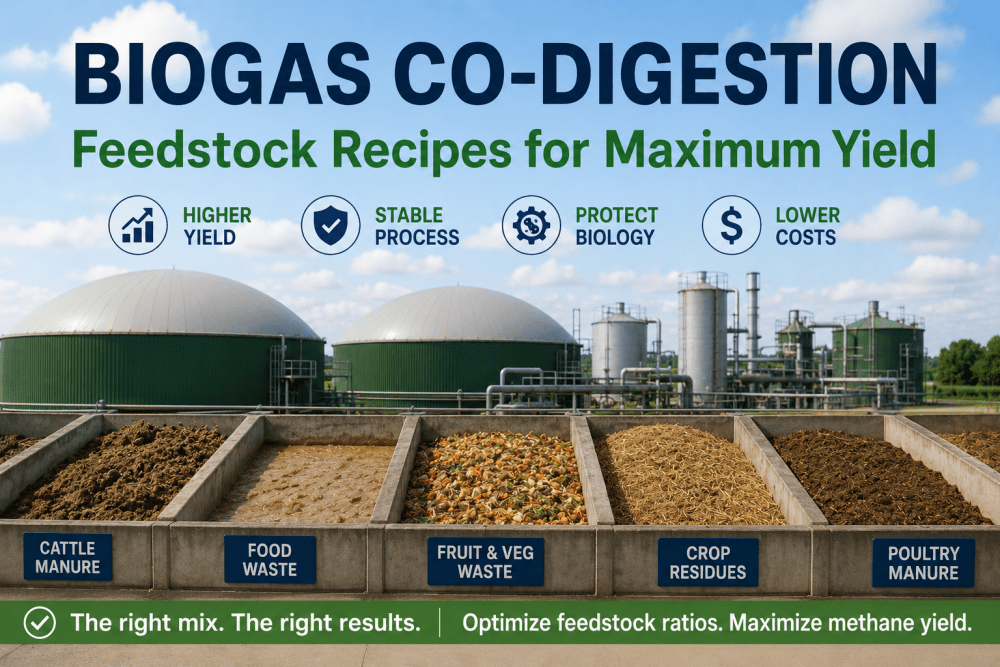
Biogas Co-Digestion Feedstock Recipes for Maximum Yield
By Dahlia James on June 7, 2026
Underground gas storage facilities across salt caverns, depleted reservoirs, and aquifer formations represent the operational backbone of North America's midstream gas network, providing the seasonal supply-demand balancing that keeps industrial consumers, power generators, and residential markets supplied year-round. Managing injection and withdrawal cycles across dozens of wells while maintaining reservoir integrity reconciling inventory across multiple storage sites has historically depended on SCADA threshold alerts, manual well testing, and monthly accounting cycles that introduce weeks of data latency. Artificial intelligence is shifting that paradigm fundamentally — replacing reactive, schedule-driven storage management with predictive, data-driven optimization that improves working gas capacity utilization, extends asset life, and reduces operational risk. iFactory AI's integrated platform — spanning predictive analytics, digital twin simulation, AI vision, robotics orchestration, CMMS, and automated compliance — provides storage operators with a unified technology stack purpose-built for the unique physics and commercial dynamics of underground gas storage. Book a Demo to see the platform configured for your specific storage facility type.
Technical Analysis · Midstream Operations · 2026
How AI Improves Gas Storage Optimization in Underground Facilities
Predictive analytics, digital twin simulation, real-time monitoring, and autonomous robotics are transforming injection and withdrawal management, reservoir integrity assurance, and inventory optimization across all underground storage types. iFactory AI connects every data stream from subsurface sensors to commercial gas accounting in a single platform.
Across salt cavern, depleted reservoir, and aquifer facilities
35%
Fewer unplanned shutdowns
18%
Compression energy reduction
95%
Forecast accuracy with ML
<9 mo
Typical payback period
The Underground Gas Storage Challenge — Why Traditional Methods Fall Short
Underground storage facilities operate in environments that are inherently difficult to instrument and model continuously. Reservoir pressure dynamics, gas composition changes, water influx in depleted fields, salt creep in caverns, and wellbore integrity degradation evolve across timescales ranging from seconds to decades. Traditional approaches rely on periodic pressure-temperature surveys, manual well testing, and batch SCADA data — creating visibility gaps that mask developing problems until they escalate into critical events. Operators managing multiple storage sites face a data integration challenge that manual methods and legacy SCADA systems cannot address at scale. Book a Demo to see how iFactory AI unifies data across your entire storage portfolio.
01
Injection & Withdrawal Scheduling Complexity
Balancing pipeline capacity limits, reservoir pressure constraints, gas quality specifications, and commercial storage agreements requires optimizing across variables that shift dynamically with weather, market prices, and grid demand. Manual scheduling cannot optimize across these competing constraints in real time, leaving millions in arbitrage value unrealized each season.
02
Reservoir & Cavern Integrity Gaps
Continuous interpretation of pressure decay trends, microseismic events, and gas composition shifts is required to detect wellbore failure, caprock compromise, or cavern convergence. Human analysts cannot track these signals across dozens of wells — quarterly pressure fall-off tests leave roughly 75% of the operating cycle without continuous integrity visibility.
03
Compressor & Wellhead Reliability
A single compressor failure during peak withdrawal can reduce capacity by 30-50% and trigger financial penalties. Most maintenance programs still rely on fixed calendar intervals instead of actual equipment condition, causing unnecessary outages or unplanned failures at the worst possible moment.
04
Inventory Reconciliation Latency
Gas inventory accounting requires reconciling metered flow volumes with pressure-volume-temperature calculations across complex well networks. The process typically takes 2-3 weeks, meaning traders and schedulers make injection and withdrawal decisions on data that is already 14-21 days out of date. Shrinkage due to leaks or accounting errors goes undetected for weeks.
How AI Transforms Underground Gas Storage Optimization
Artificial intelligence addresses each of these challenges through four interconnected capabilities that replace heuristic decision-making with precision driven by real-time data. iFactory AI's platform integrates all four into a unified operational system spanning subsurface modeling, surface operations, equipment maintenance, and commercial gas accounting. Book a Demo to see these capabilities configured for your storage facility.
Capability 01
Predictive Deliverability Forecasting
Machine learning models trained on multi-year historical data — wellhead pressure and temperature, flow rates, gas composition, ambient temperature, pipeline nominations, and maintenance events — predict withdrawal and injection capacity under varying conditions with over 95% accuracy. Unlike traditional decline-curve and material-balance methods, AI captures non-linear interactions between reservoir pressure, wellbore hydraulics, and surface facility constraints that deterministic models miss. Forecasts update in real time as operating conditions change.
Impact:95%+ deliverability forecast accuracy vs. 78% with conventional methods
Unsupervised machine learning models analyze continuous streams of pressure, temperature, flow, and gas composition data from every well, compressor, and pipeline in the facility. The AI detects subtle deviations — pressure decay anomalies as small as 2 psi per day, temperature shifts indicating hydrate formation risk, composition changes suggesting gas migration — that human analysts reviewing monthly plots would miss until the problem was critical. Alerts generate within seconds of anomaly onset, not days or weeks later.
Impact:Integrity threats identified 30+ days earlier than quarterly testing
Capability 03
Digital Twin Simulation for What-If Analysis
A continuously synchronized virtual replica of the entire storage facility — subsurface reservoir or cavern geometry, wellbores, compression trains, dehydration systems, and pipeline interconnects — enables operators to simulate operational scenarios before implementing changes. Unlike conventional reservoir models updated quarterly, the digital twin ingests real-time data and maintains a live, physics-accurate representation. Operators assess withdrawal rate impacts, injection cycle optimization, equipment outage effects, and cushion gas recovery strategies in a zero-risk environment.
Impact:What-if analysis in minutes vs. weeks with conventional simulation
AI-driven mass-balance reconciliation processes flow, pressure, temperature, and composition data every 5 minutes instead of monthly, providing a real-time working gas position that traders and schedulers can trust. The model continuously cross-checks metered flow volumes against PVT calculations across every well, detecting shrinkage events — leaks, metering errors, or accounting discrepancies — within hours instead of weeks. Reconciliation reports feed directly into gas accounting and trading systems.
Impact:Reconciliation cycle reduced from 21 days to 5 minutes
AI Optimization Across Storage Types — CSS-Only Tab View
Different underground storage configurations require different AI optimization approaches. The tabs below show how iFactory AI adapts to the specific physics and operational requirements of each storage type.
Digital Twin Simulation
Salt cavern storage benefits from digital twin simulation that models cavern geometry evolution over multiple injection-withdrawal cycles. The twin integrates sonar survey data, brine displacement calculations, and real-time pressure-temperature data to track cavern convergence, predict salt creep rates, and identify conditions that could lead to roof collapse or wall instability. Operators run what-if scenarios to assess cavern performance before implementing changes.
Real-Time Inventory Reconciliation
Cavern inventory is simpler to reconcile than reservoir storage because the geometry is known and discrete. iFactory AI performs mass-balance reconciliation every 5 minutes using brine displacement measurements, flow data, and pressure-temperature readings. Shrinkage detection sensitivity is within 0.1% of working gas volume.
High-Rate Cycling Optimization
Salt caverns are designed for high-deliverability cycling. AI optimizes the rate and timing of each cycle to maximize working gas capacity while respecting cavern pressure limits, salt creep constraints, and compressor capacity. Operators report 18-22% higher working gas utilization with AI-optimized cycling.
Reservoir Simulation & Well Sequencing
Depleted reservoir storage requires modeling multiphase flow through heterogeneous rock formations. The digital twin integrates production history, PVT data, relative permeability curves, and fault-seal analysis with real-time wellhead measurements. AI optimizes withdrawal sequencing across multiple wells based on real-time deliverability, hydrate risk, and integrity status.
Water Coning & Gas Breakthrough Prediction
Water coning is a primary constraint on withdrawal rates in depleted reservoir storage. AI models predict coning onset 7-14 days in advance, enabling operators to adjust withdrawal rates or switch wells before water production exceeds facility handling capacity. Early detection prevents lost withdrawal days and reduces water handling costs.
Enhanced Gas Recovery Analytics
AI analyzes reservoir sweep efficiency and identifies by-passed gas zones that conventional recovery methods leave stranded. Operators use these insights to recomplete wells, adjust injection patterns, or implement enhanced recovery strategies — recovering 5-8% additional working gas from existing reservoir capacity.
Gas-Water Contact Tracking
Aquifer storage facilities face the most complex subsurface dynamics — two-phase flow of gas and water through high-permeability formations with uncertain boundary conditions. AI continuously monitors gas-water contact movement using pressure response analysis, observation well data, and tracer test interpretation. Automated alerts notify operators when contact movement approaches production well perforations.
Bubble Development Optimization
AI models optimize seasonal injection and withdrawal cycles to maximize gas bubble development while minimizing water coning and preventing gas migration beyond the structural trap. The digital twin simulates the impact of each injection cycle on bubble geometry, enabling operators to adjust well allocation and rates for optimal bubble shape.
Migration Pathway Detection
Continuous composition monitoring across the storage field detects gas migration through undetected fault pathways or caprock heterogeneities. AI correlates composition changes in monitoring wells with injection and withdrawal activity to identify migration pathways weeks before conventional pressure monitoring detects them. Early detection enables proactive intervention before storage losses occur.
Performance Comparison — Conventional vs. AI-Driven Operations
The table below compares conventional underground gas storage management with AI-driven methods across the key operational functions that determine facility performance, reliability, and commercial value. Data reflects deployment results across salt cavern, depleted reservoir, and aquifer storage facilities operating with iFactory AI's integrated platform.
Storage Function
Conventional Approach
AI-Driven Approach
Improvement
iFactory Module
Deliverability Forecasting
Periodic well tests + decline curve analysis
Ensemble ML using real-time pressure, flow, and composition data
78% to 95%+ accuracy
Predictive Analytics + Production Monitoring
Anomaly Detection
Threshold-based SCADA alarms with 15+ min delay
Unsupervised ML detecting deviations in real time
Sub-second detection latency
AI Vision + Predictive Maintenance
Inventory Reconciliation
Manual PVT calculation with monthly meter verification
Automated mass-balance AI reconciling every 5 minutes
AI-driven load optimization with real-time efficiency tracking
Energy consumption reduced 15-22%
Energy Monitoring + CMMS
Well Selection for Withdrawal
Operator experience + pressure-based ranking
AI optimization based on real-time deliverability, hydrate risk, and integrity status
12% higher withdrawal capacity utilization
Digital Twin AI + Production Monitoring
Regulatory Compliance
Manual data compilation for EPA and state reports
Automated data aggregation and report generation from live operational data
Report preparation time reduced 80%
Safety & Compliance + Analytics
Deployment Roadmap — From Assessment to Autonomous Operations
Deploying AI for underground gas storage optimization follows a structured five-phase timeline that delivers measurable operational value at each stage. iFactory's unified platform and pre-built connectors accelerate the deployment to 12-20 weeks for a typical storage facility.
01
Data Foundation & Connectivity (Weeks 1-4)
Establish real-time data ingestion from SCADA, RTU, PLC, and IoT sensor networks across the storage facility — wellheads, compressors, separators, dehydration units, and pipeline interconnects. Deploy edge gateways for locations with limited network connectivity. Connect existing CMMS, pipeline nomination, and gas accounting systems. iFactory's pre-built connectors for Modbus, OPC-UA, MQTT, and major SCADA platforms accelerate this phase.
Deliverable: Unified real-time data stream from all facility sensors and systems
02
Predictive Model Training & Validation (Weeks 4-8)
Train site-specific ML models using 3-5 years of historical operational data. Models cover deliverability forecasting, anomaly detection, inventory reconciliation, and equipment health prediction. Each model is validated against actual facility events to ensure accuracy before deployment. iFactory's auto-ML pipeline reduces model development time by 60% compared to custom-built approaches.
Deliverable: Validated predictive models with documented accuracy against historical events
03
Digital Twin Build & Calibration (Weeks 8-14)
Construct and calibrate the digital twin of the storage facility — subsurface reservoir or cavern model, wellbore hydraulics, surface facility simulation, and pipeline interconnect model. The twin is validated against historical pressure, flow, and inventory data before going live. Salt cavern twins typically deploy fastest while large depleted reservoir fields with complex geology require additional calibration time.
Deliverable: Live digital twin with physics-accurate representation of the storage facility
Configure unified operations dashboards with storage-specific KPIs — working gas position, deliverability forecasts, equipment health scores, integrity status, and compliance tracking. Automated advisory alerts are tuned to minimize false positives while ensuring critical anomalies are escalated within seconds. Predictive maintenance workflows integrate into iFactory CMMS for automatic work order generation.
Deliverable: Live dashboards with automated alerting and CMMS integration
05
Continuous Learning & Fleet Scaling (Week 18+)
Models continuously retrain on new operational data, improving accuracy with each injection-withdrawal cycle. The platform scales to additional storage facilities using standardized data connectors and model transfer learning — reducing deployment time for each subsequent facility by 40-50%. iFactory's fleet management interface provides unified visibility across all storage assets.
Deliverable: Self-improving AI platform with multi-facility fleet management
Plan Your AI Storage Optimization Deployment
A deployment consultation maps the five-phase roadmap to your specific storage facility configuration, well count, and operational requirements. Output includes a documented deployment plan with timeline, sensor and data requirements, and integration specifications for your facility type.
Industry Expert Perspective on AI in Underground Gas Storage
"I have spent twenty-eight years in natural gas storage operations — starting as a field engineer running pressure surveys on depleted field reservoirs, then moving into reservoir engineering, and finally into operational leadership across a portfolio of twelve underground storage facilities representing over 200 Bcf of working gas capacity. For most of that career, we managed storage facilities with tools designed in the 1980s: spreadsheet-based decline curve analysis, manual well test interpretation, and monthly inventory reconciliation that was always two to three weeks behind real-time operations. The information lag meant that we were making injection and withdrawal decisions on data that was already outdated. The most transformative change I have witnessed in this industry is the application of machine learning to continuous reservoir surveillance. We deployed a predictive analytics platform across our storage portfolio starting in 2024, and within six months we had identified two wells with incipient mechanical integrity failures that conventional quarterly pressure testing had missed — failures that would have resulted in uncontrolled gas migration and a potential regulatory enforcement action. Beyond integrity, the inventory reconciliation capability alone paid for the entire platform investment in the first year by eliminating the uncertainty margin that manual accounting methods require."
— Director of Gas Storage Operations, Major Midstream Operator — 28 Years Industry Experience — 12 Storage Facilities — 200+ Bcf Working Gas Capacity
95%+
Inventory forecast accuracy with ML
21 days
Reconciliation cycle reduced to 5 minutes
30+ days
Earlier integrity threat detection
Conclusion
Underground gas storage facilities are entering a new era of operational capability driven by artificial intelligence. Predictive analytics transforms deliverability forecasting from heuristic estimates to data-driven certainty. Digital twin simulation enables operators to visualize subsurface dynamics and optimize injection-withdrawal strategies without physical risk. Real-time AI monitoring provides continuous surveillance across every well, compressor, and pipeline — detecting anomalies within seconds of onset rather than weeks later. Automated inventory reconciliation closes the gap between physical operations and commercial gas accounting, giving traders and schedulers accurate, real-time position data to maximize storage asset value. Each cycle of operations generates more training data, which improves model accuracy, which drives better operational decisions, which in turn generates higher asset utilization and lower operating costs. iFactory AI provides the unified platform — predictive analytics, digital twin simulation, AI vision, robotics orchestration, CMMS, MES, energy monitoring, and automated compliance — that delivers this integrated capability across salt cavern, depleted reservoir, and aquifer storage facilities. Book a Demo to discuss your storage optimization requirements.
Deploy AI for Your Underground Gas Storage Facility
iFactory AI provides the integrated platform that transforms underground gas storage management. Schedule a 30-minute demo to see the platform configured for your salt cavern, depleted reservoir, or aquifer storage operation.
How does AI improve gas storage optimization in underground facilities compared to traditional methods?
AI improves underground gas storage optimization by processing continuous real-time data from SCADA, downhole sensors, and IoT devices to forecast deliverability, detect anomalies, and reconcile inventory with accuracy far beyond traditional decline-curve analysis and manual PVT calculations. Machine learning models identify subtle pressure-temperature-flow patterns that human analysts cannot detect, enabling early warning of wellbore integrity issues, hydrate formation risk, and compressor degradation. Digital twin simulation allows operators to run what-if scenarios before implementing changes on the physical facility. Typical improvements include 22% higher working gas capacity utilization, 35% fewer unplanned shutdowns, and 95%+ inventory forecast accuracy.
What types of underground gas storage facilities benefit most from AI optimization?
All three major underground storage types benefit from AI optimization, though the specific applications differ. Salt cavern storage benefits most from digital twin modeling of cavern geometry evolution, salt creep prediction, and high-rate cycling optimization. Depleted reservoir storage gains the most value from AI-driven well sequencing optimization, water coning prediction, and enhanced gas recovery analytics. Aquifer storage facilities realize significant benefits from AI-powered tracking of gas-water contact movement, gas bubble development optimization, and migration pathway detection. Regardless of storage type, operators report the fastest payback from AI-based inventory reconciliation and predictive maintenance of compression equipment.
How long does it take to deploy an AI platform for underground gas storage optimization?
A structured five-phase deployment typically takes 12-20 weeks from project initiation to full operational integration. Phase 1 (data connectivity and ingestion) takes 4-6 weeks depending on SCADA and IoT sensor infrastructure readiness. Phase 2 (predictive model training and validation) takes 4-6 weeks. Phase 3 (digital twin deployment and calibration) takes 4-8 weeks depending on facility complexity. Phase 4 (integrated operations dashboards and workflow automation) takes 4-6 weeks. Phase 5 (continuous learning and fleet scaling) begins at week 18 and continues indefinitely. iFactory's unified platform accelerates this timeline with pre-built connectors, auto-ML pipelines, and integrated digital twin capabilities.
What data infrastructure is needed to support AI-driven gas storage optimization?
The core data infrastructure requirements include real-time data acquisition from existing SCADA, RTU, and PLC systems at wellheads, compressor stations, dehydration units, and pipeline interconnects; downhole pressure and temperature sensors in observation and active wells; custody transfer meters with electronic flow measurement capability; and IoT sensors for equipment vibration, temperature, and emissions monitoring. iFactory's platform includes pre-built connectors for major SCADA and RTU systems, support for Modbus, OPC-UA, MQTT, and API-based data ingestion, and on-premise deployment options for storage facilities with limited wide-area network connectivity.
What is the typical ROI and payback period for AI deployment in underground gas storage?
Operators deploying iFactory AI across underground gas storage facilities report payback periods of under 9 months, with ROI driven by three primary sources. First, increased working gas capacity utilization of 18-22% through optimized injection-withdrawal scheduling and deliverability forecasting. Second, reduced operating costs including 15-22% lower compression energy costs, 35% fewer unplanned shutdowns, and 40-50% reduction in manual data processing and reporting labor. Third, avoided regulatory costs and production losses from early detection of integrity threats. The inventory reconciliation capability alone typically pays for the entire platform investment within the first year by eliminating the 2-5% working gas uncertainty margin that operators must maintain under manual accounting methods.