Six months ago, the plant manager at a 2.5 MW food-waste AD facility in the Midwest watched his daily methane yield drift from 58 Nm³/ton VS down to 49 Nm³/ton VS over a single quarter. At $3.50 per MMBtu for pipeline-injected natural gas, that 15% drop was costing the plant over $180,000 a year in lost revenue. The digester temperature was stable the feed was consistent, but the CH₄ content had quietly slipped from 54% to 48%. No alarms fired. No one noticed until the monthly P&L review. That scenario — yield leakage without a visible cause — is the single most expensive problem in anaerobic digestion. This page shows you exactly how to close that gap.
From 75% to 90% of Theoretical Methane Yield — Without a Capital Digester Retrofit
iFactory identifies the three levers — temperature stability, organic loading rate precision, and mixing effectiveness — that recover 12–18% of lost methane yield in 6–12 weeks. On-premise, turnkey, no cloud dependency.
What a 15% Methane Yield Recovery Looks Like on Your P&L
These are real results from a 3 MW agricultural-waste biogas plant that deployed iFactory. No digester expansion. No new feedstocks. Just precision control of the three variables that matter most.
Most biogas plants leave 15–20% of potential methane revenue in the digester. Book a 30-min walkthrough and we'll show you exactly where your plant is leaking.
The Three Levers That Control Methane Yield
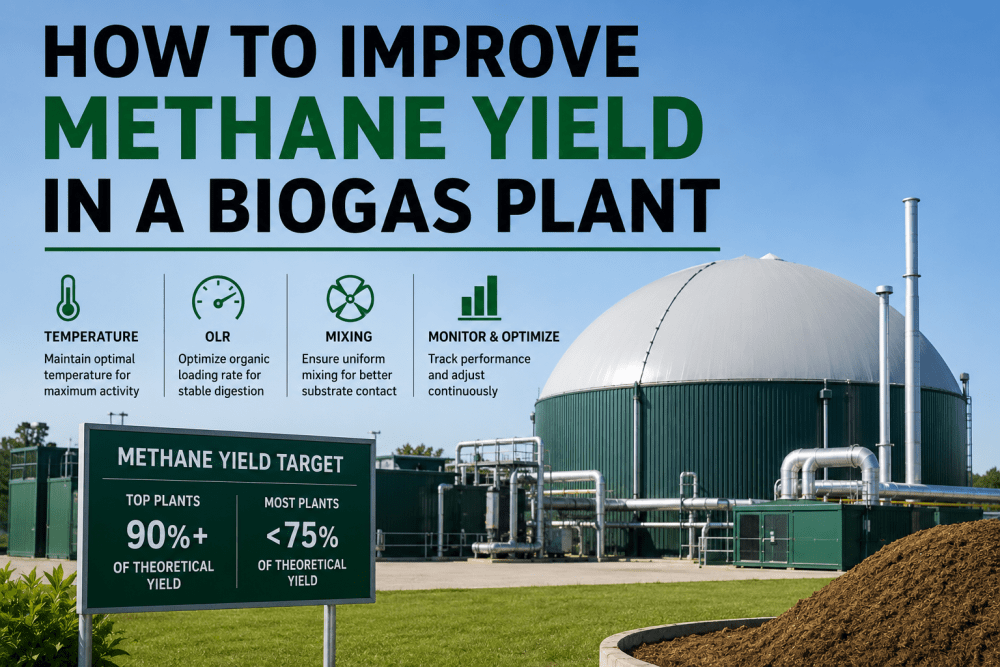
iFactory continuously monitors and optimizes the three process variables that determine CH₄ production. Each is a known lever in AD science. iFactory makes them actionable in real time.
Temperature Stability Within ±0.3°C
Methanogens are temperature-sensitive. A 2°C swing can cut methane yield by 15% for 48 hours. iFactory detects thermal drift from recirculation loops, fouled heat exchangers, and seasonal ambient shifts — and recommends corrective feed-rate or heating adjustments before yield drops.
Organic Loading Rate Precision
Overloading causes VFA accumulation and pH suppression. Underloading leaves capacity on the table. iFactory correlates feed composition, solids content, and historical yield to recommend the exact OLR that maximizes CH₄ production without risking digester instability.
Mixing Effectiveness Monitoring
Dead zones and short-circuiting reduce contact between substrate and microbes. iFactory analyzes temperature profiles, gas production patterns, and solids distribution to flag mixing inefficiency — a cause of yield loss that most operators never see until they dig out a digester.
VFA-to-Alkalinity Ratio Tracking
The FOS/TAC ratio is the earliest warning of process imbalance. iFactory monitors it continuously, not weekly, and flags the specific variable — feed rate, temperature, or mixing — that needs adjustment to keep the digester in the optimal 0.3–0.4 range.
Most biogas plants leave 15–20% of potential methane revenue in the digester. Book a 30-min walkthrough and we'll show you exactly where your plant is leaking.
The Three Costs of Unseen Yield Leakage
Most biogas plants operate with weekly lab samples and monthly yield reporting. By the time you see the problem in the P&L, you have already lost six figures of potential revenue. Here is what is actually happening.
Chronic Underperformance Becomes Invisible
A 1% daily yield loss compounds to over 25% annual leakage. Without sub-daily CH₄ monitoring, operators normalize to a lower baseline and never recover the gap. At a 3 MW plant, that is $50,000–$80,000 per year in lost gas that no one detects.
Corrective Action Is Always Late
By the time a pH or VFA lab result flags an issue, the digester has been sub-optimal for 48–72 hours. The cost is not just the lost yield during that window — it is the 5–7 days of reduced feed rate needed to recover stability.
Feedstock Variability Is Never Fully Accounted For
Seasonal shifts in corn silage dry matter, FOG content changes, or food waste composition variance all change methane potential. Most plants adjust feed rate by feel. iFactory correlates real-time feedstock analytics with yield data to set the OLR that matches today's substrate, not last month's average.
Most biogas plants leave 15–20% of potential methane revenue in the digester. Book a 30-min walkthrough and we'll show you exactly where your plant is leaking.
From Data-Source Connection to Measurable Yield Lift in One Quarter
iFactory is not a dashboard you have to learn. It is an AI-native system that connects to your existing sensors, DCS, and SCADA — and starts delivering recommendations within weeks.
Connect Your Data Sources
iFactory connects to your existing PLCs, temperature sensors, gas analyzers, flow meters, and feed scales — no new instrumentation required.
Baseline Your Current Yield Profile
We analyze 90 days of historical data to establish your plant's actual methane yield, CH₄ content, and the specific variables that are constraining performance.
Deploy Real-Time Yield Optimization
iFactory's AI model continuously correlates OLR, temperature stability, mixing effectiveness, and VFA balance with real-time CH₄ production — and recommends specific, actionable adjustments.
Monitor and Verify Yield Recovery
Daily and weekly yield reports show the exact improvement in Nm³ CH₄/ton VS, CH₄ content, and revenue impact. You see the ROI in the same quarter you start.
Everything You Need to Close the Yield Gap
End-to-End, Turnkey Deployment
You hand over data-source access. We deliver a working pilot in 6–12 weeks. No IT project, no multi-year implementation.
On-Premise NVIDIA Appliance
Zero cloud dependency. All data stays on your plant network. No data egress, no cybersecurity review delays.
Pilot-to-ROI in One Quarter
Measurable methane yield improvement within 8–12 weeks. You see the revenue recovery before you commit to a full deployment.
24x7 Managed Service
iFactory's operations team monitors your digester performance around the clock. You get alerts, recommendations, and monthly yield reviews — no additional headcount required.
Common Questions About Methane Yield Improvement
Stop Leaving Methane Revenue in Your Digester
Most plants recover 12–18% of lost yield within a single quarter. See what your plant is capable of producing.