Biogas plants face a reliability challenge that distinguishes them from conventional power generation assets: the feedstock is a living biological process, gas quality varies hourly, and critical equipment operates in ATEX-classified environments where failure consequences extend beyond production loss to safety exposure and regulatory non-compliance.Operations that have deployed AI-driven reliability platforms across their biogas assets are reporting 52% improvement in MTBF and 63% reduction in MTTR within the first twelve months of continuous monitoring. Book a Demo to see how iFactory's biogas reliability platform can transform your plant's uptime performance and maintenance economics.
Stop Firefighting Biogas Equipment Failures. Start Predicting Them.
iFactory AI monitors digester systems, CHP engines, gas upgrading trains, and BoP equipment in real time — with AI-driven failure prediction that delivers the right alert to the right technician before equipment failure forces unplanned downtime.
Digester System Reliability
Monitor agitation motor current draw, mixing cycle effectiveness, heating system heat exchanger fouling, and feed pump runtime. Detect developing blockages and mechanical degradation before they cause process upsets that require days to re-stabilize the biological population.
CHP Engine Availability
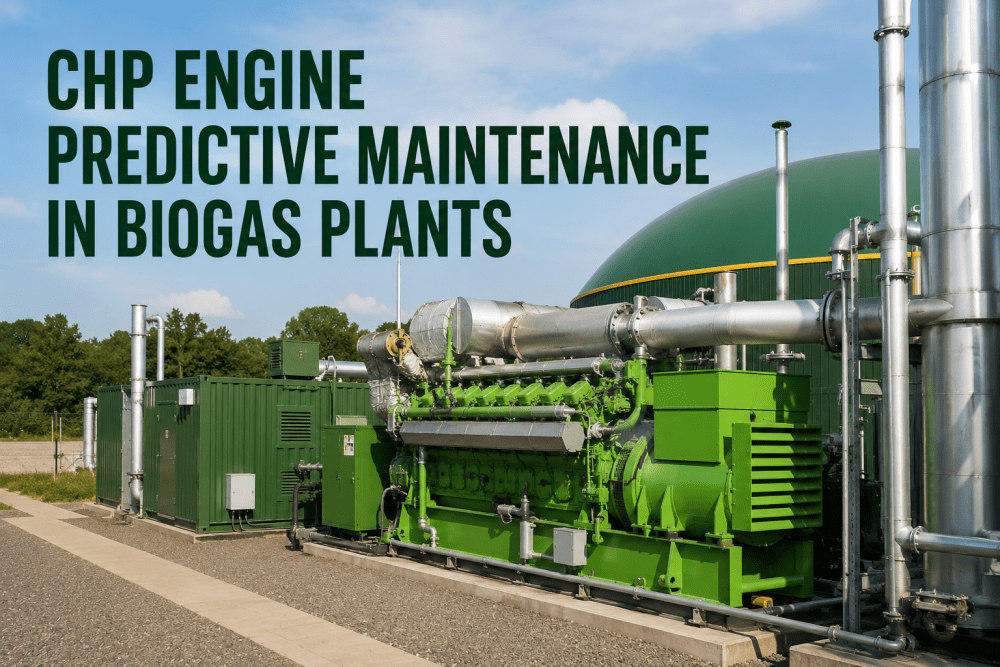
Track spark plug life, valve recession, oil analysis trends, coolant system condition, and gas quality parameters. AI models predict engine component failures 200–500 operating hours in advance, enabling planned shutdowns instead of emergency trips.
Gas Treatment Uptime
Monitor H2S scrubber media condition, activated carbon bed saturation, membrane differential pressure, and condensate drain operation. Predictive replacement scheduling eliminates unplanned gas quality excursions that force CHP engine derating or shutdown.
Balance of Plant Performance
Cover flare systems, condensate management pumps, flare stack ignition, gas boosters, blowers, and electrical distribution. Automated condition monitoring across this geographically distributed equipment set prevents the small failures that accumulate into plant-wide outages.
Root Causes of Low MTBF and High MTTR in Biogas Operations
Biogas plant reliability programs that fail to move the needle on MTBF and MTTR typically share a predictable set of structural gaps. These are not equipment-specific failures — they are system-level deficiencies in how maintenance strategy, data utilization, and workflow design are deployed across the facility. The six root causes below appear consistently across biogas plants that operate below industry median reliability performance. Understanding which gaps exist in your program is the prerequisite to building a targeted improvement plan that delivers measurable results within a single operating quarter.
Calendar-based maintenance intervals that do not account for actual equipment condition. CHP engines serviced every 2,000 hours regardless of oil analysis results, gas quality, or duty cycle variation — resulting in both over-maintenance and unexpected failures between intervals.
Critical spares not stocked on-site or lead times not factored into maintenance planning. A failed CHP spark plug that could be replaced in 2 hours instead takes 72 hours because the correct plug is not in inventory — driving MTTR artificially high for the most common failure mode.
No vibration analysis on rotating equipment, no thermography on electrical distribution, no oil analysis program for gearboxes and hydraulic systems. Failures detected only after audible or visible degradation — when damage has already progressed to internal component failure.
Failure resolution knowledge held by individual technicians with no documented standard repair procedures. When the most experienced CHP technician is unavailable, MTTR doubles or triples as less experienced staff diagnose and repair the same failure mode without prior art to reference.
Work order data entered inconsistently — failure codes not standardized, repair duration not recorded, root cause not captured. Without reliable CMMS data, MTBF and MTTR calculations are inaccurate, and reliability improvement efforts are guided by anecdote rather than evidence.
MTBF and MTTR not tracked by equipment class, no targets established, no visibility into quarter-over-quarter trends. Without the discipline of benchmarking, the plant cannot distinguish between a temporary performance dip and a structural reliability decline that requires management attention.
Closing these root causes requires a systematic approach that combines condition monitoring deployment, CMMS workflow redesign, and reliability culture change. Book a Demo to see how iFactory's biogas reliability platform addresses each root cause with purpose-built analytics and workflow automation.
Stop Firefighting Biogas Equipment Failures. Start Predicting Them.
iFactory AI monitors digester systems, CHP engines, gas upgrading trains, and BoP equipment in real time — with AI-driven failure prediction that delivers the right alert to the right technician before equipment failure forces unplanned downtime.
MTBF Improvement Strategies Across Biogas Asset Groups
Improving MTBF in a biogas plant requires a strategy calibrated to the specific failure physics and operating conditions of each asset group. A condition monitoring approach that works for a centrifugal pump handling digestate will not detect the precursor signals of CHP engine valve recession or gas upgrading membrane fouling. The table below documents the recommended MTBF improvement strategy for each major biogas asset group, including the specific failure modes addressed, the condition monitoring technology deployed, and the MTBF improvement range operators can expect from a structured reliability program.
| Asset Group | Primary Failure Modes | MTBF Improvement Strategy | Monitoring Technology | Expected MTBF Gain |
|---|---|---|---|---|
| Digester Systems | Agitator gearbox failure, heating jacket fouling, feed pump blockage, foaming events | Vibration analysis on agitator drives, temperature trending on heating circuits, pump runtime and current monitoring | Wireless vibration sensors, RTD temperature probes, pump motor current transducers | 55–75% MTBF improvement |
| CHP Gas Engines | Spark plug wear, valve recession, bearing degradation, oil degradation, coolant leaks | Continuous oil analysis, cylinder head temperature monitoring, ignition voltage trending, coolant condition sensors | Online oil sensors, cylinder-specific thermocouples, ignition system monitors | 40–60% MTBF improvement |
| Gas Upgrading | Membrane fouling, H2S scrubber media exhaustion, carbon bed saturation, condensate drain failure | Differential pressure trending across membranes, H2S breakthrough modeling, carbon bed lifecycle tracking | Differential pressure transmitters, H2S analyzers, gas chromatograph integration | 50–70% MTBF improvement |
| Gas Booster & Flare | Blower bearing failure, flare ignition failure, condensate pump seal leak, pressure control valve sticking | Vibration spectrum analysis on blowers, flare pilot monitoring, pump seal leak detection, valve stroke testing | Vibration transducers, pilot flame sensors, seal leak detectors, position sensors | 45–65% MTBF improvement |
| Electrical & Control | VFD failure, contactor wear, transformer overheating, PLC I/O module faults | Thermography scanning, VFD harmonic analysis, contactor cycle counting, control cabinet environment monitoring | IR cameras, power quality analyzers, temperature-humidity sensors | 60–80% MTBF improvement |
| Pumps & Valves | Mechanical seal failure, bearing wear, cavitation damage, valve seat erosion | Pump curve deviation monitoring, seal leak detection, valve stroke time trending, cavitation detection via vibration | Flow meters, pressure transmitters, vibration sensors, position feedback | 50–70% MTBF improvement |
How AI-Driven Workflows Reduce MTTR Across Biogas Maintenance Operations
MTTR is not solely a function of technician skill or parts availability — it is a system property of how maintenance operations are structured, how information flows between detection and resolution, and how work is prioritized when multiple competing demands exist across the plant. Biogas facilities that achieve sub-4-hour MTTR for routine failures and sub-8-hour MTTR for complex equipment failures share common workflow characteristics: automated fault detection that eliminates diagnosis time, pre-configured repair kits that eliminate parts sourcing delays, and role-based alerting that ensures the right technician receives the right work order with the right documentation before they arrive at the equipment. iFactory's biogas reliability platform is designed around this MTTR reduction architecture.
Automated Fault Detection and Diagnosis
AI models analyze sensor data continuously across every biogas asset. When a parameter trend deviates from the asset-specific baseline — CHP cylinder temperature spread widening, gas upgrading membrane differential pressure rising, digester agitator vibration increasing — the platform generates a specific fault diagnosis with the probable failure mode, severity score, and recommended repair action. This eliminates the 30–90 minutes of manual diagnosis time that typically precedes biogas equipment repairs.
Intelligent Work Order Generation with Parts Integration
The fault diagnosis is automatically converted into a structured work order that includes the asset ID, fault description, repair procedure reference, required parts list with stock check, and technician skill level required. The work order is routed to the appropriate maintenance queue based on severity, and parts are reserved from inventory or flagged for procurement — eliminating the parts sourcing delay that accounts for 35–50% of total MTTR in biogas plants without integrated CMMS.
Role-Based Technician Assignment with Mobile Delivery
The platform assigns the work order to the available technician whose skill set matches the required repair complexity. The technician receives the work order on their mobile device with asset location mapped, repair procedure embedded, parts list confirmed, and safety documentation attached — including any ATEX zone entry permits required. This eliminates the clipboard walk to the maintenance office and the 10–20 minutes of documentation retrieval that precedes every repair in paper-based systems.
Real-Time Repair Tracking and Escalation
The platform tracks repair duration from assignment to completion against the standard repair time for that asset and failure mode. If the repair exceeds the expected duration by 20%, the supervisor receives an escalation alert with the current status, the elapsed time, and any flagged obstacles. This prevents the scenario where a technician encounters an unexpected complication and spends hours resolving it without management visibility or resource support.
Failure Code Capture and Knowledge Base Update
Upon repair completion, the technician records the confirmed failure mode, the actual repair duration, the parts consumed, and any observations about the root cause. This data feeds back into the reliability knowledge base — enriching the failure signature library, updating the standard repair time estimate, and improving the accuracy of future fault diagnoses.
Biogas plants that deploy this MTTR reduction architecture consistently report 55–70% reduction in mean time to repair within 90 days of go-live, with the largest gains realized in CHP engine maintenance and gas upgrading system repairs. Book a Demo to see how iFactory's biogas reliability platform targets each MTTR component with purpose-built workflow automation.
"Over fifteen years of reliability engineering in the anaerobic digestion and renewable natural gas sector, I have evaluated more than 40 biogas plant maintenance programs across the U.S. and Europe. The finding that appears consistently in plants with below-median MTBF is not equipment quality or operator capability — it is the absence of a systematic approach to failure detection. These plants collect sensor data, maintain CMMS records, and employ experienced technicians, but the data streams are disconnected and the maintenance strategy remains calendar-based rather than condition-based. A biogas plant running calendar-based CHP maintenance intervals while collecting real-time oil analysis, cylinder temperature, and ignition voltage data is leaving 50% of its potential MTBF improvement on the table. The technology to bridge this gap exists and is commercially proven. The question is whether the biogas industry will adopt condition-based reliability at the same pace that combined-cycle gas turbine operators did fifteen years ago.
The Reliability Gap Between Calendar-Based and Condition-Based Biogas Maintenance Is the Gap Between Loss and Profit
Biogas plants that experience chronic low MTBF and high MTTR are not suffering from bad equipment or inadequate technicians. They are suffering from a maintenance strategy that treats all assets equally, schedules interventions by the calendar, and relies on manual detection of failures that have already occurred. The pathway to top-decile reliability performance is clear: deploy continuous condition monitoring across every biogas asset group, connect sensor data to AI models that detect developing failures 200–500 hours before they cause downtime, and automate the work order and parts logistics workflows that determine whether a repair takes 2 hours or 48 hours.
The investment required to deploy iFactory's biogas reliability platform across the same facility averages $75,000–$185,000, with payback periods of 4–8 months. Book a Demo with iFactory's biogas reliability team to build a site-specific MTBF and MTTR improvement plan for your biogas assets.
MTBF and MTTR in Biogas Plants — Frequently Asked Questions
Q1. What is a good MTBF target for biogas CHP engines, and how do I calculate it?
A good MTBF target for biogas CHP engines depends on the engine size, manufacturer, gas quality consistency, and maintenance program maturity. For modern lean-burn gas engines in the 500 kW–2 MW range operating on pipeline-quality upgraded biogas, a top-quartile MTBF target is 6,000–8,000 operating hours between forced outages. For engines operating on raw biogas with variable methane content and H2S levels, a realistic target is 3,000–5,000 hours with a structured reliability improvement program. MTBF is calculated as total operating hours divided by the number of forced failures in that period — planned maintenance shutdowns are excluded.
Q2 How does iFactory's platform reduce MTTR specifically for biogas equipment?
iFactory's platform addresses every component of MTTR systematically. The four MTTR components that the platform targets are: diagnosis time (reduced 60–80% through AI fault detection that identifies the failure mode before the technician arrives), parts sourcing time (reduced 70–90% through work order integration with inventory management and automated parts reservation), travel time (reduced 30–50% through mobile work order delivery with asset location mapping and optimized technician routing), and repair execution time (reduced 25–40% through embedded repair procedures, standardized checklists, and real-time escalation if the repair exceeds expected duration).
Q3 What condition monitoring sensors are most important for biogas plant MTBF improvement?
The highest-ROI condition monitoring investments for biogas plant MTBF improvement depend on the plant's current failure profile, but a universal priority list applies. First priority is CHP engine oil analysis — online oil condition sensors that track viscosity, oxidation, nitration, and wear metals continuously, enabling condition-based oil changes and early detection of bearing and valve train degradation before component failure. Second priority is vibration monitoring on rotating equipment — agitator drives, gas boosters, centrifugal pumps, and CHP generator bearings — with wireless vibration transducers that provide continuous acceleration and velocity data for bearing fault detection and imbalance diagnosis.
Q4 How long does it take to see measurable MTBF and MTTR improvement after deploying the platform?
Biogas plants deploying iFactory's reliability platform typically see measurable MTTR improvement within 30 days of go-live and meaningful MTBF improvement within 90 days. The rapid MTTR improvement comes from the workflow automation components — AI fault detection, intelligent work order generation, mobile technician delivery, and inventory integration — which begin delivering value as soon as the platform is connected to the CMMS and the technician mobile app is deployed.
Q5 Can iFactory's platform integrate with my existing CMMS and SCADA systems?
Yes. iFactory's biogas reliability platform is designed for integration with existing plant OT and IT infrastructure. The platform includes native protocol adapters for Modbus, OPC-UA, and MQTT for SCADA and PLC connectivity, enabling direct data ingestion from existing sensors, engine control units, and process controllers without replacing or duplicating instrumentation. CMMS integration is supported for major maintenance management platforms including SAP PM, IBM Maximo, Infor EAM, and Maintenance Connection, with two-way data synchronization that creates work orders from AI-detected faults in the reliability platform and feeds work order completion data back for model training and MTBF/MTTR calculation.
Transform Your Biogas Plant's Reliability Performance with iFactory
Deploy AI-driven condition monitoring, automated work order workflows, and real-time reliability analytics across your digester, CHP, gas upgrading, and balance of plant assets — in one platform built for biogas operations.