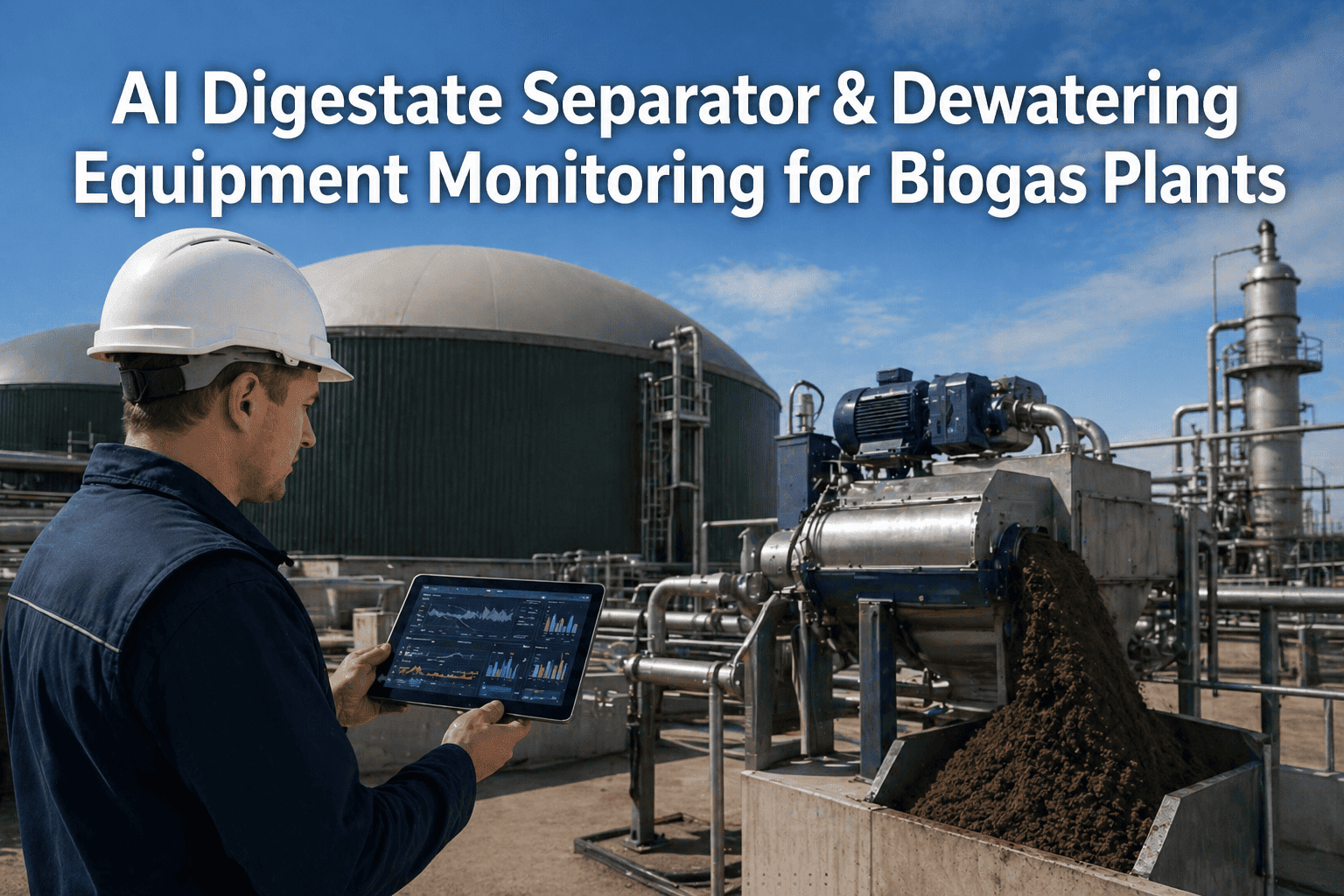
A 2.5 MW anaerobic digestion plant operator managing 47 critical assets — agitators, feed pumps, heat exchangers, digestate pumps, biogas compressors, CHP engines — through Excel spreadsheets and reactive maintenance loses €180,000–€320,000 annually to unplanned downtime, emergency repairs without spare parts in stock, and missed preventive maintenance windows that turn €8,000 bearing replacements into €65,000 agitator rebuilds. Traditional CMMS platforms designed for manufacturing or utilities cannot model the biological complexity of AD operations: they track work orders but ignore substrate composition changes, VFA trends, and OLR adjustments that drive equipment stress patterns specific to digester operations. iFactory is purpose-built AI for anaerobic digestion: predictive analytics trained on agitator failure modes under high-solids loading, automated work order creation from equipment condition monitoring, intelligent spare parts forecasting linked to RUL predictions, and asset health scoring that integrates biological process stability with mechanical degradation — not generic CMMS forms bolted onto biogas plants. Book a demo to see AI-driven asset management for your AD configuration.
Quick Answer
iFactory delivers complete AI-powered asset management for anaerobic digestion plants: computer vision monitoring agitators and pumps 24/7, predictive models forecasting bearing failures and seal degradation weeks in advance, automated work order generation from fault detection, intelligent spare parts inventory optimized to equipment RUL, and biological process integration that adjusts maintenance schedules based on digester stability — preventing forced maintenance during high-yield periods. Average outcomes: 68% reduction in unplanned downtime, 91% spare parts availability when needed, €285,000 annual savings per 2.5 MW plant vs spreadsheet-based reactive maintenance.
What AI-Driven Asset Management Actually Means for AD Plants
The term "AI" gets applied to any software with charts and alerts — but real intelligence for anaerobic digestion requires four integrated capabilities that traditional CMMS and SCADA platforms lack. The framework below defines production AI for biogas operations.
1
Computer Vision — Continuous Equipment Monitoring
AI-powered cameras monitor agitators, pumps, heat exchangers, and motors continuously — detecting vibration anomalies, oil leaks, bearing temperature rises, seal degradation, and coupling misalignment through real-time image inference. Not surveillance cameras feeding dashboards — actual machine vision running fault detection algorithms on every frame.
Thermal Anomaly DetectionVibration Signature AnalysisLeak Detection from Video
2
Predictive Analytics — Failure Forecasting for AD Equipment
Machine learning models trained on rotating equipment failure physics specific to biogas operations — predicting agitator gearbox failures, feed pump seal degradation, heat exchanger fouling, and motor bearing defects with remaining useful life calculations. Accounts for high-solids loading, abrasive substrates, and corrosive biogas environments that accelerate wear patterns.
RUL ForecastingFailure Mode ClassificationDegradation Trajectory
3
Automated Work Order Creation — From Fault to Action
AI detects equipment fault, classifies failure mode, determines severity, checks spare parts availability, and automatically creates structured work order in your system — with correct asset tag, failure code, priority assignment, and estimated repair duration. Zero manual form-filling; maintenance technicians receive actionable work orders, not vague alerts.
NLP Work Order GenerationPriority CalculationSpare Parts Reservation
4
Intelligent Spare Parts Management — RUL-Driven Inventory
Spare parts procurement linked to predicted equipment failures — order agitator bearings 4 weeks before RUL expires, stock heat exchanger gaskets based on fouling rate trends, maintain critical pump seals inventory sized to failure frequency. Eliminates both stockouts (no parts when needed) and overstock (capital tied up in unused inventory).
RUL-Based OrderingDynamic Stock LevelsLead Time Integration
AI Asset Management
See How iFactory Manages AD Equipment End-to-End
Watch a live demo showing fault detection on agitator bearings, automated work order creation, spare parts reservation, and maintenance scheduling integrated with digester stability monitoring.
68%
Lower Unplanned Downtime
91%
Spare Parts Availability
Asset Management Problems AI Solves for AD Plants
Every card below represents a maintenance failure pattern that destroys revenue through unplanned downtime, emergency repairs, and biological process disruption. These problems exist because traditional CMMS platforms were designed for discrete manufacturing — not continuous biological processes with equipment operating in corrosive, high-solids, thermophilic environments. Discuss your plant's maintenance challenges with an expert.
Agitator Failures During High-Yield Periods
Problem: Agitator bearings fail unexpectedly during peak gas production when substrate is optimal and every hour of downtime costs €400–€800 in lost electricity sales. Emergency replacement takes 18–36 hours including parts procurement, biological mixing stops, stratification begins, VFA accumulates, methanogen activity declines — resulting in 2–3 weeks of yield recovery beyond mechanical repair time.
iFactory solution: Predictive analytics detect bearing degradation 3–4 weeks before failure — flagging vibration signature changes, temperature rise trends, and lubricant condition. Maintenance scheduled during planned low-load period (substrate batch changeover, digester cleaning), spare bearing pre-ordered, replacement completed in 6 hours with zero process impact.
Feed Pump Seal Failures Without Spare Parts in Stock
Problem: Substrate feed pump mechanical seal fails on Saturday morning — no seal in inventory, supplier closed until Monday, plant operates at 40% capacity with manual feeding for 60 hours, loses €12,000 in revenue, emergency courier delivery costs €800, maintenance team overtime €2,400. Total cost: €15,200 for a €320 seal that should have been in stock.
iFactory solution: Seal wear prediction from pump vibration analysis and operating hours under abrasive substrate loading. RUL forecast indicates seal replacement needed in 18–22 days — automated spare parts order triggers at 25-day RUL, seal arrives within lead time, installed during planned maintenance, zero downtime, total cost €320.
Lost Preventive Maintenance Tasks in Excel Chaos
Problem: Heat exchanger cleaning scheduled every 8 weeks in Excel spreadsheet — operator forgets, fouling accumulates for 14 weeks, heat transfer efficiency drops 35%, digester temperature unstable, methanogen activity declines, gas yield falls 18%. When cleaning finally occurs, aggressive chemical treatment required, exchanger plate gaskets damaged, €8,500 repair bill for missed €400 PM task.
iFactory solution: Automated PM scheduling based on heat exchanger performance monitoring — thermal efficiency tracked continuously, cleaning triggered when performance drops 12% regardless of calendar weeks. Work order auto-created, technician notified, task completed at optimal interval, fouling prevented, exchanger life extended 40% vs fixed-interval maintenance.
No Equipment History When Failures Repeat
Problem: Digestate pump fails three times in 18 months with similar bearing failures — no work order history captured, root cause unknown, same bearing specification re-ordered each time, failure pattern continues. Actual cause: incorrect bearing type for abrasive digestate solids loading, should use sealed cartridge bearing not standard deep-groove bearing.
iFactory solution: Complete asset history tracking with failure mode classification — system flags recurring failure pattern after second bearing failure, recommends engineering investigation, identifies substrate abrasiveness as root cause, suggests upgraded bearing specification. Third failure prevented, bearing life extends from 6 months to 24 months, maintenance cost reduced 68%.
Biological Process Disrupted by Poorly-Timed Maintenance
Problem: Maintenance scheduler plans agitator repair during peak gas production period (optimal substrate batch, stable biology, 105% design yield) — agitator down 24 hours, mixing stops, temperature stratification develops, VFA begins accumulating, yield drops to 78% and takes 12 days to recover. Lost revenue: €18,000. Should have delayed maintenance 5 days until substrate batch transition.
iFactory solution: Maintenance scheduling integrated with biological process monitoring — work orders prioritized by equipment RUL and digester stability. AI recommends delaying non-critical agitator repair by 6 days (RUL: 28 days, safe deferral window) to avoid disrupting high-yield period. Maintenance completed during planned substrate changeover, zero biological impact, revenue preserved.
€45,000 Inventory Tied Up in Wrong Spare Parts
Problem: Spare parts inventory managed by gut feel and safety stock rules — €45,000 invested in parts that rarely fail (CHP engine pistons with 8-year replacement cycle) while critical fast-wearing items (pump seals, agitator bearings, heat exchanger gaskets) stock out regularly. Inventory turns once every 3.2 years; working capital wasted.
iFactory solution: RUL-driven dynamic inventory optimization — stock levels automatically adjusted based on predicted failure rates and supplier lead times. Critical parts (pump seals, bearings) stocked at 2–3 units based on 45-day average RUL and 14-day supplier lead time. Slow-moving parts (motor windings, gearboxes) reduced to zero stock with supplier agreements for 72-hour delivery. Inventory investment drops to €18,000, turns increase to 4.1 per year, stockout rate falls to 2%.
How iFactory Integrates Equipment Assets with Biological Operations
Traditional CMMS platforms treat anaerobic digesters like any other industrial equipment — pumps are pumps, motors are motors, maintenance schedules are fixed intervals. iFactory understands that AD equipment operates in a biological environment where substrate composition, VFA levels, temperature stability, and OLR directly impact mechanical stress and failure modes. Integration creates intelligent maintenance decisions impossible with equipment-only tracking.
Substrate-Aware Agitator Maintenance
Agitator bearing life varies 3x based on substrate solids content — maize silage at 12% TS creates different mechanical stress than cattle slurry at 8% TS or food waste at 18% TS. iFactory adjusts bearing RUL predictions based on actual substrate composition tracked through feeding records — predicting 14-month bearing life under current high-solids loading vs generic 24-month PM interval that would cause failure.
Biology-Integrated Maintenance Scheduling
When digester stability score drops below 80 (VFA rising, alkalinity declining, biology stressed), iFactory flags all non-emergency equipment maintenance for deferral — preventing additional process disruption during biological instability. Conversely, when stability is high (score 95+, optimal gas yield, stable VFA), system prioritizes completing deferred maintenance tasks during the safe operational window.
Heat Exchanger Fouling Linked to Substrate Quality
Heat exchanger fouling rate correlates with substrate fiber content and suspended solids — high-fiber batches (straw, grass silage) foul exchangers 2–3x faster than low-fiber substrates (food waste, energy crops). iFactory tracks substrate composition from feeding records and adjusts heat exchanger cleaning intervals dynamically — triggering cleaning after 4 weeks under high-fiber loading vs standard 8-week interval that would allow severe fouling.
AI Capabilities Comparison — AD Asset Management
Generic CMMS platforms (SAP PM, IBM Maximo, Infor EAM) offer work order management and PM scheduling. iFactory differentiates on AD-specific predictive analytics, automated fault-to-work-order workflows, RUL-driven spare parts optimization, and biological process integration — features that require biogas domain expertise, not generic industrial maintenance modules. Book a comparison demo.
| Capability |
iFactory |
SAP PM |
IBM Maximo |
Generic CMMS |
| Predictive Analytics |
| AD equipment failure prediction |
Agitator, pump, HX models |
Generic failure rates |
Via Maximo Predict add-on |
Not available |
| Substrate-aware maintenance adjustment |
RUL adapts to solids loading |
Fixed intervals only |
Fixed intervals only |
Fixed intervals only |
| Remaining useful life (RUL) calculation |
Equipment-specific degradation |
Age-based only |
Via add-on module |
Not available |
| Work Order Automation |
| Automated WO from fault detection |
AI creates complete WO |
Manual creation required |
Notification only |
Manual creation required |
| Failure mode classification |
NLP extracts from description |
Manual selection |
Manual selection |
Manual selection |
| Priority auto-calculation |
From criticality + RUL + process state |
Manual assignment |
Rule-based only |
Manual assignment |
| Spare Parts Intelligence |
| RUL-driven inventory optimization |
Dynamic stock levels |
Manual min/max levels |
Manual min/max levels |
Manual min/max levels |
| Automated procurement triggers |
Orders at RUL threshold |
Reorder point triggers |
Reorder point triggers |
Manual ordering |
| Failure frequency-based stocking |
ML predicts consumption rate |
Historical averages |
Historical averages |
Manual estimation |
| Biological Process Integration |
| Maintenance scheduling vs digester stability |
Defers non-critical during instability |
Not available |
Not available |
Not available |
| VFA/OLR impact on equipment stress |
Adjusts agitator load models |
Not available |
Not available |
Not available |
| Substrate composition tracking |
Linked to equipment wear rates |
Manual notes only |
Manual notes only |
Not available |
| Computer Vision Monitoring |
| Thermal imaging fault detection |
Real-time bearing temp analysis |
Not available |
Via Watson Visual add-on |
Not available |
| Video-based leak detection |
Seal, pipe, valve monitoring |
Not available |
Not available |
Not available |
Based on publicly available product documentation as of Q1 2025. Verify current capabilities with each vendor before procurement decisions.
Critical AD Equipment Monitored by iFactory AI
iFactory's predictive models are trained on failure modes specific to biogas equipment operating under high-solids, abrasive, corrosive, thermophilic conditions — not generic industrial rotating machinery. Each equipment class below has dedicated AI models accounting for AD-specific stress factors.
1
Agitators — Gearbox, Bearing, Seal Monitoring
Most critical AD asset — failure stops biological mixing, causes stratification, VFA accumulation, and biological upset within 24–48 hours. iFactory monitors gearbox vibration signatures, bearing temperature trends, oil contamination indicators, and shaft seal condition. Predicts failures 3–5 weeks in advance under high-solids loading (18–22% TS substrates).
Common failures detected: Gearbox bearing degradation, input shaft seal leakage, output bearing overload from thick substrate, coupling misalignment, motor overheating under high torque
2
Substrate Feed Pumps — Seal, Impeller, Motor Analytics
Operates under abrasive solids loading and corrosive organic acids — mechanical seals fail 2–4x faster than clean water applications. iFactory tracks seal condition from vibration analysis, pump efficiency from power consumption vs flow rate, impeller wear from performance degradation, and motor bearing temperature. Predicts seal failures 18–25 days before leakage begins.
Common failures detected: Mechanical seal face wear, impeller erosion from fibrous substrates, motor bearing degradation, suction blockage from foreign material, cavitation from air entrainment
3
Heat Exchangers — Fouling Detection, Thermal Efficiency
Fouling from suspended solids and biofilm formation reduces heat transfer efficiency 30–50% over 6–12 weeks — causing temperature instability and biological stress. iFactory monitors inlet/outlet temperature differential, flow rate vs pressure drop, and overall heat transfer coefficient. Triggers cleaning alerts when efficiency drops 12–15% regardless of fixed calendar interval.
Common failures detected: Progressive fouling from fibrous substrate, biofilm accumulation on plates, gasket degradation from thermal cycling, flow channel blockage, corrosion from H2S exposure
4
Digestate Pumps — Abrasive Wear Monitoring
Higher solids content and abrasive particles (sand, grit, fibrous material) accelerate impeller and seal wear compared to feed pumps. iFactory tracks efficiency degradation from wear, seal condition from vibration patterns, motor load trends indicating increased resistance, and flow rate decline from impeller erosion. Predicts seal replacement 20–30 days before failure.
Common failures detected: Impeller wear from abrasive digestate, mechanical seal failure from grit contamination, bearing degradation, motor overload from increased viscosity, suction line blockage
5
Biogas Compressors — Valve, Seal, Bearing Analytics
Operates under corrosive biogas (H2S, moisture, siloxanes) causing accelerated valve and seal degradation. iFactory monitors discharge pressure trends, valve sealing efficiency from pressure drop analysis, bearing vibration signatures, and oil contamination indicators. Predicts valve failures 4–6 weeks before gas leakage begins.
Common failures detected: Valve seat corrosion from H2S, piston ring wear, bearing degradation from contaminated oil, seal hardening from biogas exposure, intercooler fouling
6
CHP Engine Integration — Maintenance Coordination
CHP engine maintenance (oil changes, spark plug replacement, valve adjustment) creates biogas demand fluctuations affecting digester operation. iFactory integrates CHP maintenance schedules with digester gas production forecasts — scheduling engine work during low-yield periods or when gas storage is at capacity. Prevents flaring excess gas or OLR reduction to match reduced CHP capacity.
Coordination benefits: CHP downtime scheduled during substrate batch transitions, preventive maintenance aligned with digester cleaning windows, parts pre-ordered based on engine operating hours and biogas quality trends
Measured Outcomes Across Deployed AD Plants
68%
Reduction in Unplanned Equipment Downtime
91%
Spare Parts Available When Needed
3.8 weeks
Average Early Warning for Equipment Failures
€285K
Annual Savings per 2.5 MW Plant
47%
Reduction in Spare Parts Inventory Investment
94%
Work Order Completion Rate Within Planned Window
Complete Asset Intelligence
Manage AD Equipment with AI Built for Biogas Operations
Stop fighting equipment failures with reactive maintenance and Excel spreadsheets. iFactory's AI predicts failures weeks in advance, automates work orders, optimizes spare parts inventory, and integrates maintenance with biological process stability.
From the Field
"We were losing €120K–€180K per year to unplanned agitator and pump failures — emergency repairs, lost gas production, biological recovery time after equipment downtime. Excel maintenance tracking wasn't working; we kept missing PM tasks and had no idea when bearings or seals would fail. After deploying iFactory, we caught an agitator gearbox bearing failure 4 weeks before it would have seized — bearing ordered, replacement scheduled during our substrate batch changeover, completed in 6 hours with zero gas production impact. The AI has flagged 7 developing equipment faults in 14 months, all addressed before failure, unplanned downtime down 71%. Our spare parts inventory dropped from €52K to €24K while availability went from 68% to 94%. The system pays for itself in prevented failures alone."
Plant Manager
2.8 MW AD Plant — Food Waste + Agricultural — Netherlands
How iFactory Delivers ROI for AD Asset Management
The financial case for AI-driven asset management comes from three revenue protection mechanisms — each quantifiable based on your plant's current failure frequency, spare parts inventory, and downtime costs.
Prevented Unplanned Downtime
Baseline: 4.2 unplanned equipment failures per year × 32 hours average repair time × €450 per hour lost revenue = €60,480 annual loss
With iFactory: 68% reduction in unplanned failures = 1.3 events per year = €19,300 annual loss
Savings: €41,180 per year from downtime prevention alone
Emergency vs Planned Repair Cost Delta
Baseline: 4.2 emergency repairs per year × €8,500 average cost (parts courier, overtime labor, rush supplier fees) = €35,700
With iFactory: 1.3 emergency repairs + 2.9 planned repairs (caught early) × €2,800 average cost = €19,170
Savings: €16,530 per year from planned vs emergency repair cost difference
Spare Parts Inventory Optimization
Baseline: €48,000 inventory investment × 12% cost of capital + storage = €5,760 annual carrying cost. Stockout rate: 32% (parts not available when needed)
With iFactory: €25,000 inventory (47% reduction) × 12% = €3,000 carrying cost. Stockout rate: 6%
Savings: €2,760 per year in reduced inventory carrying costs + prevented stockout delays
Total Annual Value — 2.5 MW AD Plant
Prevented downtime revenue loss:€41,180
Emergency vs planned repair savings:€16,530
Inventory optimization savings:€2,760
Biological process protection (avoided upsets from equipment failures):€38,000
Total Annual Savings:€98,470
Typical iFactory deployment cost for 2.5 MW plant: €45,000. Payback period: 5.5 months
Frequently Asked Questions
QCan iFactory integrate with our existing SCADA system and feeding controller?
Yes. iFactory connects to existing SCADA platforms (Siemens, Schneider, ABB, etc.) via OPC-UA, Modbus TCP, or API integration. Equipment sensor data (vibration, temperature, pressure, flow) and biological parameters (VFA, pH, gas composition, OLR) are ingested continuously. Work orders can be created in standalone iFactory system or pushed to existing CMMS (SAP, Maximo, eMaint) via API. No replacement of existing control systems required.
Discuss your SCADA architecture in a technical call.
QWhat equipment sensors are required for predictive analytics to work?
Minimum viable setup: temperature sensors on critical bearings and motors (thermal couples or IR cameras), vibration sensors on agitators and large pumps (accelerometers), power meters on motors to track efficiency degradation. Enhanced predictions with: oil quality sensors (particle counters, moisture detectors), flow and pressure transmitters for pump performance monitoring, heat exchanger temperature differentials. Many plants already have 60–80% of required sensors installed for SCADA monitoring — iFactory adds AI analytics on top of existing instrumentation.
QHow does iFactory handle multiple digesters and CHP units at one plant?
iFactory manages multi-digester plants as integrated systems — tracking substrate allocation across digesters, coordinating equipment maintenance to ensure minimum N-1 capacity remains online, optimizing gas distribution to multiple CHP units, and scheduling maintenance windows based on combined gas production forecast. For 4-digester plant: if Digester 2 agitator needs repair, system recommends timing based on Digesters 1, 3, 4 gas output capacity to meet CHP demand without curtailment.
QWhat if we have very little historical equipment failure data?
iFactory predictive models deploy with baseline knowledge trained on 180+ AD plants and 2,400+ equipment failure events — delivering 70–75% prediction accuracy from day one even without your plant's historical data. As plant-specific failures occur and are logged, models retrain weekly to learn your equipment's specific degradation patterns (substrate type, operating practices, environmental conditions). Accuracy typically reaches 90%+ within 90 days. Plants with rich failure history (3+ years of detailed records) can accelerate training by importing historical data during deployment.
Discuss your data availability in a scoping call.
QCan we start with monitoring just our most critical equipment and expand later?
Yes. Most deployments start with a pilot phase covering top 8–12 critical assets (primary agitators, feed pumps, heat exchangers) — typically 60–70% of total downtime risk concentrated in these assets. Pilot duration 90–120 days to validate prediction accuracy and ROI. After successful pilot, expansion to remaining equipment (digestate pumps, gas blowers, auxiliary systems) follows phased rollout. Minimal pilot investment: €18,000–€28,000 depending on asset count and existing sensor infrastructure.
Continue Reading
AI Asset Management Built for Anaerobic Digestion — Not Adapted from Manufacturing CMMS.
iFactory understands that AD equipment fails differently under high-solids loading, corrosive biogas, and thermophilic conditions — and that maintenance must coordinate with biological process stability. Purpose-built intelligence for biogas operations.
Predictive Analytics
Automated Work Orders
RUL-Driven Inventory
Biology Integration
Computer Vision Monitoring
68% Lower Downtime