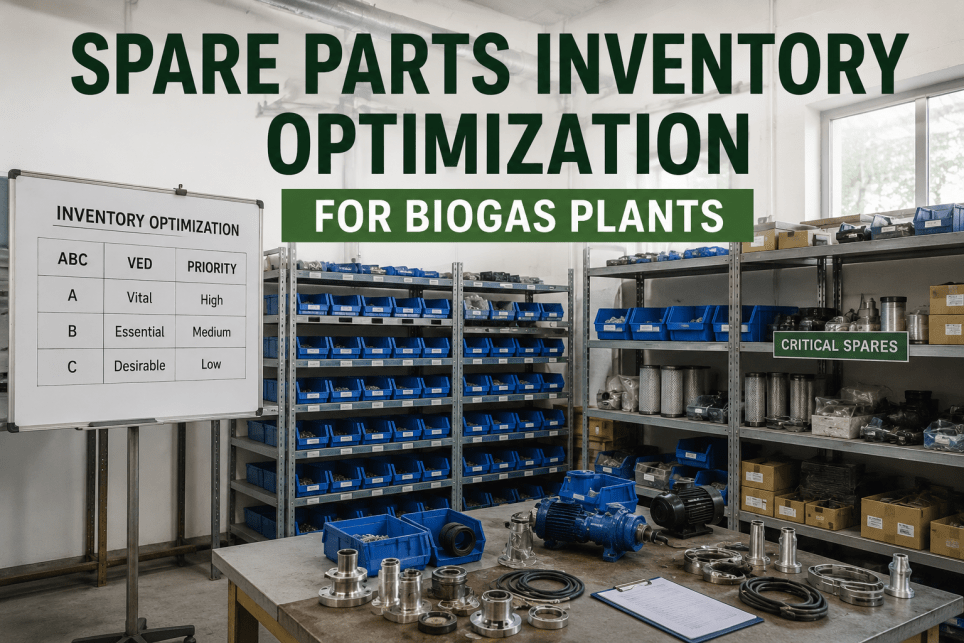
A biogas plant manager in the Midwest started every maintenance week the same way — checking the CHP engine service kit inventory, cross-referencing the last six months of spark plug replacement records, and calling three suppliers to find an ATEX-rated mechanical seal for the digester feed pump before the next day's scheduled repair. Control did not. When the CHP unit threw a cylinder head gasket failure on a Sunday afternoon, it took his team 38 hours to locate a replacement gasket — a part that a real-time spare parts optimization platform would have flagged as below minimum stock and automatically reordered the previous Thursday. By then, the plant had lost $6,200 in feed-in tariff revenue.
iFactory Maintenance Intelligence
Spare Parts Optimization Platform for Biogas Plant MRO Management
The centralized spare parts intelligence platform that turns fragmented MRO inventory data, consumption trends, and criticality classifications into a single live view your entire maintenance team can act on — before stockouts stop your CHP unit
2,400+
Average MRO SKUs across a typical biogas plant
68%
Of biogas plants lack real-time inventory visibility
86%
Stockout-related maintenance delays eliminated with AI-driven reorder optimization
22%
MRO inventory cost reduction through demand-driven stocking optimization
Why Biogas Spare Parts Management Demands a Different Approach
The average biogas plant carries 2,000–3,000 MRO SKUs spanning CHP engine consumables, gas compressor spares, digestate pump components, ATEX-rated electrical parts, instrumentation spares, and general maintenance supplies. Unlike conventional manufacturing spare parts management, biogas MRO inventory operates under constraints that most industrial inventory models never account.
Spare Parts Optimization Platform
CMMS / EAM
Work order history, parts consumption, asset hierarchy, PM schedules
Inventory System
On-hand quantities, bin locations, stockout records, reorder points
Supplier Data
Lead times, minimum order quantities, pricing, ATEX certification status
Asset Sensors
Running hours, vibration trends, temperature profiles, degradation alerts
Procurement
Purchase orders, delivery schedules, supplier performance, cost history
Compliance
ATEX zone classifications, certification records, inspection schedules, ISO 55001 documentation
Anatomy of Biogas Spare Parts Management
A spare parts optimization platform is not just an inventory tracking system — it is the operational nerve center of your biogas plant MRO strategy. It unifies every spare parts data stream into a single, role-specific, real-time interface that transforms consumption signals into procurement decisions. Here are the seven layers that make it work.
01
ABC-VED Criticality Classification Engine
Every spare part automatically classified by annual consumption value (ABC) and criticality to plant operations (VED) — CHP cylinder head gaskets and gas compressor seals land in the highest priority cells while general maintenance consumables queue with lower criticality scores.
02
AI-Driven Reorder Point Optimization
ML models trained on your plant's parts consumption history, seasonality patterns, and supplier lead times calculate dynamic reorder points that adjust as usage patterns change — eliminating the static spreadsheet min/max values that inevitably drift out of alignment with actual demand.
03
ATEX Certification and Approved Supplier Matching
Parts requiring ATEX certification or approved supplier sourcing are flagged at every stage of the procurement workflow. Requisitions for non-certified substitute parts are blocked automatically. Supplier lead times and certification renewal dates are tracked as part of the inventory record.
04
Parts Consumption Trending and Anomaly Detection
Historical consumption patterns for every SKU are compared against current usage rates. Anomalous spikes — a CHP consuming spark plugs 40% faster than the 6-month average — trigger alerts that may indicate an underlying equipment issue needing investigation before failure.
05
Stockout Risk Forecasting
Current on-hand quantities, open purchase orders, consumption velocity, and supplier lead time variability are combined into a stockout probability score for every SKU. Parts with high stockout risk appear on the maintenance planning dashboard before they run out — not after.
06
Automated Procurement Trigger and PO Generation
When stock crosses the dynamic reorder point, a purchase requisition is generated automatically with the preferred supplier, approved unit price, required ATEX certification documentation, and delivery timeframe. Procurement teams approve with one click instead of starting from scratch.
07
Inventory Health Scorecard and KPI Dashboard
Stockout frequency by asset class, inventory turnover ratio by SKU category, carrying cost vs. stockout cost analysis, and supplier delivery performance — all visible on a single live dashboard that replaces the monthly spreadsheet report with real-time intelligence.
Want to see these seven layers working together for your biogas plant's spare parts management? Book a Demo with iFactory's maintenance intelligence team.
ABC-VED Matrix: Classification Model for Biogas Spare Parts
An ABC-VED matrix combines annual consumption value (ABC) with criticality to plant operations (VED) to determine the optimal inventory management strategy for every spare part in your biogas plant. Without this classification, all parts appear equally important — and critical CHP spares compete for the same inventory carrying budget as general maintenance consumables.
See the full ABC-VED classification model applied to your plant's spare parts data. Book a Demo with iFactory's maintenance intelligence team.
Role-Based Views — One Inventory Platform, Every Perspective
A spare parts management platform that shows the same screen to everyone serves no one well. The power of a centralized platform is that it provides role-specific views — giving each person exactly the information they need to make inventory decisions at their level, without noise.
Sees: Total MRO inventory value trend, stockout frequency by asset class, inventory turnover ratio, carrying cost vs. stockout cost balance, supplier delivery performance, monthly savings from optimized reorder points
Decides: Inventory carrying budget allocation, capital spares approval, supplier rationalization decisions, strategic stock level targets
Sees: Stockout risk dashboard by SKU, critical parts below reorder point, ATEX certification expiration calendar, consumption trend anomalies, PM parts pre-allocation status, work order parts availability
Decides: Reorder point adjustments, criticality classification changes, alternative part approvals, PM parts reservation priorities
Sees: Auto-generated purchase requisitions by priority, approved supplier list per SKU, lead time variance tracking, open PO status, price history trends, supplier certification compliance
Decides: PO issuance timing, supplier selection for non-automated parts, expediting priority, order consolidation opportunities
Sees: Bin location map, pick list for upcoming PM tasks, incoming delivery schedule, parts return processing queue, out-of-stock notification board, quick reorder request form for missing parts
Decides: Bin location optimization, parts receipt confirmation, quality inspection at goods-in, stock rotation for consumables with shelf life limits
Stockout Impact: From Missing Part to Production Loss — How Fast?
The cost of a biogas plant spare parts stockout is measured in the gap between a part running out and production stopping. Here is how response times compare between traditional inventory management and a centralized AI-driven platform.
Part identified as below reorder point
2–5 days (next manual stock check)
Purchase requisition created
Part delivered to storeroom
3–14 days (standard procurement)
1–4 days (expedited by early detection)
Part booked to work order
15–45 min (manual storeroom trip)
Production loss avoided
Often too late — CHP stopped
Stockout prevented before impact
Manual / Spreadsheet Inventory
iFactory AI Platform
Ready to close the gap between stockout detection and production impact? Book a Demo with iFactory's maintenance intelligence team.
Frequently Asked Questions
How does iFactory determine the optimal reorder point for each spare part?
iFactory calculates dynamic reorder points using ML models trained on your plant's actual parts consumption history, supplier lead time variability, asset running hours, and ATEX zone criticality. The model considers seasonal consumption patterns — CHP parts may be consumed faster during winter peak production — and adjusts reorder points automatically as usage patterns change. Static min/max values in spreadsheets inevitably drift out of alignment with actual demand;
Can iFactory handle ATEX-certified parts sourcing and substitution controls?
Yes. Parts requiring ATEX certification or approved supplier sourcing are flagged at every stage of the procurement workflow. The platform maintains a supplier approval database linked to ATEX certification documentation, and requisitions for non-certified substitute parts are blocked automatically during the procurement approval workflow. Supplier certification renewal dates are tracked, and the platform notifies procurement teams
Does iFactory integrate with our existing CMMS and ERP systems?
Yes. iFactory connects to your existing CMMS and ERP — including SAP PM, IBM Maximo, Infor EAM, Oracle EBS, and most biogas-specific CMMS platforms — via OPC-UA, REST APIs, and direct database connectors. The platform ingests parts usage data from work order histories, inventory balances from stock systems, and supplier data from procurement modules. No data migration is required. CMMS and ERP integration is completed during the Week 1–2 data audit phase of the 5-week deployment program.
What is the typical ROI timeline for spare parts optimization at a biogas plant?
Plants completing the 5-week deployment program typically report measurable ROI within the first 30 days of full production rollout. The primary drivers are: elimination of emergency procurement premium (30–60% cost reduction on expedited parts), reduction in obsolete stock (15–25% of MRO inventory value identified for write-off or return), and stockout-related production loss avoidance (1–2 CHP stopped events per year at $3,000–$6,000 per day of lost feed-in tariff revenue). Most facilities achieve full payback within 3–5 months of deployment.
Can the platform support multi-site biogas plant operations with centralized inventory management?
Yes. iFactory is designed for multi-site deployments with centralized inventory visibility and site-specific stock management. Each plant maintains its own inventory records, stock levels, and reorder points, while regional or corporate leadership sees aggregated inventory data across all sites. Cross-plant inventory transfers — where one facility's surplus stock can fulfill another facility's urgent requirement — are supported with automated transfer request workflows and real-time availability visibility across all connected sites.
Never Run Out. Never Overstock.
Your Biogas Plant's Spare Parts Data Already Exists. Your Control Does Not. Fix That Today.
iFactory's Spare Parts Optimization Platform unifies every MRO SKU, consumption trend, supplier lead time, and ATEX certification into a single real-time inventory intelligence dashboard. From storeroom to boardroom, everyone sees the truth — and acts on it before stockouts stop your CHP unit.
Real-Time
MRO inventory visibility across all storerooms
22%
Reduction in MRO inventory carrying cost
86%
Fewer stockout-related maintenance delays
5 wk
To full platform deployment and live data