Choosing a predictive maintenance strategy for a modern biogas plant is no longer a choice between competing approaches — it is a choice between reactive firefighting and data-driven profitability. In the high-stakes environment of anaerobic digestion and RNG production, the traditional debate between calendar-based preventive maintenance condition-based monitoring AI-driven predictive analytics has been resolved by the arrival of unified industrial intelligence. This guide provides a deep comparison of these biogas plant reliability strategies, exploring how the most successful AD facilities are moving beyond "fix-when-fail" by integrating these frameworks into a single, AI-driven operational layer. Organizations that schedule a discovery session with iFactory are finding that the platform doesn't just support these strategies — it automates the data-gathering and causal logic required to make predictive maintenance a reality on the digester floor.
Unify Your Preventive, Condition-Based, and AI Predictive Strategies
iFactory's AI platform provides the unified intelligence layer that bridges scheduled maintenance, real-time condition monitoring, and failure prediction — purpose-built for the complexities of modern biogas and RNG operations.
Why Most Biogas Plants Struggle to Choose a Maintenance Strategy
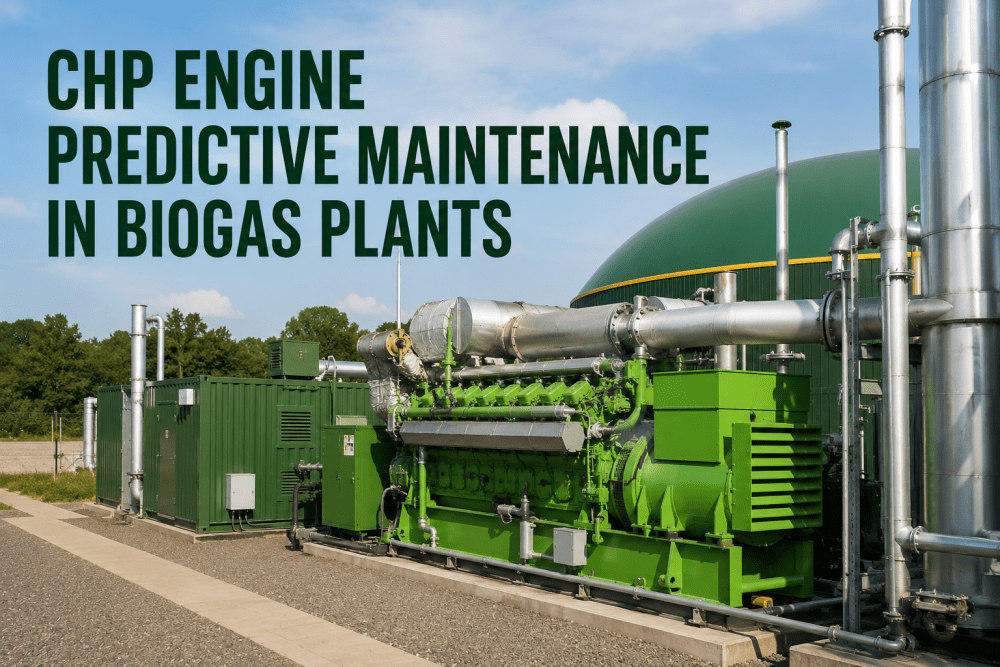
The core challenge in biogas production is the sheer diversity of asset classes and operating conditions. A Combined Heat and Power (CHP) engine running 8,000 hours per year requires the precision of AI-driven predictive analytics to prevent catastrophic rod throw or turbocharger failure. An anaerobic digister with 20-year design life needs continuous condition monitoring to detect early-stage shell corrosion or mixer bearing degradation. The entire biogas upgrading system — membrane skids, pressure swing adsorption vessels, amine scrubbers — demands a hybrid approach where preventive filter changes are optimized by real-time performance data. This fragmentation creates "The Reliability Gap," where data exists but intelligence is missing. iFactory solves this by acting as the single source of truth — collecting vibration, temperature, pressure, and gas composition data from sensors and operator mobile check-ins to provide a 360-degree view of plant health. For leadership teams looking to close this gap, booking a platform demo is typically the first step toward strategic unification.
Preventive (Calendar)
Core Focus: Fixed Intervals. Maintenance performed at predetermined calendar or runtime intervals regardless of actual asset health. Oil changes every 500 hours, filter replacements every quarter, belt replacement every 12 months. Simple but inherently wasteful and failure-blind.
Condition-Based (CBM)
Core Focus: Real-Time Thresholds. Maintenance triggered when monitored parameters cross defined limits. Vibration exceeding 7 mm/s, bearing temperature above 85°C, pressure drop across scrubber above threshold. Better than calendar — but still reactive to active deterioration.
AI Predictive (PdM)
Core Focus: Failure Foresight. Machine learning models trained on historical failure data and live sensor streams forecast failures 30–180 days before they occur. Enables planned intervention during production windows, optimized spare parts procurement, and zero unplanned downtime.
iFactory AI Integration
Core Focus: Unified Intelligence. iFactory provides the digital infrastructure to run all three approaches concurrently. It schedules preventive tasks, monitors real-time CBM thresholds, and runs AI models for predictive failure foresight — all within a single platform for every asset in the biogas plant.
"We ran our CHP engines on a strict 500-hour preventive oil change schedule for years — until iFactory's vibration analysis showed we were changing perfectly good oil and ignoring developing bearing fatigue on the generator end. The platform's AI models now give us 45-day advance warning of mechanical issues, and we've gone from 12 unplanned CHP trips per year to zero. Our maintenance OpEx dropped by 28% in the first year."
The Strategic Matrix: Mapping Maintenance Strategies to Biogas Plant Assets
A digiator mixer operating in a corrosive, solids-laden environment needs condition monitoring of seal integrity and bearing health. The membrane upgrading skid benefits most from performance-based preventive maintenance where filter change intervals are optimized by real-time pressure and purity data. iFactory's modular architecture allows you to toggle these capabilities asset-by-asset. Reliability managers who schedule a technical review often find that this flexibility is what finally allows them to scale predictive maintenance across diverse plant zones.
| Strategic Metric | Preventive (Calendar) | Condition-Based (CBM) | AI Predictive (PdM) | iFactory Advantage |
|---|---|---|---|---|
| Primary Driver | Fixed Schedule | Threshold Alarms | Failure Foresight | Predictive AI Unification |
| Data Foundation | Runtime Hours / Calendar | Live Sensor Parameters | Historical + Live ML Models | Live IoT + Causal AI |
| Detection Window | No failure detection | At failure onset (hours) | 30–180 days ahead | Avg 47-day foresight |
| Biogas Asset Fit | Pumps, valves, filters | Mixers, compressors, blowers | CHP engines, turbochargers | Universal asset coverage |
| Spare Parts Strategy | Stocked for schedule | Stocked for risk | Stocked with 180-day foresight | JIT procurement capability |
| Unplanned Downtime Impact | Moderate prevention | Reduces severity | Near-elimination | 82% reduction achieved |
How iFactory Delivers What Only an AI-First Platform Can
We don't just host your inspection checklists; we use mobile geolocation and digital signatures to verify that rounds are actually completed. Most importantly, we provide **180-day Failure Foresight** — the ability to see a CHP engine bearing fatigue or a compressor valve failure six months before it happens. This allows your procurement team to source replacement parts globally when prices are lowest, while your maintenance engineers schedule the intervention during a planned process shutdown. This is the level of intelligence that stakeholders see when they book a live demonstration.
Phased Strategy Integration: From Calendar-Based to Predictive Excellence
Moving from a reactive or calendar-based maintenance culture to a unified predictive model doesn't happen overnight. It requires a structured progression that builds data integrity, workforce trust, and model accuracy. iFactory's implementation team follows a proven 3-phase roadmap that aligns with your plant's specific maturity level. If you are unsure where your plant sits on this curve, booking a strategic audit can provide the clarity needed to begin.
Visibility & The Condition Monitoring Foundation
Eliminate paper logs and digitize operator inspection routes. Deploy wireless vibration, temperature, and pressure sensors on critical rotating assets — CHP engines, digestor mixers, biogas compressors and blowers. Establish baseline operating signatures and real-time alarm thresholds for all monitored parameters. Timeline: 6–10 weeks.
Precision & The AI Predictive Intelligence
Deploy iFactory's Causal AI to train failure prediction models using the baseline data collected in Phase 1. Transition from threshold-based alarming to predictive failure forecasting on all critical assets. Automate work order generation from prediction alerts and integrate with existing CMMS workflows. Timeline: 10–14 weeks.
Excellence & The Autonomous Optimization
Integrate maintenance backlogs with real-time spare parts logistics and OEM lead times. Activate automated preventive interval optimization where the platform dynamically adjusts service schedules based on actual asset degradation rates rather than fixed calendar intervals. Achieve zero unplanned downtime target. Timeline: Ongoing.
Biogas Plant Predictive Maintenance — Frequently Asked Questions
What is the difference between condition-based monitoring and AI predictive maintenance?
**Condition-based monitoring (CBM)** triggers alerts when real-time sensor readings cross fixed thresholds — for example, an alarm when CHP engine vibration exceeds 7 mm/s. By the time this alarm fires, the asset is already actively degrading. **AI predictive maintenance (PdM)** uses machine learning models trained on historical failure data and live trends to forecast failures 30–180 days before any measurable parameter exceeds its threshold. PdM provides the lead time needed for planned, cost-effective intervention rather than emergency response.
Which biogas plant assets benefit most from AI predictive maintenance?
The highest ROI assets are typically **CHP engines** (where catastrophic failure costs $50K–$150K in repairs plus lost RNG revenue during downtime), **biogas compressors and blowers** (where unplanned failure forces biogas flaring), **digestor mixers** (where failure leads to solids settling, reduced gas production, and potential digester re-start costs), and **gas upgrading membrane/PSA systems** (where performance degradation affects gas quality compliance). These four asset classes typically represent 80% of the predictive maintenance value in a biogas plant.
How does AI predictive maintenance reduce maintenance costs compared to calendar-based preventive maintenance?
Calendar-based preventive maintenance replaces parts based on a fixed schedule regardless of their actual condition — this is inherently wasteful. A CHP oil change at 500 hours might be perfectly good oil in a clean-gas operation, while the same oil might be severely degraded at 300 hours in a siloxane-heavy environment. AI predictive maintenance optimizes service intervals based on actual asset degradation rates, eliminating unnecessary maintenance labor and spare parts consumption while ensuring critical interventions never occur too late.
Can iFactory integrate with our existing CMMS or EAM system?
Yes. iFactory features bidirectional API connectors for all major CMMS and EAM platforms including SAP, Oracle EAM, IBM Maximo, Maintenance Connection, Fiix, and UpKeep. This allows our predictive failure alerts to automatically generate work orders in your existing system, populate job plans with AI-recommended repair procedures, and reserve spare parts from inventory — closing the loop between sensor data and maintenance execution.
What sensors are required to start a predictive maintenance program?
iFactory's platform works with a standard sensor suite that most biogas plants already have or can install cost-effectively: **tri-axial accelerometers** for vibration monitoring on rotating equipment, **RTD temperature probes** for bearing and winding temperature, **pressure transducers** for compressors and upgrading systems, and **motor current sensors** for CHP generator and motor monitoring. The platform also ingests existing data from the plant's gas chromatograph, SCADA system, and flow meters. Typical sensor deployment cost for a single biogas plant ranges from $15K to $45K depending on asset count and existing instrumentation.
How long does it take to train the AI models for accurate failure prediction?
iFactory's AI models begin generating actionable alerts within **4–6 weeks** of live sensor data collection. Initial model accuracy is approximately 70–80%, using the baseline operating signatures established during Phase 1 deployment. Model accuracy improves to **90–95%** over 6–12 months as the platform accumulates more operational data and failure event correlation. The platform's lifetime learning architecture means models continuously improve without manual recalibration.
Is this strategy applicable to smaller farm-scale biogas plants?
Absolutely. While the asset count is smaller, the ROI multiple is often higher for farm-scale operations because they have less redundant equipment and tighter margins. A single CHP engine failure at a 250 kW farm digester can shut down the entire facility for weeks, representing a catastrophic revenue loss relative to operational budget. iFactory offers scaled-down sensor packages and subscription tiers specifically designed for smaller biogas operations — delivering predictive maintenance capability at farm-scale economics.
How do I justify the cost of predictive maintenance to my CFO?
The justification is straightforward: **recovered EBITDA through avoided downtime and optimized maintenance spend**. By reducing unplanned CHP downtime by 82% and maintenance OpEx by 28%, iFactory typically delivers a payback period of under 8 months. We provide a detailed plant-specific ROI model during our live demo sessions that includes your specific asset counts, current maintenance costs, and biogas/RNG revenue streams — ready to take directly to your finance leadership.
Stop Changing Oil on Schedule. Start Predicting Failures with iFactory AI.
iFactory's industrial AI platform delivers the unified intelligence needed to execute calendar-based preventive, condition-based, and AI predictive maintenance at scale — purpose-built for the global biogas and RNG industry.