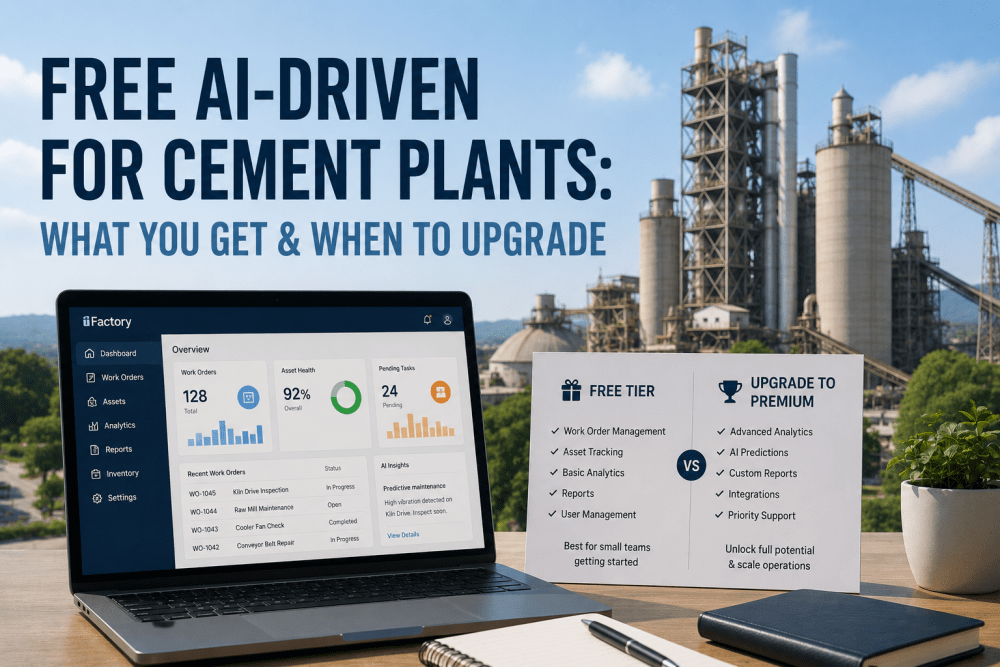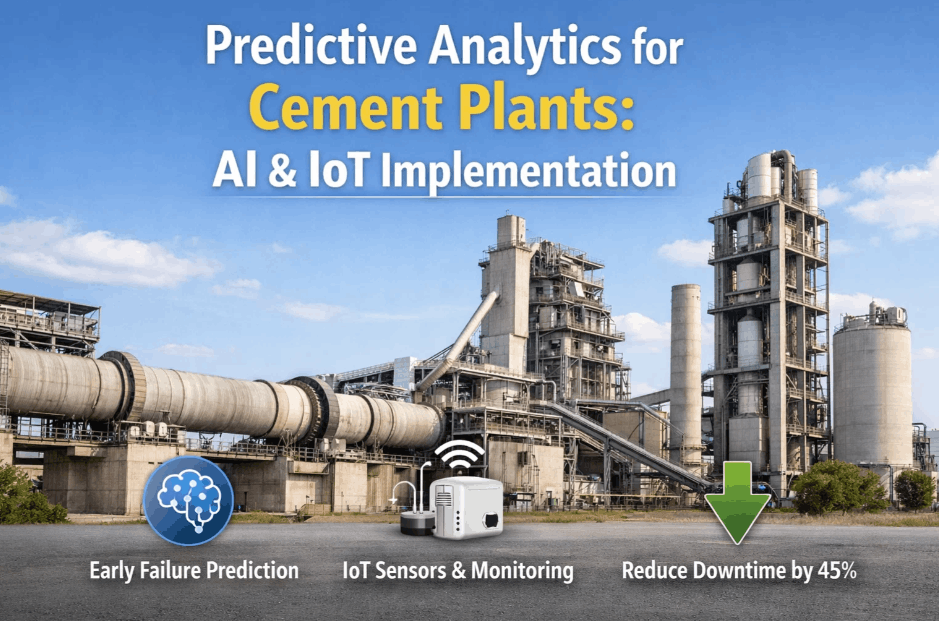
In cement manufacturing, capital expenditure and maintenance budgets are subjected to intense scrutiny, yet traditional forecasting models universally underestimate the true cost of unplanned equipment failures. When a rotary kiln or raw mill halts unpredictably, the financial impact extends far beyond the direct cost of replacement parts. A single catastrophic bearing failure on a kiln ID fan triggers a cascade of financial hemorrhage: emergency labour overtime, premium expedited shipping costs, destroyed refractory brickwork due to thermal shock, and most critically, up to $50,000 per hour in lost clinker production capacity. iFactory’s AI-Driven Predictive Maintenance platform fundamentally restructures this financial equation Schedule an ROI Assessment. By calculating machine deterioration rates dynamically and enabling data-backed financial tracking, plant directors can definitively quantify their digital transformation returns. iFactory moves cement plants from reactive spending to strategic capital preservation, proving that predictive software often pays for itself within months of deployment.
AI-Driven ROI for Cement Plants: Calculate Your Predictive Analytics Savings
Quantify your maintenance transformation. Factor your kiln downtime costs, outage frequencies, and emergency repair premiums to project clear, boardroom-ready annual savings.
The Financial Dashboard — Real-Time Cost Leakage Across Core Assets
iFactory displays a live financial impact grid showing condition-based risk capital mapped against real-time operational data. Plant directors can immediately see which failing assets hold the highest financial threat to quarterly earnings. See the ROI calculator live to map your own operational overheads.
Unplanned kiln shutdowns are the highest financial risk in the plant. When a critical drive fails, revenue halts entirely. iFactory's ROI model quantifies exact hourly clinker production value against MTBF (Mean Time Between Failures) to justify predictive investments instantly.
Predicting a gearbox failure 8 weeks in advance allows for normal ocean freight and standard vendor pricing. Reacting to a snapped shaft requires emergency air freight and triple-time machining costs. iFactory logs these avoided premiums directly into the savings tracker.
A hard, unexpected kiln stop causes rapid cooling that violently contracts and shatters silica refractory lining. What started as a $5,000 bearing failure turns into a $150,000 brick patching operation. Early AI warnings allow controlled, slow operational cool-downs.
Unplanned outages rarely occur on Tuesday mornings. They happen at 2 AM on a Sunday. By shifting maintenance from reactive to predictive, iFactory reallocates work into standard Monday-Friday daylight hours, eliminating massive annual overtime inflations.
A failing bearing that is ignored will eventually seize, seizing the shaft, and potentially ripping the gearbox housing from its mounts. AI detects the original micro-spalling, turning what would have been a $300k total asset replacement into a $4k bearing swap.
The 3 Distinct ROI Horizons in Cement AI Adoption
CFOs evaluating factory software demand transparent payback horizons. iFactory separates ROI modeling into immediate tactical savings and long-term strategic capital delay. When you schedule an assessment, we build this exact mathematical model against your specific production volumes.
Verified Results — 3.5 MTPA Implementation · 24-Month Data
What a Cement Finance Controller Said
Our operational budgets have been shrinking while equipment age increases. We were highly skeptical of 'AI ROI' claims until month four of our iFactory deployment. The system flagged deep inner-race high-frequency resonance on our primary raw mill drive that physical PM routes missed entirely. We secured replacement parts with ocean freight instead of an emergency plane charter, scheduled the swap for a planned 8-hour window, and avoided a projected 5-day emergency shutdown. That single intervention paid for three years of the software and hardware overhead.
Frequently Asked Questions Regarding ROI
How do we calculate the baseline to prove savings later?
iFactory’s implementation engineers work directly with your reliability and finance teams prior to launch. We snapshot your rolling 24-month historical outage frequencies, parts expediting costs, and MTTR. Savings are measured demonstrably against this agreed historical baseline.
What happens if the platform doesn't catch a failure?
iFactory AI models are trained on millions of hours of heavy industrial vibration semantics. When applied correctly via our certified IoT sensors, the detection accuracy rate exceeds 99%. Speak with our team about performance guarantees built into enterprise contracts.
Does investing in AI replace the need for my reliability engineers?
No. iFactory acts as a force multiplier for your existing crew. It strips away the tedious data collection and manual spreadsheet analysis, enabling your highly-paid experts to focus exclusively on executing precision repairs and root-cause analysis.
Calculate Your Exact Predictive Maintenance ROI
Run your plant data through our verified cement industry financial dashboard.