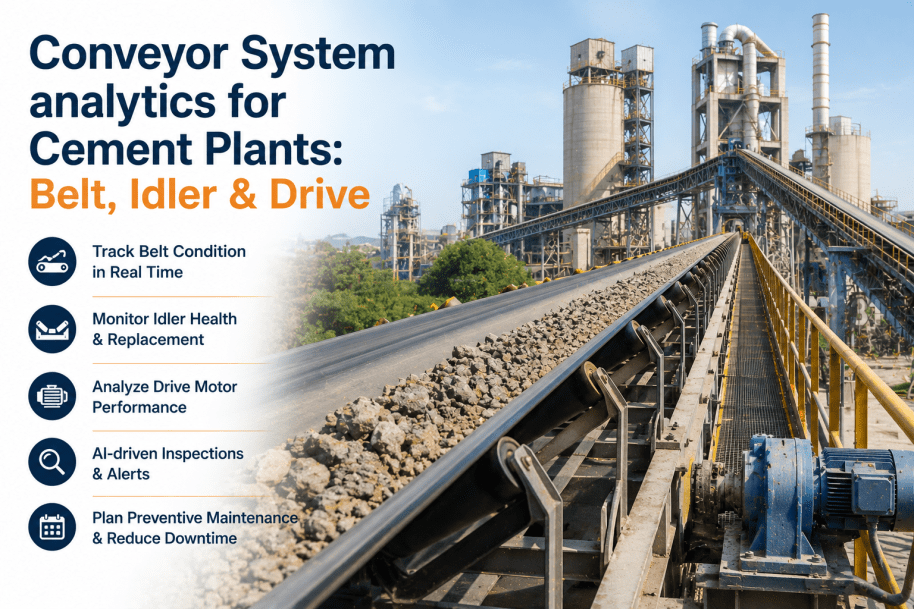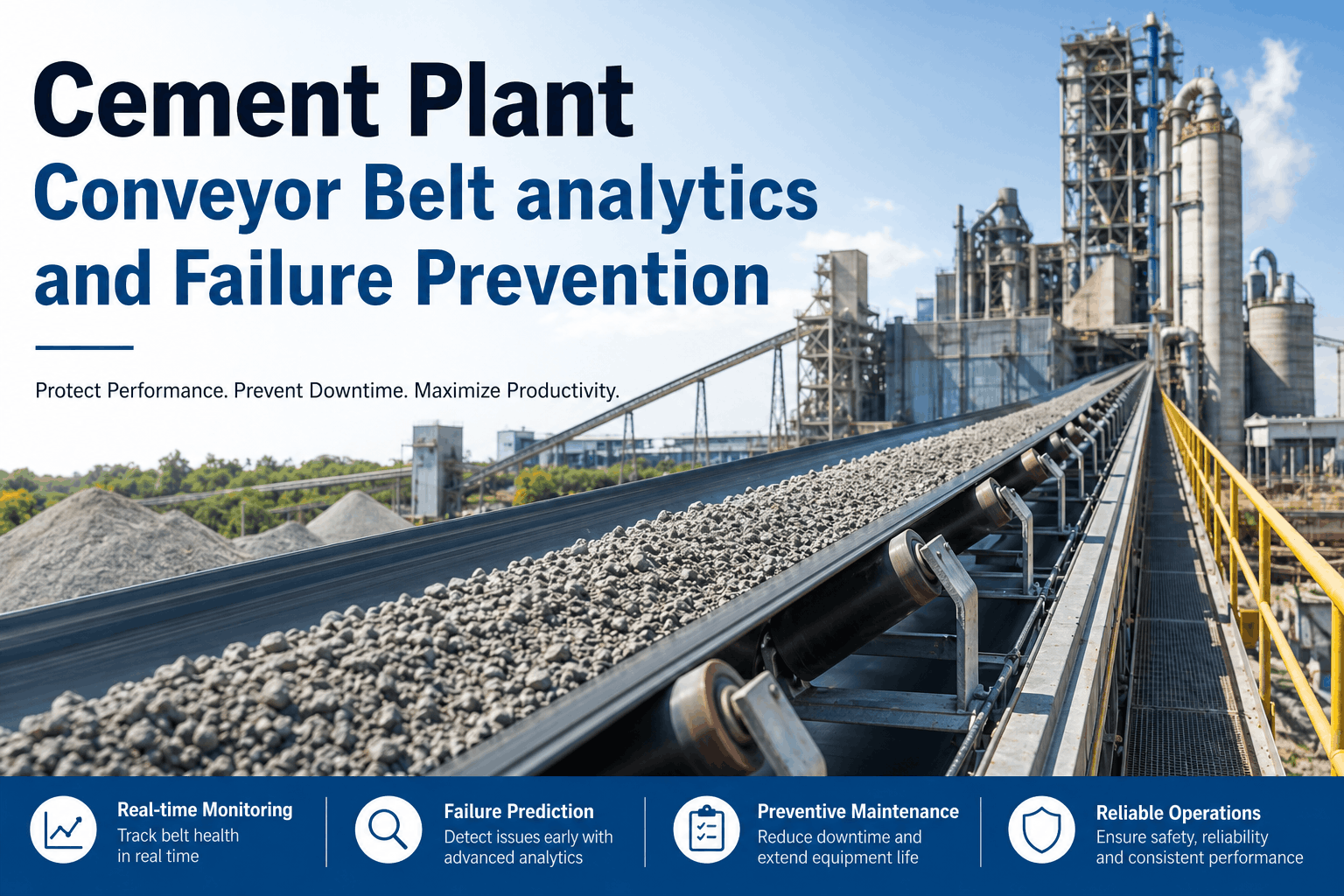
Conveyor belt equipment failure in cement plants doesn't just cost downtime — it triggers kiln feed interruptions, clinker cooler backups, and catastrophic safety risks that can result in facility shutdowns and massive revenue loss. In 2026, AI-powered equipment monitoring systems are transforming how cement producers predict, prevent, and document mechanical failures before they reach the main production line. With kiln throughput pressures intensifying and labor shortages reducing manual inspection frequency, book a demo to see how iFactory's predictive analytics platform keeps your conveyor equipment running at peak compliance and operational efficiency.
Prevent Conveyor Failures Before They Stop Your Kiln
iFactory's AI monitoring platform delivers real-time predictive alerts, belt health scoring, and automated maintenance records — purpose-built for the demands of cement operations.
Why Conveyor Failure Rates Are Rising in Cement Operations
Cement processing environments are among the most mechanically demanding in heavy industry. Raw meal conveyors, overland belts, and high-heat clinker circuits operate under extreme dust exposure, 150°C+ thermal loads, and continuous mechanical tension — conditions that accelerate wear patterns conventional maintenance schedules cannot track precisely. As facilities push throughput targets higher to meet infrastructure demand, belt run times are increasing while inspection windows are shrinking. The result is a growing gap between the maintenance intervals that asset health requires and the maintenance intervals that production schedules allow.
AI-powered equipment monitoring systems for cement plants close this gap by moving beyond scheduled greasing cycles to condition-based monitoring. Rather than replacing an idler every 6 months regardless of its actual wear state, AI analytics evaluate real-time acoustic signatures, temperature gradients, and belt alignment patterns to identify the specific point at which intervention is needed — preventing both premature replacement and catastrophic longitudinal rips. Facilities using book a demo to understand how condition-based monitoring reduces maintenance costs while extending equipment service life simultaneously.
How AI Monitoring Systems Detect Conveyor Failures Early
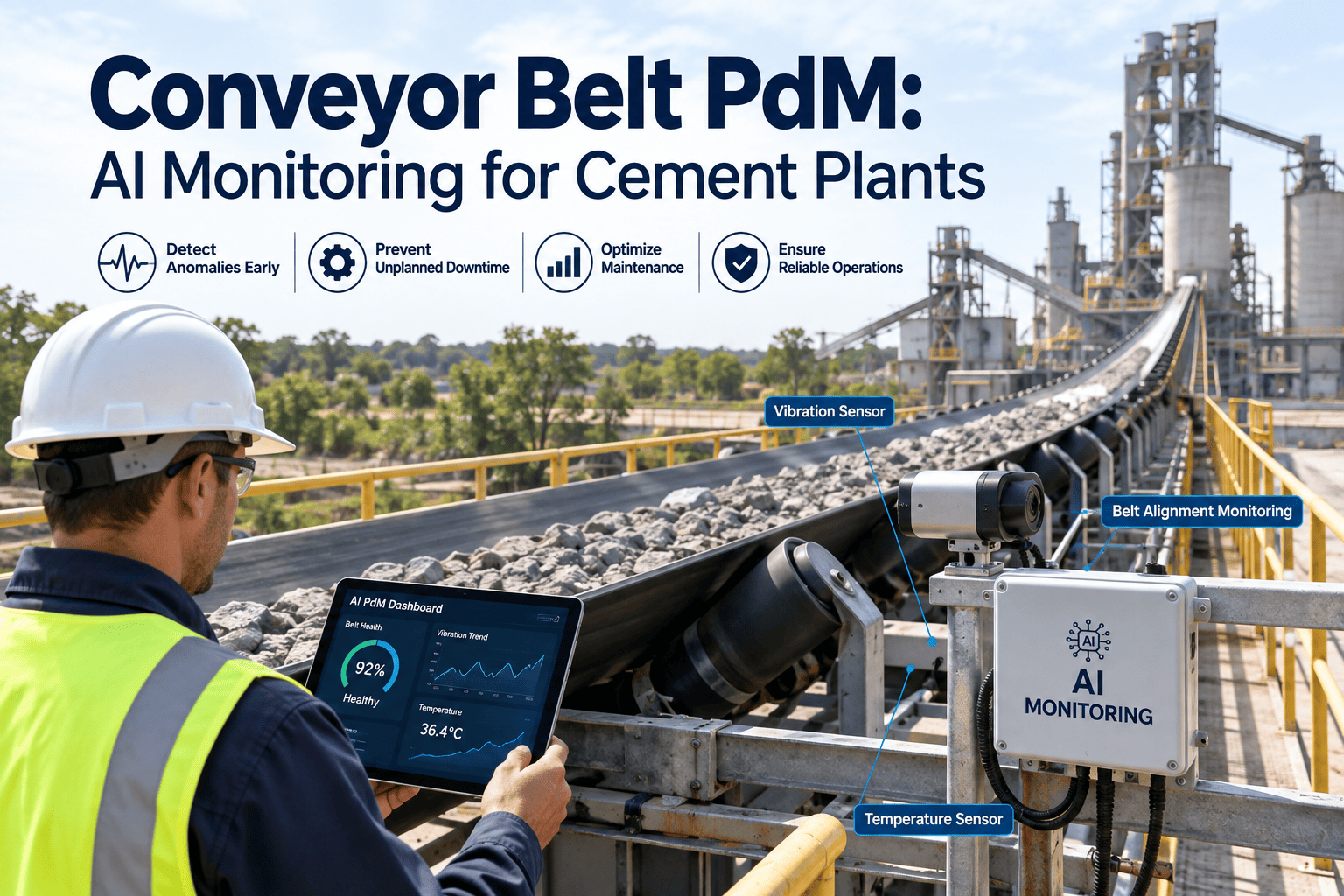
Predictive maintenance in cement conveyors relies on machine learning models trained on equipment-specific failure signatures — the acoustic, thermal, and mechanical patterns that precede breakdowns by days or weeks. When an AI analytics platform monitors a clinker belt or a raw mill drive, it isn't just checking whether the equipment is running. It is continuously comparing current operating signatures against baseline performance models and known failure precursors, scoring asset health in real time and flagging deviations that indicate developing faults.
Idler Bearing Failure Detection Weeks in Advance
AI models trained on acoustic frequency spectra identify bearing race defects and lubrication loss in idlers that precede seizing — giving teams a 14-day intervention window before a frozen roller causes a belt friction fire.
Pulley and Gearbox Overheating Before Stoppage
Temperature trending algorithms detect abnormal heat buildup in drive pulleys, gearbox housings, and bearings weeks before thermal cutout events — allowing corrective action during scheduled kiln downtime windows.
Joint Degradation Detection Without Stoppage
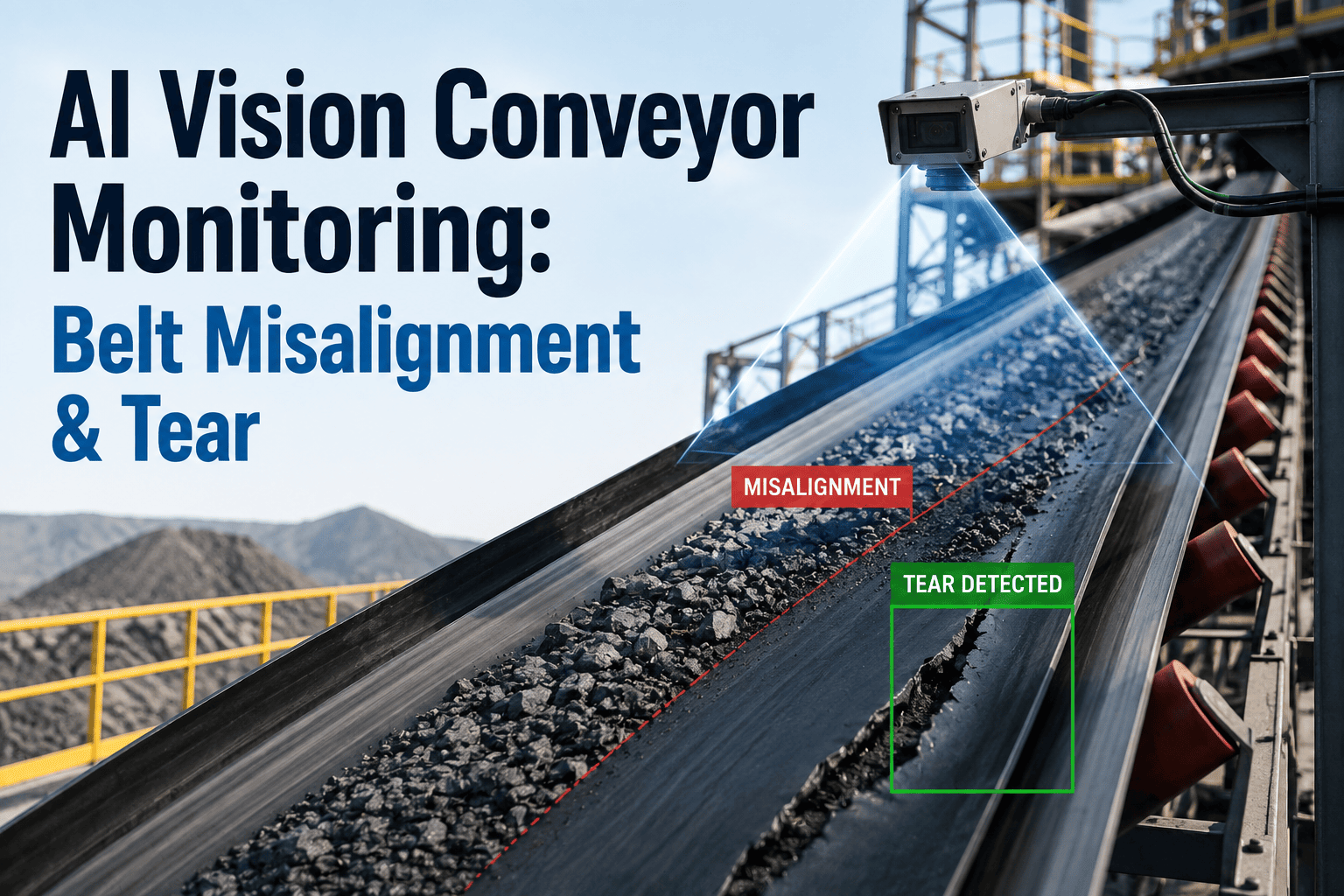
Computer vision monitoring detects splice elongation, step-up gaps, and surface cracks in belt joints during operation — expanding predictive coverage to the most common point of sudden, catastrophic belt snaps.
Tracking Deviations as Early Failure Indicators
AI systems correlate belt mistracking with load imbalances and structural shifts — identifying cases where edge fraying or structure contact reflects developing issues, enabling root cause diagnosis before asset damage.
Critical Equipment Categories in Cement That Require AI Monitoring
Not all conveyors in a cement facility carry equal failure consequence. AI monitoring deployment strategies prioritize assets based on failure impact — the equipment categories where a breakdown halts the entire kiln or stops raw mill production. Understanding which asset categories demand continuous monitoring is the foundation of an effective cement analytics program. Facilities new to predictive monitoring can book a demo to walk through an asset criticality assessment.
High-Heat Thermal and Chain Link Monitoring
Failures in clinker handling create immediate kiln backups — forcing a reduction in feed or a full kiln shutdown. AI monitoring of pan temperatures and drive-chain vibration detects developing faults before high-heat materials cause structural deformation or chain breaks.
Long-Distance Health & Tension Analytics
Overland conveyor failures cut off the limestone supply to the raw mill. AI acoustic monitoring along the belt length detects failing rollers across miles of terrain, while tension analytics prevent belt slip during startup cycles in variable ambient temperatures.
Drive Belt, Idler, and Alignment Prevention
Conveyor failures on raw mill lines create immediate kiln-feed shortages. AI vibration and tension monitoring on drives detects bearing degradation and tracking anomalies — triggering predictive alerts that allow repairs during scheduled kiln stops rather than mid-shift.
Vertical Belt and Bucket Integrity Monitoring
Elevator failures produce massive material spillage at the kiln pre-heater. AI verticality monitoring and bucket impact detection identify belt elongation and bucket detachment before they cause a blockage or a catastrophic drop event.
Predictive Alerts in Cement: From Notification to Action
The value of a predictive alert system depends entirely on what happens after the alert fires. AI monitoring platforms that generate alerts without structured maintenance integration produce alert fatigue. Effective cement analytics software links predictive alert severity scoring to work order generation, parts inventory checking, and maintenance scheduling systems.
iFactory's predictive alert architecture classifies equipment health degradation into severity tiers — from early-warning efficiency decline to imminent failure risk — with each tier triggering a defined response workflow. Critical alerts for clinker lines or primary raw meal belts automatically notify both maintenance and operations teams. Facilities managing high-consequence equipment categories should book a demo to review the alert-to-action workflow.
AI Monitoring vs. Traditional Maintenance: A Direct Comparison
| Dimension | Reactive / Scheduled Maintenance | AI Predictive Monitoring | Operational Impact |
|---|---|---|---|
| Failure Detection | After breakdown or at fixed schedule | Days to weeks before failure | Eliminates unplanned kiln feed stoppages |
| Maintenance Timing | Calendar-based, regardless of asset condition | Condition-triggered, precisely timed | Reduces both over-maintenance and failure risk |
| Idler Management | Manual noise detection during rounds | Acoustic AI flags specific coordinates | Friction fire risks prevented proactively |
| Documentation | Manual work orders, paper logs | Automated digital maintenance records | Continuous ISO and internal audit readiness |
| Parts Inventory | Emergency belt procurement at 3x cost | Planned procurement with lead time | Eliminates emergency belt splicing premiums |
| Downtime Cost | Full unplanned kiln stoppage cost | Planned maintenance window intervention | Downtime shifted to off-peak kiln stops |
| Multi-Site Visibility | Site-by-site, manual reporting | Unified conveyor health dashboard | Enterprise-wide material handling management |
Implementing Cement Conveyor Analytics: What to Expect
Critical Asset Sensor Deployment
Non-invasive vibration, thermal, and acoustic sensors installed on highest-consequence assets — clinker belts, overland drives, and pre-heater elevators — during scheduled stops. No structural modification required.
Baseline Modeling and Alert Calibration
AI models establish performance baselines across full load cycles, including variable ambient temperatures and material densities. Alert thresholds are calibrated to each belt's actual profile — eliminating false positives.
Continuous Learning and Fleet Expansion
AI models continuously refine failure prediction as history accumulates. Monitoring coverage expands to secondary belts as initial ROI is validated — building toward full facility coverage within 12 months.
Building a Predictive Maintenance Culture in Cement Operations
Technology deployment is the starting point, not the end state. The full ROI of AI equipment monitoring in cement plants compounds over time as maintenance teams shift their operating model from reactive response to predictive intervention. Facilities that invest in conveyor analytics software now are building the operational foundation that separates cost-leading cement producers from those perpetually managing unplanned downtime and emergency parts procurement. The return compounds: year one delivers immediate downtime reduction; years two and three surface the equipment performance patterns that drive systemic throughput improvements.
Stop Reacting to Conveyor Failures — Start Predicting Them
iFactory's AI monitoring platform gives cement plants real-time equipment health scoring, predictive failure alerts, and automated compliance documentation — so your next belt failure becomes a planned maintenance event.
Frequently Asked Questions: AI Monitoring for Cement Plants
What types of equipment can AI monitoring systems track in a cement plant?
AI equipment monitoring platforms can track any asset with measurable operating signatures — overland conveyors, clinker belts, bucket elevators, raw mill drives, and gearbox systems. Non-invasive sensor installation makes deployment practical even in high-dust and high-heat zones.
How does predictive maintenance reduce conveyor fire risk?
Most conveyor fires are caused by seized idler bearings creating friction heat. Acoustic AI detects failing bearings weeks before they seize, while thermal analytics monitor pulley and motor heat, allowing intervention before temperatures reach the ignition point of material dust or the belt itself.
Can AI monitoring systems detect belt rips?
Yes. Using a combination of magnetic loops and computer vision, iFactory detects longitudinal rips in milliseconds. The system triggers an immediate emergency stop, limiting a potentially kilometer-long rip to just 1–2 meters, saving millions in replacement costs.
How long does it take to deploy AI monitoring in a cement facility?
Priority equipment monitoring — clinker belts and primary overland drives — typically goes live within 4–6 weeks using non-invasive sensor installation. No production interruption is required, and predictive alerts begin generating from initial baseline calibration completion.
What is the ROI of AI equipment monitoring in cement operations?
ROI comes from unplanned downtime elimination (avoiding $320k/hr kiln stoppages), emergency belt procurement reduction, and extended asset life. Preventing a single catastrophic belt snap or rip typically covers platform costs for the entire facility for 2+ years.