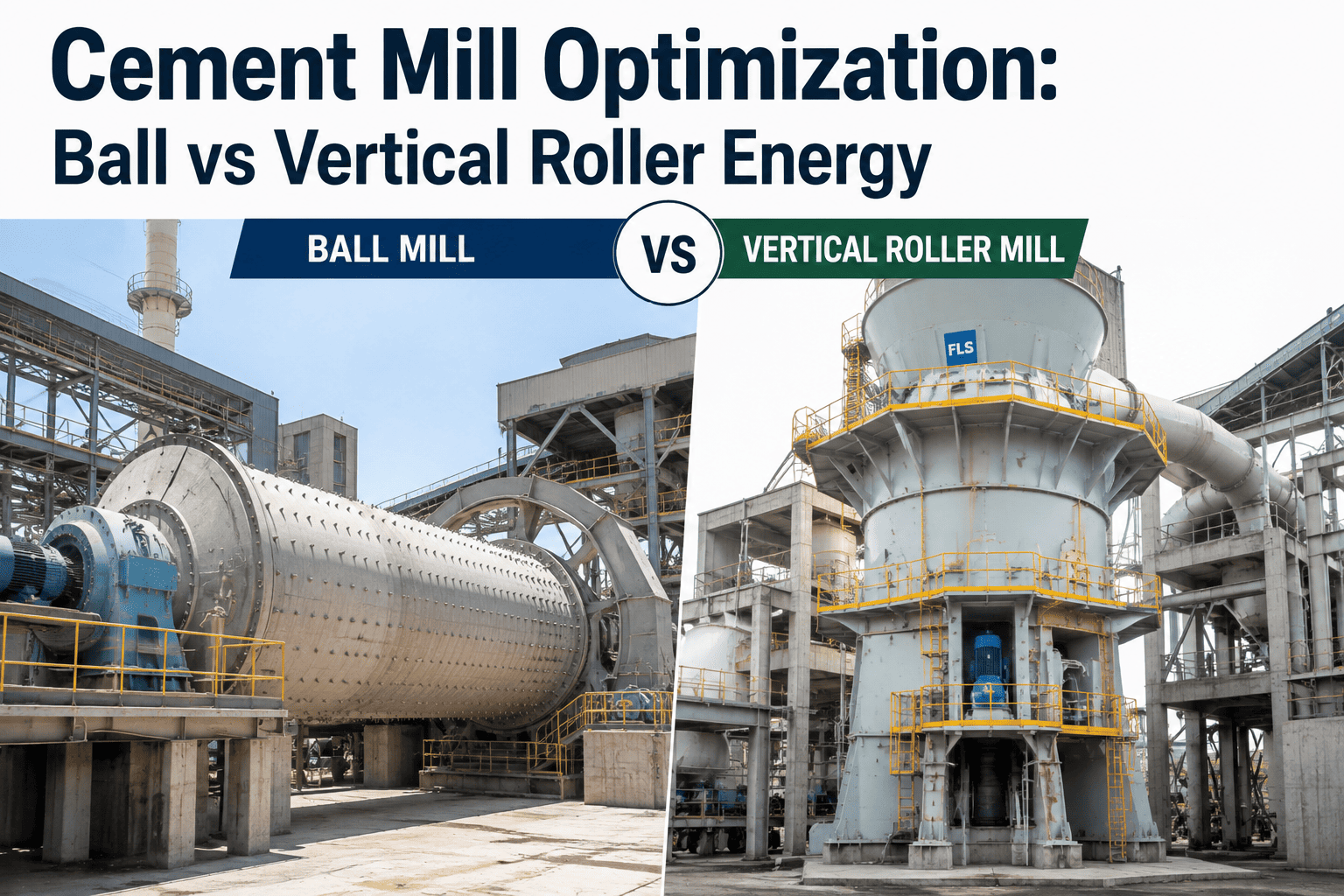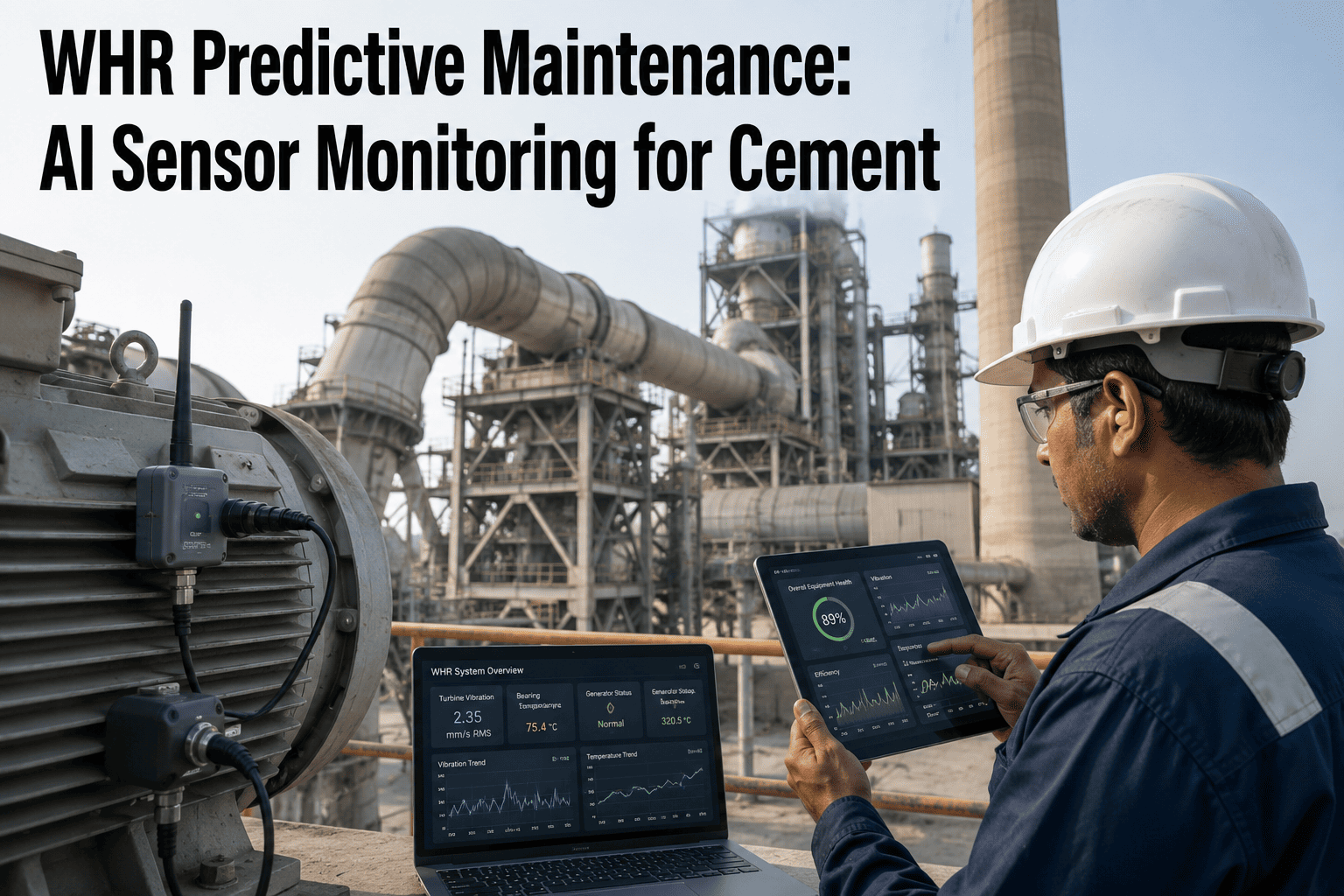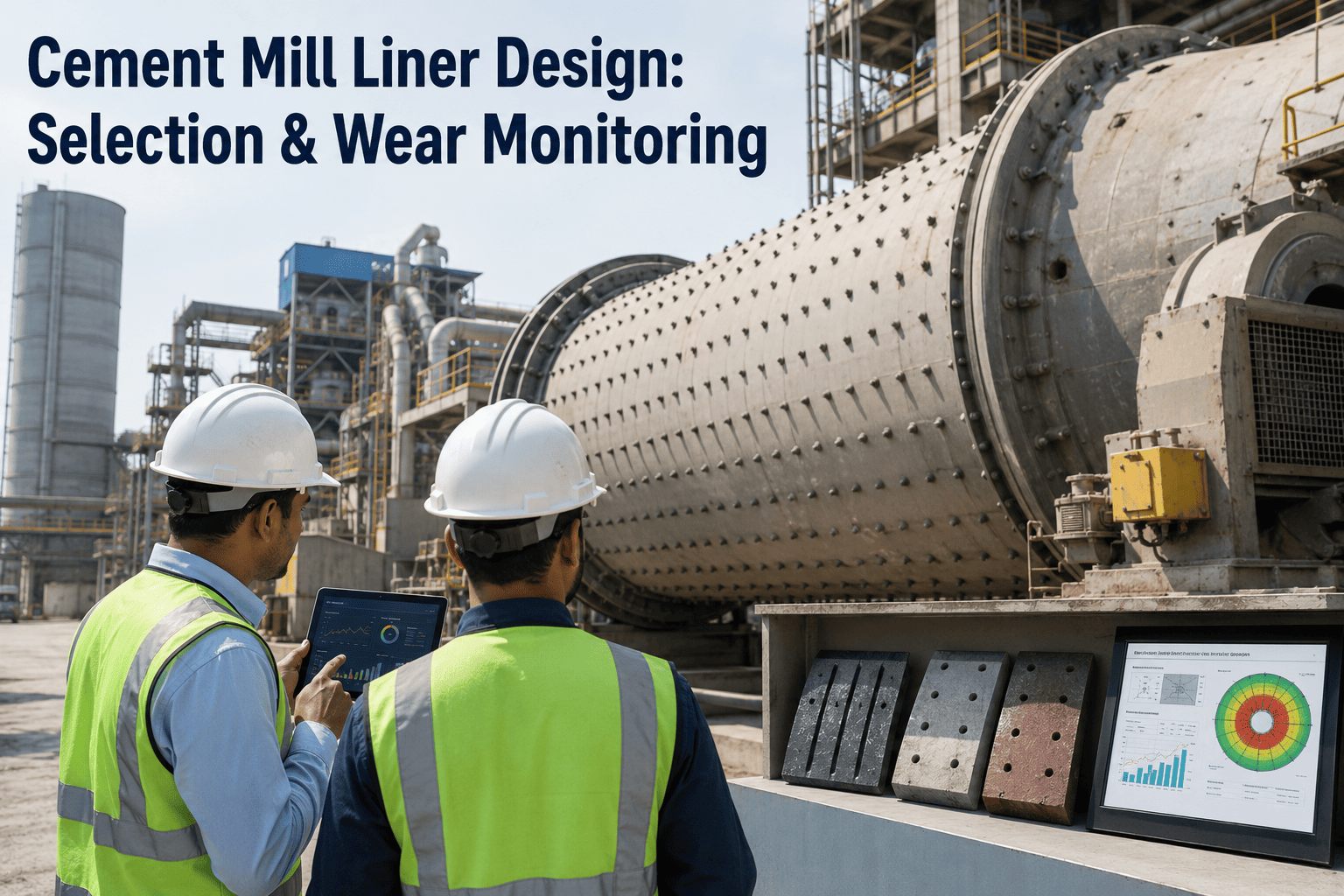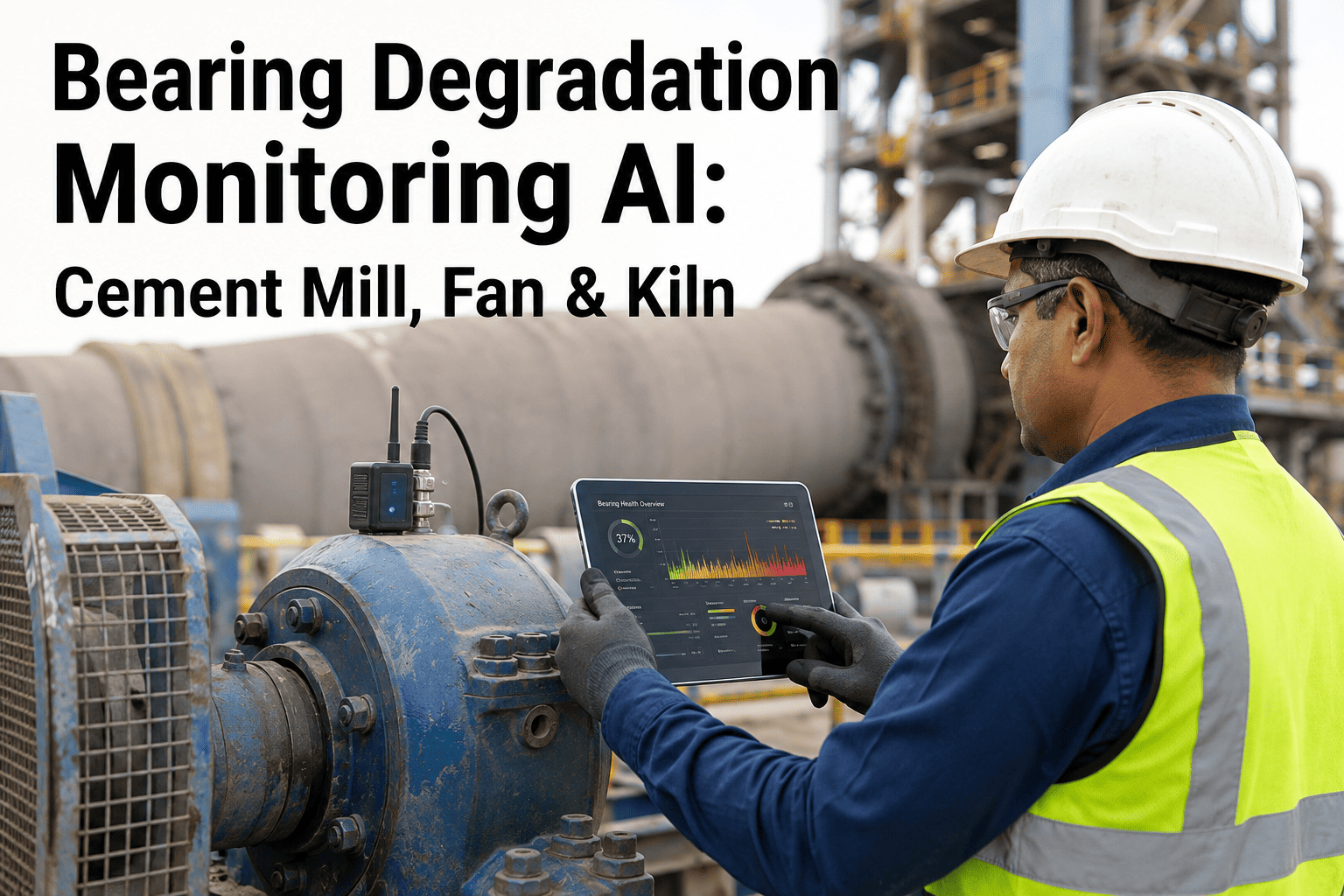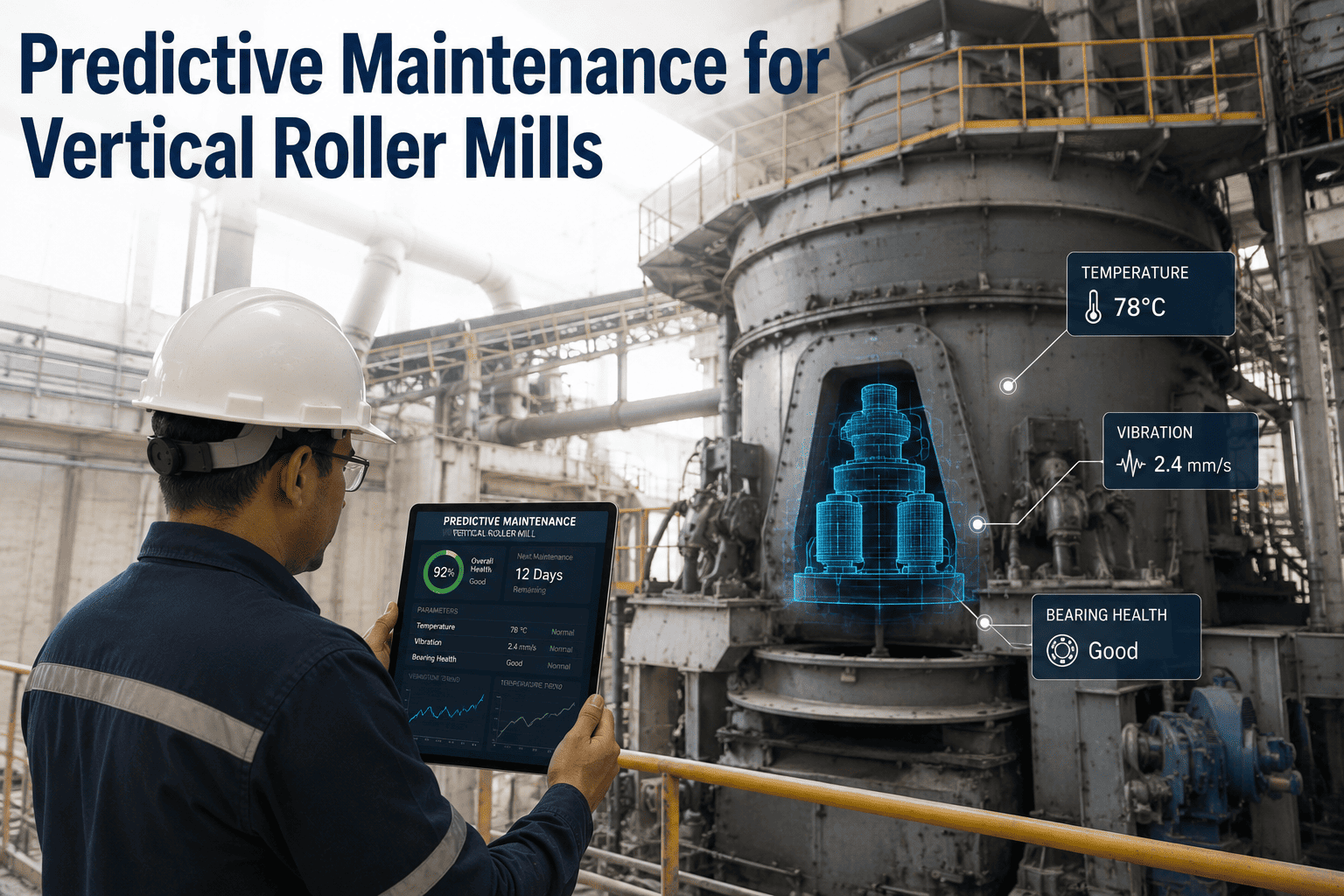
Vertical roller mills (VRMs) are the backbone of cement production, responsible for grinding raw materials and clinker with extreme efficiency. However, these massive machines operate under punishing conditions—high vibration, extreme hydraulic pressures, and continuous abrasive wear—making them prone to sudden, catastrophic failures. A single unplanned mill trip can halt production for days, costing upwards of $500,000 in lost output, emergency repairs, and replacement parts. Traditional time-based maintenance is no longer viable; it misses early warning signs and leads to either premature part replacement or unexpected breakdowns. Industry 4.0 introduces a paradigm shift: AI-driven predictive maintenance that continuously monitors VRM vibration patterns, hydraulic system anomalies, roller wear progression, and separator efficiency in real time. By deploying advanced machine learning models on edge devices or cloud platforms, plant operators can predict failures weeks in advance, optimize maintenance schedules, and extend equipment lifespan by 30% or more. This comprehensive guide dives deep into the technical architecture, sensor strategies, and analytical methods for implementing a world-class VRM predictive maintenance program. For a personalized strategy tailored to your mill's specific configuration, Book a Demo with our experts today.
Transform Your Mill Reliability Today
Stop unplanned downtime. Predict failures before they happen. Achieve 99%+ availability with AI-driven VRM monitoring.
Understanding VRM Failure Modes
Vertical roller mills are complex electromechanical systems where multiple failure modes interact. The grinding table, driven by a massive gearbox, rotates at controlled speeds while hydraulic cylinders press rollers against the material bed. This configuration creates intense stress points: the roller bearings endure radial and axial loads exceeding 500 kN; the hydraulic system must maintain precise pressure differentials; and the separator vanes face constant erosion from fine particles. Common failure modes include: (1) roller wear leading to reduced grinding efficiency and increased vibration; (2) hydraulic accumulator bladder rupture causing pressure loss; (3) gearbox bearing fatigue from cyclic loading; (4) separator motor bearing failure due to dust ingress; (5) mill body structural cracks from thermal stress. Each mode exhibits distinct precursors detectable through sensor data. For instance, roller wear manifests as a gradual increase in mill motor current draw and specific power consumption (kWh/t). Hydraulic leaks show as slow pressure decay during mill operation. Bearing fatigue generates characteristic vibration signatures in the 2x to 10x rotational frequency range. Understanding these patterns is the foundation of any predictive maintenance system.
Vibration Monitoring
Accelerometers mounted on mill housing and roller journals capture high-frequency data. AI models detect imbalance, misalignment, and bearing defects weeks before failure.
Hydraulic Pressure
Pressure transducers on each hydraulic cylinder track setpoint deviations. Machine learning identifies accumulator leaks, pump wear, and valve sticking.
Roller Wear
Laser profilometers and power draw analysis estimate remaining roller liner life. Predictive models schedule replacement during planned outages.
Separator Efficiency
Particle size distribution sensors combined with motor current data optimize separator speed and vane angle, reducing recirculation load and energy waste.
Implementation Roadmap
Sensor Deployment
Install vibration sensors (ICP accelerometers, 0-10kHz range) at key locations: mill housing near roller journals, gearbox input/output bearings, and separator drive. Deploy hydraulic pressure transducers (0-250 bar) on each cylinder. Connect to edge data acquisition unit with 1kHz sampling rate.
Data Pipeline Setup
Configure data ingestion from PLCs and sensors via OPC UA or Modbus TCP. Stream data to cloud-based time-series database (e.g., InfluxDB) with 10-second aggregation. Implement data quality checks to filter sensor noise and communication dropouts.
Model Training
Use historical failure data and normal operation data to train supervised models (Random Forest, XGBoost) for fault classification. Implement anomaly detection using autoencoders for unknown failure modes. Validate models with 3-month shadow deployment.
Dashboard & Alerts
Deploy real-time dashboard showing VRM health index, vibration trends, hydraulic pressure profiles, and remaining useful life estimates. Configure SMS/email alerts for critical thresholds. Integrate with CMMS for automatic work order creation.
Sensor Specifications for VRM Monitoring
| Parameter | Sensor Type | Range | Sampling Rate | Mounting Location |
|---|---|---|---|---|
| Vibration | ICP Accelerometer | ±50g | 10 kHz | Mill housing, roller journal |
| Hydraulic Pressure | Strain Gauge Transducer | 0-250 bar | 100 Hz | Each cylinder port |
| Motor Current | Current Transformer | 0-1000 A | 1 kHz | Main drive VFD output |
| Temperature | RTD PT100 | -50 to 200°C | 1 Hz | Gearbox oil, roller bearings |
| Roller Wear | Laser Profilometer | 0-50 mm depth | 1 Hz | Above roller path |
| Separator Speed | Encoder | 0-3000 RPM | 100 Hz | Separator motor shaft |
Ready to Predict Your Next VRM Failure?
Deploy AI-driven monitoring in weeks, not months. Our platform integrates with any existing sensor infrastructure.
Advanced AI Models for VRM Diagnostics
The core of any predictive maintenance system lies in its analytical engine. For VRMs, we employ a hybrid approach combining physics-based models with data-driven machine learning. Physics-based models capture known relationships—for example, the correlation between hydraulic pressure and grinding force, or the Stribeck curve for bearing friction. These models provide physical constraints that prevent the AI from making unrealistic predictions. On top of this, we train deep learning architectures: convolutional neural networks (CNNs) on vibration spectrograms to classify fault types (e.g., outer race defect vs. inner race defect), and long short-term memory (LSTM) networks on time-series data to predict remaining useful life (RUL). The CNN processes 2-second windows of vibration data transformed into frequency-domain images using short-time Fourier transform. The LSTM ingests multivariate sequences (vibration, pressure, current, temperature) over the past 24 hours and outputs a health score from 0 to 100. Ensemble methods combine predictions from multiple models to reduce false alarms. For instance, if the CNN detects a bearing fault but the LSTM shows normal health trend, the system flags a low-confidence alert requiring manual review. This multi-model strategy achieves 95% precision in predicting failures 72 hours in advance.
Edge vs. Cloud Processing
Latency-critical applications like vibration analysis require edge processing to detect high-frequency events in real time. Our edge devices run lightweight TensorFlow Lite models that trigger immediate alerts for severe faults. Cloud processing handles long-term trend analysis, model retraining, and cross-mill benchmarking. This hybrid architecture balances speed with computational depth.
Explainability & Trust
Enterprise maintenance teams require transparent AI. We implement SHAP (SHapley Additive exPlanations) values to show which sensor contributed most to a prediction. For example, a bearing fault alert might highlight a 12Hz vibration amplitude increase as the primary driver. This builds trust and enables root cause analysis.
VRM Health Index Calculation
Real-World Impact: 5000 TPD Cement Plant
A major cement producer in Southeast Asia with five VRMs (each 5000 TPD capacity) implemented our predictive maintenance solution. Within six months, they achieved: 99.2% mill availability (up from 94.5%), 18% reduction in specific power consumption (kWh/t), and zero unplanned mill trips. The system predicted a roller bearing failure 14 days in advance, allowing scheduled replacement during a planned outage instead of an emergency shutdown that would have cost $450,000 in lost production. The ROI was realized in under four months.
Frequently Asked Questions
What sensors are essential for VRM predictive maintenance?
For comprehensive VRM monitoring, you need at least: (1) triaxial accelerometers on the mill housing near each roller journal to capture vibration in X, Y, Z axes; (2) hydraulic pressure transducers on every cylinder to detect leaks, accumulator issues, and pump wear; (3) motor current transformers on the main drive to monitor load variations; (4) temperature sensors on gearbox oil and roller bearings for thermal runaway detection. Additionally, laser profilometers for roller wear measurement and particle counters for hydraulic oil cleanliness are recommended for advanced setups. Our team can help you design a sensor layout optimized for your mill's specific geometry. Book a Demo to discuss your requirements.
How does AI differentiate between normal wear and impending failure?
The AI models are trained on historical data that includes both normal operation periods and documented failure events. During normal wear, parameters like vibration amplitude and hydraulic pressure drift slowly over weeks or months. Impending failure is characterized by accelerated rates of change, nonlinear behavior, and correlation between multiple sensors. For example, a bearing defect might cause a sudden increase in high-frequency vibration (2-10 kHz) while also raising local temperature. The ensemble model compares current patterns against learned failure signatures and calculates a probability score. If the score exceeds a tunable threshold (typically 0.8), an alert is generated. The system also uses anomaly detection to identify completely novel patterns that don't match any historical failure mode, flagging them for expert review. Contact Support for more details on our AI methodology.
Can the system integrate with existing PLCs and SCADA?
Yes, our platform is designed for seamless integration with any major automation system. We support OPC UA, Modbus TCP/IP, Profinet, and EtherNet/IP protocols. The edge gateway can read data directly from your PLCs without requiring any changes to existing control logic. For SCADA systems, we provide REST APIs and MQTT connectors to ingest data. In cases where sensors are not already installed, we offer wireless sensor kits that communicate via LoRaWAN or 4G to the gateway. The entire integration process typically takes 2-4 weeks, depending on the complexity of your existing infrastructure. Book a Demo to see a live integration example.
What is the typical ROI timeline for VRM predictive maintenance?
Most cement plants see a complete return on investment within 6 to 12 months. The primary savings come from: (1) eliminating unplanned mill trips, which cost $500K+ per event; (2) reducing spare parts inventory by 20-30% through predictive replacement; (3) lowering energy consumption by 10-15% via optimized mill operation; (4) extending equipment lifespan by 30%, delaying capital expenditure for new mills. For a plant with five VRMs, the annual savings typically exceed $2 million. The exact timeline depends on current maintenance practices, sensor infrastructure, and data availability. Our ROI calculator can provide a customized estimate based on your plant's data. Contact Support to schedule a consultation.
How often do the AI models need to be retrained?
We recommend retraining the models every 3 to 6 months to adapt to gradual changes in mill condition, such as component aging or process modifications. Retraining is automated and occurs in the cloud without any downtime for your operations. The system continuously collects new data and compares model predictions against actual outcomes (e.g., did a predicted failure actually occur?). When prediction accuracy drops below a threshold, a retraining cycle is triggered. Additionally, if a new failure mode is identified, the models are updated to recognize it in the future. Our platform also supports transfer learning, where models trained on one mill can be quickly adapted to another similar mill with minimal data. Book a Demo to learn more about our model management features.
Secure Your Mill's Future
Join industry leaders who have eliminated catastrophic VRM failures. Start your predictive maintenance journey today.