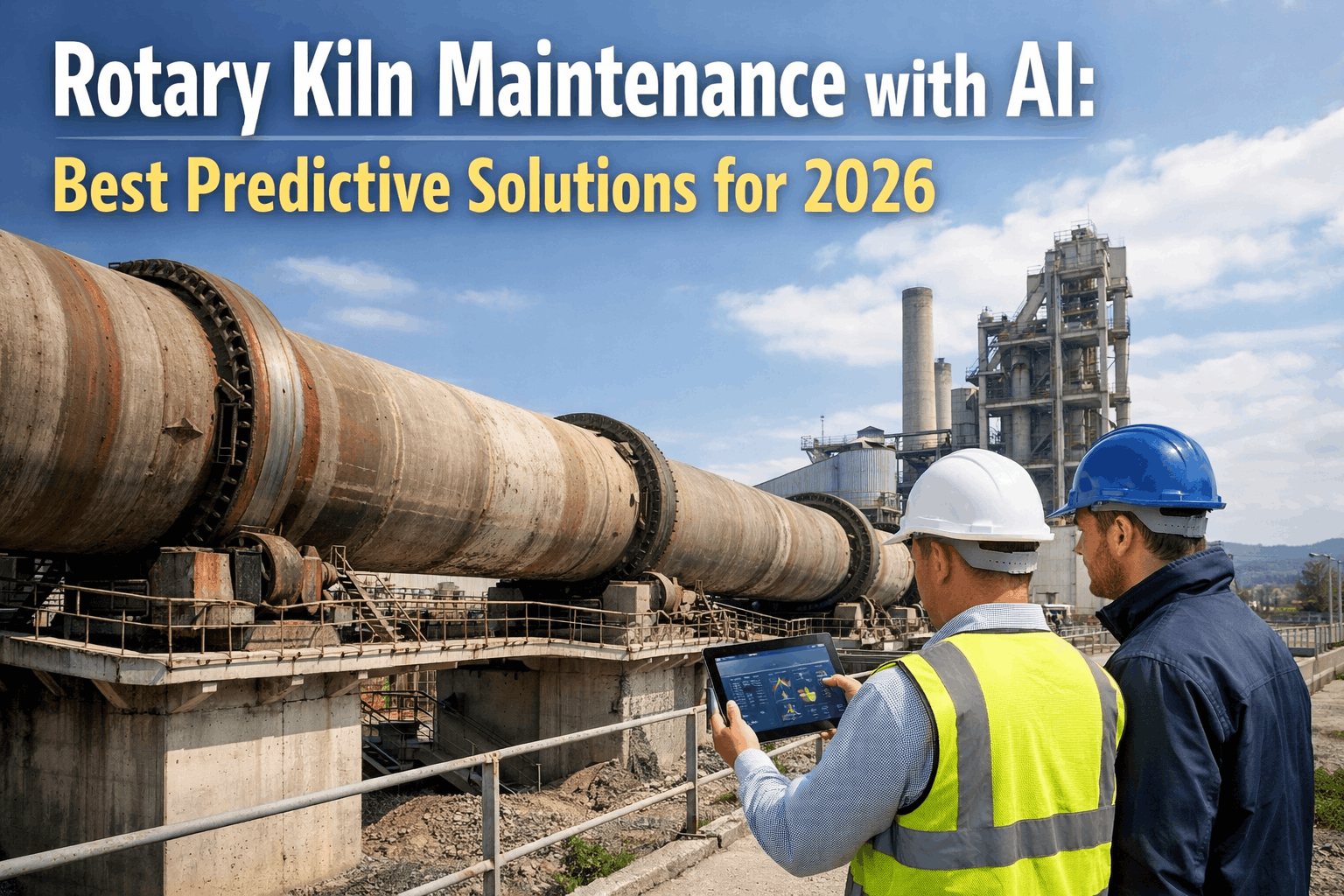
Right now, somewhere in your kiln, a bearing is developing micro-pitting. A refractory brick is losing thickness. A tyre is creeping imperceptibly against the shell. You won't see it on your next walkthrough. Your operators won't feel it in the drive amperage—not yet. But in 60 to 90 days, one of these silent failures will announce itself the only way it knows how: with a $260,000-per-hour shutdown you didn't plan for. This is the reality for 82% of cement plant failures. They arrive without warning. AI changes that math entirely.
The Silent Countdown
Your Kiln Is Failing Right Now
You just don't know it yet
82%
of failures arrive without warning
$260K
cost per hour of unplanned downtime
9-10
kiln failures per plant annually
3-9x
higher cost for reactive vs planned repair
The Three Silent Killers Inside Your Kiln
Your kiln doesn't fail randomly. It fails in predictable patterns—patterns that humans can't detect until it's too late, but AI sees weeks in advance.
Week 1-4
Micro-pitting begins
Week 5-6
Vibration pattern shifts
Week 7-8
Catastrophic failure
AI Detection Window:
6-8 weeks before failure
Stage 1
Brick at 50% thickness
Stage 2
Shell temp creeping up
Stage 3
Red shell visible at night
Reline Cost:
$800K-$1.5M + 5-10 days lost production
Normal
6-8mm creep maintained
Warning
Ovality exceeds 0.5%
Critical
Shell deformation begins
Consequence:
Refractory collapse, shell cracks
See these failure patterns in your own kiln data? Book a diagnostic demo to find out what's developing right now.
What AI Actually Monitors (That You Can't)
Vibration Signatures
ML algorithms detect bearing wear patterns, girth gear looseness, and drive system anomalies weeks before they manifest as audible problems.
Thermal Mapping
IR sensors feed AI models that calculate refractory thickness from heat signatures—detecting degradation zones invisible to the human eye.
Tyre Migration
Continuous creep monitoring correlated with thermal conditions and shell ovality to diagnose root causes before permanent deformation occurs.
Multi-Parameter Correlation
AI analyzes vibration, thermal, and displacement data simultaneously—identifying complex failure modes humans can't diagnose from single parameters.
Stop Guessing. Start Predicting.
iFactory connects to your existing sensors, historians, and SCADA—then adds the AI layer that transforms raw data into 6-8 week failure predictions with 95% confidence.
The Real Cost of "We'll Fix It When It Breaks"
Reactive Repair
Lost production (3-7 days)
$900K - $4.3M
Emergency parts freight
$50K - $150K
Contractor callout
$75K - $200K
Secondary damage
$100K - $500K
Total Impact
$1.1M - $5.2M
VS
Planned Replacement
Scheduled during outage
$0 lost production
Standard parts delivery
$15K - $30K
Planned labor
$25K - $50K
No secondary damage
$0
Total Impact
$40K - $80K
Want to calculate the ROI for your specific plant? Contact our team for a customized analysis.
What Plants Are Actually Achieving
30-50%
Reduction in unplanned downtime
Industry average, first 12 months
18-25%
Lower maintenance costs
4-8 weeks
Advance failure detection
95%
Prediction confidence level
96%+
Kiln availability achieved
Case Study
Kiln Drive Motor: 18-Day Warning
Machine learning detected subtle vibration pattern changes in a kiln's main drive motor. The AI predicted bearing failure 18 days before it would have occurred catastrophically. Planned replacement during scheduled maintenance avoided a 3-week emergency shutdown—saving an estimated $3.5M in lost production and emergency repair costs.
Ready to see what's developing in your kiln right now? Schedule a diagnostic assessment.
Frequently Asked Questions
How does AI predict kiln failures weeks in advance?
AI analyzes continuous data streams from vibration sensors, thermal cameras, and process historians. Machine learning models identify subtle pattern changes—bearing micro-pitting signatures, refractory thickness degradation, tyre migration anomalies—that precede failure by 4-8 weeks. These patterns are invisible to human operators but statistically significant to trained algorithms.
What sensors do we need to install?
Most plants already have the foundation: vibration accelerometers, temperature probes, shell scanners, and process historians. AI platforms integrate with existing OPC-UA, MODBUS, and IoT inputs—no proprietary hardware lock-in required. Where gaps exist, strategic sensor additions typically cost 5-10% of a single avoided emergency shutdown.
What's the typical payback period?
Industry data shows 6-12 month payback periods for full AI monitoring implementations in cement plants. Given that a single avoided kiln failure can save $1-5M, many plants achieve ROI from their first prevented unplanned shutdown.
Can AI monitor refractory condition without stopping the kiln?
Yes. AI models analyze external shell temperature patterns captured by IR cameras to calculate internal refractory thickness. The system maps thermal signatures to 3D kiln models, identifying degradation zones and predicting optimal replacement timing—all while the kiln runs at full production.
How accurate are the predictions?
Leading AI systems achieve 95% confidence intervals for remaining useful life predictions. Vibration analysis identifies bearing wear patterns weeks in advance, while thermal imaging catches refractory hotspots days to weeks before they become visible. False positive rates are typically under 5% after initial model training.
The Clock Is Already Ticking
Somewhere in your kiln, a failure is developing. The question is whether you'll find it in 6 weeks with AI—or in 90 days when production stops. iFactory gives you the visibility to see what's coming.