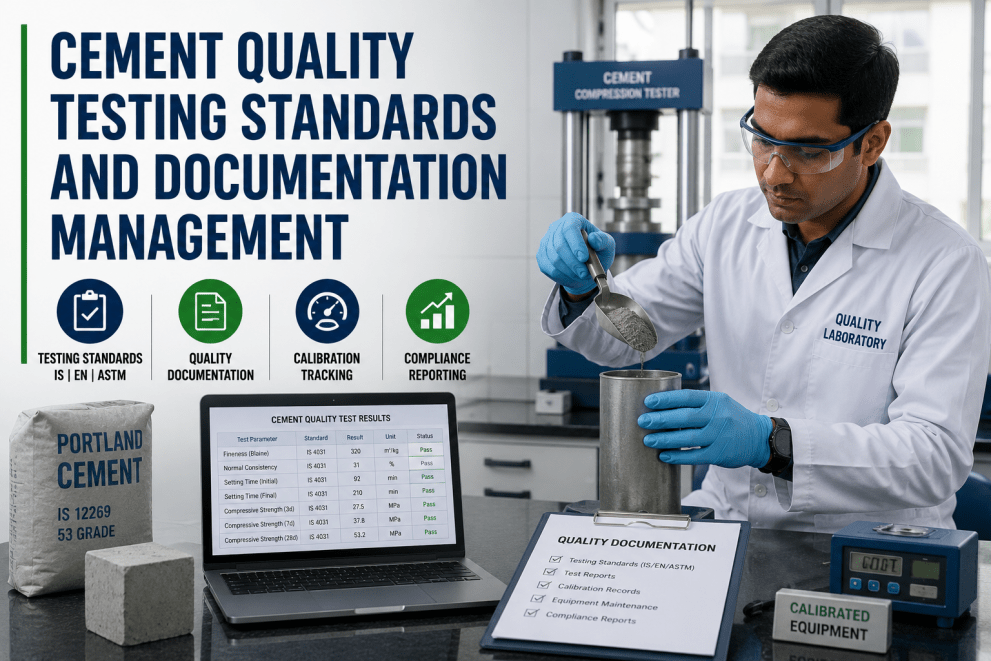
Cement quality begins in the laboratory — at the sample testing benches where raw mix chemistry, clinker mineralogy, cement fineness, and finished product strength are measured recorded and compared against specification before any decision about kiln operation, grinding parameters, or dispatch release is made. In most U.S. cement plants today the laboratory that sits at the center of every quality decision is also the facility's most information-dense and documentation-intensive operation — and the least digitally integrated. Samples arrive from the plant floor on a schedule driven by production demands that no lab system tracks. Test schedules are managed in spreadsheets that do not connect to the sample queue. Results are entered manually into quality records that the production system cannot query. Compliance documentation is assembled by hand for every ASTM, EPA, or customer audit from paper test sheets that live in binders, not databases. The operational cost of this disconnection is not visible on a single line item — it shows up as quality decisions delayed because results are not yet available, as production adjustments that come an hour after the chemistry indicated they were needed, and as compliance audits that require two days of document assembly for a question that should take two minutes to answer. iFactory's digital LIMS integration platform connects cement laboratory operations to the quality monitoring and analytics reporting systems that need laboratory data — automating sample tracking from collection through result entry, scheduling test workflows against production demand, and generating compliance documentation packages from structured digital records rather than paper assembly. Cement facilities using iFactory's lab management platform report 71% reduction in result reporting delays, 83% faster compliance documentation generation, and 64% improvement in out-of-specification detection response time from automated result comparison against quality targets.
Cement Laboratory Management: Digital LIMS Integration
iFactory's LIMS integration automates sample tracking, test scheduling, and result reporting — connecting cement laboratory data to the quality monitoring and analytics systems that production, quality, and compliance teams depend on, in real time.
The Five Information Gaps That Make Manual Lab Management a Quality Risk
Laboratory data is the most authoritative quality signal in a cement plant — and in most U.S. facilities, it is also the signal that travels slowest from the point of measurement to the point of decision. The five gaps below define where that travel time creates operational risk, and where iFactory's LIMS integration eliminates it.
Sample Queue Without Production Context
Lab technicians receive samples without structured connection to the production order, shift, or equipment state that generated them. When a test result shows a chemistry deviation, there is no automated link back to the specific kiln feed composition or raw mill parameters active at the time of sampling — making the corrective action investigation manual and slow.
Test Schedules Disconnected from Production Demand
Fixed-interval test schedules do not adjust to production rate changes, product grade switches, or incoming material quality events that would justify more frequent sampling. A kiln operating at an unusual temperature profile warrants increased clinker sampling frequency — but a paper-based schedule has no mechanism to respond to that signal from the production system.
Manual Result Entry Creating Transcription Lag and Error
Instrument results transcribed manually to lab worksheets and then re-entered into quality records introduce both transcription errors and time delays. A strength test result that takes 15 minutes to run and 45 minutes to enter and distribute has effectively taken an hour — during which production decisions are made without the most current data. The transcription error rate, typically 0.5% to 2% of manual entries, also creates data quality issues that surface during audits.
Out-of-Spec Results Without Automated Escalation
When a test result falls outside specification, the next step — notifying the shift supervisor, logging a quality event, initiating a corrective action, holding the relevant production — depends on a technician recognizing the exceedance and manually initiating each downstream action. Manual escalation introduces delay and inconsistency; automated escalation ensures the same response every time, regardless of which technician ran the test.
Compliance Documentation Assembled From Paper Records
ASTM product certification, EPA Method 40 CFR reporting, and customer quality documentation requests require assembly of test records from the relevant time period — a process that takes hours to days when those records are paper worksheets, and minutes when they are structured digital records in a queryable system. The paper assembly process also introduces selection bias risk: auditors who assemble their own documentation packages may inadvertently omit records that would have been relevant.
iFactory LIMS Integration: How Cement Lab Data Flows From Sample to System
iFactory's LIMS integration is not a standalone laboratory software — it is a data integration and workflow automation layer that connects the cement laboratory to the quality monitoring, analytics reporting, and production systems that need lab data, converting the laboratory from an isolated measurement function into a real-time quality intelligence source. Book a Demo to see iFactory's LIMS configured for a full cement quality workflow equivalent to your facility's testing program.
Sample Tracking — From Collection Point to Result Entry With Full Chain of Custody
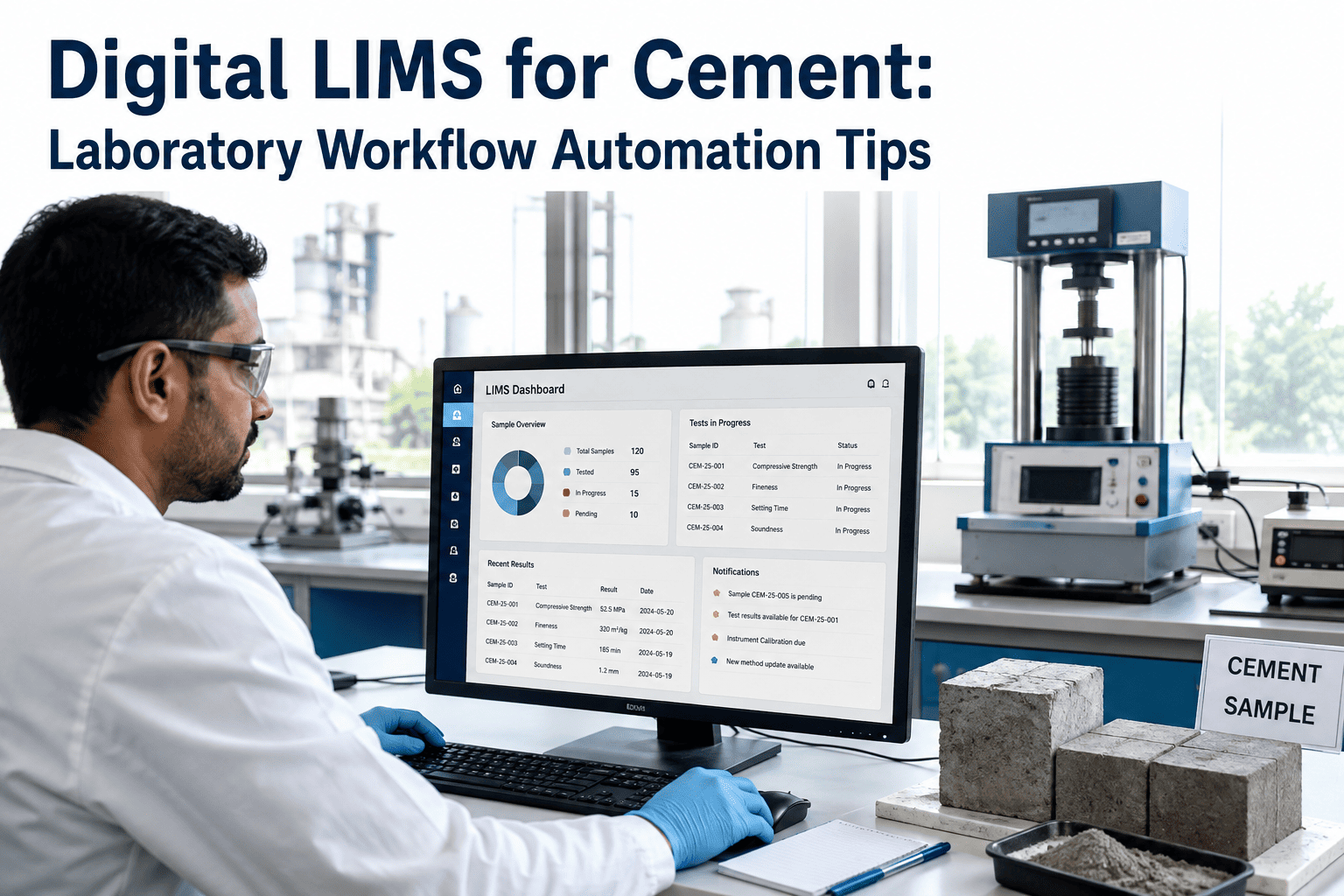
iFactory's sample tracking module assigns a structured digital record to every sample at the point of collection — capturing sampling location, production order, shift, equipment state, collection time, and collecting technician. Samples are tracked through each step of the laboratory workflow: receipt at the lab, preparation, test assignment, instrument measurement, result entry, and result distribution. The chain of custody record is complete and automatic — no manual log book, no handoff slip that gets misplaced between the quarry and the lab. When a result requires investigation, the sample record provides the complete production context: what was the kiln feed LSF at the time of this raw meal sample, which operator was on shift when this clinker sample was collected, what was the mill circuit loading when this cement sample was taken.
Test Scheduling — Dynamic Sampling Frequency Driven by Production Demand
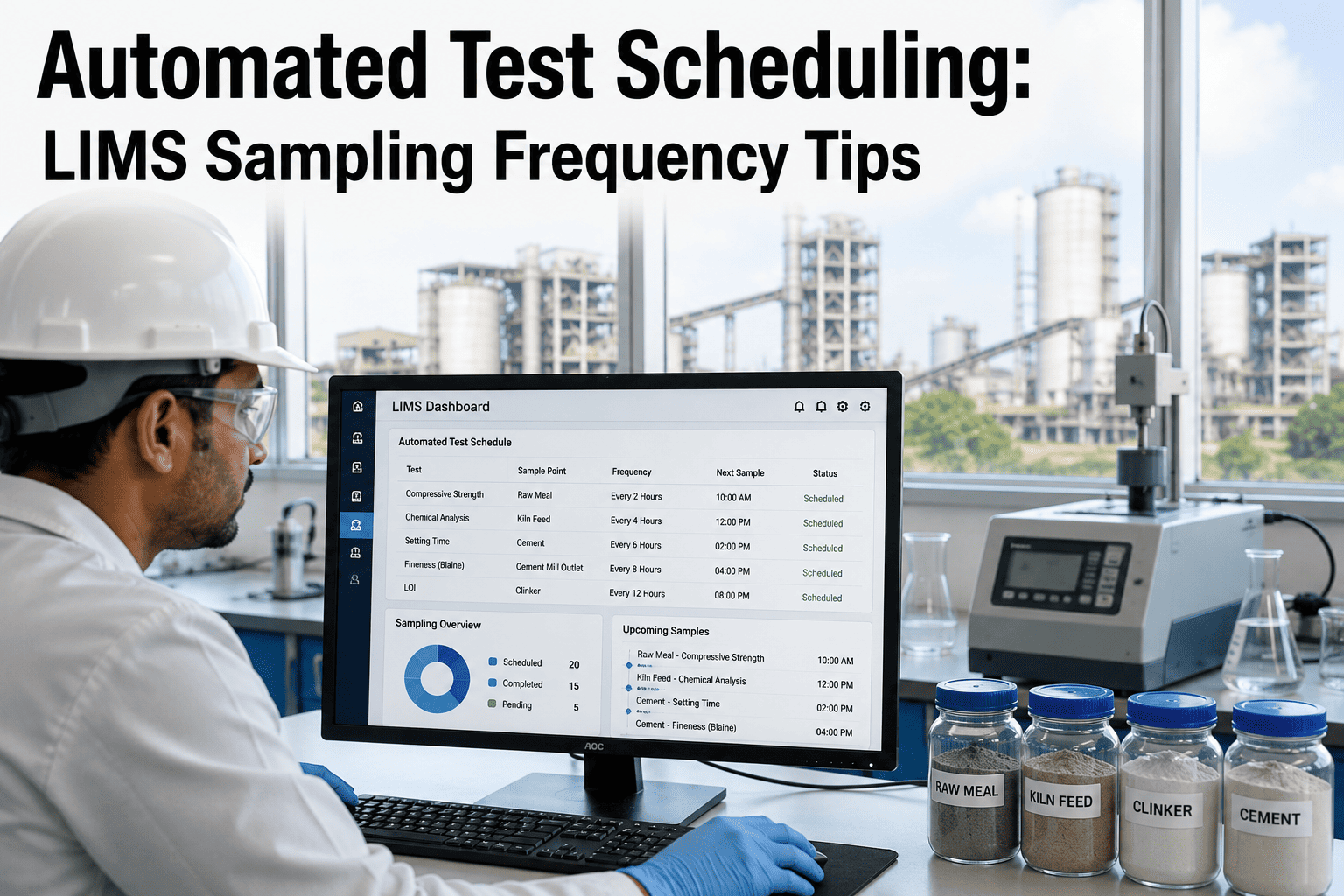
iFactory's test scheduling engine generates and updates the daily laboratory test schedule by connecting to production system data — active production orders, current product grade, equipment operating parameters, and quality events from the previous shift. The schedule accounts for ASTM and internal quality plan minimum testing frequencies, adjusts sampling frequency upward when production events warrant increased monitoring, and distributes the test workload across the shift to prevent end-of-shift test backlogs. Test due alerts notify the shift supervisor when a scheduled sample is overdue — replacing the current situation where missed samples are discovered at the shift-end log review rather than when the sample window was active. The test schedule is visible to both the laboratory and the production team in real time, so shift supervisors know which quality data is currently pending and when results will be available for production decisions.
Result Reporting — Automated Distribution to Production, Quality, and Management Dashboards
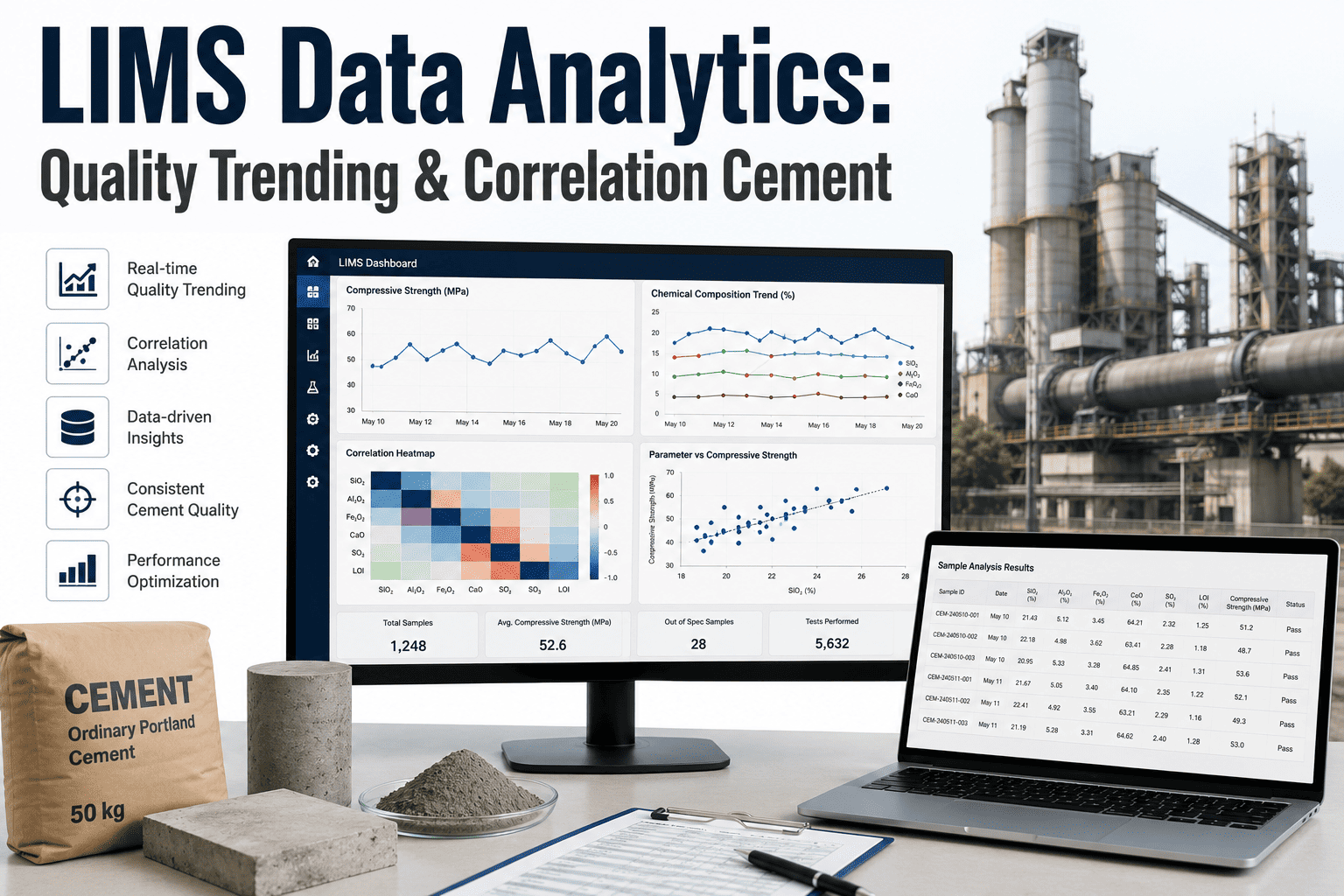
iFactory's result reporting engine captures test results directly from instrument interfaces where available — X-ray fluorescence, Blaine fineness analyzers, compressive strength testing machines, and particle size analyzers — eliminating manual transcription for connected instruments. For instruments without direct interface capability, structured digital entry forms guide technicians through result input with range validation that flags potential transcription errors before submission. Results are automatically compared against specification limits at entry — triggering color-coded visual alerts for values approaching or exceeding limits, generating escalation notifications to the shift supervisor and quality manager for out-of-specification results, and creating a quality event record in the analytics system that connects the result to the production context. Distribution is configurable by result type: raw mix chemistry results to kiln operators and process engineers, cement fineness and strength results to quality managers and dispatch supervisors, clinker mineralogy results to process engineering.
Compliance Documentation — Auto-Generated Packages From Structured Digital Records
iFactory's compliance documentation module converts the structured LIMS record database into an on-demand documentation generation system. Audit requests that previously required 8 to 16 hours of manual record assembly — pulling paper test sheets, verifying completeness, organizing by date and product — are satisfied by configuring a documentation query: select the time period, product grades, and test types, and the system generates a complete, formatted documentation package with test records, instrument calibration records, technician qualifications, and chain of custody data included. The documentation package is generated as a PDF with a digital audit trail — timestamped, signed with the generating user's credentials, and tamper-evident — meeting ASTM, EPA, ISO 9001, and facility-specific compliance documentation requirements. No manual assembly, no selection bias, no completeness concern.
Digital LIMS vs. Manual Lab Operations: Performance Gap Across Seven Cement Quality Metrics
The performance difference between a digital LIMS-integrated cement laboratory and a manual paper-based lab operation is measurable across every dimension that determines quality decision speed, compliance readiness, and production impact. The comparison below reflects actual operational differences across U.S. cement facilities with and without structured LIMS integration. Book a Demo to model iFactory's LIMS integration against your facility's specific testing program and compliance requirements.
Cement LIMS Integration Deployment: Outcomes Table Across Testing Programs
The table below presents measured outcomes from iFactory LIMS integration deployments at U.S. cement facilities across raw mix, clinker, and finished product testing programs. Annual value estimates reflect the combined impact of quality decision speed improvement, compliance labor recovery, and rework cost reduction.
| Testing Program Area | Manual Baseline | iFactory LIMS Platform | Key Improvement | Annual Value |
|---|---|---|---|---|
| Raw Mix Chemistry | XRF results transcribed 30–90 min after measurement; kiln corrections delayed | Direct XRF interface; results on kiln operator dashboard within 5 min | 71% reduction in result-to-correction delay | $35K–$110K fuel and clinker quality value |
| Clinker Mineralogy | Rietveld results in paper log; process engineer review next day | Automated distribution to process engineering with trend chart | Same-shift process adjustment vs. next-day | $28K–$85K kiln operation optimization value |
| Cement Fineness (Blaine) | Manual Blaine entry; mill adjustment initiated after lab call to control room | Blaine result auto-feeds mill control dashboard; alert if trending toward limit | 64% improvement in OOS detection response | $22K–$70K grinding energy and quality value |
| Compressive Strength (1/3/7/28 day) | Strength results entered in spreadsheet; no automated comparison to running average | Results auto-compared to specification and 30-day trend; OOS escalation automatic | 83% reduction in delayed OOS identification | $40K–$130K product quality and rework value |
| ASTM Compliance Documentation | 16+ hrs manual assembly per audit; paper binder review for completeness | Auto-generated package in <90 sec; complete, tamper-evident, digital | 99% documentation time reduction | $18K–$55K compliance labor recovered annually |
| Instrument Calibration Management | Paper calibration log; gaps not surfaced until external audit | Automated calibration schedule; calibration status flagged on each result record | Zero calibration gap audit findings post-deployment | Audit finding and corrective action cost eliminated |
| Certificate of Analysis Generation | Manual CoA preparation per customer request — 1–2 hrs each | CoA auto-generated by product grade and shipment date on demand | From hours to minutes per CoA request | $12K–$38K customer service labor recovered |
Ready to Connect Your Cement Lab to the Production and Quality Systems That Need Its Data?
iFactory's LIMS integration team configures the platform to your facility's specific testing program, instrument inventory, and compliance requirements — and demonstrates the full workflow on a production-equivalent environment before any platform commitment.
Expert Review: What Cement Quality Managers Say About Digital LIMS Integration
I managed cement quality at three different U.S. plants over 21 years — two integrated facilities and one terminal blending operation — and the laboratory information problem was identical at every one of them regardless of plant size or technology level: the lab was generating the right data, but the data was not getting to the people who needed it in time to act on it. By the time an XRF result for a raw meal sample had been run, written on a worksheet, transcribed to the quality log, and the log reviewed by the process engineer, the kiln had been operating for another hour on the basis of the previous chemistry reading. In some cases, that hour mattered a great deal.
Conclusion
The cement laboratory produces the most authoritative quality data in the plant — and in most U.S. facilities, that data travels too slowly, distributes too narrowly, and disappears too completely into paper records to deliver its full operational value. XRF results that take an hour to reach kiln operators cannot correct chemistry in the window where correction is still economical. Strength test data that lives in paper logs cannot be queried for the trend analysis that would prevent specification creep. Compliance documentation that takes two days to assemble cannot be produced for an auditor who needs it in two hours.
iFactory's digital LIMS integration closes every one of these gaps — connecting laboratory instruments directly to the result database, distributing results to production and quality teams automatically at entry, generating compliance documentation packages from structured digital records in under two minutes, and making the full history of laboratory results queryable for the trend analytics that convert quality data from a compliance record into a production optimization tool. The 71% reduction in result reporting delays, 83% faster compliance documentation, and 64% improvement in out-of-specification response time reflect what happens when laboratory data is treated as operational intelligence rather than administrative documentation. Book a Demo to see iFactory's LIMS integration configured for your cement facility's specific testing program and compliance structure.
Frequently Asked Questions
Yes. iFactory supports direct instrument interfaces for major XRF brands (PANalytical, Bruker, Thermo), Blaine fineness testers, compressive strength testing machines, and particle size analyzers via RS-232, USB, and Ethernet connections. Instruments not supported by direct interface are served by structured digital entry forms. Book a Demo to confirm interface support for your specific instruments.
Yes. iFactory's compliance documentation module includes pre-configured templates for ASTM C150, C595, C1157, and C1600 certification documentation — pulling the relevant test results, instrument calibration records, and sample chain of custody data into a formatted, tamper-evident package that satisfies third-party certification body and customer audit requirements.
iFactory supports configurable result approval workflows — results can be routed for supervisor review before distribution for test types that require it, with configurable approval tiers by test category. Approved results are released automatically to configured distribution lists. The approval step is timestamped and recorded in the result's audit trail for compliance documentation purposes.
For a full cement laboratory with 4 to 8 instrument interfaces, sample tracking, test scheduling, result reporting, and compliance documentation, deployment runs $32,000 to $75,000 over 5 to 8 weeks. First measurable reductions in result reporting delay are typically visible within the first week of live instrument integration. Book a Demo for a site-specific quote.
Yes. iFactory's multi-plant LIMS configuration aggregates quality data across facilities into a corporate quality analytics dashboard — enabling cross-plant performance comparison by product grade, test type, and specification compliance rate. Plant-level data remains accessible to site quality teams while corporate quality managers see consolidated performance across the entire network.