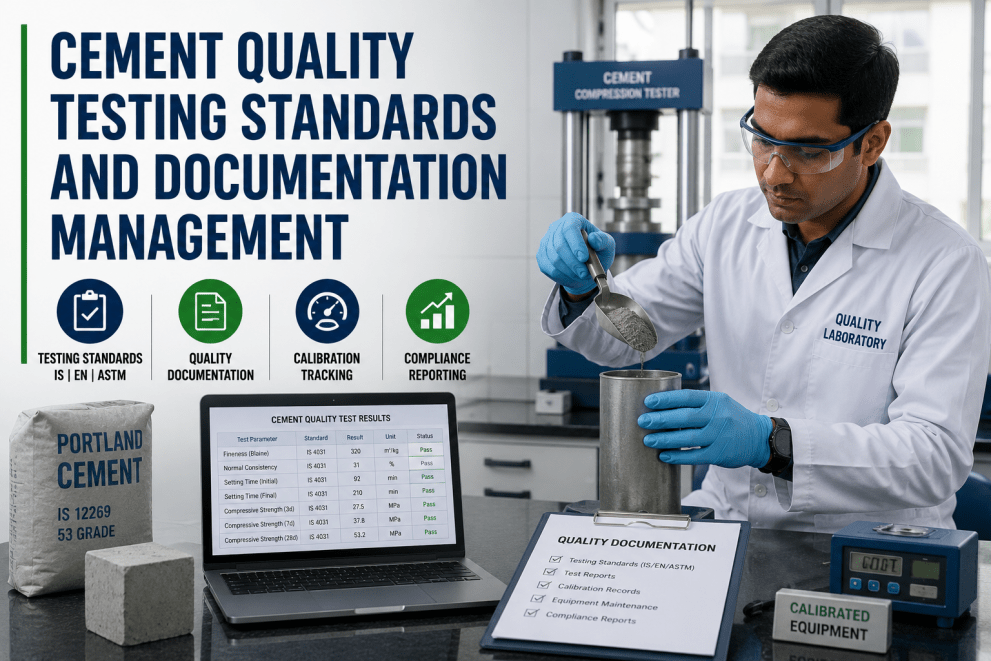
Cement quality testing is the foundation of regulatory compliance, customer acceptance, and structural performance in cement manufacturing — but the documentation that proves quality is tested, verified, and traceable is often the weakest link in the quality management chain. A typical U.S. cement plant producing 3,500 to 4,000 TPD of clinker generates between 12,000 and 18,000 individual quality test results per month across raw materials, in-process materials, and finished cement — compressive strength tests, fineness measurements, chemical composition analyses, setting time determinations, and autoclave expansion checks — each of which must be recorded, reviewed, retained, and made available for customer certification, regulatory inspection, or third-party verification on demand. The testing standards that govern these measurements differ by market: ASTM C150 for portland cement in the U.S. market, ASTM C595 for blended cements, AASHTO M85 for state DOT projects, API 10A for oil well cement, and customer-specific specifications that overlay additional testing requirements on top of the standard. Managing the documentation for this volume of testing across multiple standards, multiple production sources, and multiple customer specifications is not a clerical function — it is a quality assurance discipline that determines whether a customer order ships on time or is held for documentation review, whether a DOT audit finds your quality records complete or identifies gaps, and whether a strength complaint is resolved with traceable test data or becomes a warranty claim. iFactory's Quality Control Management and Documentation modules give cement plant quality managers the digital infrastructure to manage every test result, calibration record, certificate of analysis, and customer compliance package in a single platform built for the volume and variety of cement quality documentation. Book a Demo to see how iFactory manages cement quality testing documentation from sample collection through customer certificate delivery.
Is Your Cement Quality Testing Documentation Ready for the Next Customer Audit or DOT Inspection?
iFactory's Quality Control Management and Documentation modules manage every test result, calibration record, certificate of analysis, and customer compliance package in one platform built for the volume and variety of cement quality documentation across ASTM, AASHTO, and customer-specific standards.
Quality Testing Standards That Govern Cement Manufacturing in the U.S. Market
Cement quality testing in the United States is governed by a layered framework of standards that define test methods, acceptance criteria, sampling frequency, and documentation requirements for every quality parameter. ASTM International publishes the primary standard specifications — ASTM C150 for portland cement, ASTM C595 for blended hydraulic cements, and ASTM C1157 for hydraulic cement performance specification — each of which references a family of standard test methods (ASTM C109 for compressive strength, ASTM C191 for setting time by Vicat needle, ASTM C204 for fineness by Blaine air permeability, ASTM C114 for chemical analysis) that define how each quality parameter is measured. State departments of transportation typically overlay AASHTO standards (M85, M240) and may add project-specific testing requirements. Customer specifications for ready-mix producers, precast manufacturers, and infrastructure contractors add another layer of documentation requirements for certificates of analysis and mill test reports. The result is that a single cement plant must maintain proficiency across 30 to 45 distinct ASTM test methods, manage testing frequency requirements that vary from every hour (fineness, Blaine) to every shift (compressive strength at 1, 3, 7, and 28 days) to weekly (full chemical analysis), and produce documentation packages that satisfy multiple standards simultaneously for different customer shipments.
ASTM, AASHTO, and API Cement Standards — Key Quality Parameters and Documentation Requirements
Each cement standard defines quality parameters differently — the same chemical oxide may have different limits, the same physical test may have different acceptance criteria, and the documentation requirements for each standard differ in format, content, and retention period. The table below maps the key quality parameters across the four primary cement standards applicable to U.S. cement plant production, with the specific test methods, acceptance limits, and documentation requirements for each standard.
| Quality Parameter | Test Method | ASTM C150 Type I/II | AASHTO M85 | API 10A Class G | Documentation Required |
|---|---|---|---|---|---|
| Compressive Strength (28-day) | ASTM C109 / AASHTO T106 | 28 MPa minimum | 28 MPa minimum | 14 MPa at 8 hr; 21 MPa at 24 hr | Individual and average strength reports per sample date |
| Fineness (Blaine) | ASTM C204 / AASHTO T153 | 370 m²/kg minimum | 370 m²/kg minimum | 300–450 m²/kg specified range | Hourly test results on production log |
| Setting Time (Vicat) | ASTM C191 / AASHTO T131 | Initial 45 min min; Final 375 min max | Initial 45 min min; Final 375 min max | Initial 60–150 min; Final 120 min max | Per-sample setting time report |
| Autoclave Expansion | ASTM C151 / AASHTO T107 | 0.80% maximum | 0.80% maximum | 0.80% maximum | Expansion test report; weekly minimum frequency |
| Magnesium Oxide (MgO) | ASTM C114 / AASHTO T105 | 6.0% maximum | 5.0% maximum (M85) | 6.0% maximum | Full chemical analysis per standard frequency |
| Sulfur Trioxide (SO₃) | ASTM C114 / AASHTO T105 | 3.0% max (Type I); 3.5% max (Type II) | 3.0% maximum | 3.0% maximum | Hourly SO₃ test on finish mill production |
| Loss on Ignition (LOI) | ASTM C114 / AASHTO T105 | 3.0% maximum | 3.0% maximum | 3.0% maximum | Per-sample LOI on cement and clinker |
Cement Quality Documentation Framework — From Sample Collection to Customer Certificate
The documentation chain for cement quality testing extends from the moment a sample is collected at the finish mill discharge to the moment a certificate of analysis is delivered to the customer with the shipment. Each link in the chain must be traceable, verifiable, and auditable — and each link generates documents that must be retained for defined periods per the applicable standard and plant quality manual. The five-level documentation framework below maps the complete quality documentation lifecycle for a cement plant operating under ASTM and AASHTO standards.
Sample Collection and Identification — The Traceability Foundation
Every quality test result is only as reliable as the sample it was performed on. Sample collection at a cement plant follows documented procedures that specify sampling location (finish mill discharge, truck loading spout, rail loading spout, bulk storage silo), sampling frequency (hourly for Blaine fineness and SO₃, per shift for full physical tests, daily for composite samples), sample identification protocol (sample number, date, time, production source, sampler ID), and sample retention requirements (retained samples held for minimum 90 days per ASTM C183). iFactory's sample tracking module assigns a unique sample ID at collection, links it to the production source and time, and tracks the sample through every subsequent test and certification step.
- Sample ID auto-generated at collection; barcode or QR label printed for physical sample container
- Sampling procedure, location, and frequency configured per standard and plant quality manual
- Sample chain-of-custody recorded from collection through testing through disposal
- Retained sample location and disposal date tracked in iFactory sample record
Test Execution and Result Recording — The Data Core
Each test method in the quality laboratory follows a documented procedure that specifies equipment setup, sample preparation, test conditions, calculation method, and acceptance criteria. Test results are recorded with the sample ID, test method reference, technician ID, equipment ID, test date and time, and individual result values for each parameter measured. iFactory's quality module provides configurable test form templates for each ASTM method, with automated calculations, specification limit checking, and out-of-specification alert generation when a result falls outside the defined acceptance range.
- Test form templates configured for each ASTM method with automated calculations and limit checking
- Out-of-specification alerts generated immediately when result exceeds control limits
- Technician and equipment ID captured with each result for full traceability
- Test results linked to sample record and available for certificate generation immediately
Equipment Calibration and Verification Records
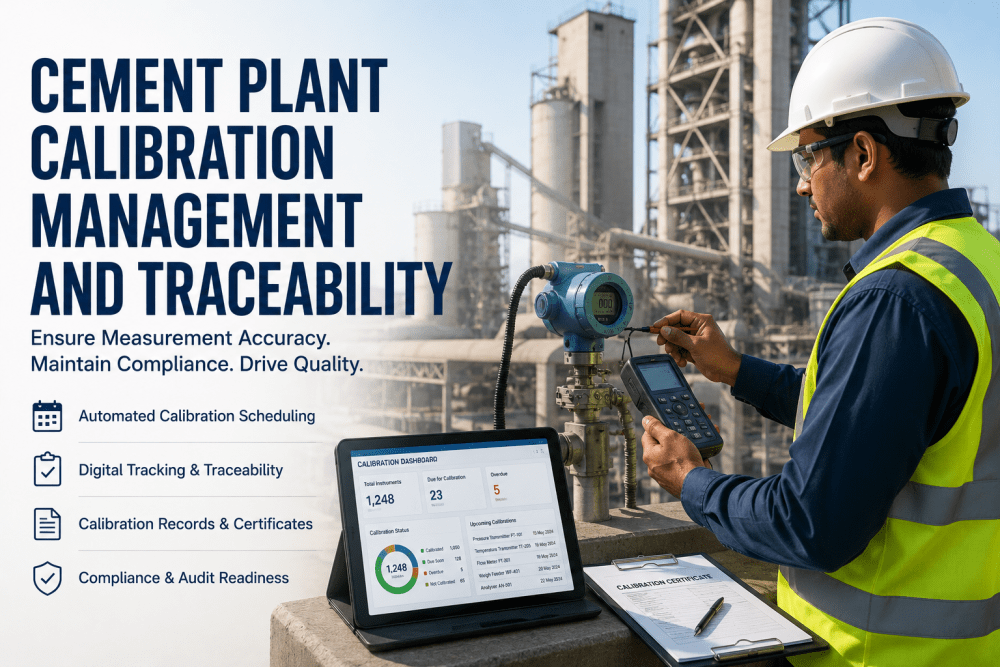
Every piece of testing equipment in the cement quality laboratory — compression machines, Blaine apparatus, Vicat apparatus, XRF spectrometers, calorimeters, and balance scales — must be calibrated at defined intervals per ASTM standard requirements and the plant quality manual. Calibration records document the calibration date, standard used, results, adjustment made (if any), technician ID, and next calibration due date. iFactory's calibration tracking module generates calibration due reminders, maintains the complete calibration history for each equipment item, and prevents test result entry on equipment with an overdue calibration status.
- Calibration schedule configured per equipment type and applicable ASTM standard requirement
- Calibration status displayed on equipment record; overdue calibration blocks new test entry
- Calibration history retained per quality record retention requirements (typically 5 years minimum)
- Automated calibration due reminders sent to quality lab manager and technician
Certificates of Analysis and Customer Documentation Packages
The certificate of analysis (COA) or mill test report (MTR) is the final documentation output that accompanies every cement shipment. The COA must report the specific quality parameters required by the applicable standard and any customer-specific requirements — typically compressive strength at 1, 3, 7, and 28 days, Blaine fineness, setting time, autoclave expansion, and chemical composition. iFactory's certificate generation module produces COA documents automatically from the test results linked to the production period covered by the shipment, formats them per the customer's required layout, and delivers them electronically with the shipping documentation.
- COA generated automatically from test results for the production period; no manual data entry required
- Customer-specific certificate formats and parameter requirements configured per customer record
- Electronic certificate delivery with shipment documentation; downloadable by customer via portal
- Certificate archive retained per quality record retention policy; instant retrieval by certificate number
Digitizing Cement Quality Documentation — Implementation Timeline from Assessment to Full Deployment
Transitioning from paper-based or spreadsheet-driven quality documentation to a digital quality management platform at a cement plant requires structured effort across four phases — from current-state assessment through full deployment with customer certificate automation. The timeline below reflects the implementation pace achievable when the plant quality manager and laboratory staff are engaged full-time during the deployment period.
Current-State Assessment and Standard Configuration
iFactory's quality team conducts a current-state assessment of the plant's quality testing program — documenting all test methods in use, sampling locations and frequencies, equipment calibration schedules, certificate formats, customer-specific requirements, and record retention policies. The assessment identifies documentation gaps where existing records do not meet standard requirements. iFactory configures the quality module with the plant's applicable standards, test form templates, specification limits, and certificate formats before deployment begins.
Laboratory Staff Training and Pilot Testing
Quality laboratory technicians and managers receive hands-on training on iFactory's quality module — sample creation, test result entry, out-of-specification response, calibration tracking, and certificate generation. A two-week pilot period runs the digital system in parallel with the existing paper system to validate that test results are captured accurately and completely. Pilot results are compared against paper records to confirm data integrity; discrepancies are investigated and resolved before the system goes live.
Full Deployment and Paper Transition
The digital quality management system goes live for all production testing. Paper forms are discontinued and replaced with iFactory's mobile test entry interface accessible on laboratory tablets and workstations. Calibration tracking is activated with automated due-date reminders. Certificate generation is configured for each customer and production source. The quality manager completes a final validation review of all configured standards, test forms, and certificate templates before the system is placed in full production use.
Continuous Improvement and Customer Portal Activation
After deployment, iFactory's analytics module provides trend analysis on quality parameters, out-of-specification frequency, and testing efficiency. The customer portal is activated to provide direct access to certificates of analysis, reducing the quality team's time spent responding to customer documentation requests by 70 to 85 percent. Quarterly quality review meetings use iFactory's trend data to identify improvement opportunities in testing consistency and documentation accuracy.
Paper-Based vs. Digital Quality Documentation — The Difference in Cost, Speed, and Compliance Risk
The difference between paper-based and digital quality documentation is not a matter of preference — it is a measurable difference in documentation cost, retrieval speed, out-of-specification response time, and audit finding frequency. The comparison below is drawn from actual cement plant quality department performance data before and after digital quality management system deployment.
- Test results recorded on paper forms; manual transfer to spreadsheet for reporting
- Certificate generation requires manual data entry from paper test logs
- Out-of-specification result identified when technician notices during data entry — hours or days after test
- Calibration due dates tracked on paper calendar or spreadsheet; overdue calibrations missed without active monitoring
- Customer documentation request requires manual retrieval from file room — 20 to 45 minutes per request
- Audit preparation requires days of document gathering and filing review
- Test results entered on mobile device at the test station; automated calculation and limit check
- Certificates generated automatically from test results; no manual data entry for certificate creation
- Out-of-specification alert generated at the moment of result entry; immediate corrective action triggered
- Calibration tracking automated with due-date reminders; test entry blocked when calibration is overdue
- Customer documentation request fulfilled in under 30 seconds via search and instant retrieval
- Audit-ready documentation generated on demand from the digital record archive
What a Cement Plant Quality Manager Learned from Digitizing Quality Documentation Across Three Facilities
I have managed quality control at three cement plants over my 22-year career — a 2,600 TPD wet-process plant in Ohio, a 4,200 TPD dry-process plant in Florida, and a 3,800 TPD dry-process plant in Texas — and at every facility the quality documentation challenge was the same: the testing was accurate, the laboratory was well-equipped, the technicians were competent, but the documentation system could not keep up with the volume of testing and the variety of customer requirements. At the Ohio plant, we had seven different customer certificate formats, each requiring a different set of parameters displayed in a different layout. Our quality clerk spent an average of 14 hours per week manually entering test results into customer certificate templates — and the error rate from manual data entry meant we issued corrected certificates on approximately 8 percent of shipments. The Florida plant had a better system — they used a spreadsheet-based approach with formulas — but the spreadsheet had grown to 14 linked files over eight years of use, and when the quality manager who built it retired, no one on the team could confidently maintain or modify it. The Texas plant was where I finally deployed a digital quality management platform. The transition took eight weeks from initial assessment to full deployment. The results in the first year were clear: the quality clerk's 14 hours of weekly certificate data entry became zero because certificates were generated automatically from the test results. The corrected certificate rate dropped from 8 percent to 0.3 percent. The time to respond to a customer documentation request went from 25 minutes average to under 30 seconds. The annual DOT audit, which previously required three days of document preparation, was completed with two hours of dashboard review because every quality record was accessible, traceable, and compliant. The lesson I carry from that experience is that the quality testing itself is rarely the problem — the documentation system that supports it is where the compliance risk and operational cost accumulate. A digital quality management system does not make the testing more accurate, but it makes the documentation of that testing accurate, complete, and instantly accessible — and that is what regulators, customers, and auditors are actually verifying.
Quality Testing Documentation Is the Competitive Differentiator That Most Cement Plants Underinvest In
Cement quality testing standards define what must be measured, how it must be measured, and how the results must be documented — but the documentation infrastructure that supports that testing is too often an afterthought in the quality management system. A plant that invests in the best testing equipment and the most qualified laboratory technicians but manages the resulting documentation on paper forms, disconnected spreadsheets, and manual certificate templates is a plant that will ship a customer order without a certificate because the clerk who creates them is out sick, or will fail a DOT audit because a calibration record cannot be located, or will lose a warranty claim because the test result traceability chain has a gap at the sample collection step.
iFactory's Quality Control Management and Documentation modules give cement plant quality managers the digital infrastructure to manage every sample, every test result, every calibration record, and every customer certificate in a single platform built for the volume and standards complexity of cement quality documentation. Book a Demo with iFactory's quality team to see the cement quality documentation system configured for your plant's standards, equipment, and customer requirements.
Deploy Digital Quality Testing Documentation Management Across Your Cement Plant with iFactory AI
iFactory manages every sample, test result, calibration record, and customer certificate — from sample collection through automated COA delivery — in one platform built for ASTM, AASHTO, and customer-specific cement quality standards.
Cement Quality Testing Standards and Documentation — Frequently Asked Questions
Which ASTM cement standard applies to the majority of portland cement produced in the United States?
ASTM C150 is the standard specification for portland cement and covers Type I, II, III, IV, and V cements — representing approximately 85 to 90 percent of U.S. cement production. ASTM C595 covers blended hydraulic cements (Type IL, IS, IT) and is increasingly used as the industry transitions to lower-carbon cement products with supplementary cementitious materials.
What is the minimum retention period for quality test records under ASTM cement standards?
ASTM C183 requires that test records and retained samples be held for a minimum of 90 days after shipment for routine quality verification. Most cement plant quality manuals set a retention period of 3 to 5 years for complete quality records, and customer contracts may require longer retention. State DOT specifications typically require 5-year retention for all quality documentation related to DOT-supplied projects.
How does iFactory handle customer-specific certificate formats that differ from the standard ASTM format?
iFactory's certificate generation module is configured with customer-specific certificate templates that define the parameter layout, included tests, rounding rules, and certification statements required by each customer. When a shipment is assigned to a customer order, the system automatically selects the correct certificate template and populates it with results from the production period, requiring no manual re-formatting or data entry.
Can iFactory integrate with existing laboratory instrument data output for automated result capture?
Yes. iFactory's quality module supports direct data capture from laboratory instruments that provide digital output — including compression testing machines, XRF spectrometers, calorimeters, and Blaine apparatus. Instrument data can be imported automatically through serial, Ethernet, or file-based interfaces, eliminating manual transcription from instrument displays to the quality record and reducing data entry error rates.
What is the most common documentation finding during a DOT quality audit at a cement plant?
The most common DOT quality audit finding is incomplete calibration documentation — either a calibration record missing for a specific date range, a calibration that exceeded its due interval without documented justification, or a calibration certificate that does not include the required traceability information. iFactory's calibration tracking module prevents these findings by blocking test entry on overdue equipment and maintaining the complete calibration history with NIST-traceable documentation.