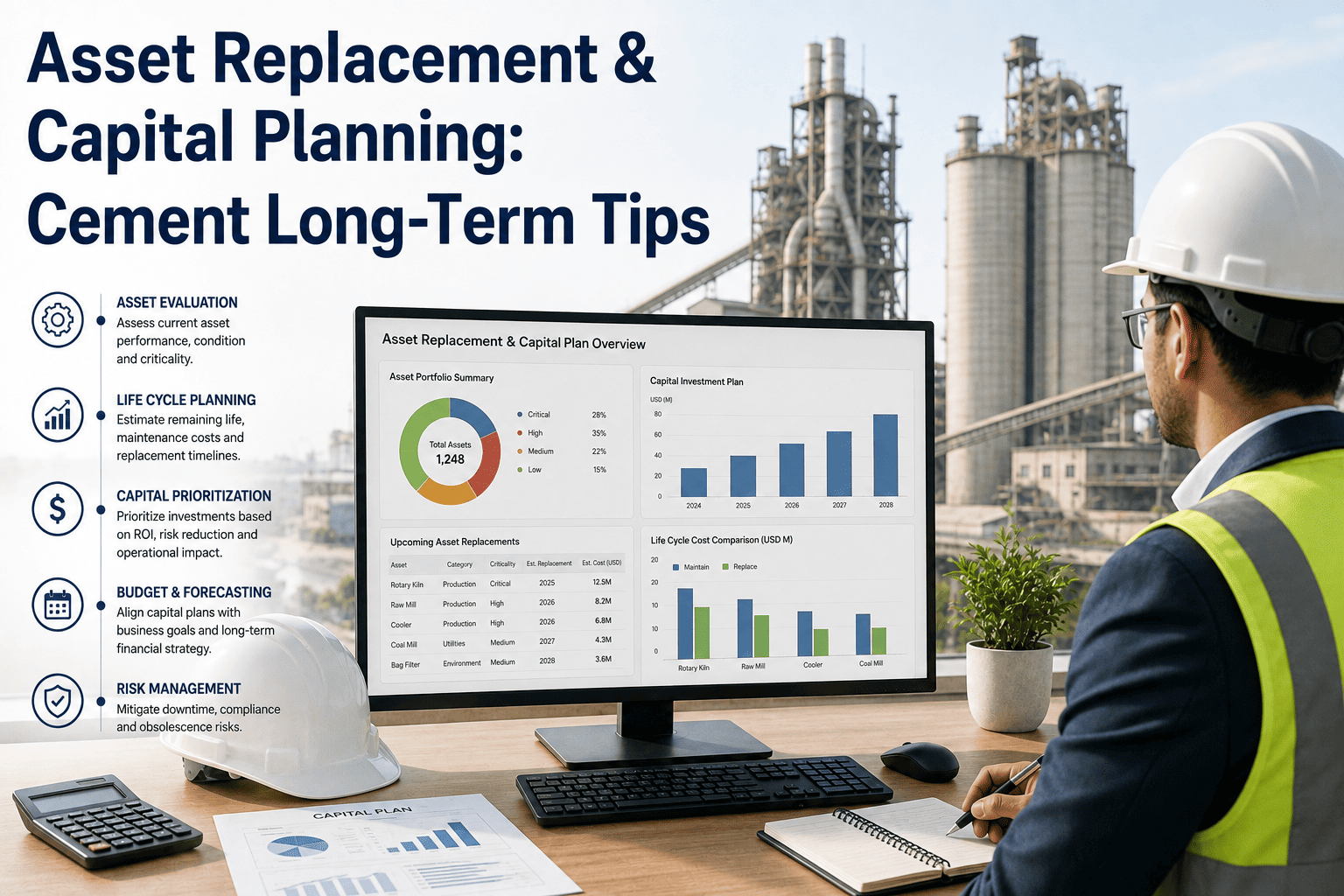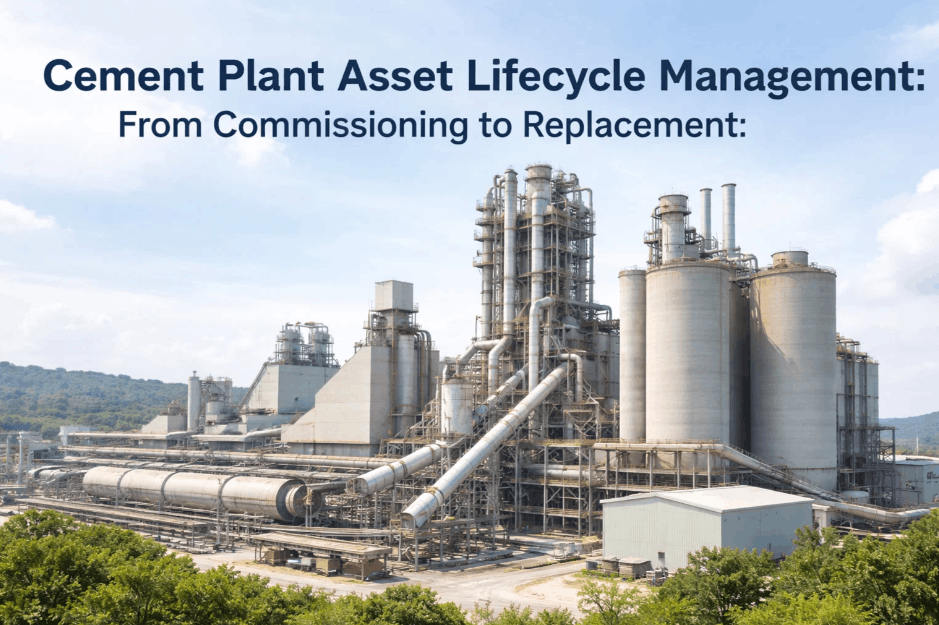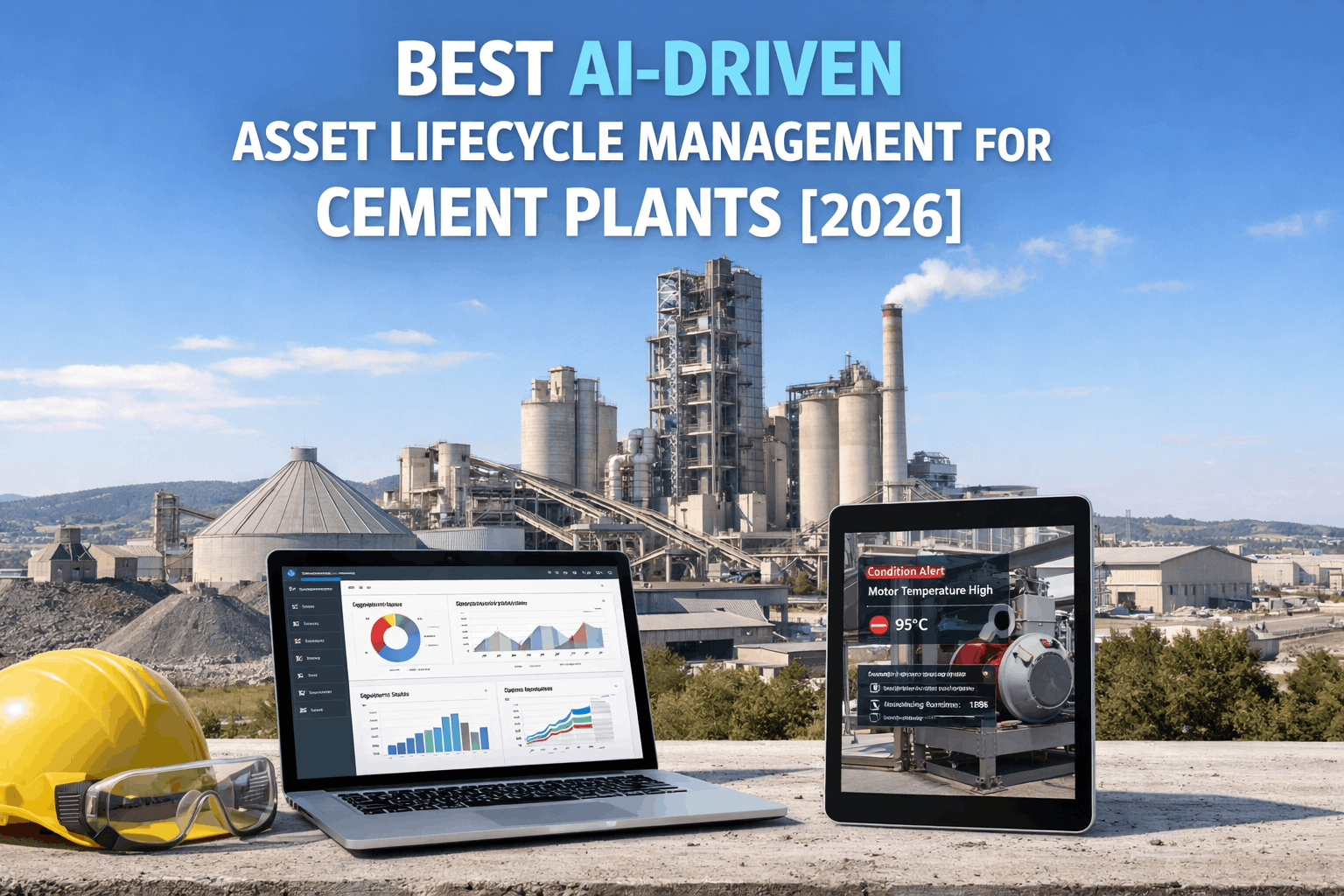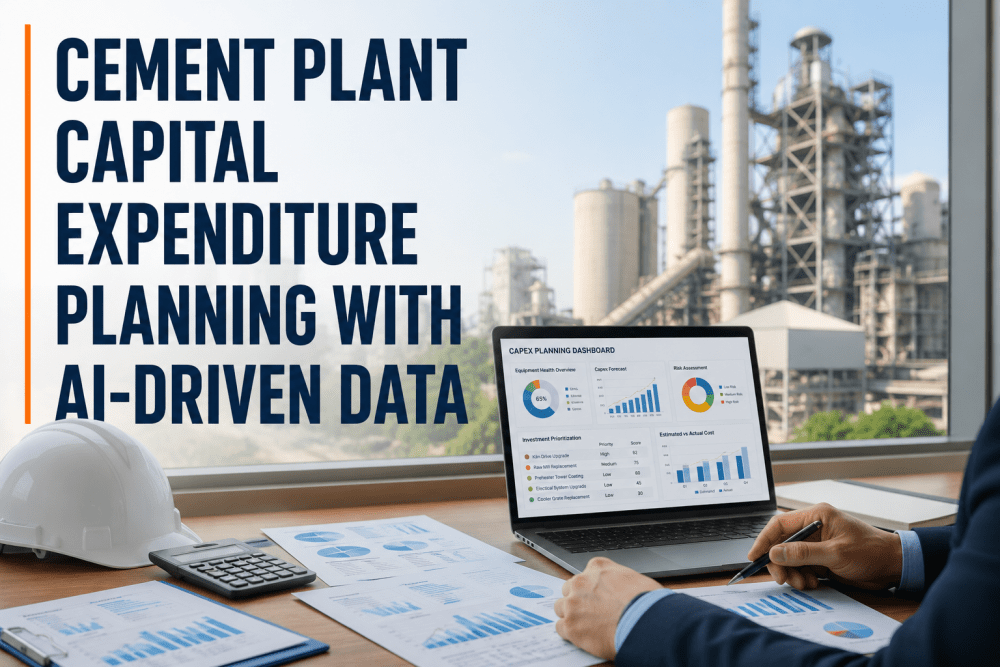
Capital expenditure planning in cement manufacturing has historically been driven by equipment age, OEM replacement recommendations, and the judgment of plant engineering teams — all of which are necessary inputs but none of which, on their own, produce an optimized capital allocation strategy. A typical U.S. cement plant with an annual maintenance budget of $8 million to $15 million and a capital budget of $12 million to $25 million faces the same structural problem every fiscal year: how to distribute limited capital across competing equipment replacement, structural rehabilitation, and technology upgrade projects when the data required to rank those investments by risk-adjusted return is scattered across the CMMS, the financial ERP, the condition monitoring system, and the engineering manager's experience. The consequence is that capital is frequently allocated to the most visible equipment failures from the prior year rather than to the assets where early investment would deliver the highest avoided-failure return over a 5-year horizon. AI-driven CAPEX analytics changes this dynamic by connecting equipment health data, failure probability models, cost-of-failure calculations, and remaining useful life projections into a single prioritization framework that ranks every capital investment opportunity by its risk-adjusted financial impact. iFactory's Analytics and Reporting modules give cement plant financial and engineering leadership the digital infrastructure to build, defend, and track capital plans that are driven by asset data rather than by the urgency of the most recent breakdown. Book a Demo to see how AI-driven CAPEX analytics transforms capital planning from an annual exercise in budget negotiation into a continuous process of data-informed investment optimization.
From Reactive Budgeting to AI-Optimized Capital Allocation — Data-Driven CAPEX Planning for Cement Plants
Every capital dollar allocated to equipment replacement, structural rehabilitation, or technology upgrade competes against every other dollar. AI-driven analytics ranks those investments by risk-adjusted financial impact — connecting equipment health data, failure probability, and cost-of-failure models into a single prioritization framework.
Why Cement Plant Capital Allocation Is Broken — and How Data Fixes It
Capital expenditure planning at most U.S. cement plants follows a predictable pattern. In the third quarter, the engineering team circulates a spreadsheet to each department asking for capital project requests. Each department submits its wish list — a kiln drive rebuild here, a baghouse bag conversion there, a preheater tower structural assessment, a new loader, a conveyor belt replacement. The requests arrive with varying levels of justification: some include equipment health data and failure history, others include a single line item description and a budget number. The plant manager and controller review the combined list, apply whatever decision criteria are available, and make cuts until the total matches the capital budget allocation from corporate. The assets that generate the highest avoided-failure return if replaced today are frequently not the assets that get funded — because the data that would demonstrate that return is not connected to the capital planning process.
Capital Investment Categories — Where AI-Driven Data Changes the Decision
Every capital investment in a cement plant falls into one of five categories: equipment replacement, structural rehabilitation, technology upgrade, regulatory compliance, or capacity expansion. Each category has different data requirements for investment prioritization, and each benefits differently from AI-driven analytics that connects equipment health data, failure probability models, and financial impact calculations.
Equipment Replacement — timing the investment to maximize avoided failure cost
Equipment replacement is the largest capital expenditure category at most cement plants, covering kiln drives, mill motors, conveyor systems, crushers, fans, and gearboxes. The critical decision is not whether to replace these assets — it is when. Replace too early, and capital is wasted on remaining useful life. Replace too late, and an unplanned failure costs 3-5 times the planned replacement cost in emergency repairs and lost production. AI-driven remaining useful life (RUL) models, trained on vibration data, oil analysis trends, operating hours, and historical failure patterns, determine the optimal replacement window for each asset. iFactory's CAPEX analytics module connects RUL predictions to financial models that calculate the net present value of replacing the asset at each possible date over a 5-year planning horizon.
Structural Rehabilitation — prioritizing interventions across aging infrastructure
Structural rehabilitation covers concrete repair, steel reinforcement, foundation stabilization, and structure replacement for preheater towers, silos, conveyor galleries, and retaining walls. The data challenge here is that structural degradation is slow and distributed — a preheater tower column deteriorating at 2 mm per year of carbonation depth may not reach the critical threshold for 8-12 years, but the inspection data that tracks that rate must be collected consistently, trended accurately, and compared against intervention thresholds that account for both safety risk and production impact. AI-driven condition trend analysis identifies accelerating deterioration rates that signal the optimal timing for structural intervention — early enough to avoid emergency structural repairs but late enough to maximize the remaining service life of the existing structure.
Technology Upgrade — building the business case for automation and digital investment
Technology upgrades — including automation systems, sensor networks, CMMS implementation, predictive maintenance platforms, and AI analytics tools — require a different CAPEX justification than equipment replacement because the ROI is indirect: reduced maintenance cost, improved equipment reliability, extended asset life, and lower energy consumption. The data required to build a credible technology upgrade business case comes from the same systems the technology is intended to improve — current maintenance cost per asset, current failure frequency, current overtime spend on emergency repairs. iFactory's analytics platform captures this baseline data before the technology investment, calculates the projected improvement based on industry benchmarks and site-specific conditions, and tracks the actual ROI after implementation — creating a closed-loop justification framework that strengthens future technology upgrade proposals.
Regulatory Compliance — minimizing forced capital through proactive data management
Regulatory compliance capital covers investments required by EPA, OSHA, MSHA, and state environmental agencies — baghouse upgrades, stack monitoring systems, dust control equipment, noise barriers, and safety system improvements. Unlike equipment replacement or technology upgrade, compliance capital is non-discretionary in timing but can be discretionary in scope and approach. Plants that track compliance-related equipment condition data in the same platform as production equipment data can identify compliance investment requirements earlier, budget for them in the normal capital planning cycle rather than through emergency appropriations, and in some cases defer compliance investments by demonstrating through data that existing equipment is performing within regulatory limits. iFactory's inspection management module tracks compliance inspection findings, generates corrective action work orders, and provides the documentation trail required for regulatory demonstration of compliance status.
Capacity Expansion — data-driven justification for production increase investments
Capacity expansion capital — new mills, additional silo capacity, expanded preheater trains, additional cooler grate area — requires the most rigorous justification of any capital category because the investment is large and the payoff depends on market conditions that are outside the plant's control. AI-driven CAPEX analytics supports capacity expansion justification by modeling the reliability impact of adding capacity to the existing asset base. A new mill does not just add grinding capacity — it changes the load profile on the existing preheater, kiln, and cooler, and the interaction effects on asset reliability must be modeled to produce an accurate ROI projection. iFactory's digital twin integration enables this modeling by simulating the combined operation of existing and new assets under various production scenarios.
CAPEX Prioritization Matrix — Ranking Investments by Risk-Adjusted Financial Impact
The core output of AI-driven CAPEX analytics is a prioritized investment list that ranks every proposed capital project by its risk-adjusted financial impact. The prioritization matrix considers five factors for each asset: current condition score, failure probability within the planning horizon, cost of unplanned failure (production loss + emergency repair), cost of planned intervention, and net present value of intervening at each possible date within the planning window. The table below presents the prioritization analysis for the major capital investment categories at a typical U.S. cement plant.
| Asset / Investment Category | Current Condition Score | 5-Year Failure Probability | Cost of Unplanned Failure | Cost of Planned Intervention | Priority Rank |
|---|---|---|---|---|---|
| Kiln main drive gearbox replacement | 2.8 / 5 | 62% | $480,000 — $720,000 | $185,000 — $260,000 | 1 |
| Preheater tower concrete column rehab | 3.2 / 5 | 48% | $620,000 — $950,000 | $210,000 — $340,000 | 2 |
| VRM hydraulic system modernization | 3.5 / 5 | 41% | $350,000 — $520,000 | $140,000 — $200,000 | 3 |
| Clinker silo wall UT assessment + repair | 3.8 / 5 | 35% | $890,000 — $1,400,000 | $320,000 — $480,000 | 4 |
| Baghouse pulse-jet conversion (compliance) | 4.0 / 5 | 28% | $180,000 — $300,000 | $75,000 — $120,000 | 5 |
| Conveyor C-4 belt and drive replacement | 2.2 / 5 | 55% | $210,000 — $340,000 | $95,000 — $150,000 | 6 |
| Cooler grate drive gearbox upgrade | 3.0 / 5 | 38% | $290,000 — $440,000 | $130,000 — $190,000 | 7 |
| Raw mill motor replacement | 2.5 / 5 | 44% | $310,000 — $490,000 | $155,000 — $225,000 | 8 |
Condition score: 1 = critical, 5 = excellent. Failure probability estimated from equipment age, condition trend, vibration and oil analysis history, and OEM mean-time-between-failure data. Cost ranges reflect regional variation in contractor rates and production value per ton.
Your Capital Budget Is Competing Against Itself — AI Shows You Which Investment Delivers the Highest Return
Every capital dollar allocated to one project is a dollar not allocated to another. iFactory's CAPEX analytics module ranks every proposed investment by risk-adjusted financial impact — connecting equipment health data, failure probability models, and cost-of-failure calculations into a single prioritization framework that plant managers and corporate finance teams can trust.
Traditional vs. AI-Driven CAPEX Planning — How the Decision Process Changes
The difference between traditional CAPEX planning and AI-driven CAPEX analytics is not just in the quality of the data — it is in the structure of the decision process itself. Traditional capital planning is an annual event driven by spreadsheets, departmental requests, and management judgment under uncertainty. AI-driven CAPEX analytics transforms capital planning into a continuous process of data-informed investment optimization supported by financial models that are updated automatically as equipment condition data changes.
- Annual capital budgeting cycle with fixed submission deadlines
- Equipment condition data assembled manually from CMMS, spreadsheets, and engineer knowledge
- Failure probability estimated qualitatively — "high," "medium," "low"
- Cost of failure based on memory of last similar failure, not modeled data
- Prioritization driven by urgency of recent breakdowns and departmental advocacy
- No systematic connection between condition data and financial ROI model
- Capital plan approved in Q4, executed over following 12 months regardless of condition changes
- Post-project review limited to budget vs. actual — no condition data feedback loop
- Continuous capital planning with quarterly refresh of prioritized investment list
- Equipment condition data streamed automatically from CMMS, sensors, and oil analysis
- Failure probability calculated from AI model trained on site-specific failure history
- Cost of failure calculated from production loss model, repair cost history, and escalation factors
- Prioritization by risk-adjusted net present value calculated consistently across all assets
- ROI model automatically updated when condition data changes or failure occurs
- Capital plan dynamically adjusted as condition data reveals changes in deterioration rate
- Post-project condition data automatically establishes new baseline for remaining useful life tracking
Deploying AI-Driven CAPEX Analytics — A Phased Implementation Timeline
Transitioning from traditional annual capital planning to continuous AI-driven CAPEX analytics is a structured process that delivers measurable value at each phase. iFactory's implementation methodology is designed to produce the first prioritized CAPEX list within 8 weeks of project start and to achieve full operational capability within 6 months.
Phase 1 — Data Integration and Asset Baseline (Weeks 1-3)
iFactory engineers connect the plant's CMMS, condition monitoring systems, oil analysis database, and financial ERP to the analytics platform. All major assets are catalogued with their current condition score, installation date, replacement value, and maintenance cost history. The initial data integration produces the first complete asset health picture — typically revealing that 15-25% of assets have condition data that was previously scattered across disconnected systems.
Phase 2 — Failure Probability Model Calibration (Weeks 4-6)
AI failure probability models are trained on the plant's historical failure data, equipment age distribution, condition trend data, and OEM reliability data. The models are calibrated against actual failure events from the prior 3-5 years to validate prediction accuracy. The calibration process typically achieves ±12% failure probability prediction accuracy at the 12-month horizon for the asset classes with sufficient historical data.
Phase 3 — Financial Model Configuration (Weeks 6-8)
The CAPEX financial model is configured with the plant's specific cost parameters: production value per ton, hourly production loss cost, emergency repair cost multipliers, planned intervention cost estimates by asset type, and the plant's weighted average cost of capital for net present value calculations. The financial model is validated against the plant's actual capital spending history from the prior 3 years.
Phase 4 — Prioritization Dashboard and Team Training (Weeks 8-10)
The CAPEX prioritization dashboard is deployed, showing every capital project ranked by risk-adjusted net present value with drill-down detail on each asset's condition data, failure probability, cost model, and recommended intervention timing. Engineering and finance teams receive hands-on training on the dashboard, scenario modeling tools, and the quarterly capital plan refresh process.
Phase 5 — Continuous Operation and Quarterly Review (Week 10+)
The CAPEX analytics platform operates continuously, updating failure probability models and financial projections as new condition data is recorded. The engineering and finance teams conduct quarterly capital plan reviews, adjusting the prioritized investment list based on the latest condition trends, completed projects, and changes in the plant's operating context.
Expert Perspective — What Data-Driven CAPEX Planning Looks Like in Practice
I spent 14 years as the plant controller and later the plant manager at a 4,000-tpd cement plant in the southeastern U.S. During that time, I participated in 12 annual capital budget cycles, and the process was essentially the same every year. In August, the engineering manager would send out a spreadsheet with 30-40 capital project requests. The maintenance manager would advocate for the projects that addressed the most painful failures from the previous year. The production manager would advocate for the projects that increased throughput. The engineering manager would advocate for the projects that addressed structural and compliance risks that kept him up at night. And I would try to fit the total into the $18 million capital budget we had been allocated by corporate. The problem was that I had no way to compare the financial return of a $400,000 kiln drive replacement against a $350,000 preheater tower structural repair against a $250,000 baghouse upgrade. Each project had a different type of justification — one had a vibration trend chart, one had an engineering assessment report, one had a regulatory deadline. There was no common financial framework for comparing them.
We implemented iFactory's CAPEX analytics module in 2022, and the change was immediate and structural. For the first time, every capital project was evaluated using the same framework: current condition, failure probability, cost of unplanned failure, cost of planned intervention, and net present value of intervening at each possible date. The first prioritized list identified that three of the projects we had been planning to fund in the upcoming year were actually lower priority than four projects that had been deferred in previous years because their justification was less visible at the time. We reallocated $2.1 million from lower-return projects to higher-return projects based on the data. Two years later, the failure rate on the reallocated portfolio was 40% lower than the failure rate on the portfolio we would have funded under the traditional approach. That is the value of connecting asset condition data to capital allocation decisions — and it is available to any cement plant that is willing to move from spreadsheet-based capital planning to AI-driven CAPEX analytics.
Cement Plant CAPEX Planning — Frequently Asked Questions
What data does iFactory need to start building AI-driven CAPEX prioritization models?
The minimum data set is the asset register with installation dates, replacement values, and maintenance cost history from the CMMS. With condition data (vibration, oil analysis, inspection scores) added, the failure probability models become more accurate. With financial data (production value per ton, repair cost history) added, the ROI calculations become plant-specific. iFactory works with whatever data is available and improves model accuracy as more data is connected.
How does AI-driven CAPEX planning handle the uncertainty in failure probability predictions?
The AI model outputs failure probability as a range with confidence intervals rather than a single point estimate. The CAPEX prioritization framework incorporates this uncertainty through sensitivity analysis — projects with wider confidence bands are flagged for additional data collection before the final capital allocation decision. As more condition data accumulates, confidence intervals narrow and prioritization confidence increases.
Can iFactory's CAPEX module integrate with existing corporate ERP and financial planning systems?
Yes. iFactory's analytics platform supports integration with major ERP systems including SAP, Oracle, and Microsoft Dynamics. The CAPEX prioritization output can be exported in standard formats for import into corporate financial planning tools. The platform also supports API-based integration for plants that operate with custom financial systems or that want to embed CAPEX prioritization data directly into their ERP capital budgeting modules.
How often should the CAPEX prioritization list be updated?
The AI models update continuously as new condition data is recorded — every vibration reading, oil analysis result, and inspection finding refines the failure probability projection. The formal CAPEX prioritization list should be reviewed quarterly by the plant leadership team to align capital allocation with the latest condition trends and operating context. iFactory's platform sends automated notifications when a significant change in any asset's priority rank occurs between reviews.
Does AI-driven CAPEX planning replace the judgment of the plant engineering team?
No. AI-driven CAPEX analytics augments engineering judgment by providing a consistent, data-supported framework for comparing investments across different asset classes and risk profiles. The engineering team's knowledge of site-specific conditions, vendor relationships, and operational context remains essential for interpreting the model output and making final capital allocation decisions. The AI handles the data integration and calculation — the team handles the strategic judgment.
Capital Expenditure Planning Is an Information Problem — AI Provides the Information
The fundamental challenge in cement plant CAPEX planning is not that plant engineers and managers do not know which investments are most important — it is that the data required to rank investments by financial return is scattered across disconnected systems and inconsistent formats. Equipment condition lives in the CMMS. Cost data lives in the ERP. Failure probability lives in the experience of the maintenance team. Production value lives in the sales forecast. Connecting these data sources into a single prioritization framework is what enables the shift from reactive capital allocation — funding the projects that address last year's most visible failures — to strategic capital allocation — funding the projects that deliver the highest risk-adjusted financial return over the plant's 5-year planning horizon.
iFactory's Analytics and Reporting modules provide cement plant financial and engineering leadership with the digital infrastructure to connect equipment health data, failure probability models, cost-of-failure calculations, and remaining useful life projections into a single CAPEX prioritization platform purpose-built for cement manufacturing. The transition from spreadsheet-based annual capital planning to continuous AI-driven CAPEX analytics is not a technology project — it is a financial management discipline that determines whether a cement plant's capital budget is deployed as a strategic investment in reliability or as an emergency response to conditions that should have been addressed years earlier. Book a Demo to see how iFactory's platform builds, defends, and tracks data-driven capital plans for cement plant assets.
Every Capital Dollar Has a Data-Driven Answer — iFactory Shows You Where It Delivers the Highest Return
iFactory connects equipment health data, failure probability models, and financial ROI calculations into a single CAPEX prioritization platform — so every capital allocation decision is supported by data, not by the urgency of the most recent breakdown.