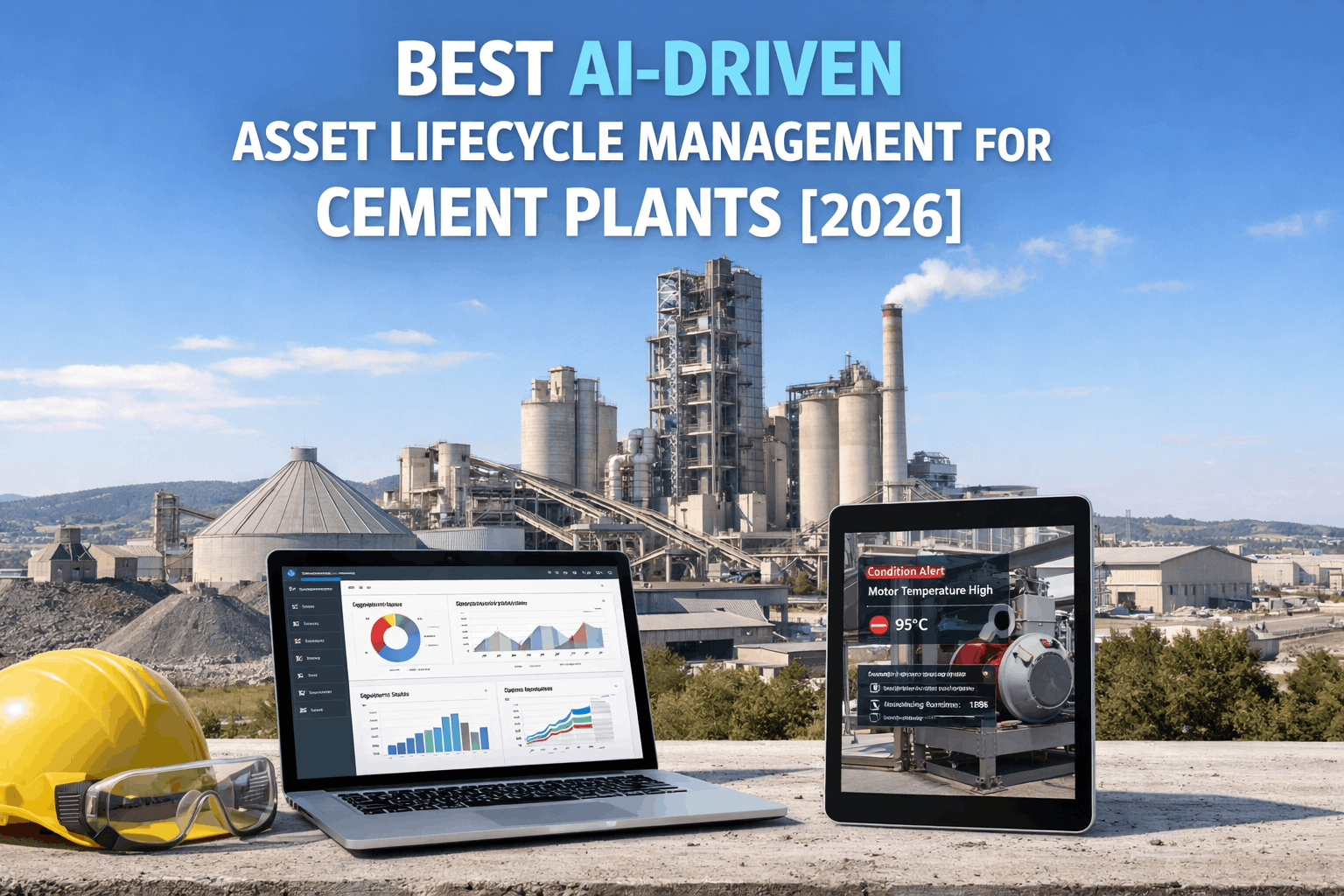
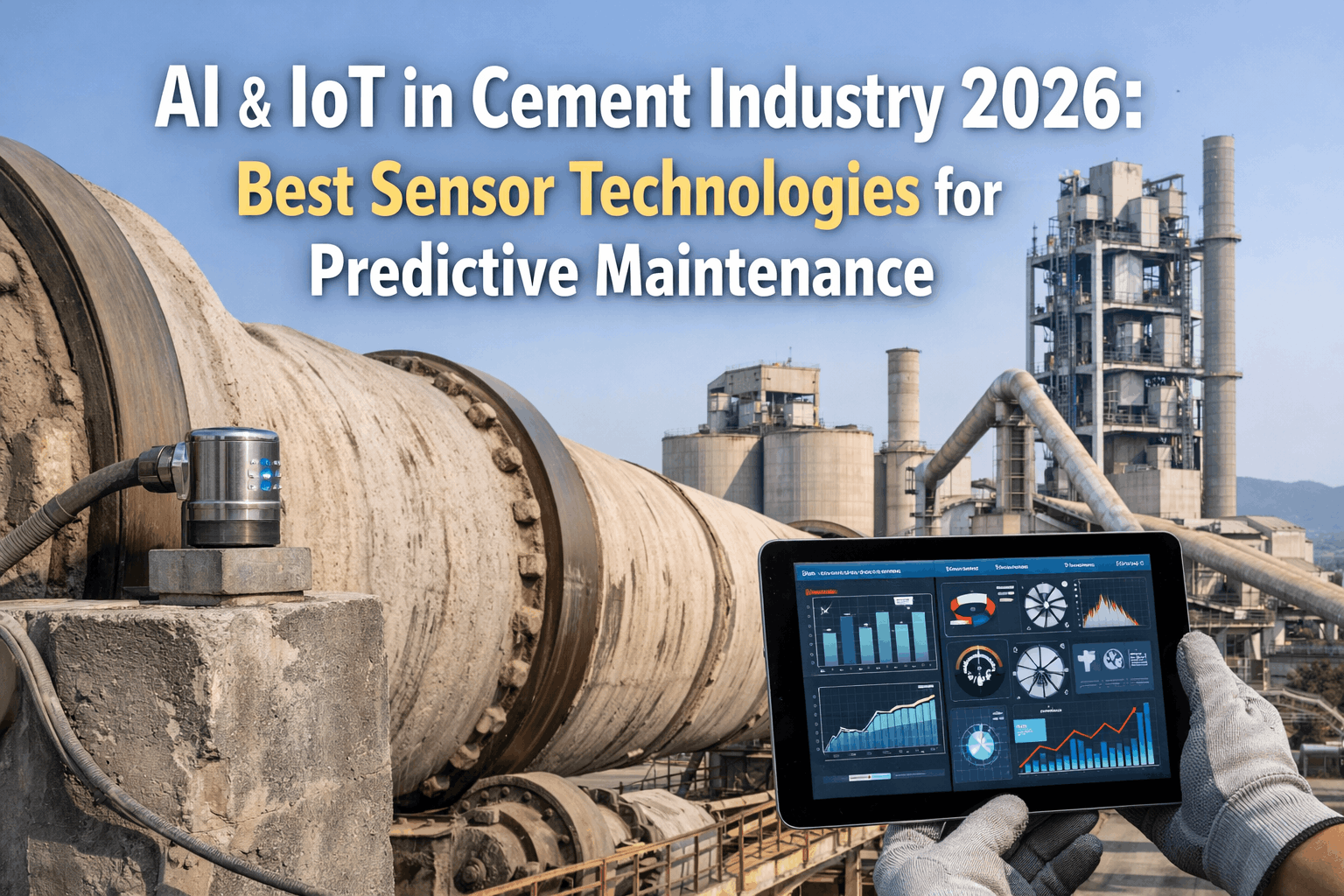
Cement plants run on some of the most capital-intensive, mechanically demanding equipment in industrial manufacturing. Rotary kilns, vertical roller mills, preheater towers, and clinker coolers represent multi-million dollar investments that are expected to deliver decades of continuous output under extreme heat, dust, and vibration. Yet across the industry, asset failure remains the single largest driver of unplanned downtime and cost overruns — and the root cause is almost always the same: lifecycle management that reacts rather than anticipates.
AI Asset Management
·
Cement Industry
·
2026 Guide
·
EAM & Digital Twin
Best AI-Driven Asset Lifecycle Management
for Cement Plants in 2026
How AI digital twins, predictive analytics, and smart EAM platforms are extending cement equipment life by up to 30% — while cutting total cost of ownership across every asset class.
The Aging Infrastructure Challenge
Over 60% of cement plant equipment globally is operating beyond its originally designed service life. The industry is caught between the capital cost of replacement and the operational risk of continued aging — and traditional maintenance frameworks cannot bridge that gap.
AI-driven lifecycle management changes the equation entirely. Instead of scheduled replacements based on age, iFactory's platform makes decisions based on actual equipment condition, remaining useful life predictions, and total cost of ownership modeling. Plant managers who get support gain a real-time asset intelligence layer across every critical piece of cement equipment.
60%
of cement equipment is past designed service life
38%
of production losses are asset-lifecycle-related
30%
longer asset life achievable with AI EAM platforms
The AI Lifecycle Stack: What Powers Modern Cement Asset Management
Effective AI-driven asset lifecycle management is not a single technology — it is a layered intelligence architecture that integrates sensor data, machine learning models, and enterprise asset management workflows into a unified system. Each layer builds on the one below it, progressively transforming raw equipment data into strategic decisions.
04
Strategic Decision Layer
Repair vs. replace analytics, capital planning, TCO optimization, and lifecycle-driven budget forecasting
03
AI Prediction Engine
Remaining useful life (RUL) models, failure probability scoring, predictive replacement timing, anomaly detection
02
Digital Twin & EAM Platform
Virtual asset models mirroring real-time equipment state, maintenance history, OEM specs, and performance baselines
01
Sensor & Data Ingestion
Vibration, temperature, current, pressure, and acoustic sensors feeding continuous telemetry from plant equipment
See iFactory's AI Lifecycle Platform in Action
Built specifically for heavy industrial and cement plant environments
AI Digital Twins: The Foundation of Lifecycle Intelligence
A digital twin is a continuously updated virtual replica of a physical asset, synchronized with real-world sensor data in near real time. For cement plant equipment, digital twins are transformative because they allow engineers to model degradation patterns, simulate operating scenarios, and predict failure timelines without taking equipment offline for physical inspection.
iFactory's digital twin engine creates individual asset models for each major piece of cement equipment — from the kiln drive gear to the raw mill separator. Each twin tracks over 200 operational parameters, compares current performance against OEM design specifications, and flags deviations that indicate accelerating wear or emerging failure modes. Plant engineers who book a demo with iFactory consistently describe this capability as the most impactful shift in how they manage capital equipment.
Rotary Kiln
Tire & Roller Wear Modeling
Digital twin tracks shell ovality, tire slip, and axial thrust in real time. AI predicts grinding ring replacement needs 8–12 weeks in advance, allowing planned stops instead of emergency shutdowns.
Avg. downtime reduction42%
Vertical Roller Mill
Grinding Table Lifecycle Tracking
AI monitors roller wear progression against throughput data to predict optimal roller segment replacement timing and avoid over-grinding losses.
Preheater Tower
Refractory Life Management
Thermal imaging integration with the digital twin models refractory degradation rates, predicting hot spot formation before shell damage occurs.
Clinker Cooler
Grate Plate Wear Analysis
Tracks grate plate condition through pressure differential and airflow analytics, scheduling replacements to coincide with planned kiln stops.
Cement Mill
Ball Charge Optimization
AI models grinding media consumption rates against production targets, generating recharge schedules that maintain optimal energy efficiency.
Repair vs. Replace Analytics: Making the Right Call Every Time
One of the most consequential — and most frequently misjudged — decisions in cement plant asset management is whether to repair aging equipment or invest in replacement. Traditional approaches rely on age-based rules of thumb, OEM recommendations, or gut instinct from experienced engineers. All three approaches consistently lead to either premature replacement of still-viable equipment or over-investment in assets that are past economic recovery.
iFactory's repair vs. replace analytics engine changes this entirely. The platform builds a multi-variable economic model for each asset that accounts for remaining useful life, current repair cost trajectory, replacement asset price, installation downtime cost, and expected productivity differential. The output is a clear, data-backed recommendation with full financial justification — enabling plant managers to contact support and start making defensible capital decisions based on real asset economics rather than estimates.
Traditional Approach
iFactory AI Approach
Decision Basis
Age, OEM schedule, experience
RUL model + economic analysis
Replacement Timing
Often too early or too late
Optimal window identified by AI
Cost Visibility
Estimated, often inaccurate
Live TCO modeling per asset
Capital Justification
Subjective, hard to defend
Automated financial case output
Risk Assessment
Qualitative, experience-based
Probabilistic failure risk scoring
TCO Optimization Across the Cement Asset Portfolio
Total cost of ownership in a cement plant is rarely visible in a single dashboard — it is distributed across procurement, maintenance, energy, downtime, and disposal in ways that obscure the true economic burden of each asset. AI-powered TCO optimization aggregates all of these cost streams and models them across asset classes and time horizons.
The practical result is a ranked view of the most economically burdensome assets in the plant, the levers available to reduce their lifecycle cost, and the projected financial impact of each intervention. Plant engineers who book a demo today are consistently surprised by how much capital is locked in avoidable lifecycle costs that iFactory surfaces within the first week of deployment.
Energy Consumption
Before AI: 82%
Energy Consumption
After AI: 61%
Unplanned Downtime Cost
Before AI: 74%
Unplanned Downtime Cost
After AI: 38%
Maintenance Spend Index
Before AI: 68%
Maintenance Spend Index
After AI: 46%
Index values relative to total plant operational cost baseline | iFactory customer data composite
Measurable ROI from AI Lifecycle Management
What cement plants are actually reporting after deploying iFactory's AI EAM platform
30%
Extension in average asset service life across major cement equipment categories
45%
Reduction in unplanned downtime incidents within 6 months of platform deployment
22%
Decrease in total maintenance spend through predictive scheduling and optimized parts procurement
18%
Improvement in energy efficiency through asset-condition-based operating parameter optimization
Predictive Replacement Timing: Eliminating Guesswork from Capital Planning
Cement plants typically operate on 3–5 year capital expenditure cycles. The challenge is that equipment degradation does not follow a predictable calendar — it accelerates or decelerates based on operating conditions, process chemistry, and maintenance quality in ways that generic age-based models cannot capture. The result is capital plans that are either over-budgeted for equipment that still has years of reliable life, or under-budgeted for assets that fail ahead of schedule.
iFactory's predictive replacement timing module solves this by generating 18–36 month rolling replacement forecasts for each asset, updated continuously as new operating data comes in. Capital planning teams can get support and immediately begin building replacement schedules grounded in actual equipment condition rather than scheduled guesses — making every capital budget cycle more accurate and defensible.
iFactory AI EAM · Cement Industry
Extend Your Cement Equipment Life by 30% in 2026
iFactory's AI-driven asset lifecycle platform gives cement plant managers the digital twin visibility, predictive analytics, and TCO intelligence they need to make every capital asset decision with confidence.
Frequently Asked Questions
What is AI-driven asset lifecycle management in cement plants
AI-driven asset lifecycle management uses machine learning, sensor data, and digital twin technology to monitor, predict, and optimize the full lifecycle of cement plant equipment — from commissioning through decommissioning. Unlike traditional maintenance, which reacts to failures, AI lifecycle management anticipates them and models the optimal economic timing for repairs, overhauls, and replacements across every asset class in the plant.
How does a digital twin help manage cement equipment lifecycle
A digital twin is a continuously updated virtual model of a physical asset that mirrors its real-time operating state through sensor data. For cement equipment, digital twins track hundreds of parameters simultaneously — temperature, vibration, wear rates, throughput efficiency — and use AI to compare current performance against design baselines. This allows engineers to detect degradation trends weeks or months before they manifest as failures, enabling planned interventions instead of emergency shutdowns.
What does AI TCO optimization actually calculate for a cement plant
AI TCO optimization aggregates and models all costs associated with owning and operating each asset: purchase price, installation, energy consumption, maintenance labor and parts, downtime losses, and eventual disposal or replacement cost. It then identifies which cost levers have the greatest impact and models the financial outcome of different maintenance and replacement strategies — giving plant managers a clear, quantified basis for every capital decision.
Which cement plant assets benefit most from AI lifecycle management
The highest ROI is typically seen on the most capital-intensive, process-critical assets: rotary kilns, vertical roller mills, preheater towers, clinker coolers, and cement mills. These assets combine high replacement cost, long procurement lead times, and severe production impact when they fail — making AI-driven lifecycle visibility particularly valuable. Secondary equipment such as fans, conveyors, and compressors also benefit significantly through optimized maintenance scheduling.
How long does it take to see ROI from an AI EAM platform in a cement plant
Most cement plants deploying iFactory's AI EAM platform report measurable improvements within the first 60–90 days of operation. Early wins typically come from identifying previously invisible degradation on critical equipment, eliminating over-maintained assets from unnecessary service windows, and improving parts procurement timing. Full ROI — including lifecycle extension and capital planning accuracy — is typically demonstrated within 6–12 months of full deployment.
Can AI lifecycle management integrate with existing plant control systems and SCADA
Yes. iFactory is built with industrial integration as a core design principle. The platform connects with leading SCADA systems, DCS platforms, historian databases, and ERP systems through standard industrial protocols including OPC-UA, MQTT, and REST APIs. Most cement plant data environments can be fully integrated within 2–4 weeks, enabling the AI engine to begin learning from historical data immediately while simultaneously ingesting live operating data.