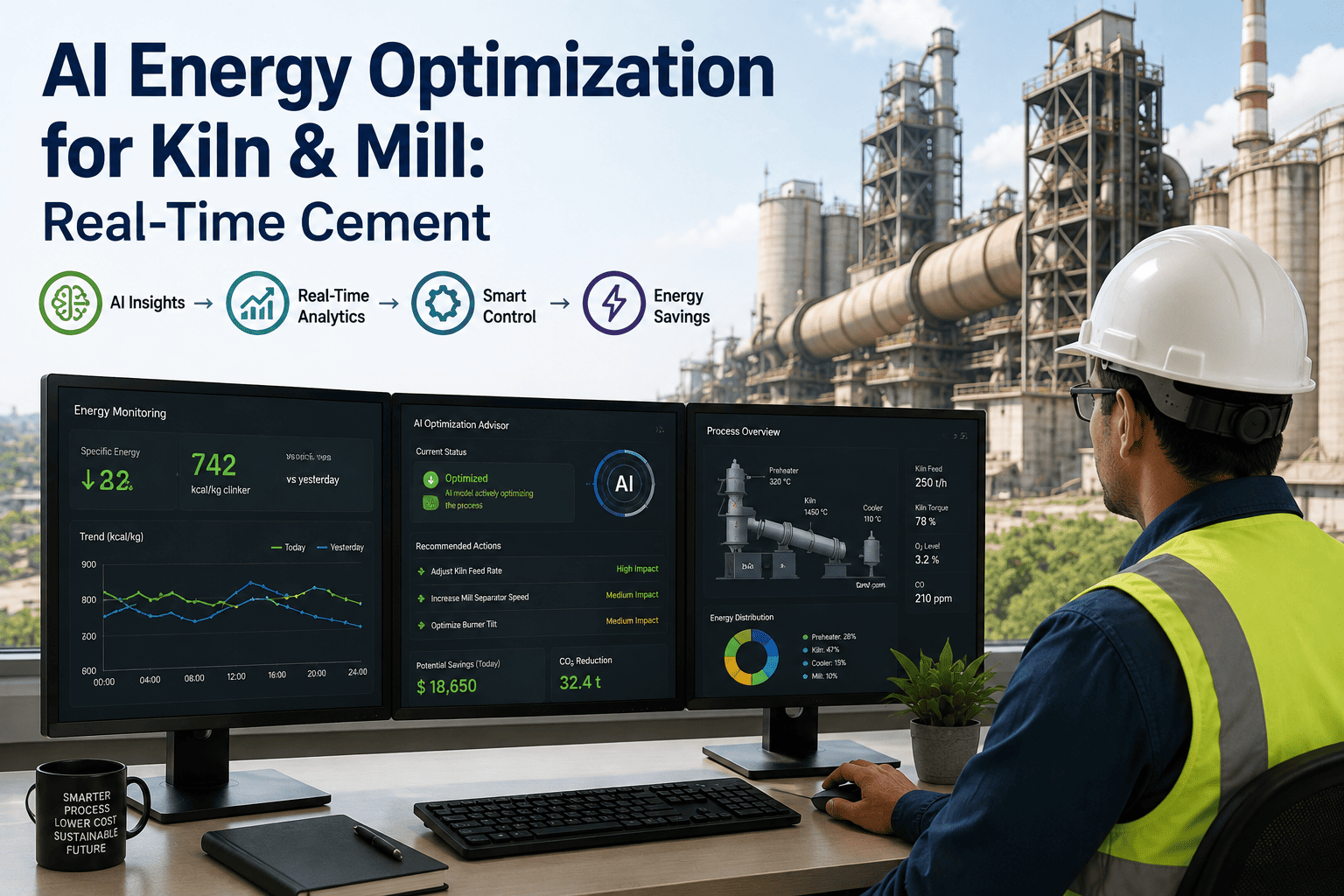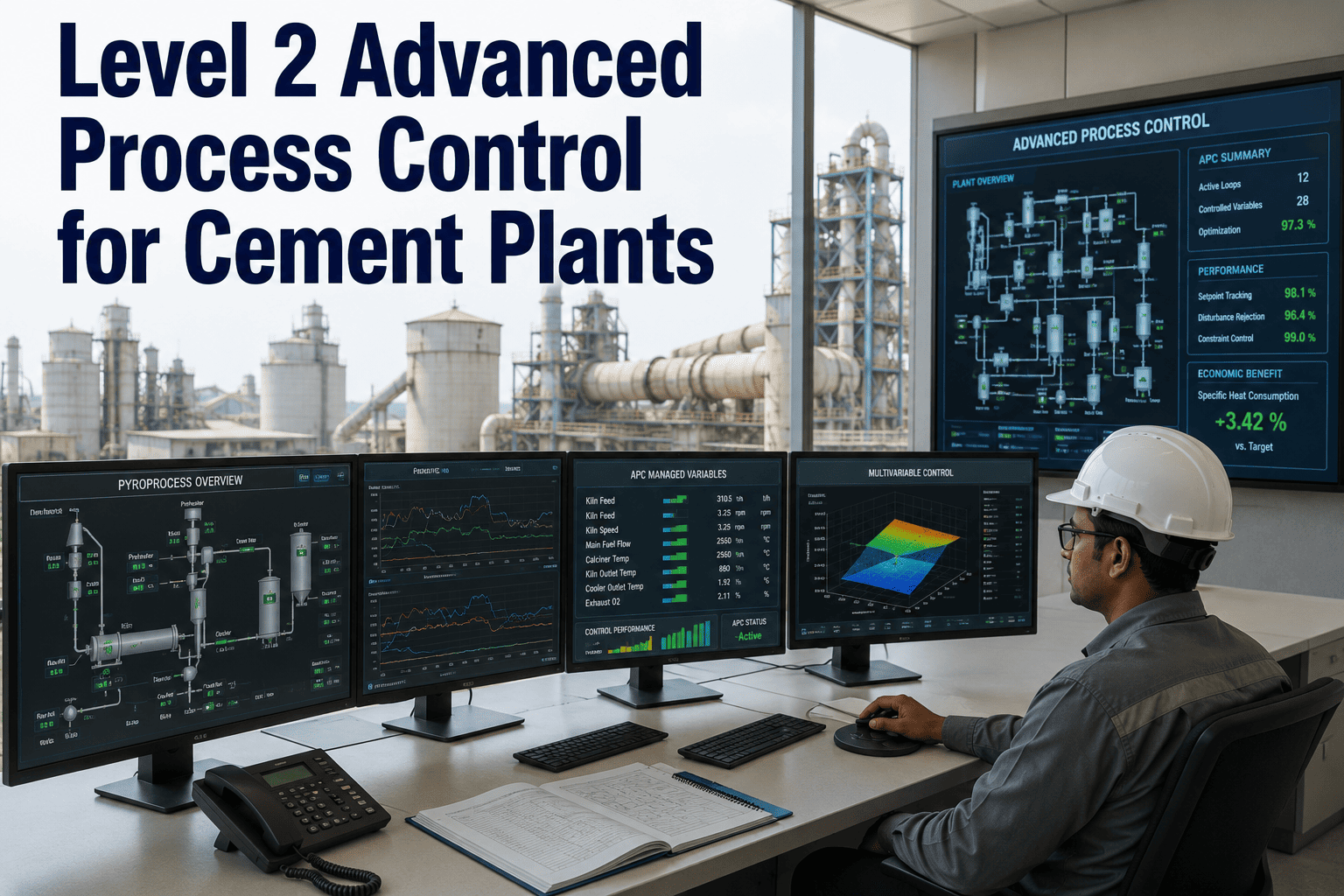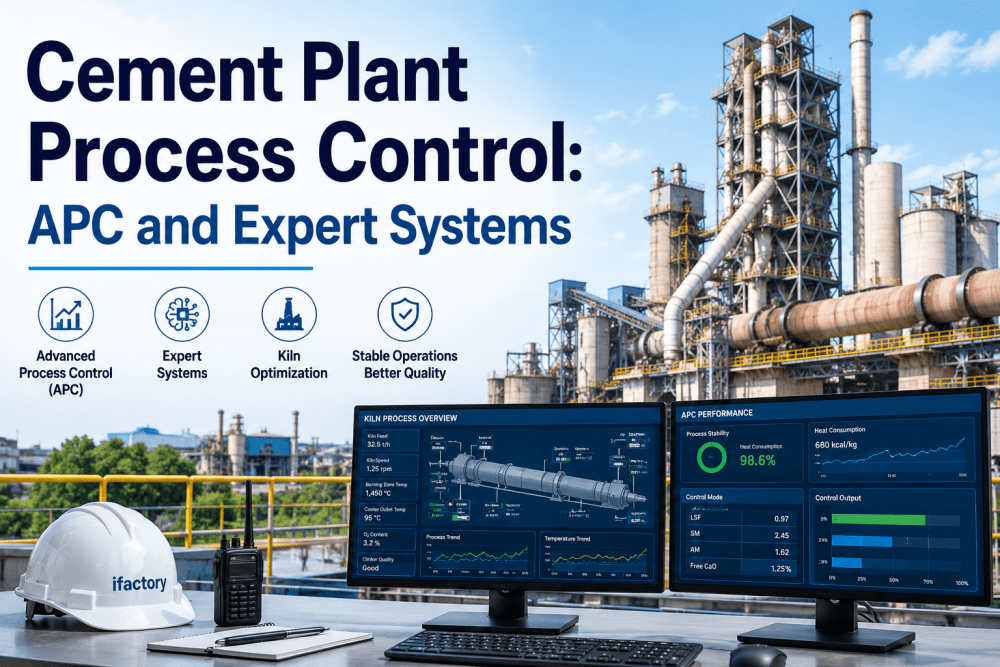
Advanced process control (APC) in cement manufacturing is the difference between a kiln that drifts and a kiln that produces. In a typical U.S. cement plant operating without APC, kiln feed rate, fuel flow, and calciner temperature are adjusted reactively — operators responding to deviations after they have already propagated into clinker quality variation, energy waste, and refractory stress. The consequence is measurable: plants without APC systems run kiln standard deviation on free lime at 1.8 to 2.4 times higher than APC-controlled kilns, consume 3 to 6% more fuel per tonne of clinker to maintain quality targets under manual control, and produce clinker free lime exceedances that require expensive corrective blending in the finish mill. iFactory's process optimization module integrates APC logic, rule-based expert systems, and AI-driven setpoint advisory across kiln, raw mill, and finish mill circuits — connecting to existing DCS and PLC infrastructure via the OPC-UA edge gateway and delivering continuous stabilization recommendations to control room operators. U.S. cement plants that have deployed iFactory's process control analytics report kiln thermal energy reductions of 3.8 to 6.2% within the first production year, free lime standard deviation reductions of 38 to 52%, and annualized savings of $620,000 to $1.4 million at plants with single-kiln production rates of 4,000 to 6,500 TPD. Book a Demo to see iFactory's APC module configured for your plant's kiln and mill circuits.
Why Manual Process Control Costs Cement Plants More Than Any Efficiency Project Can Recover
The fundamental limitation of manual kiln and mill control in cement plants is not operator skill — it is the lag between process measurement, human perception, and corrective action. A kiln burning zone temperature change takes 8 to 14 minutes to propagate visibly into back-end gas analysis data. By the time an operator identifies the trend and adjusts fuel rate, the kiln has been operating out of its optimal thermal window for 12 to 20 minutes. Multiply that response lag across three shifts, seven days a week, 365 days a year, and the cumulative fuel waste and quality variability from manual control gaps exceeds what most plants can recover through capital equipment investments.
APC systems close the control loop faster than any operator team can. iFactory's process optimization module monitors kiln inlet gas composition, burning zone temperature profiles, cyclone exit temperatures, and secondary air temperature at 15-second intervals — and calculates corrective setpoint recommendations before the deviation has propagated through the full process chain. The result is a kiln that operates continuously inside its optimal thermal envelope rather than oscillating around it under manual correction cycles.
APC Architecture in Cement Plants — The Four Control Domains iFactory Covers
iFactory's APC module is structured around four control domains — kiln thermal management, raw mill product quality, finish mill Blaine control, and plant-wide process coordinator logic. Each domain has its own model-predictive control layer, expert rule set, and setpoint advisory output. The four domains operate independently but share a common data layer, meaning the kiln APC layer can communicate feed quality predictions from the raw mill APC layer and pre-adjust kiln calciner parameters before a raw mix chemistry change reaches the burning zone.
Kiln Thermal Management APC
iFactory's kiln APC layer monitors burning zone temperature, cyclone stage exit temperatures, kiln inlet O2 and CO, secondary and tertiary air temperatures, and back-end draught — computing fuel rate, kiln feed rate, and ID fan setpoint recommendations at 30-second intervals. The model-predictive layer uses a kiln thermal model calibrated to each plant's specific kiln geometry, feed chemistry, and fuel blend to predict burning zone temperature response 4 to 8 minutes ahead of the current state — allowing pre-emptive fuel adjustments that prevent free lime exceedances before they form. Expert rules overlay the MPC output with interlock logic for refractory protection, drive overload limits, and emergency fuel cutback conditions.
Raw Mill Product Quality APC
Raw mill APC controls product fineness (residue on 90-micron sieve), raw mix chemistry (LSF, SM, AM), and mill circuit stability. iFactory's raw mill APC layer monitors mill differential pressure, separator speed, fresh feed rate, and on-line X-ray analyzer chemistry data — adjusting feed rate, separator speed, and component proportioning to maintain target chemistry and fineness within tighter bands than manual or basic PID control achieves. Plants with limestone, clay, and corrective component variability benefit most: the APC layer absorbs feed chemistry fluctuations into proportioning adjustments before the impact reaches kiln feed chemistry.
Finish Mill Blaine and Residue Control
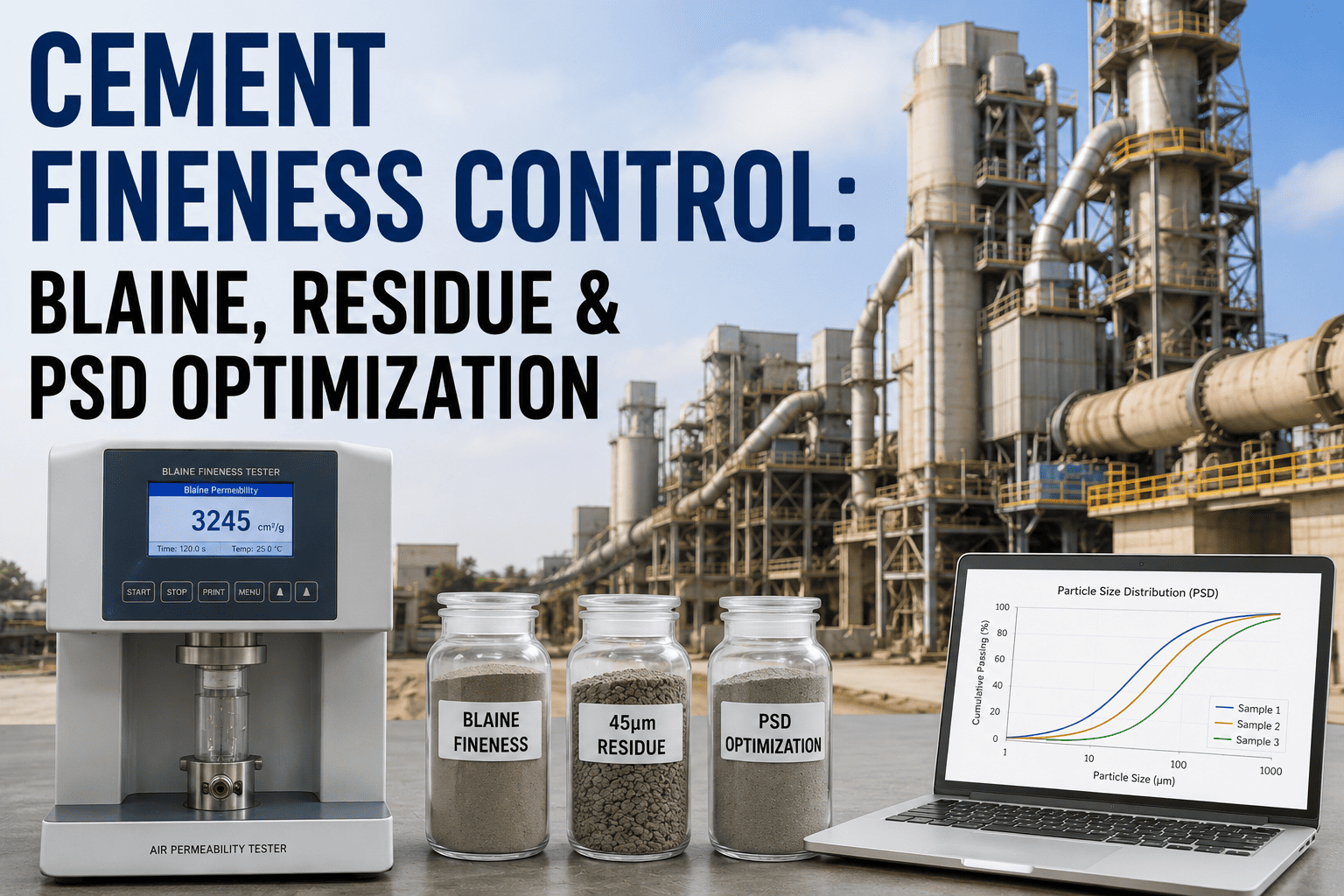
Finish mill APC targets product Blaine surface area and residue simultaneously — a multi-variable control problem that single-loop PID controllers handle poorly because feed rate changes affect both Blaine and mill loading in coupled ways. iFactory's finish mill APC uses a decoupled multi-variable model to adjust fresh feed rate, separator speed, and water injection in coordinated moves that maintain Blaine target within ±50 cm²/g versus the ±180 to ±250 cm²/g typical under manual control. Tighter Blaine control reduces over-grinding energy waste and allows the finish mill to run closer to its design feed rate without quality exceedances.
Plant-Wide Process Coordinator Logic
The plant-wide coordinator layer manages production rate optimization across the full process chain — kiln feed, kiln throughput, and finish mill intake — to maximize clinker output within quality and energy constraints. When the APC system detects that kiln thermal stability allows throughput increase, the coordinator layer recommends coordinated feed rate increases across kiln and raw mill that maintain quality targets. During periods of feed chemistry excursion or equipment constraint, the coordinator layer reduces throughput proactively to prevent quality rejects rather than reacting after they occur.
Expert System Rule Architecture — How iFactory Codifies 30 Years of Kiln Operator Knowledge
Model-predictive control handles quantitative process optimization — adjusting setpoints to minimize a cost function subject to constraints. Expert systems handle qualitative operational knowledge — the rules that experienced kiln operators follow when they recognize a pattern that does not appear in the model's training data. iFactory's expert system layer combines both into a single control advisory output. The expert rule library is structured around five operational scenario categories: normal production optimization, transition management, quality excursion response, equipment constraint management, and shutdown/startup sequencing.
During stable production, expert rules manage the trade-off between throughput maximization and energy minimization — implementing proven operator heuristics such as "increase feed rate by 0.5% per hour when burning zone temperature is stable within ±15°C for 45 consecutive minutes" that cannot be expressed in a standard MPC cost function but represent decades of operational experience encoded into reproducible logic.
When on-line analyzer data indicates a raw mix LSF shift of more than 2 units, the expert system fires a transition rule sequence that pre-adjusts kiln fuel rate and feed rate to absorb the chemistry change without burning zone disruption — a management technique that experienced kilnmen apply instinctively but that basic APC systems without rule layers miss until the chemistry change propagates into clinker quality.
When free lime trends above the upper control limit, the expert rule system activates a structured response sequence — fuel increase, feed rate reduction, and draught adjustment — in a prioritized order that protects refractory while correcting the free lime excursion. The response sequence is faster and more consistent than manual correction and eliminates the operator-to-operator variability in how quality excursions are handled across shifts.
When kiln drive current, induced draught fan power, or preheater back-pressure approaches equipment limits, expert rules reduce process load proactively — preventing the equipment trips that create production losses larger than the throughput gain that drove the machine toward its limit in the first place. Constraint management rules reduce unplanned kiln stops by 25 to 40% at plants where equipment limits were previously managed reactively by operators.
Expert rules manage the ramp-up sequence from cold start to full production — applying proven heat-up curves, refractory protection ramp rates, and chemistry stabilization hold points that minimize startup energy consumption and time-to-stable-production. iFactory-managed startups reduce time-to-full-production by 18 to 28% versus manual sequencing and reduce off-spec clinker produced during the startup stabilization period.
APC vs. Basic DCS Control — Performance Comparison Across Key Process KPIs
The performance difference between APC-controlled and manually-controlled kiln and mill circuits is consistent across process metrics and across plant sizes. The comparison below documents performance outcomes across four core KPIs for plants operating under three control regimes: manual DCS operation with basic PID loops, rule-based expert system without model-predictive control, and iFactory's full APC with integrated expert system. Data is sourced from U.S. cement plant deployments with 4,000 to 6,500 TPD single-kiln production rates.
| Process KPI | Manual DCS / Basic PID | Expert System Only | iFactory APC + Expert System | Improvement vs. Manual |
|---|---|---|---|---|
| Free lime standard deviation (% absolute) | 0.38–0.52% | 0.28–0.38% | 0.16–0.24% | 38–52% reduction |
| Kiln thermal energy (kcal/kg clinker) | 760–820 kcal/kg | 730–780 kcal/kg | 705–755 kcal/kg | 3.8–6.2% reduction |
| Finish mill Blaine deviation (±cm²/g) | ±180–250 cm²/g | ±120–160 cm²/g | ±45–70 cm²/g | 72–80% tighter control |
| Unplanned kiln stops (per quarter) | 4.2–7.8 stops/qtr | 2.8–5.0 stops/qtr | 1.2–2.4 stops/qtr | 63–71% reduction |
| Kiln throughput utilization (%) | 88–93% | 91–95% | 95–98% | +5–7% utilization gain |
APC Implementation Checklist — What iFactory Configures and Monitors Continuously
The checklist below covers the 22 configuration parameters and continuous monitoring actions that define a fully operational iFactory APC deployment. Parameters are organized by control domain. Items marked as model-based are computed from the MPC thermal and quality models; items marked as rule-based are managed by the expert system rule engine. All parameters are available on the iFactory process dashboard in real time.
- Burning zone temperature model — model-based, 30-sec update
- Fuel rate setpoint advisory — model-based, real-time
- Kiln feed rate optimization — model-based, real-time
- O2 and CO profile trending — rule-based monitoring
- Refractory protection constraint tracking — rule-based
- Secondary and tertiary air temperature control — model-based
- LSF, SM, AM target tracking — model-based, real-time
- Separator speed optimization — model-based
- Feed chemistry excursion rule triggers — rule-based
- Mill differential pressure stability — real-time
- Component proportioning correction — rule-based
- 90-micron residue trending — model-based
- Blaine target deviation tracking — model-based, real-time
- Fresh feed rate advisory — model-based
- Water injection decoupled control — model-based, trended
- Over-grinding energy penalty tracking — rule-based
- Separator speed decoupled advisory — model-based
- Plant throughput optimizer — coordinator layer, real-time
- Free lime exceedance prediction — model-based, trended
- Unplanned stop risk scoring — rule-based, hourly
- Energy cost per tonne attribution — coordinator, daily
- Startup sequence progress tracking — rule-based
Expert Review: What Cement Plant Process Engineers Say About APC Implementation
I have commissioned APC systems at four U.S. cement plants over fifteen years, and the experience at two plants using iFactory's platform stands apart from the legacy APC vendors in one specific way: the expert rule layer is transparent and maintainable by the plant's own process engineers. With traditional APC vendors, the rule base is a black box — the vendor commissions it, the vendor updates it, and when the process changes or the kiln is relined, you need a service call to recalibrate the model. With iFactory, the rule library is documented, accessible, and editable by the process engineering team. When we relined the kiln and the thermal model needed recalibration, our process engineer updated the heat transfer parameters in the iFactory configuration interface over a weekend without a vendor dispatch. That is a fundamental difference in the long-term total cost of APC ownership. The performance numbers at the second iFactory deployment I managed were a 4.9% reduction in thermal energy per tonne — equivalent to $890,000 per year at our fuel cost — and a free lime standard deviation that dropped from 0.44% to 0.19% absolute within the first three months of full deployment. The finish mill Blaine control tightened to plus or minus 55 cm²/g from the plus or minus 210 cm²/g we were running under manual control, which allowed us to reduce the finish mill energy buffer we had been using to avoid Blaine underruns. Total value realization in year one was $1.26 million at a 5,200 TPD plant with two-component fuel and a four-stage preheater kiln.
— Senior Process Engineer, U.S. Portland Cement Plant — 15 Years in Cement APC Commissioning and Process Optimization — Licensed Professional Engineer (PE), Chemical EngineeringConclusion
Advanced process control and expert systems in cement plants are not software projects — they are operational infrastructure that determines the precision with which every kiln and mill in the plant converts fuel and raw material into specification-grade clinker and cement. The performance gap between plants operating under manual DCS control and plants with deployed APC is not incremental: it is 3 to 6% of total kiln fuel cost, 38 to 52% of free lime variability, and 63 to 71% of unplanned kiln stops — differences that accumulate to seven-figure annual savings at every plant above 4,000 TPD operating rate.
iFactory's APC and expert system module provides the control layer that closes that gap — connecting to existing DCS and analyzer infrastructure via the OPC-UA edge gateway within 6 to 10 weeks, delivering model-predictive setpoint advisory and expert rule logic across kiln, raw mill, and finish mill circuits, and giving plant process engineers a transparent, maintainable control system they can calibrate and update without vendor dependency. The documented performance outcomes at U.S. cement plant deployments confirm that APC is the highest-return process investment available to any cement plant still managing kiln and mill circuits under manual or basic PID control. Book a Demo to see iFactory's APC module configured for your plant's kiln and mill circuits.
Frequently Asked Questions
No. iFactory connects to existing DCS, PLC, and on-line analyzer systems via the OPC-UA edge gateway — operating as a supervisory advisory layer above existing control infrastructure without requiring DCS replacement or hardware modification.
Initial kiln thermal model calibration typically requires 3 to 4 weeks of connected operation for data collection. Expert rule commissioning begins in parallel. Full APC deployment with validated model performance runs 6 to 10 weeks from gateway connection to live operation.
Yes. iFactory's rule library is fully accessible and editable by the plant's process engineering team through the configuration interface — enabling independent recalibration after kiln relinings, fuel blend changes, or raw mix chemistry shifts without vendor dispatch or service contracts.
At 4,000 to 6,500 TPD plants, documented year-one savings range from $620,000 to $1.4 million. Deployment costs for a single-kiln plant with raw mill and finish mill APC typically run $95,000 to $210,000, producing full payback in 2 to 5 months of live operation. Book a Demo for a site-specific ROI estimate.
Yes. iFactory's kiln APC thermal model supports multi-fuel configurations including coal, petcoke, natural gas, and alternative fuel co-processing blends. The model accounts for alternative fuel heat value variability and moisture content to maintain burning zone stability during fuel blend transitions.