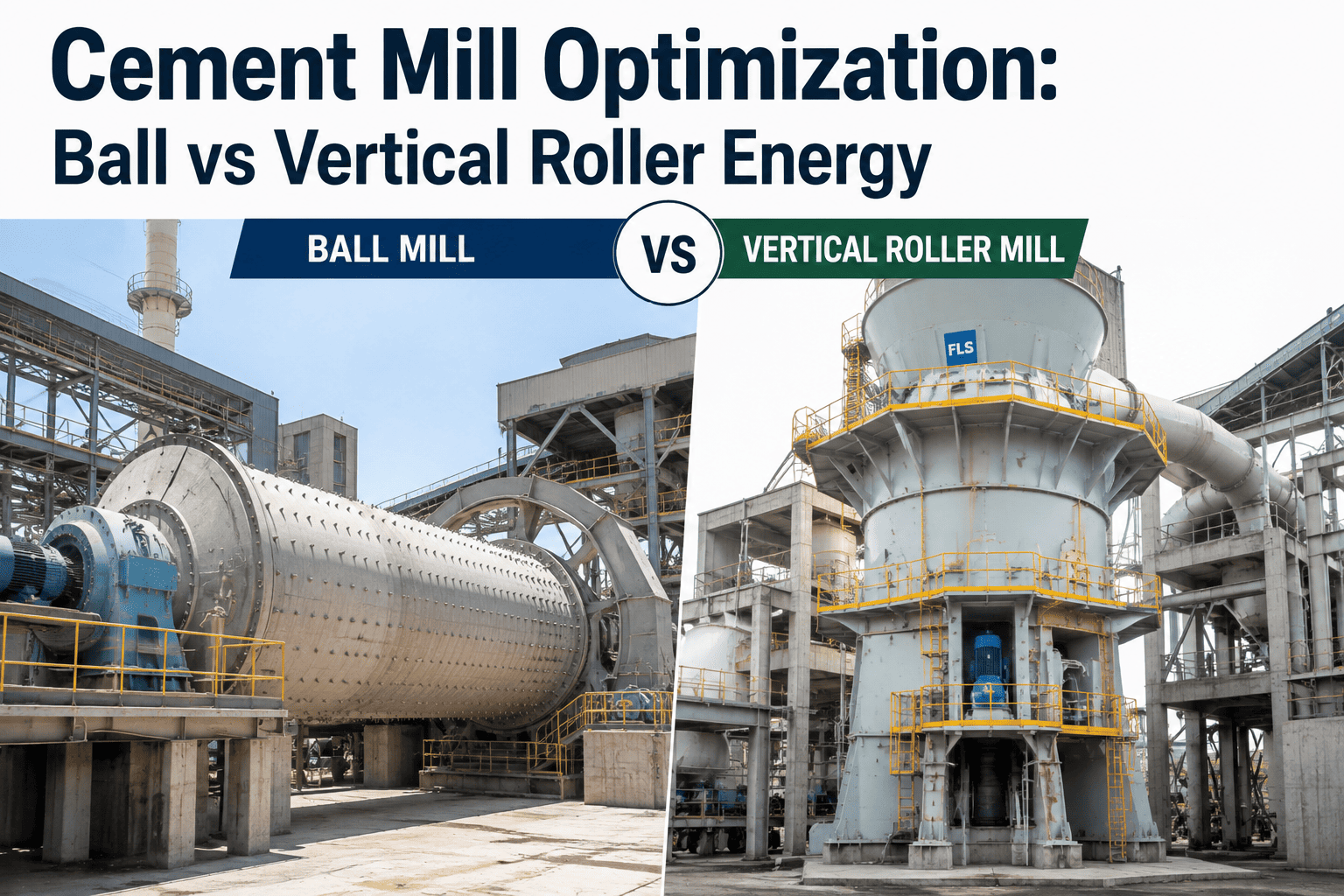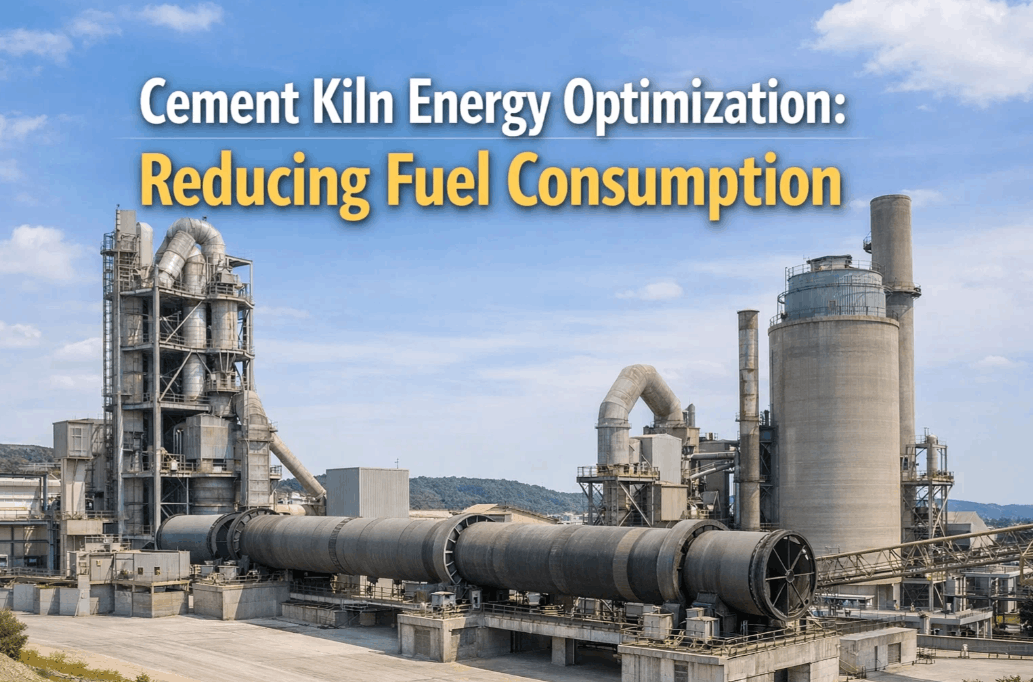
Kiln and mill energy consumption in a cement plant isn't set once and left alone — it drifts constantly with raw meal chemistry, fuel quality, ambient humidity, and dozens of other variables shifting minute to minute. Operators manage this with setpoint ranges built from experience, adjusting one variable at a time and waiting to see the result before touching the next. By the time a change in burning zone temperature shows up in specific fuel consumption, the moment to act on it has often passed, and the next disturbance is already underway. AI-driven multi-variable control processes those interactions in real time, well past what a human operator can track manually — book a demo to see it running against your own kiln and mill data.
Energy Management · Real-Time Kiln & Mill Optimization
AI Energy Optimization for Kiln and Mill Operations, Adjusted in Real Time
Kiln burning zone temperature, mill separator speed, excess air, and grinding pressure all interact — change one and three others move with it. AI multi-variable control reads all of them together, predicts the energy impact of each adjustment, and tunes setpoints continuously instead of waiting for the next manual round.
Burning Zone Temp
CurrentTarget Band
Specific Thermal Energy
CurrentTarget Band
Mill Specific Power
CurrentTarget Band
Kiln Exhaust O2
CurrentTarget Band
Why This Is Hard Manually
Kiln and Mill Energy Are Governed by Variables That Move Together, Not One at a Time
01
Variables Interact, Not Isolate
Raising kiln feed rate changes burning zone temperature, which changes excess air requirements, which changes ID fan power draw — a single adjustment ripples through the whole system before an operator can evaluate its effect on any one number.
02
Experience-Based Setpoint Ranges
Most operating windows come from what's worked before, not from a model of the current raw meal chemistry, fuel mix, and ambient conditions — which means the same setpoint can be efficient one shift and wasteful the next.
03
Lag Between Action and Result
Kiln thermal response can take twenty minutes or more to fully show up downstream, so an operator adjusting fuel rate is often reacting to a condition that's already changed by the time the effect is visible.
04
Kiln and Mill Treated Separately
Kiln combustion tuning and mill grinding efficiency are usually optimized by different people on different shifts, even though clinker hardness from the kiln directly affects how much power the mill needs to grind it.
How Multi-Variable Control Works
From Live Sensor Data to an Adjusted Setpoint
1
Live Data Captured Across Both Processes
Kiln temperatures, O2 and CO readings, fuel rates, mill power draw, separator speed, and feed rate are all read continuously from the DCS rather than sampled periodically.
2
Model Predicts How Variables Interact
The model has learned how a change in one variable — feed rate, fuel mix, mill load — propagates through the rest of the process, based on the plant's own operating history rather than generic assumptions.
3
Optimal Setpoints Calculated Together
Instead of optimizing one variable at a time, the system calculates a coordinated set of adjustments across fuel rate, air flow, and mill parameters that lowers energy use without pushing any single reading outside its safe range.
4
Adjustment Applied — Advisory or Automatic
Depending on how the plant configures it, the recommended setpoints are either pushed to the operator as a suggestion or written directly to the control loop within pre-approved limits.
5
Result Monitored and Model Retrained
The actual outcome of each adjustment feeds back into the model, so it keeps adapting as raw material sources, fuel blends, or equipment condition change over time.
What Actually Changes
Traditional Control vs. AI Multi-Variable Optimization
| Dimension | Traditional PID / Rule-Based Control | AI Multi-Variable Control |
|---|---|---|
| Variables considered per adjustment | One loop tuned in isolation | Multiple interacting variables evaluated together |
| Response to changing conditions | Fixed setpoint ranges until manually retuned | Continuously adapts as raw meal, fuel, and ambient conditions shift |
| Prediction horizon | Reactive, adjusts after a deviation appears | Predictive, anticipates the effect before it fully develops |
| Kiln-mill coordination | Optimized independently by separate teams | Clinker quality and mill load considered together |
| Operator role | Makes every adjustment manually | Reviews and approves system-recommended setpoints |
Kiln-Side Optimization
Where AI Control Applies on the Kiln
Burning Zone Temperature Stability
Holding burning zone temperature in a tighter band reduces the fuel spent over-firing to compensate for swings, while still protecting clinker quality against under-burning.
Excess Air and O2 Trim
Running excess air closer to the minimum needed for complete combustion cuts the fuel wasted heating air that does no useful work, without drifting into incomplete-combustion territory.
Alternative Fuel Blend Ratio
As alternative fuel proportions shift, the model adjusts primary fuel and air setpoints to hold thermal output steady instead of leaving that compensation to operator judgment.
Clinker Cooler Airflow
Cooler airflow is coordinated with kiln firing rate so secondary air temperature stays where combustion needs it, recovering more heat back into the process instead of losing it out the stack.
See Your Kiln and Mill Data in the Model
Run a Live Comparison Against Your Current Setpoints
Bring a week of kiln and mill process data and we'll show what the model would have recommended, and roughly what that difference means in specific energy consumption.
Mill-Side Optimization
Where AI Control Applies on the Mill
Separator Speed Optimization
Separator speed is tuned continuously against actual fineness readings rather than a fixed setting, avoiding the over-grinding that burns extra kWh per ton for no product-quality benefit.
Feed Rate and Mill Load Balancing
Feed rate is adjusted to keep mill load in the efficient operating band, since both underloading and overloading push specific power consumption up in different ways.
Grinding Aid Dosing
Dosing is correlated against measured grinding efficiency instead of a flat rate, so the aid is applied where it actually reduces energy use rather than as a standing assumption.
Ventilation and Fan Power
Mill ventilation is matched to actual material flow and fineness targets, trimming fan power that's often set conservatively high and left unadjusted for months at a time.
Looking Ahead, Not Just Reacting
Energy Consumption Prediction Before the Shift Even Starts
Beyond real-time adjustment, the same model can forecast expected specific energy consumption for an upcoming shift based on planned feed rate, scheduled fuel blend, and current ambient conditions — giving operations a target to plan against instead of only a number to react to after the fact.
| Forecast Input | What It Adjusts For |
|---|---|
| Planned kiln feed rate | Expected thermal load and fuel demand for the shift |
| Scheduled fuel blend | Heating value and combustion characteristics of the fuel mix |
| Ambient temperature and humidity | Combustion air density and cooling system efficiency |
| Raw meal chemistry trend | Burnability and expected fuel requirement to reach target clinker quality |
Advisory or Closed-Loop
How Automated Adjustment Actually Runs
Advisory Mode
Recommended setpoint changes appear to the operator with the expected energy impact, and the operator applies or rejects each one — a common starting point while trust in the model builds.
Closed-Loop Mode
Adjustments within pre-approved limits are written directly to the control system, with hard guardrails on safety-critical variables and an operator override available at any time.
A Composite Scenario
Mid-Size Kiln Line, Six-Month Rollout
Before
Kiln burning zone temperature and mill separator speed were each managed by different shift teams using setpoint ranges built over years of experience. Specific thermal energy and mill power consumption both varied noticeably between shifts, and nobody could say with confidence which shift's habits were actually more efficient.
After
The AI model started in advisory mode, showing each shift the same recommended setpoints regardless of who was on console. After six months, kiln and mill setpoints moved into closed-loop control within agreed guardrails, and shift-to-shift variation in specific energy consumption narrowed substantially.
Before You Start
Getting Ready for AI Energy Optimization
Confirm DCS or PLC access to the kiln and mill process points the model would need to read
Gather at least several months of historical process data to train the model against your specific plant behavior
Decide whether to start in advisory mode or move toward closed-loop control, and set the guardrails either way
Align kiln and mill teams on shared energy targets rather than optimizing each process independently
Common Questions
AI Kiln and Mill Energy Optimization — FAQ
Does the AI system take control away from operators?
Not by default. Most plants start in advisory mode, where the system recommends setpoint changes and the operator decides whether to apply them. Moving to closed-loop control for specific variables is a separate decision made once confidence in the recommendations is established, and an override is always available. Talk to our team about how that transition is typically staged.
How is this different from the DCS's existing PID loops?
PID loops hold individual variables to a fixed setpoint, one at a time. The AI layer sits above that, adjusting the setpoints themselves based on how multiple variables are interacting in real time — it doesn't replace the DCS control loops, it makes smarter use of them.
Can the model handle changes in fuel mix or raw material source?
Yes — the model retrains continuously on the plant's own operating data, so as fuel blends shift or a new raw material source comes online, its recommendations adapt rather than staying fixed to conditions that no longer apply.
Does clinker quality get affected by chasing energy savings?
Quality constraints are built into the optimization itself, not treated as an afterthought — the model is not permitted to recommend a setpoint that would push clinker quality outside its target range, even if that setpoint would use less energy.
How long before we'd see a measurable energy impact?
It depends on the plant's current setpoint variability and how much of the kiln-mill interaction is currently left to manual judgment, but most rollouts see the model producing useful recommendations within the first few weeks of data collection. Book a demo to map out a realistic timeline for your line.
Stop Optimizing One Variable at a Time
Put Kiln and Mill Energy Under One Coordinated Model
iFactory reads kiln and mill process data together, predicts how they interact, and recommends or applies the setpoints that keep energy use down without putting clinker quality at risk.