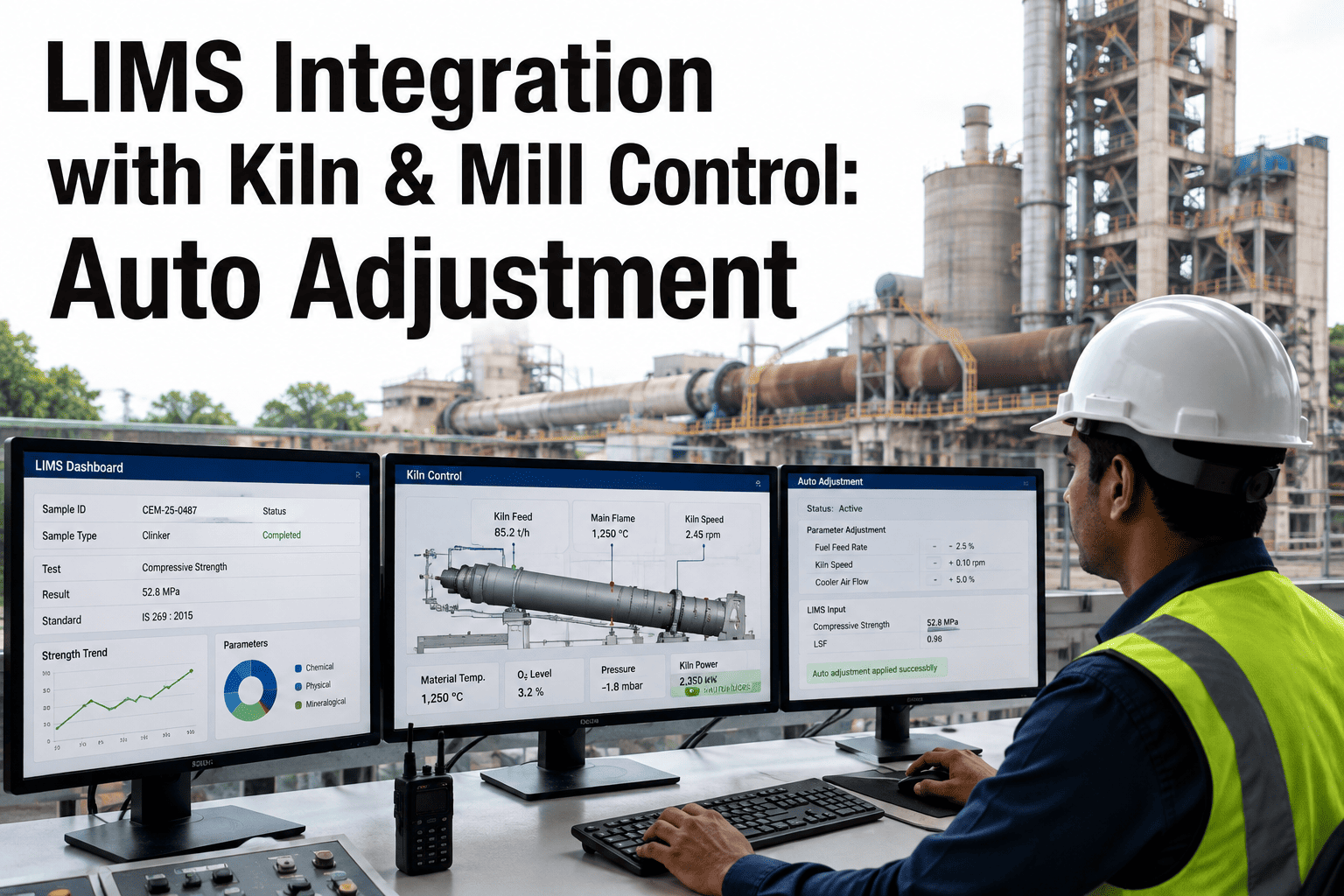
A free lime spike on a cement kiln is a chemistry problem with a clock attached to it. The moment a raw mix ratio drifts out of target, every tonne of kiln feed processed before that drift is corrected becomes clinker that needs blending, reprocessing, or quality compromise downstream. In a plant where lab results still travel by phone call or handwritten note, the gap between "the lab knows" and "the kiln operator can act" routinely runs twenty to forty minutes — and that gap is pure unmanaged risk, not a chemistry limitation. Integrating LIMS directly with kiln and mill control closes that gap structurally, and plants that want to see what a closed-loop quality adjustment actually looks like on their own DCS screens can Book a Demo to walk through it.
Why Quality Results Need to Reach the Control Room Instantly
Cement kilns are large-mass thermal systems, and that mass is exactly why the timing of a correction matters as much as the correction itself. A raw mix adjustment applied within minutes of a free lime deviation can steer the process back toward target before the kiln's thermal inertia has carried the drift very far. The same adjustment applied forty minutes later is fighting a process that has already moved considerably further from target, which means the correction itself often needs to be larger and takes longer to fully settle. In practice, this means data lag does not just delay the correction — it makes the correction itself less efficient once it finally happens.
Kiln control already runs on continuous data — temperature, oxygen, draft, torque — arriving on the DCS screen in real time. Quality data has historically been the exception, arriving in a batch every hour or two hours as a technician finishes a test and relays the number verbally or via a shared spreadsheet. That mismatch means the operator is making continuous adjustments to a process using one data stream that updates every second and another that updates every hour, and treating the slower stream as though it reflects current conditions when it may already be forty minutes stale by the time it is read.
The practical effect shows up most clearly during upset conditions — a raw material quality change, a feeder malfunction, a sudden shift in fuel characteristics — where the free lime or LSF trend is moving quickly and a forty-minute-old result is actively misleading rather than simply delayed. LIMS-to-DCS integration does not change how fast the chemistry test itself runs, but it removes every step after the test completes that previously depended on a person noticing, writing down, and relaying the number.
There is a second, less obvious cost to the manual relay model: it shapes how operators treat the data itself. When an operator knows a free lime number might already be thirty minutes old by the time it reaches them, the rational response is to discount it slightly — to treat it as a directional indicator rather than a precise current reading, and to lean on process feel and DCS trend lines as the primary decision input. That is a reasonable adaptation to unreliable timing, but it also means the lab's most carefully produced numbers end up carrying less operational weight than the effort put into generating them deserves. Closing the timing gap does not just speed up the existing decision process — it restores the lab result to the position it should occupy: a precise, trustworthy, current input rather than a delayed confirmation of what the process trend already suggested.
| Control Loop Characteristic | Manual Relay (Open Loop) | LIMS-DCS Integrated (Closed Loop) |
|---|---|---|
| Result availability to operator | Verbal relay, 20–40 min lag typical | Pushed to DCS screen automatically |
| Consistency across shifts | Depends on individual communication habits | Identical process every result, every shift |
| Out-of-spec response | Requires someone to notice and escalate | Automatic threshold-based alert |
| Adjustment record | Rarely logged with precise timing | Every adjustment timestamped and traceable |
| Correlation with process trend | Manual, after the fact if done at all | Continuous, built into the data pipeline |
What Gets Auto-Adjusted: The Setpoints Cement Quality Data Actually Touches
Closed-loop quality integration is not a single switch — it is a set of specific setpoints that respond to specific test results, configured against the control limits a plant's quality team already works within. The categories below cover the adjustments most cement plants configure first, roughly in order of how directly the underlying test result maps to a single control action. Each one starts life as a recommendation an operator reviews before it becomes a setpoint the system can apply within an agreed range, and most plants keep it at the recommendation stage for as long as it takes to build genuine confidence in the correlation between the lab result and the correct process response.
Each of these five categories is configured independently, with its own thresholds, its own automation level, and its own escalation path, which means a plant can extend closed-loop integration one setpoint at a time rather than committing to a wholesale change across the entire control system at once.
Inside the Closed Loop: From Lab Result to Process Setpoint
The stages below describe what actually happens between a sample landing on the lab bench and a setpoint changing on the DCS, and they are the same five stages regardless of which specific quality parameter is being tracked — free lime, fineness, or setting time all move through the same structural path, just against different thresholds and different downstream setpoints.
The Guardrails: Why Auto-Adjustment Isn't the Same as Unsupervised Control
These guardrails exist because closed-loop quality control is meant to remove delay and inconsistency from the human side of the process, not to remove the human from the process entirely. A kiln operator's process feel — the sense of how the flame looks, how the kiln is drawing, how a specific raw material lot has been behaving that day — is exactly the kind of contextual judgment a rule-based system does not have access to, and the guardrail structure is built specifically to keep that judgment in the loop rather than override it. The result is a system that moves faster than a manual process on the parts that are genuinely mechanical, while leaving the parts that require experience exactly where they have always been.
Why This Is Becoming Standard Now, Not a Future Roadmap Item
Closed-loop LIMS-DCS integration has moved from an ambitious pilot project to a practical near-term rollout for a straightforward reason: the pieces that used to make it difficult have largely resolved themselves. Modern DCS and PLC platforms deployed as part of broader control system modernization projects already support the industrial communication standards that a LIMS integration layer needs, which means the integration work is now largely a configuration exercise rather than a custom engineering project. A decade ago, connecting a laboratory system to kiln control meant bespoke point-to-point interfaces that were expensive to build and fragile to maintain; today it means mapping a defined set of data tags through a standard interface layer.
The second driver is cost pressure. Fuel and energy costs have become a larger share of cement production economics than they were even five years ago, particularly for plants blending in alternative fuels with variable calorific value, and that variability makes the margin for error on kiln feed and fuel split decisions tighter than it used to be. A plant running on delayed quality data can absorb that variability less gracefully than one where fuel split adjustments respond to current chemistry within minutes rather than the better part of an hour. The plants moving first on closed-loop integration tend to be the ones already under the most pressure to defend margin, which is a reasonable signal for where the rest of the industry is heading over the next several years.
The Numbers: What Closed-Loop Quality Control Changes
The largest single benefit reported by plants that move to closed-loop quality control is not any individual number above — it is the reduction in variability between shifts. A manual relay process depends heavily on how promptly and accurately an individual technician and operator communicate, which means quality response quality effectively varies by who is on shift. Closing the loop through the LIMS-DCS integration removes that dependency, so the third-shift response to a free lime deviation looks the same as the day-shift response, because both are running through the same automated path rather than a different set of human habits.
That consistency compounds into a second effect worth quantifying separately: tighter quality bands without added safety margin. When a process runs on delayed, inconsistent data, the natural operating response is to build in buffer — targeting a slightly more conservative free lime, holding a slightly higher fineness margin, or running fuel splits more cautiously than the chemistry strictly requires. That buffer is a rational hedge against uncertain data, but every unit of it also represents raw material, fuel, or clinker factor spent defending against a timing problem rather than a genuine process constraint. As closed-loop response becomes the default and the plant's confidence in current-state data grows, quality teams typically find they can narrow those operating margins without increasing the rate of off-specification product, because the actual driver of the previous margin was never the chemistry — it was the lag.
This is also where the case for closed-loop integration extends beyond any single plant's numbers to the broader economics of cement production. Fuel and raw material costs represent a meaningful share of production cost at any integrated plant, and even a modest reduction in the safety margin a plant carries to defend against data lag translates into real savings across a full year of production. Combined with the labor time saved from eliminating manual relay and the reduction in off-target clinker requiring rework, the case for LIMS-DCS integration tends to build on itself once a plant sees the first few months of data, since each of the individual benefits reinforces confidence in extending automation to the next setpoint.