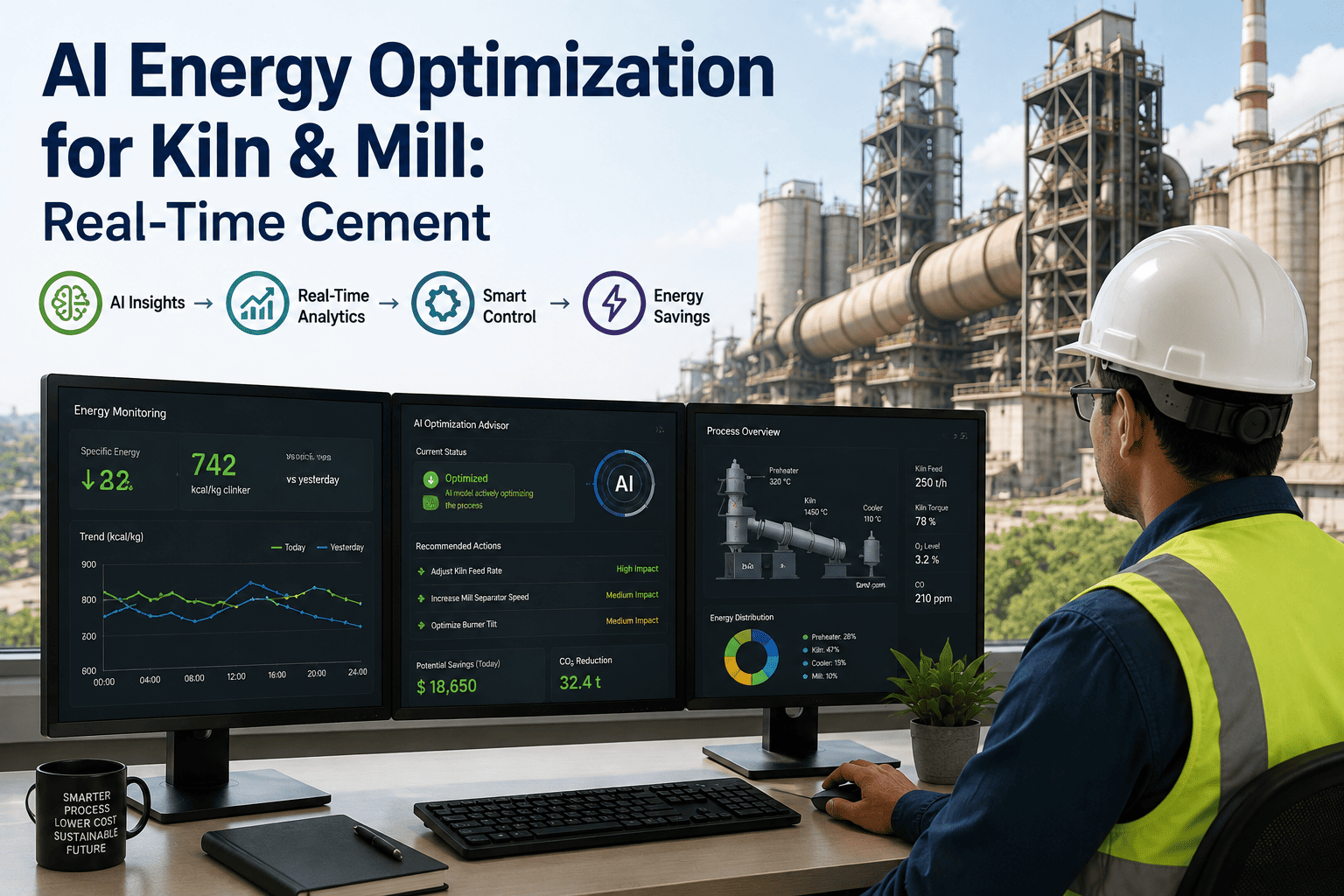
Fuel accounts for roughly a fifth to a third of everything a cement plant spends to make clinker, and most of that fuel burns through a kiln whose control setpoints haven't changed since commissioning. Operators respond to lab results that arrive twenty minutes after the material has already left the burning zone, and every setpoint carries a safety margin wide enough to cover the worst raw meal batch of the year, every single shift. The gap between what a kiln could burn and what it actually burns is where iFactory's real-time combustion optimization engine operates, reading dozens of process variables every few seconds and adjusting fuel and air setpoints before quality drifts, not after it's confirmed.
Your Kiln Is Burning More Fuel Than It Needs To
Every kiln running on fixed setpoints is compensating for the worst-case raw meal, the worst-case fuel batch, and the coldest morning of the year — all at once, all the time. Real-time AI control closes that gap continuously instead of leaving it on the table.
Why Fixed Setpoints Waste Fuel Every Single Shift
Most kiln control rooms run on setpoints tuned years ago for worst-case conditions — the hardest raw meal, the most variable fuel, the coldest ambient air. That conservatism protects clinker quality and prevents shutdowns, but it has a continuous cost. When raw meal composition shifts toward easier-to-burn material, the kiln keeps firing at the same intensity. When fuel calorific value improves on a given delivery, the extra heat goes into overburning instead of savings. When ambient conditions favor efficient combustion, nothing captures the advantage because nobody is watching closely enough, continuously enough, to act on it.
What the Optimization Engine Actually Watches
A single-loop PID controller reacts to one variable at a time — burning zone temperature drifts, so fuel feed adjusts, with no awareness of what draft, kiln speed, or precalciner temperature are doing at the same moment. Multi-variable control evaluates the whole system state together and moves several setpoints in a coordinated way, every few seconds, instead of one knob reacting late to one symptom.
| Variable Monitored | What It Signals | Typical Adjustment Window |
|---|---|---|
| Burning zone temperature | Clinker mineralogy and free lime trend | Seconds to minutes |
| Fuel calorific value / moisture | Energy actually delivered per unit of fuel fed | Per delivery batch, continuously tracked |
| Primary and secondary air ratio | Combustion efficiency and flame shape | Seconds |
| Kiln speed and draft | Material residence time and heat transfer | Minutes |
| Precalciner temperature | Calcination completeness before the kiln inlet | Minutes |
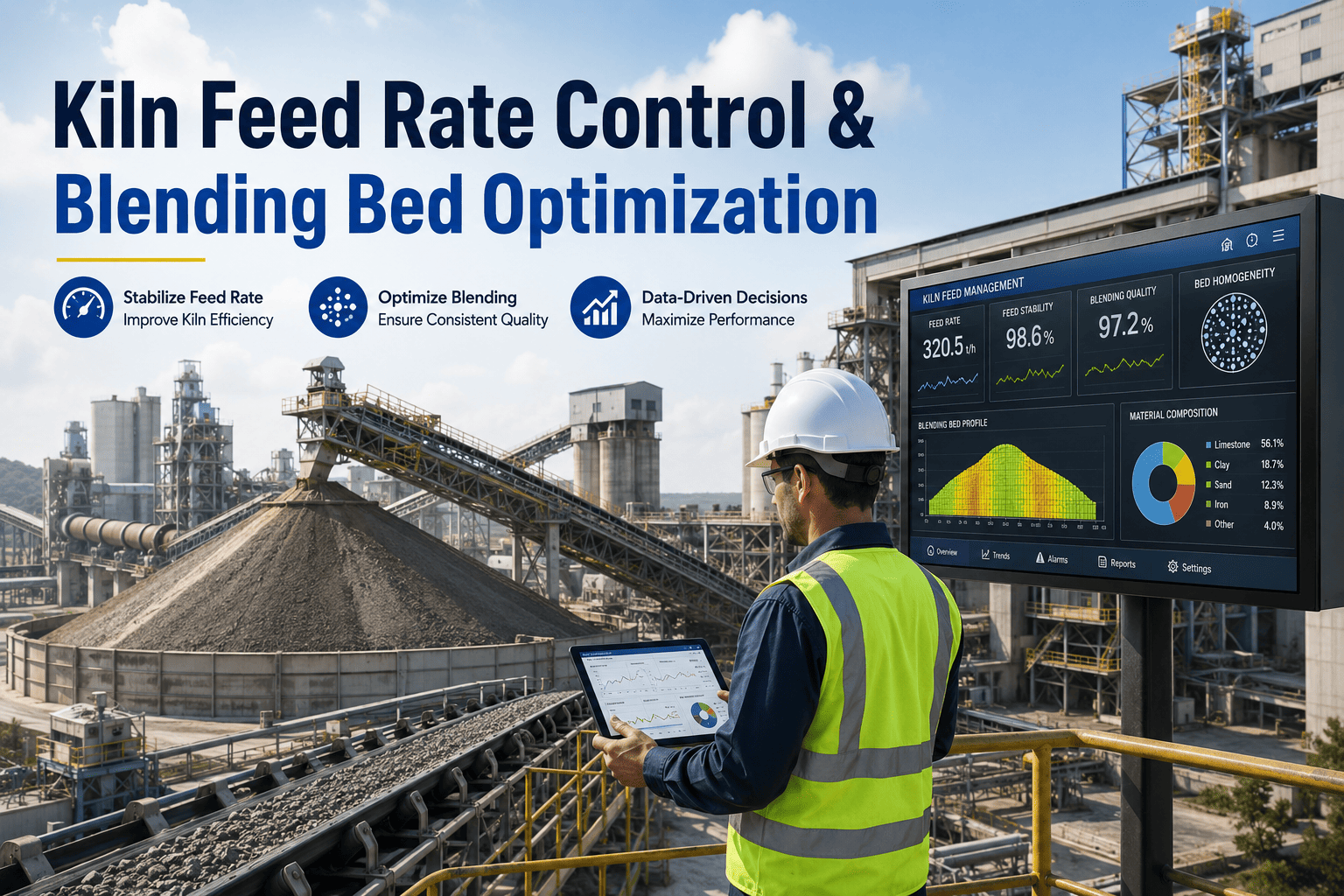
| Raw meal chemistry (LSF, SM, AM) | How easily the current batch will burn | Per feed change |
Fuel Blend Selection as a Continuously Re-Solved Problem
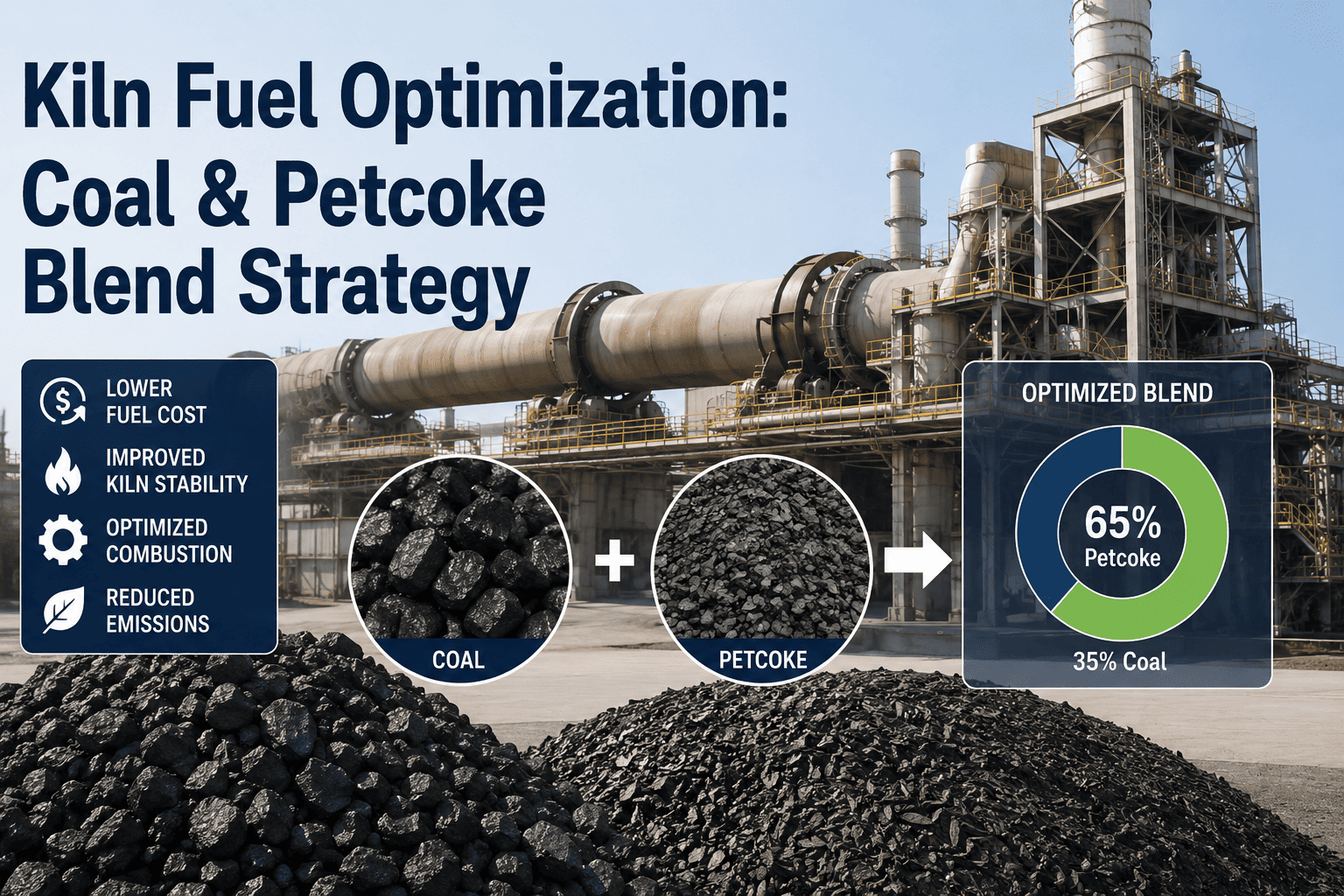
Alternative fuels — tires, RDF, biomass, waste solvents — introduce calorific value swings of 20 to 40 percent between deliveries and moisture variability from 5 to 45 percent depending on source. A fixed feed rate treats every delivery the same, which means the kiln either underfires on a low-CV batch or overfires on a high-CV one. Machine learning treats blend selection as a problem that gets re-solved continuously: the model correlates real-time process data, combustion air ratios, and kiln thermal profile against clinker quality outcomes, then recommends the fuel mix and feed rate that hits target free lime without the swings a human operator would only catch after the fact.
A Plant That Thought Its Kiln Was Already Efficient
A 3,200 TPD kiln running a 35 percent alternative fuel substitution rate had stable clinker quality and no obvious complaints from operations. But a energy audit found the kiln was overburning on roughly two shifts out of three — the setpoints, tuned for the hardest raw meal batch the plant had ever received, never relaxed when easier material came through. Once real-time AI control took over setpoint recalculation, the plant's specific heat consumption dropped from 720 kcal/kg clinker to about 660 kcal/kg within the first quarter, without any change to raw material sourcing or fuel mix. The fuel was always available to save. Nobody was watching closely enough to release it.
Advisory Mode First, Closed Loop Second
Deploying AI on a kiln does not require ripping out the existing DCS. The technology layers on top of current infrastructure, connecting data from sensors already installed to a new intelligence layer that recommends — and eventually writes — setpoints. Most plants start in advisory mode, where operators see the recommended setpoint alongside the current one and validate it against their own experience before trusting the system to act autonomously.
See What Your Kiln Is Leaving on the Table
iFactory connects to your existing DCS and sensors to show, in real time, how far your current setpoints sit from the fuel-optimal ones — without touching your control architecture until you're ready.
Common Mistakes That Undercut Fuel Savings
Tuning Once, Never Retuning
Raw material sources, fuel suppliers, and equipment condition all drift over months. A model trained once on old operating history slowly diverges from current reality unless it keeps learning from new data.
Treating Free Lime as the Only Quality Signal
Optimizing purely for free lime while ignoring C3S content, burnability index, or coating stability can produce clinker that passes one test and underperforms in the mill or in strength development later.
Skipping the Advisory Phase
Jumping straight to closed loop control without an advisory period leaves operators with no basis to trust or challenge the system's recommendations when something looks unusual on a given shift.
Ignoring Equipment Degradation Signals
A burner tip wearing down or a coating buildup in the calciner both quietly increase fuel consumption long before they show up as a maintenance event — a combustion model that only watches process variables misses them.
Estimating the Fuel Savings on Your Own Kiln
A rough savings estimate doesn't require a full audit before you start — it requires three numbers you likely already have: your current specific heat consumption in kcal per kg of clinker, your annual clinker tonnage, and your delivered fuel cost per unit of energy. A kiln burning at 750 kcal/kg against a realistic optimized target of 680 kcal/kg on a 3,000 TPD line is releasing roughly 70 kcal/kg it doesn't need to spend, which across a full year of production adds up to a fuel bill difference most finance teams will recognize immediately once it's translated from a percentage into a dollar figure.
| Plant Scale | Typical Current SHC | Realistic Optimized SHC | Approx. Annual Savings Range |
|---|---|---|---|
| 1,500 TPD line | 780–820 kcal/kg | 700–740 kcal/kg | $400K–$800K |
| 3,000 TPD line | 740–780 kcal/kg | 670–710 kcal/kg | $900K–$1.6M |
| 5,000+ TPD line | 720–760 kcal/kg | 660–690 kcal/kg | $1.6M–$2.8M |
These ranges assume a plant starting from genuinely conservative, rarely-revisited setpoints — a plant that has already invested heavily in manual process optimization will naturally see savings toward the lower end, since less inefficiency is left on the table for the AI layer to capture. The number that matters is the gap between your current SHC and the achievable target for your specific kiln design and fuel mix, not an industry-wide average applied uniformly.
How a Typical Deployment Unfolds
Weeks 1–4: Data Connection and Baseline
Sensors and DCS tags already on the kiln are connected to the optimization layer, and the model trains initially on your plant's own historical process and lab data to establish a baseline against current performance.
Weeks 4–10: Advisory Mode
Recommended setpoints appear alongside current ones for operator review. Every accepted or rejected recommendation becomes additional training signal, and quality outcomes are tracked continuously against baseline.
Weeks 10+: Phased Closed Loop
Once operator confidence is established, the system begins writing setpoints directly through the existing DCS, typically starting with lower-risk variables before extending to burning zone temperature control.
Frequently Asked Questions
How much fuel can real-time AI control actually save?
Documented results across cement plants typically range from 6 to 15 percent reduction in specific heat consumption, measured in kcal per kg of clinker, once the system moves from advisory into closed loop operation. The exact figure depends heavily on how conservative the plant's original setpoints were and how variable the fuel supply is. Plants running higher alternative fuel substitution rates, where calorific value swings are largest, tend to see savings toward the higher end of that range. Book a demo to get a savings estimate based on your specific kiln and fuel mix.
Does this require replacing our existing DCS or SCADA system?
No — the optimization layer connects to sensors and control points that already exist on your kiln and writes recommendations, and eventually setpoints, through the existing distributed control system infrastructure. There is no requirement to rip out or replace your current process control architecture to get started, which is one reason most plants complete an initial deployment within 90 days. Contact support for details on integration with your specific DCS vendor.
How does the system handle highly variable alternative fuels?
The model continuously tracks calorific value, moisture content, and combustion characteristics for each fuel stream feeding the kiln, and treats the fuel blend as a decision that gets re-solved in real time rather than fixed to a static recipe. When a delivery arrives with a different calorific value than the previous batch, the system adjusts feed rate and secondary air within seconds of detecting the shift, rather than waiting for an operator to notice a temperature swing.
Is closed loop control safe for a process this sensitive?
Every deployment starts in advisory mode, where the system's recommended setpoints sit alongside current ones and an operator has to approve each change before it's written. Plants typically spend four to eight weeks validating recommendations against their own operating experience before allowing any autonomous setpoint writes, and operators always retain override authority even after closed loop operation begins.
What happens to clinker quality while the system is learning?
The model is trained initially on your plant's own historical process and lab data before it ever makes a live recommendation, so it starts from an understanding of what your specific kiln, raw meal, and fuel supply actually look like rather than a generic combustion model. During the advisory period, quality outcomes are tracked against baseline continuously, and any recommendation an operator rejects becomes additional training signal for the model.
Stop Burning Fuel to Cover a Worst Case That Isn't Today's Case
iFactory's real-time combustion engine reads your kiln's actual condition every few seconds and adjusts fuel and air accordingly — so the safety margin shrinks to what today's raw meal and fuel batch actually require.