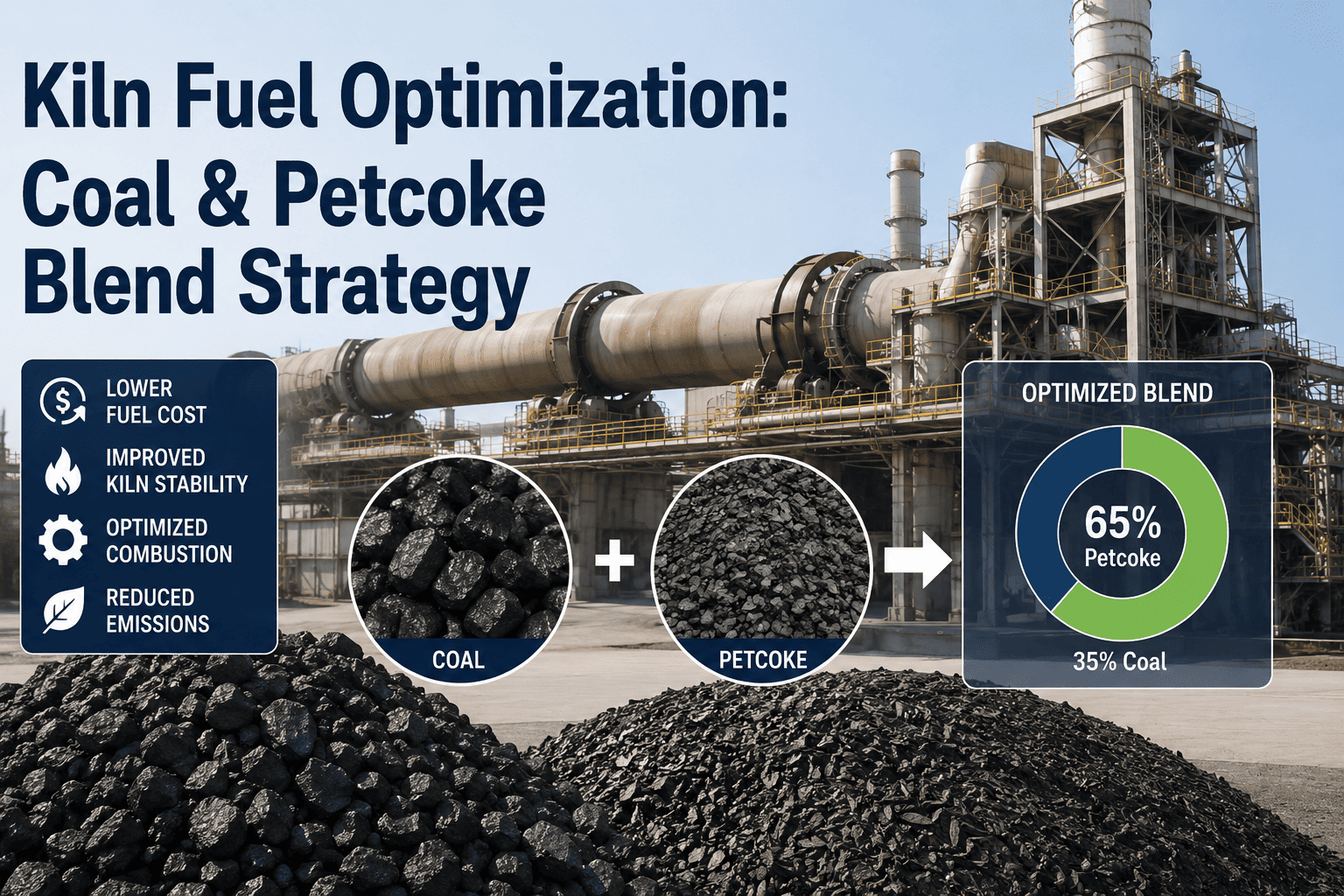
Petcoke costs less per unit of energy than coal in most markets, which is exactly why plants that blend it in without a disciplined strategy end up paying for that discount twice, once in the fuel invoice and again in higher SO2 scrubbing costs, refractory wear, or clinker quality rejects. The plants that consistently capture petcoke's cost advantage without the downside run a defined blend strategy tied to calorific value targets, sulfur limits, and ash chemistry, not a fixed percentage set once and left alone. Getting that balance right increasingly relies on real-time fuel and process monitoring rather than periodic manual sampling.
Coal and Petcoke Blend Strategy for Cement Kilns
Maximize petcoke substitution without sacrificing clinker quality, using calorific value targeting, ash management, and continuous cost tracking.
Why Petcoke Is Not a Simple Drop-In Replacement for Coal
Petcoke offers higher calorific value than most steam coal and typically comes at a lower delivered cost per gigajoule, making the substitution economics attractive on paper. The complication is that petcoke also burns differently, with slower devolatilization and higher sulfur content than most coal sources, which changes flame characteristics, SO2 loading, and in some cases free lime consistency if the substitution rate increases faster than the kiln's combustion system and operating parameters are adjusted to compensate.
Coal
- Calorific value typically 22-28 MJ/kg
- Faster ignition and devolatilization
- Lower and more variable sulfur content
- Generally more forgiving flame characteristics
Petcoke
- Calorific value typically 30-35 MJ/kg
- Slower devolatilization, requires longer flame
- Higher and more consistent sulfur content
- Lower delivered cost per unit of energy
Building a Calorific Value Optimized Blend
The core objective of blend optimization is holding total delivered thermal energy to the kiln constant while shifting the fuel cost mix toward the lowest-cost combination available, without crossing operating limits on sulfur, ash, or combustion stability. This requires treating the blend ratio as a live variable that adjusts with fuel market pricing and incoming fuel batch quality, rather than a fixed percentage locked in during the annual fuel procurement cycle.
Set the Sulfur and Ash Ceiling
Establish the maximum petcoke share the kiln can accept before SO2 emissions or clinker alkali-sulfur balance move outside the acceptable range, based on scrubber capacity and raw mix chemistry.
Model the Cost Curve
Calculate delivered cost per gigajoule for coal and petcoke at current market pricing, identifying the blend ratio that minimizes total fuel cost within the established quality ceiling.
Adjust Combustion Parameters
Tune primary air, flame shape, and burner settings to accommodate petcoke's slower devolatilization, since a blend change without a corresponding combustion adjustment often shows up as incomplete combustion or coating instability.
Monitor Quality Continuously
Track free lime, clinker sulfur-alkali ratio, and coating pattern against every blend ratio change, feeding results back into the cost model so the optimal blend point adjusts as conditions change.
Ash Management Considerations by Blend Ratio
Ash content and composition shift as petcoke share increases, and since kiln ash becomes part of the clinker chemistry rather than being removed from the process, blend decisions directly affect raw mix design. The table below outlines typical operational considerations as petcoke substitution increases.
| Petcoke Share | Sulfur Management | Raw Mix Adjustment Needed | Combustion Consideration |
|---|---|---|---|
| Under 20% | Minimal, within typical scrubber margin | Usually none required | Minor flame length adjustment |
| 20-40% | Moderate monitoring of SO2 trend | Possible alkali-sulfur ratio check | Burner tip and air ratio tuning |
| 40-60% | Active scrubber capacity management | Regular raw mix chemistry review | Dedicated combustion optimization program |
| Above 60% | Continuous SO2 and sulfur balance tracking | Frequent raw mix adjustment | Advanced burner design typically required |
Cost Minimization Against a Moving Target
Coal and petcoke prices do not move together, and the spread between them can shift substantially over a matter of weeks depending on regional supply, refinery output, and shipping costs. A fuel blend strategy that was optimal six months ago may no longer be the lowest-cost option today, which is why plants running static blend ratios typically leave savings on the table even when their original blend decision was sound at the time it was made.
Delivered Cost Tracking
Track landed cost per gigajoule for each fuel source separately, including freight and handling, rather than relying on quoted price per tonne which can be misleading across fuels with different calorific values.
Contract Flexibility
Negotiate fuel supply contracts that allow blend ratio adjustment within a defined range, avoiding rigid take-or-pay terms that prevent capturing favorable price movements in either fuel.
Quality-Adjusted Comparison
Factor in the cost of any additional scrubber reagent, raw mix adjustment, or combustion tuning required at higher petcoke ratios, since these operating costs offset part of the raw fuel price advantage.
Scenario Modeling
Run the blend optimization model against multiple price scenarios rather than a single point estimate, identifying how sensitive the optimal blend ratio is to reasonable price movements in either fuel.
iFactory connects fuel cost data, combustion parameters, and clinker quality results into one live view, so plant teams can adjust blend ratio with confidence instead of relying on periodic manual recalculation.
Procurement Strategy for a Dynamic Blend Program
Running an optimized blend program well requires procurement contracts flexible enough to actually capture the savings the model identifies. A fuel procurement strategy locked into rigid annual volumes at fixed ratios undermines the entire premise of dynamic blend optimization, regardless of how accurate the underlying cost model is, because the plant has no contractual ability to act on what the model recommends.
Multi-Supplier Sourcing
Maintain relationships with more than one supplier for both coal and petcoke, creating negotiating leverage and supply security that a single-source contract structure cannot provide during price volatility or supply disruption.
Index-Linked Pricing Terms
Negotiate pricing tied to published market indices rather than fixed annual rates, keeping delivered fuel cost aligned with actual market conditions rather than locking in a rate that may drift unfavorably over the contract term.
Volume Flexibility Bands
Build minimum and maximum volume ranges into supply contracts rather than fixed quantities, preserving the ability to shift blend ratio toward the lower-cost fuel as pricing spreads change through the year.
Quality Guarantee Clauses
Include calorific value, sulfur, and ash content guarantees with financial remedies for out-of-spec deliveries, protecting the blend model's assumptions from being undermined by inconsistent supplier quality.
Operator Training for Blend Ratio Changes
Even a well-optimized blend model delivers less value if operators are not equipped to recognize and respond to the combustion behavior differences between fuel ratios. Training programs that walk operators through the specific flame characteristics, coating patterns, and emissions signals associated with different petcoke ratios shorten the adjustment period after every blend change and reduce the chance of an operator over-correcting in response to a normal petcoke combustion characteristic mistaken for a problem.
Flame Shape Recognition
Train operators to distinguish normal petcoke flame characteristics from genuine combustion problems, reducing unnecessary manual interventions during routine blend ratio transitions.
Emissions Trend Interpretation
Build operator familiarity with expected SO2 trend shifts at different blend ratios, so genuine emissions excursions are caught quickly without treating every normal fluctuation as an alarm condition.
Data Requirements for a Reliable Blend Model
A blend optimization model is only as good as the data feeding it, and plants often underestimate how much upfront work goes into building a data pipeline accurate enough to trust for real cost decisions. Fragmented data spread across separate lab systems, procurement spreadsheets, and DCS historians tends to produce a blend recommendation nobody fully trusts, which defeats the purpose of building the model in the first place.
Fuel Quality Lab Integration
Connect incoming fuel batch test results directly into the cost model, replacing manual spreadsheet entry that introduces delay and transcription error into blend decisions.
Live Procurement Pricing Feed
Pull current contracted and spot market pricing automatically rather than updating the cost model on a manual schedule that lags actual market movement.
Combustion and Quality Correlation
Tie DCS combustion parameters and lab clinker quality results back to the specific blend ratio in effect at the time, building the historical dataset that validates the model's quality ceiling assumptions.
Scaling Blend Optimization Across Multiple Kilns
Plants operating more than one kiln line face an additional layer of complexity, since each kiln may have different burner designs, raw mix chemistry, and scrubber capacity, meaning the optimal blend ratio is rarely identical across lines even when both kilns draw from the same fuel supply. Treating each kiln's blend optimization as an independent calculation, while still coordinating total fuel procurement volume across the site, generally produces better results than forcing a single uniform blend ratio across a multi-kiln facility.
Frequently Asked Questions
What is the maximum petcoke substitution rate a cement kiln can typically handle?
Maximum petcoke substitution depends heavily on scrubber capacity, raw mix alkali-sulfur balance, and burner design, with well-equipped kilns running anywhere from 60 to 100 percent petcoke in some cases. Plants without dedicated SO2 scrubbing capacity or advanced burner systems generally find their practical ceiling well below that, often in the 20 to 40 percent range, before sulfur management or combustion stability becomes limiting. There is no universal ceiling, which is why a plant-specific analysis through continuous process monitoring gives a more reliable answer than industry averages.
How quickly should blend ratio respond to fuel price changes?
Blend ratio does not need to change daily, since combustion system adjustments and raw mix chemistry take time to stabilize after a shift, but reviewing the cost-optimal blend point on a weekly to monthly basis captures most of the available savings without introducing excessive operational instability. Plants with automated fuel cost tracking and a defined operating range for blend ratio can respond faster than those relying on manual quarterly reviews, capturing price swings that a slower review cycle would miss entirely.
Does increasing petcoke share affect clinker quality?
Petcoke's higher sulfur content can affect clinker sulfur-alkali balance if raw mix chemistry is not adjusted accordingly, potentially contributing to coating buildup or quality variability at higher substitution rates. This is not an inherent limitation of petcoke itself but a consequence of increasing substitution without corresponding adjustments to raw mix design and combustion parameters. Plants that treat blend ratio changes as a coordinated adjustment across fuel, raw mix, and combustion settings generally maintain consistent clinker quality even at substantial petcoke substitution levels.
What combustion equipment changes are needed to burn higher petcoke ratios?
Petcoke's slower devolatilization generally requires a longer, more controlled flame than standard coal-only burners are designed to produce, which is why plants planning significant petcoke substitution often invest in multi-channel burners with independently adjustable air streams. This equipment upgrade allows finer control over flame shape and length, compensating for petcoke's combustion characteristics without sacrificing burning zone temperature control. The investment case for burner upgrades should be evaluated alongside the projected fuel cost savings from higher substitution.
How does petcoke blending interact with alternative fuel co-processing?
Petcoke and alternative fuels like RDF or tire-derived fuel are typically evaluated together as part of a total fuel mix strategy, since both compete for the same thermal energy requirement and interact through combined sulfur and ash chemistry effects on the clinker. Plants running both programs simultaneously need a fuel mix model that accounts for the combined sulfur loading and ash contribution from all fuel sources together, rather than optimizing petcoke blend and alternative fuel substitution as two separate, disconnected decisions.
Stop leaving fuel cost savings on the table because blend ratio decisions are made quarterly instead of continuously. iFactory gives cement plants the live data needed to optimize coal and petcoke blend against real-time pricing and quality results.