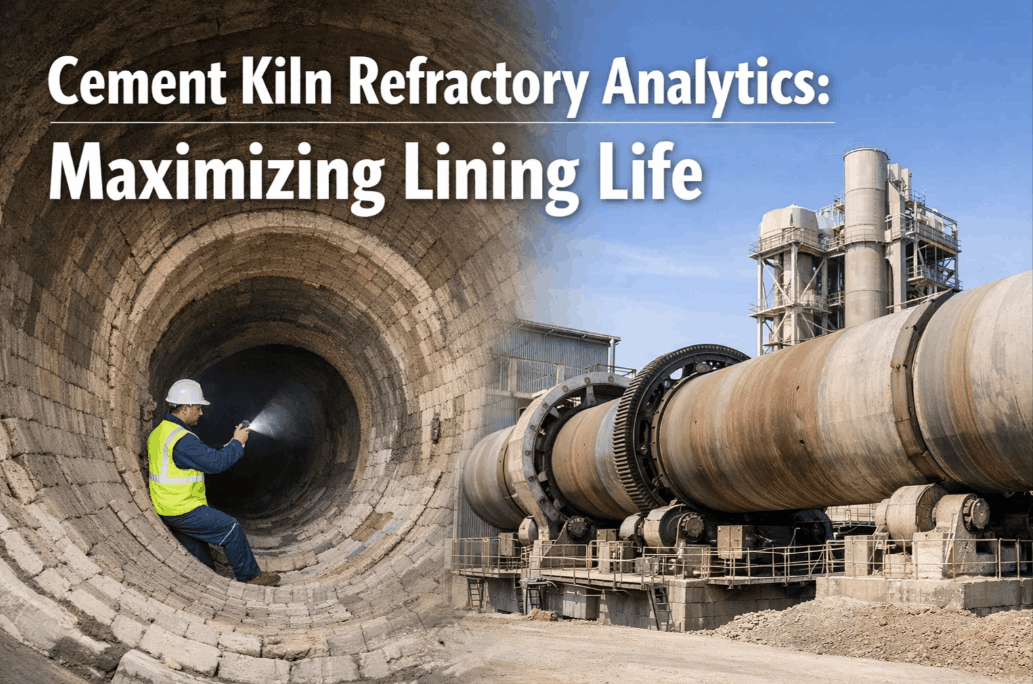
A cement kiln's refractory lining is one of the few components where the difference between an average plant and a top-quartile plant is measured in months of avoided downtime, not percentage points of efficiency. Most operators know their current campaign length, but far fewer can explain why one campaign ran 16 months while the previous one barely reached 10, because the wear that ends a campaign early is rarely caused by a single event. It builds quietly across three separate decisions — material selection, installation execution, and day-to-day process discipline — long before a hot spot or a hung ring forces a shutdown. See how iFactory tracks all three against your actual kiln data.
Quick Answer
Refractory campaign life in cement kilns is governed by three factors together, not separately: refractory material quality, installation execution, and process operating discipline. Burning zone magnesia-spinel brick typically benchmarks at 12–18 months under stable conditions, but a burning zone running just 50°C above design temperature can triple brick erosion rate, and liquid-phase corrosion at excess temperature can consume magnesia-hercynite brick at roughly 0.5mm per day. Tracking zone-specific wear against clinker chemistry and kiln temperature data is what separates plants that plan relines from plants that react to them.
Stop Guessing When Your Next Reline Is Coming
iFactory correlates refractory wear by zone against clinker chemistry, burning zone temperature, and start-stop cycles, giving you a defensible remaining-life number instead of a rough estimate carried over from the last inspection.
Why Reline Timing Affects More Than Refractory Cost
The refractory bill is usually the smallest number in a reline decision. A campaign that ends three months earlier than planned means an unscheduled kiln stop, a compressed procurement window for brick and castable that were never budgeted for that date, and a production gap that has to be absorbed somewhere else in the plant's output schedule, often at the worst possible point in the sales cycle. Conversely, pushing a campaign past its safe window because the last inspection looked "fine" risks a shell hot spot, a burn-through, or a forced emergency stop that costs far more than the brick would have. Plants that plan relines around measured wear trends, rather than around the memory of how long the previous campaign happened to run, consistently convert what would have been an emergency outage into a coordinated one that lines up with production schedules and procurement lead times. That shift alone is often the difference between a reline that costs a week of downtime and one that costs a month.
Where Campaign Life Is Actually Won or Lost, Zone by Zone
A rotary kiln does not wear evenly, and treating the whole lining as one uniform asset is the fastest way to misjudge remaining campaign life. Each zone faces a different combination of heat, chemistry, and mechanical load, and each needs a different refractory answer.
Zone 01
Burning Zone
1,400°C – 1,500°C operating range
This is the zone that decides most campaigns. Magnesia-spinel brick remains the standard here because it combines excellent coating adherence with the highest hot strength of any commonly used grade, and a stable coating is what actually protects the brick face from direct flame and chemical attack. Industry benchmark service life sits around 12 to 18 months under stable dry-process conditions, but that number moves fast when temperature control slips. Keeping clinker exit temperature below roughly 1,260°C and secondary air temperature below roughly 900°C is one of the most consistently cited safeguards against accelerated burning zone wear. Burner nozzle condition matters here too, since nozzle damage from excess secondary air temperature tends to cascade into flame shape problems that then unevenly heat the brick face, turning what started as an instrumentation issue into a refractory issue within a matter of weeks.
Zone 02
Transition Zone
Between burning and calcining zones
The transition zone rarely gets the attention the burning zone does, yet it experiences some of the most frequent thermal fluctuations in the entire kiln, along with significant mechanical wear from material tumbling through it. Alumina-magnesia spinel brick is generally recommended here because it needs to accommodate repeated expansion and contraction without spalling, a failure mode that shows up as sudden localized brick loss rather than gradual wear. Because the damage in this zone tends to be sudden rather than progressive, plants that only inspect on a fixed schedule often miss the early cracking that precedes a spall, which is why continuous tracking of thermal cycling frequency matters more here than in zones with steadier wear patterns.
Zone 03
Calcining and Preheating Zone
Upstream of the burning zone
Here the dominant threat shifts from heat alone to alkali attack combined with mechanical erosion from raw meal moving through the section. Refractory in this zone needs to resist chemical attack from circulating alkalis and sulfates as much as it needs to survive thermal cycling, and ceramic fiber modules are commonly used as backup insulation to reduce shell heat loss without adding unnecessary mass to the lining system. Alkali circulation is often the harder variable to manage, since alkali build-up depends on raw material sourcing and fuel choice as much as on kiln operation, and a plant switching fuel blends without reassessing this zone's lining is a common source of unexpectedly early wear.
Zone 04
Kiln Discharge and Cooler Interface
Kiln outlet to grate cooler transfer
Ultra-low cement castable with high abrasion resistance is standard practice here, because the lining absorbs direct impact from the hot clinker bed as it transfers onto the cooler grate. What often gets overlooked is that anchor corrosion resistance matters just as much as the castable grade itself, since combined heat and mechanical loading in this zone puts as much stress on the anchoring system as on the refractory face. A castable that looks intact on visual inspection can still be failing from behind if its anchors have corroded, so relying on surface appearance alone at this interface tends to understate how close the section actually is to a localized breakthrough.
The Three Pillars That Actually Determine Campaign Length
Refractory performance and consumption in cement kilns come down to three factors working together. Neglecting any single one shortens service life and raises consumption, no matter how well the other two are managed.
1
Material Quality
Refractory sourced from suppliers with access to high-purity raw materials, advanced high-pressure forming equipment, and high-temperature firing capacity performs measurably longer under the same operating conditions than material chosen primarily on unit price. Selection should also match the specific production process, kiln dimensions, and the chemical and physical properties of the raw materials and fuels actually in use, rather than defaulting to a generic specification.
2
Installation Quality
Brick grade selection is where most campaign-life variance actually originates, but installation execution decides whether that grade ever gets the chance to perform. Poor joint tightness, inconsistent anchor placement, and rushed curing on castable sections routinely turn a well-specified lining into an early-failure lining, and the resulting damage is frequently misattributed to material defects instead of installation error.
3
Process and Maintenance Discipline
Stable burning zone temperature, controlled start-stop cycling, and active coating management protect even a correctly specified and correctly installed lining. Modern plants increasingly run unstable operating patterns, including frequent start-stop cycles and higher alternative fuel ratios, and these generate repeated thermal stress that leads directly to spalling, cracking, and premature lining failure if left unmanaged.
See Which Pillar Is Actually Limiting Your Campaign Life
iFactory documents material specification by zone against measured wear, logs every patch and castable repair, and flags temperature or cycling patterns that are quietly cutting months off your next reline window. Most plants already have the underlying sensor and lab data; the missing piece is usually the analysis layer that turns it into a clear answer.
Campaign Life Benchmarks by Zone and Material Grade
Actual campaign life always varies with fuel mix, alkali and sulfate loading, and kiln operating stability, but these ranges reflect representative dry-process rotary kiln field data and give a useful starting point for planning.
| Kiln Zone |
Typical Material |
Benchmark Campaign Life |
Primary Wear Driver |
| Burning Zone |
Magnesia-spinel brick |
12–18 months |
Liquid phase corrosion, coating loss |
| Transition Zone |
Alumina-magnesia spinel brick |
Shorter, variable |
Thermal cycling, mechanical wear |
| Calcining and Preheating Zone |
Insulating castable, ceramic fiber backup |
Longer, chemistry-dependent |
Alkali attack, raw meal erosion |
| Discharge / Cooler Interface |
Ultra-low cement castable |
Abrasion-dependent |
Impact abrasion, anchor corrosion |
What Quietly Shortens Campaign Life Before Anyone Notices
Refractory failure is almost never a surprise in hindsight. It usually traces back to one or more of these conditions running unmonitored for weeks or months before a hot spot finally shows up on a shell scan.
Burning zone temperature drifting above design
If lab test data is based on roughly 1,400°C and the actual kiln runs closer to 1,450°C, brick erosion rate can increase by a factor of three. This is one of the most damaging and most preventable causes of early burning zone failure.
Liquid phase corrosion from clinker chemistry
CaO and SiO2 in clinker form low-melting phases at elevated temperature, and at around 1,450°C this liquid phase can erode magnesia-hercynite brick at approximately 0.5mm per day, a rate that adds up to significant lining loss over a matter of weeks.
Clinker chemistry drifting outside target ratios
A lime saturation factor near 0.91, a silica ratio near 2.6, and an alumina ratio between roughly 1.3 and 1.6 support both refractory life and clinker strength. Drift outside these bands raises liquid phase content and accelerates chemical attack on the lining.
Frequent start-stop cycling and alternative fuel swings
Unstable operating patterns generate repeated thermal stress inside the refractory structure, and if the material was not selected with this stress profile in mind, the result is spalling, cracking, and premature failure well ahead of the designed service life.
Selecting refractory on unit price instead of cost per ton of clinker
Lower-cost refractory that is mismatched to actual raw meal, fuel, and alternative fuel conditions typically produces much shorter campaign life and more frequent shutdowns, so the true cost shows up later as lost production rather than as a line item.
Reading the Warning Signs Before a Hot Spot Forces the Issue
By the time a shell temperature scan shows a visible hot spot, the lining loss behind it has usually been building for weeks. A rising trend in localized shell temperature, a coating that keeps falling away in the same section of the burning zone despite repeated buildup attempts, or a pattern of increasingly frequent patch repairs in one zone are all signals worth tracking on their own, well before they combine into an emergency stop. Plants that log every patch repair and localized castable injection by location build a picture of where wear is accelerating long before a single dramatic failure makes the decision for them. That log is also what makes remaining-life calculations meaningful, since a campaign that has already absorbed several mid-life repairs in the same zone is not on the same trajectory as one that has run clean. Comparing wear patterns across multiple kilns in a portfolio adds a further layer of confidence, since a wear rate that looks unusual on one kiln in isolation often turns out to be a known pattern once it is checked against sister units running similar raw mix and fuel conditions.
The Optimization Playbook
None of these steps require replacing your refractory strategy from scratch. Most plants already have the underlying data; what is usually missing is a consistent way to track it against actual wear.
1
Match material grade to zone conditions, not to supplier default stock
Evaluate brick and castable selection against the specific chemical and mechanical demands of each zone rather than defaulting to whatever grade the incumbent supplier has on hand, since this is where the largest share of campaign-life variance originates.
2
Verify installation quality independently of material specification
Confirm joint tightness, anchor placement, and curing procedure on every reline, since installation error is a common and frequently misdiagnosed cause of early lining failure that gets blamed on the material instead.
3
Hold burning zone temperature within design range
Keep clinker exit temperature and secondary air temperature within target bands, since even a moderate excursion above design temperature can multiply brick erosion rate well beyond what the material specification anticipated.
4
Track raw meal chemistry against target ratios continuously
Monitor lime saturation factor, silica ratio, and alumina ratio against plant-specific targets rather than only at periodic lab sampling intervals, since chemistry drift toward higher liquid phase content is a leading driver of both clinker quality and refractory wear.
5
Evaluate refractory spend on cost per ton of clinker
Compare material options on total operational cost per ton of clinker produced over the campaign, not on unit purchase price, so that shorter campaign life and more frequent shutdowns are properly weighed against any upfront savings.
6
Log every patch, injection, and localized repair against its zone
Keep a running record of mid-campaign interventions by exact location rather than treating them as one-off fixes, since a cluster of repairs in the same section is usually the earliest reliable signal that the zone is wearing faster than the rest of the lining.
7
Project replacement cost and timing years in advance, not months
Use measured wear rates and campaign history to project refractory replacement costs three to ten years forward, which gives capital planning defensible numbers instead of estimates carried over from whichever campaign happened to run most recently.
12–18
Months Typical Burning Zone Benchmark Life
3x
Erosion Rate Increase From a 50°C Overheat
0.5mm
Daily Corrosion Rate at Excess Burning Zone Temperature
3
Pillars That Determine Campaign Length Together
0.91
Target Lime Saturation Factor for Chemistry Control
4
Distinct Zones Requiring Separate Wear Tracking
We used to plan our reline budget around whatever the last campaign happened to run, which meant we were either over-ordering brick out of caution or getting caught short when a campaign ended early. Once we started tracking burning zone temperature excursions and raw meal chemistry drift against our actual wear logs, our capital planning stopped being a guess. We now schedule relines around a defensible remaining-life number instead of a rough average from memory, and our procurement team gets a real lead-time window instead of a scramble every time a campaign ends earlier than expected.
Refractory and Maintenance Planner
6,200 TPD Cement Line — Western India
Frequently Asked Questions
QHow long should cement kiln refractory actually last, and why do estimates vary so much?
Designed service life is usually based on laboratory simulation data or industry benchmarks, and for a cement kiln burning zone that benchmark commonly sits around 12 to 18 months. Real-world results vary widely because actual operating conditions rarely match lab conditions exactly, and factors like temperature fluctuations, material abrasion, and chemical corrosion all shorten service life in ways that compound rather than add up individually. Two kilns with identical brick specification can post very different campaign lengths purely because of how tightly temperature and chemistry were controlled during operation.
Book a demo to see your zone-level wear tracked against benchmark.
QWhat's the single biggest factor that shortens burning zone brick life?
Overheating is consistently one of the most damaging factors, because even a moderate temperature excursion above the design range can multiply the erosion rate of burning zone brick well beyond what the material specification was built to handle. Liquid phase corrosion compounds this effect, since clinker chemistry that runs slightly hot forms more low-melting liquid phase, which then attacks the brick surface directly. Controlling clinker exit temperature and secondary air temperature within target bands addresses both mechanisms at once.
QDoes raw mix chemistry really affect refractory life, or is it mostly a material selection problem?
Chemistry and material selection work together rather than as separate issues. A raw mix with lime saturation, silica, and alumina ratios held near their target ranges produces less liquid phase at clinkering temperature, which directly reduces chemical attack on the lining regardless of which brick grade is installed. Even a well-matched refractory grade will underperform its benchmark life if raw meal chemistry is allowed to drift, so tracking both together gives a far more accurate picture than watching either alone.
QIs it worth paying more for higher-grade brick, or does installation quality matter more?
Both matter, and neither compensates fully for a failure in the other. Refractory performance and consumption are determined by material quality, installation quality, and process maintenance together, and neglecting any one of the three shortens service life regardless of how well the other two are managed. In practice, brick grade selection is where the largest share of campaign-life variance originates, but poor installation execution can turn even a correctly specified high-grade brick into an early failure.
QHow can we tell if our refractory is wearing faster than it should before the next inspection?
Most kilns already generate the underlying signals needed, including shell temperature scans, burning zone pyrometer readings, and raw meal lab chemistry, but these data sources are rarely correlated together in a way that flags accelerated wear early. The gap is usually not missing instrumentation but a missing analysis layer that compares current temperature and chemistry patterns against the conditions that have historically preceded early failure on your kiln.
Talk to an expert about what your current data already covers.
Turn Your Next Reline Into a Planned Outage, Not an Emergency
iFactory tracks refractory wear by zone against clinker chemistry, burning zone temperature, and start-stop cycling, so your next campaign life estimate is based on your kiln's actual data instead of an average from the last one.
Zone-Level Wear Tracking
Chemistry Drift Monitoring
Temperature Excursion Alerts
Defensible Reline Planning