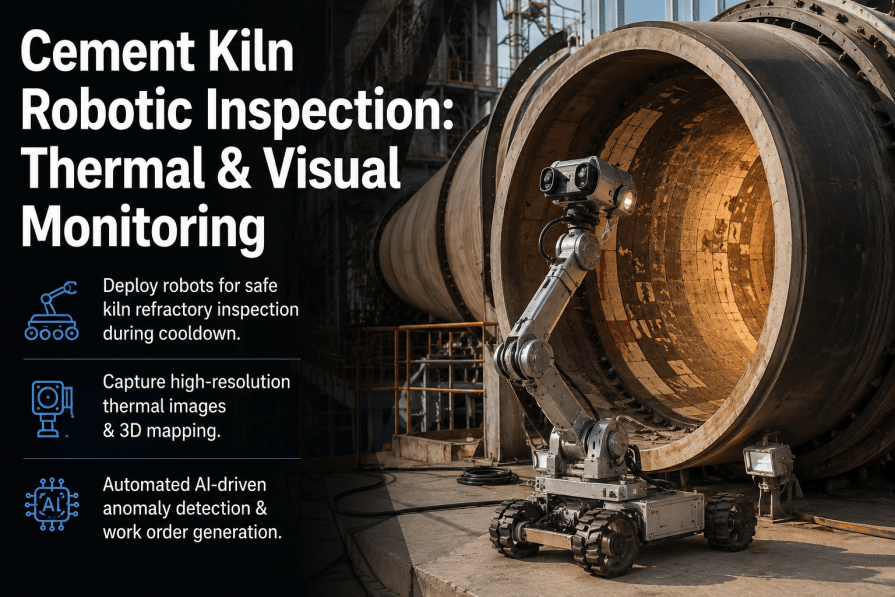
A single unplanned refractory failure in a cement kiln can cost between 800,000 and 2.5 million dollars once emergency relining, expedited brick procurement, and days of lost production are added together — and the frustrating part is that calendar-based reline schedules cause a version of the same loss every single campaign, just spread out and hidden inside routine maintenance budgets. Plants that replace lining on a fixed schedule typically retire 15 to 25% of remaining usable brick life simply because the calendar said it was time, not because the brick was actually failing. AI-based brick life prediction closes that gap by turning shell temperature into a zone-by-zone remaining-life forecast instead of a guess. If your kiln is still on calendar-based relining, book a demo to see what condition-based scheduling would look like on your campaign history.
The Two Ways Refractory Decisions Go Wrong
Every reline decision a plant makes falls into one of two failure patterns, and both are expensive in different ways.
How the Prediction Model Actually Works
The underlying data pipeline is simpler than it sounds, and in most plants it doesn't require new sensors — it uses shell temperature data the kiln is often already generating.
What a Zone-Level Health Score Actually Changes
The real shift isn't just having more data — it's the question a maintenance team can finally ask. Instead of "is the kiln okay?", a zone-level health score lets a team ask which specific zone is most at risk and how much runway is left before it needs attention.
Calendar-Based vs. Condition-Based Relining
| Dimension | Calendar-Based Schedule | AI Condition-Based Prediction |
|---|---|---|
| Decision basis | Fixed time interval regardless of actual wear | Zone-by-zone remaining life forecast |
| Brick life utilization | 15–25% of usable life typically wasted | Brick used closer to its actual service limit |
| Procurement approach | Full-kiln stock ordered ahead of schedule | Zone-specific bricks ordered only when needed |
| Failure risk | Some zones may still fail unexpectedly between intervals | Zones flagged 4–6 weeks ahead of accelerated wear |
| Planning horizon | Fixed, not tied to real wear conditions | Reline scope plannable 6–12 months in advance |
Additional Fault Signals Worth Correlating
Shell temperature is the primary input, but it becomes far more reliable when correlated against other operating signals rather than read in isolation. Increasing kiln drive current at a constant feed rate, for instance, can indicate brick loosening or coating instability building ahead of a temperature signature becoming obvious — combining these signals reduces false alarms and improves confidence in the predicted failure window.
Building the Model With Your Plant's History
An AI remaining-life model doesn't start out plant-specific — it becomes plant-specific by learning from your kiln's own history. The initial build typically pulls together as many past relining dates as records allow, along with whatever shell temperature history exists from thermocouples or prior scanning campaigns, to establish a baseline relationship between temperature trends and actual observed wear at the point of past relines. Even a plant with only two or three prior campaigns of usable history can get meaningful results, since the model refines its accuracy further with every campaign that follows. This is one of the more overlooked advantages of moving early rather than waiting for a "complete" dataset — every additional campaign the model observes makes its next prediction more accurate, so the plants that start earliest end up with the most reliable forecasts several years down the line. Plants with detailed maintenance logs, including notes on which zones needed unscheduled attention and why, tend to see faster model accuracy gains than plants with only relining dates and no supporting detail.
Common Objections From Maintenance Teams
Reliability engineers who have run calendar-based relining for years understandably ask hard questions before trusting a model to move that decision. The most common concern is what happens if the model is wrong in the optimistic direction — predicting more remaining life than a zone actually has. This is why threshold alerting is built around a safety margin rather than a bare minimum estimate, and why the model's confidence interval, not just its central prediction, should inform any decision to push a reline interval past what a calendar schedule would have called for. A second common objection is that shell temperature alone can't capture everything happening inside the kiln, which is accurate — this is exactly why correlating temperature trends with drive current, vibration, and production data produces a more reliable picture than temperature in isolation. Teams that pilot the approach on a subset of zones before fully replacing their calendar schedule tend to build trust in the model's output faster than teams that attempt a full switch on day one.