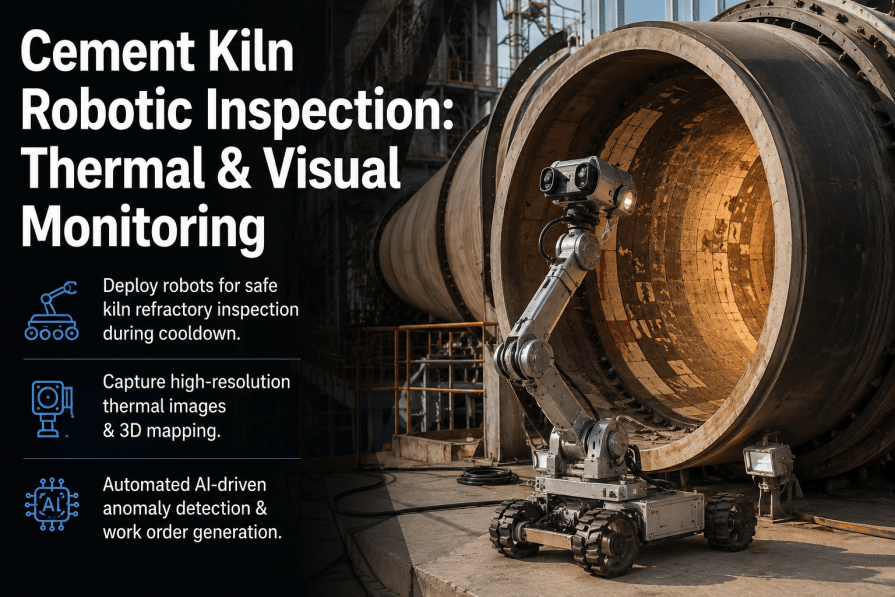
Traditional kiln refractory inspection requires plants to cool the kiln for 5-7 days, erect scaffolding, and send human inspectors into a confined space with fall hazards, thermal risks, and exposure to residual dust and combustion gases — a process that is slow, dangerous, and fundamentally limited in the data it can capture. Robotic inspection platforms equipped with thermal cameras, high-resolution visual sensors, and 3D laser scanners transform this high-risk manual process into a rapid, remotely operated data collection mission that captures every square meter of kiln refractory surface in a single cooldown window. iFactory AI's robotic integration platform connects inspection robots to AI-driven anomaly detection and automated work order generation — enabling maintenance teams to assess refractory condition, plan repairs and return the kiln to production faster and more safely than ever before. Book a Demo to see the platform configured for your kiln geometry and refractory monitoring requirements.
Why Robotic Kiln Inspection Replaces Manual Confined-Space Entry
Manual kiln refractory inspection is one of the most hazardous and data-limited activities in cement plant maintenance. Teams of inspectors working in rotating shifts enter a confined space that has just cooled from 1,400 degrees Celsius operating temperature, navigating scaffolding erected inside a 60-to-100-meter rotating cylinder while documenting refractory condition with paper notes, handheld thermal guns, and selective photographs. The process exposes workers to residual heat stress, alkaline dust inhalation, fall hazards, and the risk of unstable refractory sections collapsing — all to capture a partial view of the refractory surface that is impossible to repeat with positional accuracy on the next campaign. Robotic inspection eliminates these risks and data limitations entirely. Book a Demo to explore how iFactory's robotic integration platform transforms kiln refractory inspection into a safer, faster, and more data-rich operation.
Eliminate Confined-Space Safety Risks
Robotic inspection removes the need for human entry into the kiln interior during cooldown — eliminating fall hazards from scaffolding, thermal stress from residual shell heat, and respiratory exposure to alkaline dust and combustion byproducts that require confined-space permits, standby personnel, and emergency rescue planning for every inspection cycle.
Capture Complete Refractory Surface Data
Manual inspection typically covers only the lower quadrant of the kiln interior accessible from scaffolding near manhole openings. Robotic platforms navigate the full kiln circumference and length, capturing high-resolution visual imagery, thermal gradients, and 3D laser profiles across 100% of the refractory surface in a single deployment without repositioning or re-entry.
Accelerate Cooldown-to-Repair Cycle Time
Manual inspection of a 60-100 meter kiln requires 2-3 shifts of confined-space entry with teams rotating due to heat and fatigue limits. Robotic inspection completes the same scope in 2-4 hours of remote operation — enabling the maintenance team to assess refractory condition, identify repair zones, and begin work within a single shift rather than across multiple days, reducing total kiln downtime.
Generate AI-Ready Inspection Records
Manual inspection produces handwritten notes, paper sketches, and photographs that are difficult to compare across campaigns. Robotic inspection generates geotagged visual panoramas, calibrated thermal maps, and 3D point clouds that feed directly into iFactory's AI anomaly detection engine — creating a searchable, comparable inspection history that tracks refractory degradation rates from one campaign to the next.
Thermal Imaging vs Visual Inspection: What Robots Detect That Humans Miss
The difference between manual and robotic kiln inspection is not incremental — it is structural in terms of coverage completeness, measurement accuracy, and data consistency across inspection campaigns. The comparison below maps the specific detection capabilities and data quality outcomes for each inspection method available to cement plant maintenance teams. Book a Demo to benchmark your current inspection workflow against iFactory's robotic inspection capability model.
| Inspection Method | Surface Coverage | What It Detects | Data Quality | Risk Level |
|---|---|---|---|---|
| Manual Visual Inspection | Partial (30-40% of surface) | Spalling, cracks, missing brick, coating buildup | Subjective observations, limited photos | High |
| Manual Thermal (Handheld) | Spot measurements at accessible points | Surface hot spots, refractory thinning at measurement points | Single-point readings, no spatial context | High |
| Robotic Visual Inspection | Full (100% of surface) | Spalling, cracks, missing brick, coating, ring buildup | Stitched panoramic imagery with GPS tagging | Low |
| Robotic Thermal Imaging | Full (100% of surface) | Lining thinning, hot spots, insulation loss, anchor condition | Calibrated thermal map with temperature gradients | Low |
| Robotic 3D Laser Scanning | Full (100% of surface) | Brick erosion depth, shell ovality, profile deformation | Sub-millimeter point cloud with AI wear analytics | Low |
Robotic Kiln Inspection Workflow: From Cooldown to Repair Plan
Deploying robotic kiln inspection follows a structured five-phase workflow that integrates robot navigation, multi-sensor data collection, AI-powered analysis, and automated maintenance planning into a single continuous process. The sequence below represents a typical single-kiln inspection deployment using iFactory's robotic integration platform. Book a Demo to review iFactory's pre-configured robotic inspection templates with our cement industry solutions team.
Robot Deployment and Pre-Inspection Calibration
Position the robotic platform at the kiln inlet or outlet manhole and calibrate all sensors — thermal camera blackbody reference, visual camera white balance and focus, and 3D laser scanner alignment — against known reference targets. Configure the inspection mission plan in the control software, defining navigation waypoints, sensor sampling rates, and data resolution parameters based on kiln length, diameter, and the specific defect types targeted during the inspection.
Automated Kiln Interior Navigation and Data Collection
The robot traverses the full length of the kiln interior following the programmed mission plan, capturing synchronized thermal images, high-resolution visual panoramas, and 3D laser scans at each predefined station. Onboard sensors maintain consistent standoff distance from the refractory surface, and the robot adjusts its position automatically to account for shell ovality, coating buildup, and changes in kiln cross-section at the transition zones.
AI-Powered Anomaly Detection and Classification
Collected sensor data streams into iFactory's AI analytics engine, which processes thermal gradients to identify refractory thinning and hot spots, analyzes visual imagery to classify spalling, cracking, and missing brick patterns, and evaluates 3D point cloud data to quantify brick erosion depth and shell ovality. The AI compares current findings against historical inspection data to highlight new or accelerated degradation that requires attention.
Automated Work Order Generation for Repairs
Detected anomalies are automatically classified by severity — critical, warning, or monitor — and mapped to specific kiln zones with GPS coordinates and measurement data. The system generates work orders in the plant CMMS for each repair action, specifying the defect type, location, recommended repair method, required materials, and priority level based on the predicted rate of degradation before the next planned outage.
Post-Repair Verification and Historical Comparison
After repairs are completed, the robot performs a targeted re-inspection of the repaired zones to verify work quality and measurement compliance. The new inspection data is automatically compared against the pre-repair baseline in iFactory's inspection history database, generating a repair verification report that documents the as-found condition, the repair performed, and the as-left condition for regulatory records and future campaign planning.
Replace Manual Confined-Space Entry with AI-Driven Robotic Kiln Inspection
iFactory's robotic integration platform connects inspection robots to AI-driven anomaly detection and automated work order generation — transforming kiln refractory inspection from a hazardous, data-limited manual process into a rapid, remotely operated intelligence operation.
Industry Expert Perspective — Why Robotics Are Transforming Kiln Refractory Inspection
We asked Dr. Sarah Okonkwo, former Director of Refractory Engineering at a top-10 global cement producer and current industrial robotics advisor, to assess where robotic inspection stands across the cement industry and what plant managers should prioritize when evaluating the technology.
Dr. Okonkwo has overseen refractory inspection programs at more than 30 cement plants across North America, Europe, and Africa. Her assessment is based on direct experience transitioning facilities from manual confined-space inspection to robotic platforms equipped with thermal, visual, and 3D laser sensors.
"The most dangerous assumption in kiln refractory management is that manual inspection gives you a complete picture of your refractory condition. It does not. A human inspector on scaffolding can see roughly one-third of the refractory surface, and the data they collect is subjective — one inspector's 'moderate wear' is another inspector's 'needs attention.' Robotic inspection eliminates both the coverage gap and the subjectivity gap. You get 100% surface coverage with calibrated, repeatable measurements that can be compared across campaigns with sub-millimeter precision."
Her primary recommendation for plant managers evaluating robotic inspection investment is to start with a single-kiln pilot that includes all three sensor modalities — visual, thermal, and 3D laser. "The thermal data is where most plants see the fastest ROI because it detects refractory thinning months before visual spalling or cracking appears. But the 3D laser data is the strategic asset — it gives you the quantitative wear rates you need to predict remaining refractory life with statistical confidence. Plants that deploy all three sensors from the start build a complete refractory intelligence model that pays for itself within the first two inspection campaigns."
Three Measurable Outcomes of Robotic Kiln Inspection Deployment
Beyond eliminating confined-space safety risks and improving data quality, robotic kiln inspection delivers measurable operational and financial outcomes that directly impact kiln availability, repair cost, and refractory life. The metrics below represent results from cement plants that have deployed robotic inspection programs integrated with iFactory's AI analytics platform.
Plants deploying robotic kiln inspection eliminate all human confined-space entry for refractory assessment during cooldown. Every inspection cycle — pre-outage assessment, post-repair verification, and mid-campaign monitoring — is performed remotely with the operator stationed outside the kiln. This eliminates confined-space permit requirements, standby rescue team costs, and the risk of heat stress incidents, fall injuries, and respiratory exposure that generate OSHA recordable events in manual inspection programs.
Robotic inspection compresses the time between kiln cooldown and repair start from 2-3 days to 4-6 hours. The robot completes full thermal, visual, and 3D laser data collection in a single deployment, and the AI analytics engine delivers a prioritized defect list with repair recommendations within the same shift. Maintenance teams begin refractory repairs with a complete understanding of what needs to be fixed, where it is located, and what materials are required — eliminating the sequential inspection-assessment-planning workflow that consumes two or more days in manual programs.
Thermal imaging from robotic inspection detects refractory thinning and hot spot development 4-6 weeks before these defects become visible as spalling or cracking that manual visual inspection can identify. This early detection window enables maintenance teams to plan repairs during scheduled outages rather than responding to emergency refractory failures that force unscheduled kiln stops and extended production losses. The cumulative benefit of earlier detection across multiple inspection campaigns extends average refractory campaign life by 15-25%.
Robotic Kiln Inspection Is the New Standard for Refractory Management
The cement industry has accepted the risks and data limitations of manual kiln refractory inspection for decades because no alternative existed that could match the combination of safety, coverage, speed, and data quality that robotic platforms now deliver. The technology has matured to the point where robotic inspection is not just safer than manual confined-space entry — it is faster, more thorough, and more cost-effective across every measurable dimension.
Cement plants that deploy robotic inspection with integrated AI analytics achieve outcomes that manual programs cannot match: zero confined-space safety incidents, 60% faster inspection-to-repair cycles, AI-detected anomalies weeks before they become visible defects, and a searchable, comparable refractory condition database that tracks degradation rates with sub-millimeter precision across every inspection campaign. The question is no longer whether robotic inspection works — it is whether your plant will be among the first in your region to capture the competitive advantage of complete, continuous refractory intelligence. Book a Demo to start your robotic kiln inspection deployment with iFactory.
Cement Kiln Robotic Inspection — Frequently Asked Questions
Robotic kiln inspection uses remotely operated robotic platforms equipped with thermal cameras, high-resolution visual sensors, and 3D laser scanners to inspect the full interior surface of a cement kiln during cooldown. The robot navigates the kiln length automatically, capturing synchronized multi-sensor data at each station, and the collected data is processed by AI analytics to detect and classify refractory defects.
Thermal imaging detects refractory thinning by measuring the temperature gradient across the refractory surface. As refractory lining wears thinner, the thermal resistance decreases and the external shell temperature rises at the thinned area relative to surrounding zones with full lining thickness. Robotic thermal cameras capture calibrated temperature data across the entire kiln surface.
A complete robotic kiln inspection — including thermal, visual, and 3D laser data collection for a standard 60-80 meter kiln — is completed in 2-4 hours of remote operation. Manual confined-space inspection of the same kiln requires 2-3 shifts with teams of 3-5 inspectors working in rotating entries limited by heat stress and fatigue.
Current robotic inspection platforms are designed for cooldown deployment when kiln shell temperature has dropped below 100 degrees Celsius and interior conditions are safe for the robot's electronic systems and sensors. The robot typically deploys 48-72 hours after the kiln burner is stopped, depending on kiln size, refractory condition, and ambient temperature.
Cement plants deploying robotic kiln inspection with iFactory's AI analytics platform typically achieve payback within 12-18 months, driven by three primary value sources: elimination of confined-space safety program costs and incident risk, 60% reduction in kiln inspection downtime saving $50,000 to $120,000 per outage in production value.
Deploy Robotic Kiln Inspection with iFactory AI at Your Plant
Cement plants across North America are using iFactory's robotic integration platform to transform kiln refractory inspection — eliminating confined-space entry risks, accelerating inspection-to-repair cycles, and building a searchable refractory intelligence database that extends campaign life and reduces maintenance costs.