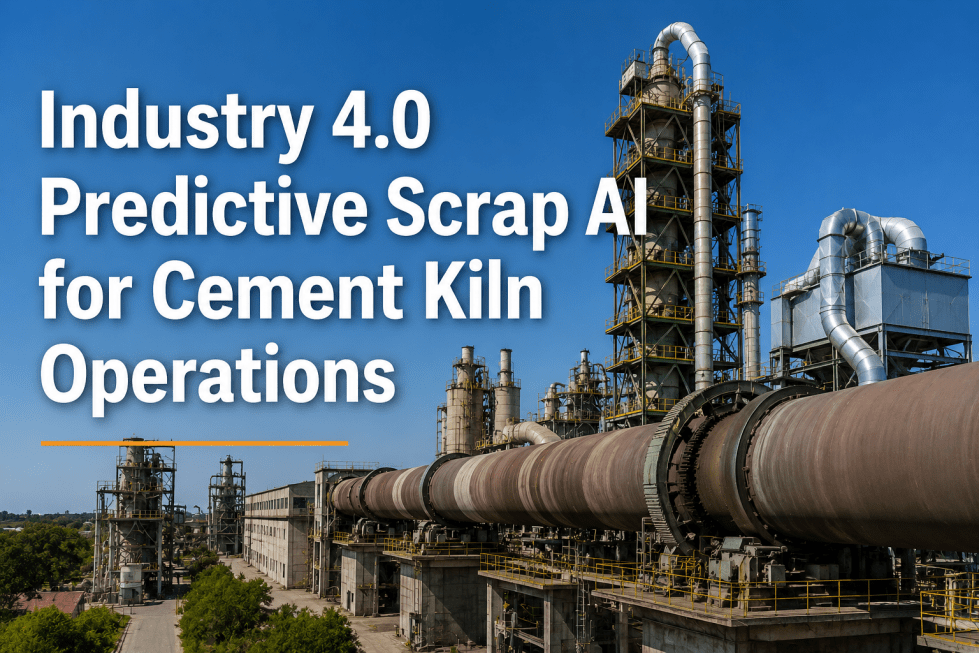
A cement kiln's refractory lining is the most capital-intensive consumable in the plant — and the most consequential. A rotary kiln operating at 2,700°F with a compromised brick lining does not degrade gently: it fails in zones with hot spots appearing on the kiln shell as the warning signal and emergency shutdown as the response. The average emergency refractory repair at a U.S. cement kiln costs $800,000 to $2.4 million in direct material and labor with a 12- to 21-day forced outage that translates to $1.5 million to $4.5 million in lost production revenue at typical U.S. clinker pricing. Yet most cement plants are scheduling refractory brick replacement on fixed-interval turnaround cycles that do not account for the actual wear state of the lining — extending campaigns that should have been cut short and cutting short campaigns that had weeks of serviceable life remaining, in roughly equal measure.
AI analytics for cement kiln refractory life prediction closes that gap by integrating the three data streams that drive brick wear — thermal scanning profiles from shell scanners or IR cameras, burner flame settings and fuel mix parameters, and raw feed chemistry from the kiln inlet — into a continuously updated, zone-specific wear model that tells plant engineers not just how the lining looks today, but how many heats remain at the current rate of degradation, and what operating parameter adjustments would extend that number. Plants that have deployed iFactory's kiln refractory analytics report average campaign life extensions of 18 to 26% and emergency refractory repair events reduced by 71% within the first full campaign cycle.
AI Analytics for Cement Kiln Refractory Life Prediction
Thermal scan integration, burner optimization, and feed chemistry correlation — purpose-built to maximize refractory brick lifespan and eliminate emergency kiln shutdowns. Predict wear. Schedule smarter. Extend campaigns.
Ready to get a zone-specific remaining life estimate for your kiln lining? Schedule your refractory analytics assessment with iFactory's cement plant team.
The Economics of Kiln Refractory Failure — and Why Fixed-Schedule Replacement Fails Both Ways
The business case for AI-driven refractory life prediction rests on a simple but powerful observation: fixed-interval brick replacement schedules are simultaneously too aggressive and not aggressive enough, depending on which zone of the kiln you are looking at. In the burning zone — where clinker is formed at the highest temperatures and the thermal and chemical attack on the lining is most severe — brick wear rates can vary by a factor of three or four depending on the feed chemistry, the burner flame geometry, and the kiln's throughput and speed history in weeks following a refractory repair. A burning zone that was lined at turnaround may be at 40% residual thickness by week 14 in a heavy-limestone campaign running hot — or still at 75% thickness at week 22 if the fuel mix was stable and the feed was consistent.
The core problem with fixed-interval scheduling is that it replaces the brick that was most recently installed — the brick whose condition the scheduler knows least about — at a date chosen based on historical averages rather than actual wear data. When the thermal scan conducted two weeks before the scheduled turnaround shows 65% residual thickness across the burning zone, the plant has spent a full shutdown and several hundred thousand dollars in brick and labor replacing lining that had 6 to 10 additional weeks of serviceable life. When the same scan shows 22% residual thickness in the upper transition zone with no turnaround scheduled for another three weeks, the plant has a developing emergency on its hands. AI refractory analytics replaces that binary uncertainty with a continuous, zone-specific condition picture that drives the replacement decision from data rather than from the calendar.
The Three Data Streams That Drive Accurate Refractory Life Prediction
Cement kiln refractory wear is not driven by time — it is driven by the thermal, mechanical, and chemical loads applied to the brick surface. Accurate life prediction requires integrating the three primary load sources simultaneously, because each one affects different zones of the kiln through different mechanisms, and their interactions produce wear patterns that no single data stream can predict in isolation.
Kiln Shell Thermal Scanning and IR Camera Integration
Shell scanner systems and infrared cameras provide the most direct measurement of refractory condition available without shutting the kiln down. Shell temperature measured from outside the kiln is a proxy for brick thickness and thermal conductivity — a hot spot appearing at 380°C on a kiln shell that normally runs at 260°C in that zone indicates a brick that has thinned to the point where thermal resistance is critically reduced. iFactory ingests continuous shell scanner data and applies zone-specific baseline models to identify developing hot spots an average of 8 to 14 days before they reach the emergency threshold.
- Zone-specific shell temperature baselines calibrated to brick type, zone position, and seasonal ambient conditions
- Hot spot rate-of-rise detection — temperature increasing faster than 2.5°C/day in any 2-meter zone triggers an alert regardless of absolute value
- Coating-on/coating-off state detection using thermal gradient pattern analysis — critical for burn zone life estimation
- Circumferential temperature asymmetry detection indicating brick ring migration or lining ovality effects
Burner Flame Geometry, Fuel Mix, and Thermal Load Analysis
The burner is the primary controllable variable affecting burning zone brick life — and the one most frequently adjusted without documentation of its refractory impact. A flame that is too long impinges on the upper transition zone and accelerates brick wear at a location that is difficult to inspect and expensive to repair during a running campaign. A flame that is too short or too hot concentrates thermal attack on the central burning zone. AI analytics correlates every burner parameter change — primary air momentum, axial fuel setting, radial air percentage, net heating value of fuel mix — with the thermal response of each lining zone to build a burner-to-wear transfer function specific to each kiln's geometry and brick configuration.
- Primary air momentum index trending correlated with burning zone shell temperature response over 48-hour windows
- Alternative fuel substitution rate impact on flame geometry and transition zone thermal exposure
- Burner position optimization recommendations that extend burn zone brick life without reducing clinker quality or throughput
- Coal-to-petcoke-to-alternative fuel blend impact modeling on brick chemical attack rate in each zone
Raw Feed Chemistry and Clinker Mineralogy Correlation
Feed chemistry is the variable that most kiln refractory models ignore — and it is often the largest single driver of abnormal brick wear. High-alkali clinker chemistry (K₂O + Na₂O above 1.0%) accelerates brick attack through infiltration of alkali compounds into the brick microstructure at operating temperature, creating a zone of chemical weakening that precedes mechanical spalling by weeks. High sulfur-to-alkali ratios drive coating formation cycles that alternately protect and stress the lining. iFactory ingests lab chemistry data from the plant's LIMS system to update the chemical attack component of the wear model continuously as feed composition changes.
- Alkali cycling index (K₂O + Na₂O) correlated with burning zone brick chemical attack rate and coating stability
- Sulfur-to-alkali molar ratio trending for coating formation and ring buildup risk assessment in the burning zone
- Clinker liquid phase content modeling from LSF, SM, and AM values — high liquid phase accelerates brick dissolution in the burning zone
- Feed change event logging — blend changes from new quarry sections or alternative raw material sources trigger wear model adjustment
Refractory Wear Pattern Map: What AI Analytics Detects Across the Kiln Zones
The following table maps the primary refractory wear mechanisms against each kiln zone, the specific analytics signals used to detect them, the typical detection lead time before an emergency condition develops, and the consequence severity without early intervention. This matrix is the technical foundation for condition-based brick replacement scheduling — the framework that replaces the calendar with actual wear data.
| Kiln Zone | Primary Wear Mechanism | AI Detection Signals | Detection Lead Time | Emergency Cost (Undetected) |
|---|---|---|---|---|
| Burning Zone (L/D 0–3) | Clinker liquid phase dissolution, thermal spalling, alkali infiltration | Shell temperature hot spot rate-of-rise, coating stability index, alkali cycling index | 8–21 days | $1.2M–$2.8M |
| Upper Transition (L/D 3–5) | Thermal shock cycling, sulfate condensation, flame impingement | Shell temperature asymmetry, primary air momentum index, sulfur-to-alkali ratio | 14–35 days | $800K–$1.8M |
| Safety Zone (L/D 5–7) | Mechanical abrasion, alkali vapor condensation, brick ring effects | Shell scanner temperature plateau deviation, ring buildup indicators, feed alkali level | 21–45 days | $600K–$1.4M |
| Lower Transition / Cooling Zone | Thermal fatigue, clinker impact abrasion, low-temperature sulfate attack | Tertiary air temperature deviation, cooler first grate pressure, exit gas temperature | 30–60 days | $400K–$1.0M |
| Inlet / Preheater Zone | Alkali chloride condensation, thermal shock, ring formation | Inlet gas temperature profile, chloride bypass efficiency, kiln inlet CO spikes | 14–30 days | $300K–$800K |
From Shell Scan to Shutdown Planning: The Analytics Workflow
The value of AI refractory analytics is measured not just by what it detects but by how completely it automates the decision chain from raw sensor data to an actionable shutdown planning recommendation. The following workflow traces that chain for a typical cement plant deployment — from data ingestion through to a financially quantified brick replacement schedule that operations and maintenance managers can act on directly.
Multi-Source Data Ingestion and Historical Context Loading
The platform connects to the plant's shell scanner, process historian (DCS or PI), and LIMS chemistry system via read-only OPC-UA, Modbus, or API protocols. Campaign start date, brick type by zone, and installation records are loaded to establish the starting condition reference. Historical shell scan data from previous campaigns feeds the zone-specific wear rate calibration models — the more historical data available, the tighter the wear rate confidence intervals in the first campaign. For plants without digital history, conservative bounding models are applied until actual campaign data accumulates over 4 to 6 weeks.
Zone-Specific Thermal Baseline Establishment and Hot Spot Detection
During the first 7 to 14 days of each campaign, the platform establishes temperature baselines for each monitored zone based on the current brick type, fresh lining thermal properties, and the plant's normal operating envelope. After baseline establishment, the system monitors shell temperature continuously against the zone baseline — not against a fixed threshold. A zone running at 310°C when its baseline is 265°C is a substantially different condition than a zone running at 310°C when its baseline is 295°C, and the alerting logic reflects that distinction. Rate-of-rise alarms — flagging zones where temperature is increasing at an anomalous rate regardless of absolute value — provide the earliest possible warning of developing hot spots.
Physics-Based Brick Thickness and Remaining Life Estimation
A one-dimensional heat conduction model calculates the estimated residual brick thickness at each scanner zone from the measured shell temperature, the known brick thermal conductivity, the interior gas temperature from the process sensors, and the coating-on/coating-off state inferred from the thermal gradient pattern. This model produces a continuously updated thickness profile for each zone expressed as both absolute thickness (mm) and percentage of original installed thickness. The remaining useful life estimate is calculated from the current thickness, the wear rate over the trailing 7 and 21-day windows, and a minimum safe operating thickness threshold derived from the brick type and zone loading conditions.
Burner and Chemistry Optimization for Life Extension
Where the thermal or chemistry models indicate above-average wear rates in a specific zone, the analytics platform identifies the controllable parameters most likely contributing to the elevated rate and generates specific adjustment recommendations. A burning zone showing accelerating wear correlated with a recent increase in petcoke substitution rate receives a specific burner momentum adjustment recommendation designed to reduce flame impingement on the affected brick surface. A transition zone showing above-baseline temperatures correlated with elevated feed alkali levels receives a recommendation to reduce clinker LSF or adjust bypass operation to moderate alkali cycling intensity. Each recommendation includes a projected wear rate reduction and estimated campaign extension in operating days.
Shutdown Scope Recommendation and Brick Procurement Lead Time Alignment
The platform's shutdown planning module combines the zone-by-zone remaining life projections with the plant's planned turnaround schedule and brick procurement lead times to generate a recommended shutdown scope — identifying which zones require full relining, which can be partial-repaired, and which have sufficient remaining life to carry over to the next turnaround. This scope is expressed in square meters of brick by zone and grade, with a total brick quantity and cost estimate that the plant can use directly for contractor and materials procurement. For zones approaching minimum thickness ahead of the scheduled turnaround, the module generates an early repair flag with a recommended timing window and the cost comparison between a planned repair during a short stop versus an emergency repair during a forced shutdown.
Measured Outcomes: What Cement Plants Achieve with Refractory Life Analytics
The ROI case for refractory life analytics is built on three compounding value drivers: emergency repair avoidance, campaign life extension, and brick procurement cost reduction from optimized replacement scopes. The figures below reflect outcomes reported by U.S. and North American cement plants operating iFactory's refractory analytics within their first 24 months of deployment.
Ready to see how refractory analytics would perform on your kiln's actual thermal and chemistry history? Schedule your kiln refractory assessment with iFactory's cement plant team.
Expert Review: What Refractory Analytics Vendors Rarely Tell You
After implementing refractory analytics programs at fifteen cement kilns across North America — ranging from 2,000 TPD dry process lines to 5,000 TPD modern preheater-precalciner kilns — the platform evaluation mistakes that cost plant engineers the most time and money follow a pattern I see consistently. Here is the checklist that separates analytics platforms that actually extend campaign life and prevent emergency shutdowns from platforms that generate reports nobody acts on.
Conclusion
Cement kiln refractory management has been a calendar-driven discipline for most of the industry's modern history because the alternative — continuous, data-driven condition assessment across five kiln zones simultaneously, integrating thermal, mechanical, and chemical load signals — has not been practical without purpose-built AI analytics. That constraint no longer applies. The same plant data that is currently being generated by shell scanners, process historians, and laboratory information management systems contains the information required to predict zone-specific brick remaining life, identify the specific operating parameters accelerating wear, and generate shutdown scopes based on actual condition rather than elapsed time.
iFactory's refractory life analytics platform brings that capability to cement kilns without requiring new sensors, without disrupting control systems, and without a multi-year implementation project. It connects to existing plant data infrastructure in weeks, generates zone-specific remaining life estimates within the first campaign month, and produces the actionable shutdown scope and brick procurement recommendations that translate analytics into maintenance planning decisions. The cement plants absorbing $800,000 to $2.4 million in emergency refractory repair costs year after year are not experiencing unavoidable failures — they are experiencing failures that were preceded by weeks of detectable, correctable degradation signals in data their systems were already collecting. The only question is whether that data is being analyzed.
Ready to get a zone-specific remaining life estimate for your kiln lining? Schedule your refractory analytics assessment with iFactory's cement plant team.
Frequently Asked Questions
Purpose-Built Refractory Life Analytics for Cement Kilns
From burning zone hot spot prediction to shutdown scope optimization, iFactory delivers AI-driven refractory intelligence for cement kilns — deployable in weeks, with ROI measurable from the first extended campaign or avoided emergency repair event.