Every maintenance department in U.S. discrete and process manufacturing is generating exactly the data needed to predict equipment failures and automatically dispatch corrective work orders — and most are doing nothing with it. Vibration sensors on rotating equipment current draws from motor control centers, temperature signals from process sensors, and oil analysis results from scheduled sampling are producing continuous condition signals that tell a clear story about developing equipment health deterioration. The gap not data availability. It is the analytics layer that converts those signals into a decision, and the workflow integration that converts that decision into an actionable work order without a human in the loop. When a bearing on a 150 kW pump motor shows a BPFO defect frequency growing at 8 dB per week, that is not a data insight that needs a maintenance engineer to interpret it, write a work order, look up the required spare parts, assign a priority, and route it to the right crew. That is a 30-second AI task that most facilities are spending 4 hours on — when they catch it at all. Facilities running iFactory's AI-triggered work order generation platform report a 74% reduction in missed failure detections, 68% reduction in emergency work order volume, and an average $310,000 annual maintenance cost reduction per facility from eliminating the manual detection, diagnosis, and dispatch lag that turns predictable failures into unplanned downtime events.
This guide maps exactly how AI-triggered automated work order generation works — from sensor anomaly to prioritized, parts-pre-populated work order in the CMMS — what the critical integration points are, how priority ranking and spare parts forecasting are handled, and what the ROI structure looks like for a U.S. manufacturer evaluating the platform investment against a current reactive or time-based maintenance baseline. If your team is still relying on manual inspections to catch equipment problems that sensors are already detecting, the cost of that gap is measurable, and the path to eliminating it is shorter than most maintenance managers expect.
Stop the Detection Lag — Start Today
See AI-Triggered Work Orders Running on Your Asset Register
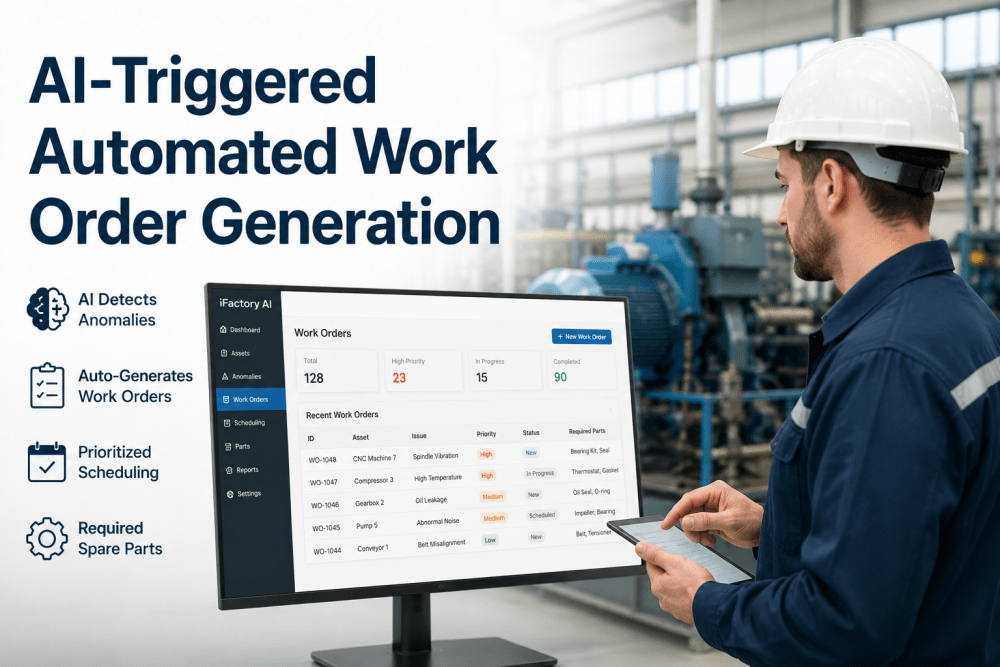
iFactory detects machinery anomalies and automatically generates prioritized, parts-pre-populated work orders in your CMMS — in under 4 minutes, without manual intervention. Book a 30-minute assessment to see it live on your facility's asset list.
Reduction in missed failure detections versus manual inspection-based programs
68%
Reduction in emergency work order volume within 12 months of AI platform deployment
$310K
Average annual maintenance cost reduction per facility from eliminated manual detection lag
4 min
Average time from anomaly detection to fully populated CMMS work order generation
Ready to see how AI-triggered work orders would perform on your facility's current asset register? Book a 30-minute platform assessment with iFactory's maintenance AI team.
Why Manual Work Order Workflows Are a Structural Maintenance Cost Problem
The manual maintenance work order process at a typical U.S. manufacturing facility follows a predictable path: an operator notices a symptom — unusual noise, elevated temperature, vibration — and reports it to a maintenance supervisor, who assigns an inspection, which produces a finding, which creates a work order, which gets prioritized against other open work, which gets scheduled, which gets executed. From symptom to repair completion, this cycle averages 3.2 days at facilities without integrated condition monitoring. From actual anomaly onset — the point at which the sensors were already measuring the deterioration — to repair completion, the average is 8.6 days. In those 8.6 days, a bearing that needed a planned 2-hour replacement at $420 in parts has often progressed to a shaft-damaged failure requiring a $4,800 emergency rebuild and 14 hours of unplanned downtime.
Detection Lag: Sensor to Human
Condition sensors detect anomalies in real time. The average facility's process for converting that sensor signal to a human action takes 18 to 72 hours — during which the developing fault progresses along its failure curve toward a more costly repair state.
HIGH COST IMPACT
Priority Misclassification
Manual work order priority assignment by supervisors with incomplete condition data generates systematic priority errors — low-priority tags on high-risk assets, high-priority tags on low-risk tasks — that misallocate technician time against actual failure risk.
HIGH COST IMPACT
Parts Availability Delays
Manual work orders that do not pre-populate required parts from the asset's bill of materials force the technician to identify parts at the time of repair — generating parts lookup delays, stockroom searches, and emergency procurement events that add 4 to 18 hours to repair cycle times.
MEDIUM COST IMPACT
Incomplete Failure Documentation
Manually created work orders without AI-generated condition evidence contain incomplete fault descriptions, missing trend data, and no historical pattern context — producing maintenance records that cannot be used to improve future predictive detection or support reliability engineering analysis.
MEDIUM COST IMPACT
Recurring Failure Blind Spots
Manual inspection-based systems have no mechanism to detect assets that failed the same way 90 days ago — because the connection between historical failure patterns and current sensor anomalies requires AI correlation across asset histories that no human can perform at fleet scale.
MANAGEABLE RISK
Supervisor Time on Administrative Routing
Maintenance supervisors at facilities without automated work order generation spend an average of 2.4 hours per shift on work order creation, parts lookup, priority assignment, and crew routing — tasks that AI automation handles in under 4 minutes per work order without supervisor involvement.
MANAGEABLE RISK
The AI Work Order Generation Workflow: From Sensor Anomaly to Scheduled Repair
The complete AI-triggered work order workflow moves from real-time sensor data through anomaly detection, fault classification, severity scoring, parts pre-population, and CMMS dispatch in a coordinated sequence that replaces what currently requires 4 to 18 hours of manual effort with an automated process completing in under 4 minutes. Each stage in the workflow is documented and auditable — every work order generated by the AI contains a complete data trail from the triggering anomaly through the classification decision to the dispatch action.
01
Continuous Multi-Signal Condition Monitoring
iFactory's platform ingests real-time data from vibration sensors, motor current analyzers, temperature transmitters, pressure sensors, oil quality monitors, and process historians via OPC-UA, Modbus, or direct PLC integration. Data streams are processed at the edge — no cloud round-trip latency on detection decisions. The platform establishes dynamic, operating-state-stratified baselines for each monitored asset within 14 to 21 operating days, creating a load-normalized reference that distinguishes genuine anomalies from process-driven signal variations that conventional threshold alarms misclassify as faults.
02
AI Anomaly Detection and Pattern Matching
When a monitored signal deviates from its load-normalized baseline, the AI engine compares the anomaly signature against a failure pattern library built from confirmed fault events across the connected asset fleet. For rotating equipment, the pattern library includes bearing defect frequencies, misalignment signatures, imbalance patterns, gear mesh anomalies, and lubrication degradation signatures — each matched to the asset's specific configuration, speed range, and operating history. Pattern match confidence above 70% triggers the classification and severity assessment step. Below 70%, the anomaly is flagged for monitoring at increased scan frequency without generating a work order, preventing false alarm generation on ambiguous signals.
03
Fault Classification, Severity Scoring, and Priority Assignment
Confirmed anomalies receive a specific fault classification — bearing outer race defect, mechanical looseness, impeller erosion, seal degradation, electrical insulation deterioration — along with a severity score from 1 to 10 based on the anomaly's current amplitude relative to the failure threshold, its rate of progression over the trailing 7 and 21-day windows, and the asset's consequence tier in the production system. The consequence tier — which the platform builds from the asset's position in the process flow, its redundancy status, and its historical failure cost record — ensures that a severity 6 anomaly on a critical single-point-of-failure asset generates a higher-priority work order than a severity 8 anomaly on a redundant asset with an immediately available standby.
04
Automatic Parts Pre-Population from Asset Bill of Materials
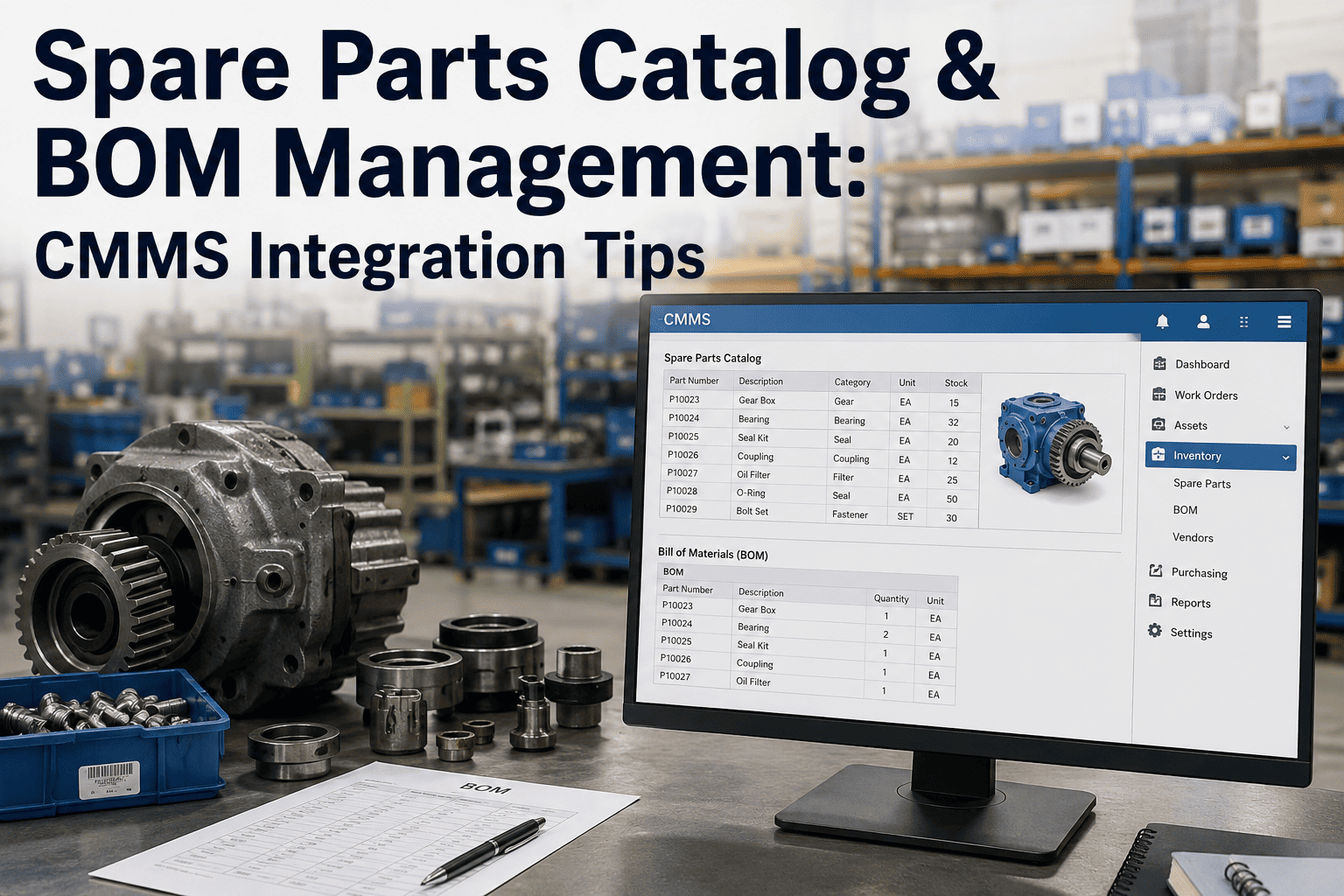
The work order generation engine cross-references the classified fault type against the asset's CMMS bill of materials to identify the required replacement parts or repair materials. For a bearing outer race defect, this populates the bearing part number, quantity, and current stock level from the CMMS inventory module. If the required part is below the safety stock level, the work order automatically includes a procurement request with the recommended order quantity based on lead time and consumption history. Parts pre-population eliminates the parts lookup step at repair time — a step that adds an average of 47 minutes to every reactive work order at facilities without this integration, and that generates emergency procurement premiums when stock is insufficient.
05
CMMS Work Order Creation and Crew Assignment
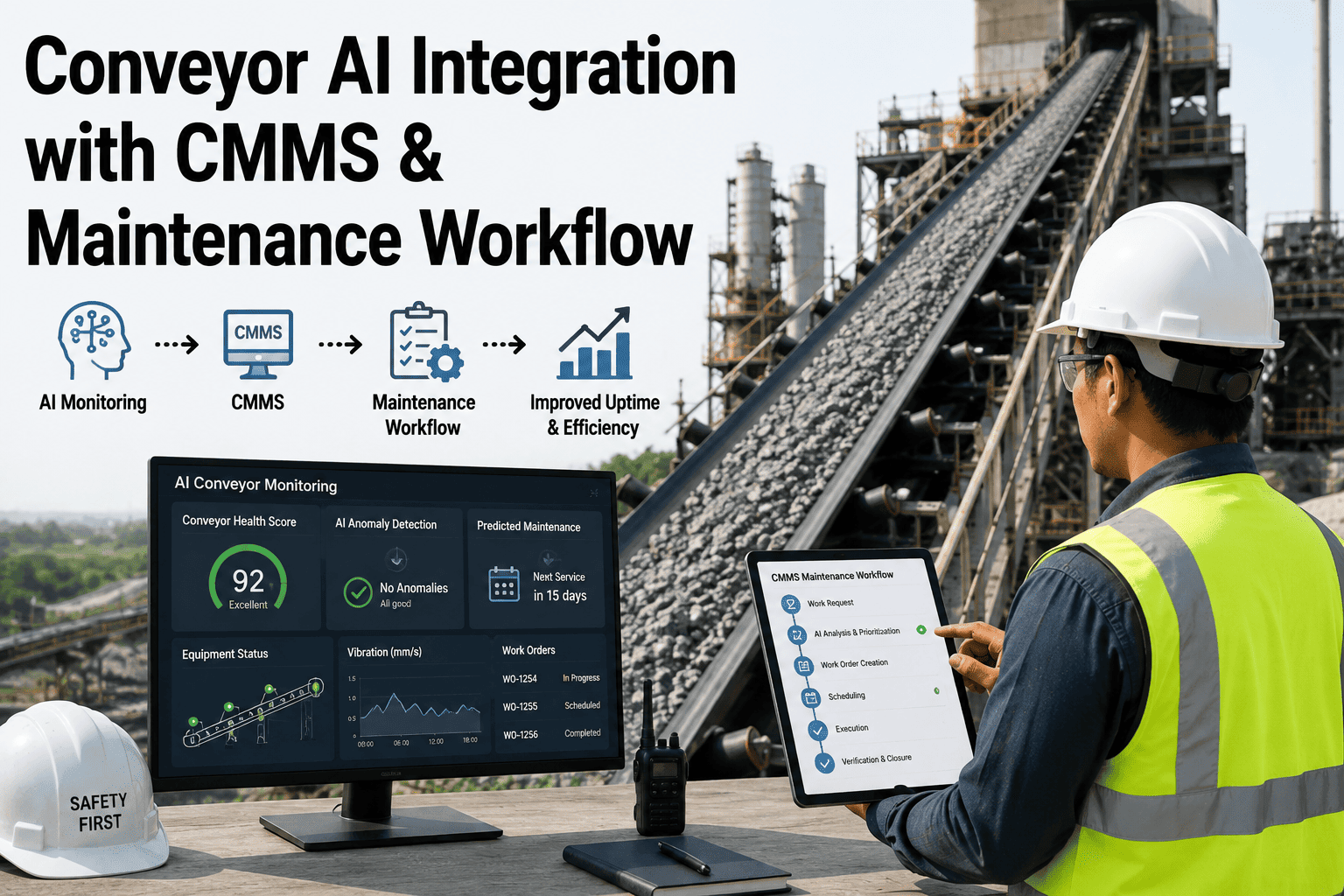
The fully populated work order is written to the CMMS via API integration — pre-filled with the asset ID, fault description, severity and priority classification, required parts list with stock status, estimated labor hours based on historical repair records for the same fault type at the same asset class, and the recommended intervention timing window based on the RUL estimate. For SAP PM and IBM Maximo integrations, the work order is created in the correct plant, functional location, and work center hierarchy with the appropriate notification type. The maintenance supervisor receives a mobile alert with the work order summary and one-tap approval or deferral options — maintaining human oversight without requiring the supervisor to create, classify, or route the work order manually.
06
Closed-Loop Learning: Repair Outcome Feedback
After each repair is completed and closed in the CMMS, the actual fault finding — confirmed failure mode, component condition at replacement, actual parts consumed, and actual labor hours — is fed back to the AI model as a labeled training example. This feedback loop continuously improves fault classification accuracy and RUL estimation precision for each asset class. Most facilities see false alarm rates drop below 5% by month 4 of operation, and fault classification accuracy exceeding 91% by month 6, as the model accumulates plant-specific evidence that supplements its pre-trained failure pattern library.
What AI-Generated Work Orders Contain That Manual Work Orders Miss
The quality difference between an AI-generated work order and a manually created one is not primarily in the formatting or completeness fields. It is in the evidential depth — the condition data, trend history, failure pattern match, and consequence context that transform a work order from a task assignment into a decision document that any technician can act on without additional investigation. The following comparison maps the specific content differences that determine whether a maintenance team addresses an emerging failure at the optimal intervention point or discovers it after the damage has compounded.
Fleet-wide pattern library match with similarity score
Priority Basis
Severity × consequence tier — fully documented
Required Parts
Pre-populated from BOM with current stock status
Estimated Labor
From historical repair records — same fault, same asset class
RUL / Intervention Window
Estimated operating hours remaining with confidence range
Stock Check
Auto-checked — procurement request triggered if below safety stock
Priority Ranking and Spare Parts Forecasting: The Two Multipliers
The two capabilities that most dramatically change the financial impact of automated work order generation — beyond the detection speed improvement — are consequence-weighted priority ranking and forward-looking spare parts forecasting. Both are invisible in a manual work order system. Both compound in value as the asset fleet and failure history database grows. Understanding how each works is essential for structuring the business case accurately.
Priority Engine
Consequence-Weighted Priority Ranking
A maintenance team that prioritizes work orders by anomaly severity alone will systematically under-respond to failures on critical assets and over-respond to anomalies on redundant equipment. iFactory's priority engine weights every work order by three factors simultaneously: fault severity (how far the signal has deviated from baseline and at what rate), consequence tier (the production impact of failure at this asset, calculated from its position in the process flow and its redundancy status), and intervention timing sensitivity (whether the RUL estimate indicates days or weeks remaining before the failure threshold is crossed). The combined priority score sorts the maintenance schedule queue in a sequence that a maintenance planner applying perfect judgment would produce — but does so automatically, across every monitored asset, in under 4 minutes of detection.
Severity scoringConsequence tier weightingRUL sensitivity factorProduction impact model
Parts Engine
Forward-Looking Spare Parts Forecasting
Spare parts inventory management at most manufacturing facilities is driven by historical consumption rates — a lagging indicator that orders parts after they have been used rather than before they are needed. iFactory's parts forecasting engine takes a forward-looking approach: the AI models the failure probability and timing for every monitored asset across the fleet and generates a 30, 60, and 90-day spare parts demand forecast that the storeroom can use to pre-position inventory before work orders arrive. When a pump bearing fleet shows 3 of 12 assets in Stage 2 degradation with estimated replacement windows in the next 30 to 45 days, the parts engine generates a pre-order recommendation for 3 bearing sets at the current contract price — before the emergency procurement premium applies. That pre-order versus emergency procurement cost differential averages 32% at facilities with supply chain data in the iFactory CMMS integration.
Average parts cost premium eliminated by pre-order versus emergency procurement on AI-predicted repair windows
47 min
Average repair cycle time reduction from pre-populated parts versus technician-identified parts at repair time
91%
Fault classification accuracy by month 6 of platform operation with closed-loop repair feedback training
See AI-Triggered Work Orders Running on Your Asset Register
iFactory's team demonstrates the complete anomaly-to-work-order workflow using your facility's asset list and current CMMS structure — showing exactly what the AI-generated work orders look like in your SAP PM, Maximo, or Infor EAM environment before any deployment commitment.
ROI Framework: What the Investment Returns Across Six Value Streams
The investment case for AI-triggered automated work order generation is built on six simultaneous value streams that compound over the platform life. The table below maps the typical investment and return profile for a U.S. discrete or process manufacturing facility with 80 to 150 monitored assets across two to three production lines.
Value Stream
Baseline (Manual / Reactive)
After AI Platform Deployment
Annual Value
Emergency to Planned Work Order Conversion
38–52% of work orders emergency or reactive
Below 12% emergency after 12 months
$85K–$180K per year
Supervisor Administrative Time
2.4 hrs/shift on WO creation, routing, prioritization
Under 0.4 hrs/shift — exception handling only
$42K–$88K per year
Parts Emergency Procurement Premium
18–28% of parts spend at emergency pricing
Below 4% emergency procurement with 30-day forecast
$38K–$92K per year
Repair Cycle Time Reduction
Avg. 3.8 hrs repair-to-complete including parts lookup
Avg. 2.1 hrs with pre-populated parts and pre-positioned stock
$55K–$120K per year
Unplanned Downtime Avoidance
4.8–8.2 hrs/week unplanned production loss
Under 1.4 hrs/week with early detection and planned intervention
$62K–$140K per year
Failure Escalation Cost Avoidance
Avg. $4,200 escalation cost per preventable failure
74% reduction in preventable failures reaching escalation
$28K–$68K per year
$48K–$96K
Platform Investment
Annual subscription for 80–150 assets with CMMS integration, parts forecasting, and mobile alerts
$310K
Average Annual Return
Combined savings across six value streams at comparable U.S. manufacturing facilities
3–5 mo
Typical Payback Period
Full investment recovery timeline at facilities with documented emergency work order history
4–6×
Year-2 ROI Multiple
As models mature, false alarms decline, and parts forecast accuracy reaches 88–94% for primary asset classes
Measured Outcomes at Facilities Running AI Work Order Automation
74%
Missed Detection Reduction
Failure events that were not detected before reaching unplanned downtime stage, compared to pre-deployment manual inspection baseline.
68%
Emergency Work Order Reduction
Emergency and reactive work order volume within 12 months of AI platform deployment across monitored asset fleet.
4 min
Detection to Work Order Time
Average time from confirmed anomaly detection to fully populated CMMS work order available for supervisor approval.
91%
Fault Classification Accuracy
By month 6 of operation with closed-loop repair feedback — specific fault type correctly identified and documented in work order.
47 min
Repair Cycle Time Saved
Per work order, from eliminating parts lookup at repair time through pre-populated BOM and pre-positioned storeroom stock.
$310K
Average Annual Savings
Combined maintenance cost reduction per facility across all six value streams at comparable U.S. manufacturing operations.
Ready to model these outcomes against your facility's current work order volume, emergency ratio, and maintenance cost baseline? Book a 30-minute ROI assessment with iFactory's maintenance AI team.
Expert Review
After running AI-triggered work order generation on 120 assets across two production lines for 14 months, the outcome that surprised us most was not the downtime reduction — we expected that. It was the change in how the maintenance team spent their shift time. Our supervisors were spending 2.5 hours per shift creating, routing, and prioritizing work orders from inspection reports and operator calls. That time is now almost entirely redirected to reviewing AI-generated work orders — which takes 20 minutes — and to executing planned maintenance work that previously got displaced by reactive events. The team is doing the same volume of maintenance work, but 68% of it is planned rather than emergency, and the repair quality is substantially better because technicians are arriving with the right parts and accurate fault descriptions rather than a one-line symptom report and an empty parts list. The ROI calculation we presented for capital approval significantly underestimated the supervisor time recovery value. We had modeled it at $40K annually. The actual impact — through the second shift crew as well — was closer to $90K.
U.S. Midwest — 120 Monitored Assets — iFactory Deployment 2024
Conclusion
AI-triggered automated work order generation is not a technology investment in the conventional sense — it is a structural correction to a workflow problem that every manufacturing facility with sensor-equipped assets already has. The sensors are generating the detection signal. The CMMS is ready to receive the work order. The gap is the 4 to 18-hour manual process in between, which turns early-stage detectable faults into escalated failures. iFactory closes that gap with a platform that takes the sensor signal, classifies the fault, scores the priority, pre-populates the parts, and writes the work order to the CMMS in under 4 minutes — with complete data trail and supervisor approval workflow intact. The 68% emergency work order reduction and $310,000 average annual savings reported at comparable facilities are the financial expression of eliminating that gap.
Frequently Asked Questions
iFactory integrates natively with SAP PM, IBM Maximo, Infor EAM, Oracle EAM, and Hippo CMMS via REST API. Work orders are created in the correct plant, functional location, and work center with the appropriate notification type. For other CMMS platforms, iFactory provides a configurable webhook that maps AI work order fields to the target schema. Contact iFactory for a compatibility check before deployment.
Three layers suppress false alarms: load-normalized baselines require deviation from the state-specific reference (not a fixed threshold); pattern match confidence must exceed 70% before a work order is generated; and all AI work orders require one-tap supervisor acknowledgment before entering the active queue. False alarm rates drop below 5% by month 4 through closed-loop repair feedback training.
For a facility with accessible OPC-UA or historian data and an existing CMMS API, deployment runs 4 to 8 weeks from kickoff to live work order generation. Initial anomaly alerts appear within 14 to 21 days as baselines establish. Fully formed work orders with parts pre-population and priority scoring appear at week 4 to 5 as confidence thresholds are reached on confirmed anomalies.
For 80 to 150 assets, iFactory's annual subscription — covering AI detection, fault classification, parts forecasting, CMMS integration, and mobile alerts — runs $48,000 to $96,000. Implementation runs $12,000 to $24,000 one-time. At the $310,000 average annual savings reported at comparable facilities, payback typically occurs within 3 to 5 months. Contact iFactory for a site-specific quote.
AI-Triggered Work Order Generation — Stop Manual Detection Lag, Start Planned Maintenance
iFactory's predictive AI detects machinery anomalies and automatically generates prioritized, parts-pre-populated work orders in your CMMS — eliminating the 4 to 18-hour manual detection and dispatch lag that turns predictable failures into unplanned downtime events.