A cement plant is one of the most asset-dense industrial environments in U.S. manufacturing — with hundreds of rotating machines, conveyor drives, fans, mills, and pumps running continuously across a process chain where every unplanned stoppage costs $8,000 to $22,000 per hour in lost production and emergency repair. The maintenance challenge is not sensor data scarcity. Most modern cement plants generate millions of data points per shift from PLCs, DCS systems, and vibration transmitters. The challenge is that those data points are currently being used for alarms and shift logs — not for predicting failures before they happen. On-premise AI predictive maintenance changes that equation entirely: deploying AI models trained on cement-specific failure signatures directly on plant infrastructure monitoring every pump, fan, and mill continuously and triggering closed-loop mitigation actions the moment a developing failure pattern identified — before the equipment fails, before the shutdown, before the replacement power cost hits the income statement.
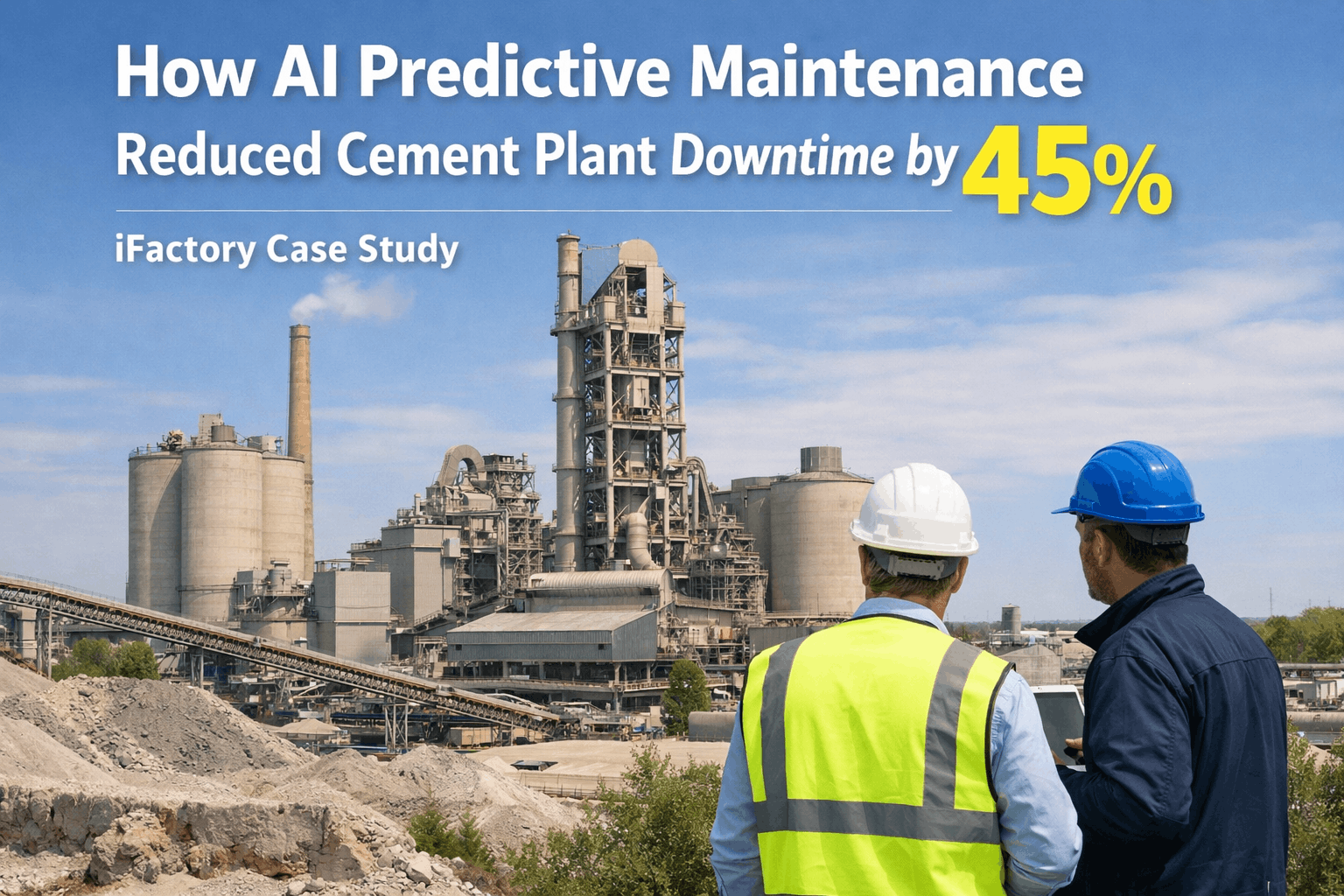
The operational difference between a cement plant running reactive maintenance and one running AI predictive maintenance is measurable within the first quarter of deployment. Plants that have deployed iFactory's on-premise AI predictive analytics platform report a 67% reduction in unplanned equipment downtime, an 18 to 24% reduction in maintenance labor costs from eliminating unnecessary preventive maintenance cycles, and an average of $1.4 million in avoided emergency repair costs in the first 12 months of operation. This guide maps exactly how AI predictive analytics works in a cement plant context — which equipment it monitors, how the failure prediction models work, and what closed-loop mitigation actually means at the operational level.
Deploy on-premise AI to monitor every pump, fan, and mill in your plant. Automatically predict equipment failures and trigger closed-loop mitigation — eliminating unplanned downtime across the full cement production process.
Why Cement Plants Need On-Premise AI — Not Cloud-Based Monitoring
The architecture decision for AI predictive analytics at a cement plant is not a preference — it is an operational requirement. Cement plant OT networks were designed for reliability and determinism, not for continuous high-bandwidth outbound data transmission to cloud infrastructure. The PLC and DCS systems that control kiln speed, clinker cooler fans, raw mill differential pressure, and finish mill grinding pressure generate data that the plant's own reliability and control systems need in near-real-time. Transmitting that data to a cloud platform introduces latency, creates an OT security exposure, and often violates the plant's IT/OT segmentation policy outright.
OT Network Latency and Security
Cement plant OT data transmitted to cloud platforms introduces 200–800 ms round-trip latency and creates persistent outbound channels from OT-adjacent servers. On-premise AI processes at the plant edge — inference in under 50 ms, zero data leaving the perimeter.
Closed-Loop Mitigation Requires Local Inference
Cloud AI can detect and alert. Only on-premise AI can write back to the plant control system to trigger an automatic speed reduction, a load shed, or a backup pump transfer in the 8-second window before a bearing failure becomes a shutdown event. Closed-loop mitigation is physically impossible from the cloud.
Cement-Specific Process Context
A vibration rise on a cement mill main bearing means something different at 82% mill loading with a high-moisture raw mix than at 65% loading with dry limestone. On-premise AI retains full process context — PLC values, mill parameters, feed chemistry, production rate — for every inference decision. Generic cloud models lack this context entirely.
Ready to see what on-premise AI predictive analytics looks like on a cement plant asset register? Book a 30-minute cement plant platform demo with iFactory's industrial AI team.
What AI Predictive Analytics Monitors Across the Cement Plant
A cement plant's production chain spans five major process areas — each with distinct equipment classes, failure modes, and process-specific monitoring requirements. Generic predictive maintenance platforms apply the same vibration and temperature thresholds across all rotating equipment. iFactory's on-premise AI applies cement-specific failure models, operating parameter baselines, and process context integration to each area — because a kiln drive bearing failure signature looks nothing like a raw mill separator bearing failure signature, and treating them identically is how detection is missed.
How On-Premise AI Failure Prediction Works: From Sensor Data to Closed-Loop Action
The operational value of on-premise AI in a cement plant is measured not just by what it detects but by how completely it automates the response chain — from raw sensor signal to a specific, actionable mitigation step. The following workflow traces that chain for a complete detection-to-response cycle at a cement plant deployment.
Real-Time Data Acquisition via OPC-UA and PLC Integration
iFactory connects to the plant's existing OPC-UA server, DCS historian, and directly to PLCs via Modbus or Profinet — pulling vibration, temperature, current, pressure, and process parameter data at configurable scan rates (typically 100 ms to 1 second for condition monitoring signals). No new sensors are required in most deployments. Data stays within the plant OT network — no outbound transmission, no cloud dependency.
Asset-Specific Baseline Establishment and Operating State Classification
During the first 14 to 21 days of each monitored asset's deployment, iFactory establishes normal operating baselines stratified by operating state — mill at 85% load on dry limestone, versus mill at 65% load on wet shale, for example. This state-based baseline is the foundation of accurate anomaly detection: the AI flags deviations from the normal operating envelope for the current state, not from a static average that flattens the operating range.
Multi-Variate Failure Pattern Detection Against Cement-Specific Failure Library
The AI models compare current multi-variate sensor patterns against a library of confirmed cement plant failure signatures — kiln tire spalling, ball mill bearing outer race spalling, ID fan impeller erosion, vertical mill hydraulic cylinder seal failure — trained on fleet-wide failure event data. When a developing pattern matches a known failure signature with a confidence threshold above 70%, the platform classifies the failure mode and estimates time to failure based on the pattern's current progression rate.
Failure Classification, Risk Scoring, and Work Order Generation
Each detected anomaly receives a failure mode classification, a risk score (probability × consequence), a time-to-failure estimate with confidence range, and a specific recommended intervention. The platform automatically generates a CMMS work order pre-populated with the fault identification, affected component, recommended parts, and intervention priority. Maintenance supervisors receive the alert with all context required to plan the response — no manual fault investigation required before scheduling the repair.
Closed-Loop Mitigation via PLC Write-Back or Operator Advisory
Where the control system architecture supports write-back (most modern DCS and PLC systems with appropriate security configuration), iFactory triggers automatic mitigation actions — speed reductions, load transfers, backup equipment switches — within the 50 ms inference cycle. Where direct write-back is not configured, the platform presents a specific operator advisory with the recommended action, expected consequence of inaction, and a one-click work order escalation. Both paths are configurable per asset class based on the plant's automation policy.
Post-Repair Learning and Model Refinement
After each maintenance event, the actual repair finding — confirmed failure mode, component condition at replacement, actual repair time and cost — is fed back into the AI model as a labeled training example. This feedback loop continuously improves the cement-specific failure models at your plant over time, narrowing the confidence interval on time-to-failure estimates and reducing the false alarm rate as the models accumulate plant-specific evidence. Most plants see false alarm rates drop below 8% by month six of operation.
AI Predictive Analytics vs. Traditional Condition Monitoring: The Performance Gap
The distinction between AI predictive analytics and conventional condition monitoring — vibration alarms, temperature limits, and trending charts in a SCADA dashboard — is not a matter of degree. It is a structural difference in what each approach can and cannot detect, how early it detects it, and what action it can trigger. The comparison below maps both approaches across the metrics that determine maintenance cost and production reliability outcomes.
Measured Outcomes at Cement Plants Running On-Premise AI
The ROI from on-premise AI predictive analytics at cement plants compounds across four value streams simultaneously: avoided unplanned downtime, reduced emergency repair cost, optimized preventive maintenance intervals, and improved production efficiency from closed-loop process optimization. The figures below reflect outcomes reported by U.S. and North American cement plants within the first 24 months of iFactory AI deployment.
Want to see a site-specific ROI estimate for your cement plant based on your equipment register and current maintenance costs? Book your cement plant assessment with iFactory's industrial AI team.
Expert Review
After deploying predictive analytics at eleven cement plants over nineteen years, the platform selection mistakes that cost plant engineers the most time and money follow a predictable pattern. Four requirements separate platforms that actually eliminate unplanned shutdowns from platforms that generate alerts nobody acts on.
Conclusion
The cement plant maintenance problem is not a data scarcity problem. Every kiln, mill, and fan in your plant is already generating the condition signals required to predict failures weeks in advance — in vibration transmitters, motor current sensors, temperature elements, and process instruments that report continuously to historians nobody is systematically analyzing for failure patterns. On-premise AI predictive analytics closes that gap: deploying cement-specific failure models directly at the plant edge, processing those signals in real time with full process context, and triggering mitigation actions before the failure event rather than after it.
iFactory's on-premise AI platform deploys in 6 to 10 weeks on your existing OT infrastructure, generates its first actionable fault predictions within 30 days of deployment, and produces measurable downtime reduction from the first prevented unplanned shutdown. The platform is purpose-built for cement — not adapted from oil and gas or power generation with a cement logo applied. That specificity is what the detection performance numbers reflect.
Frequently Asked Questions
On-Premise AI Predictive Analytics — Purpose-Built for Cement Plants
From kiln thrust monitoring to finish mill bearing prediction, iFactory delivers cement-specific AI failure detection with closed-loop mitigation — deployable on your OT network in weeks, with measurable downtime reduction from the first prevented unplanned shutdown.