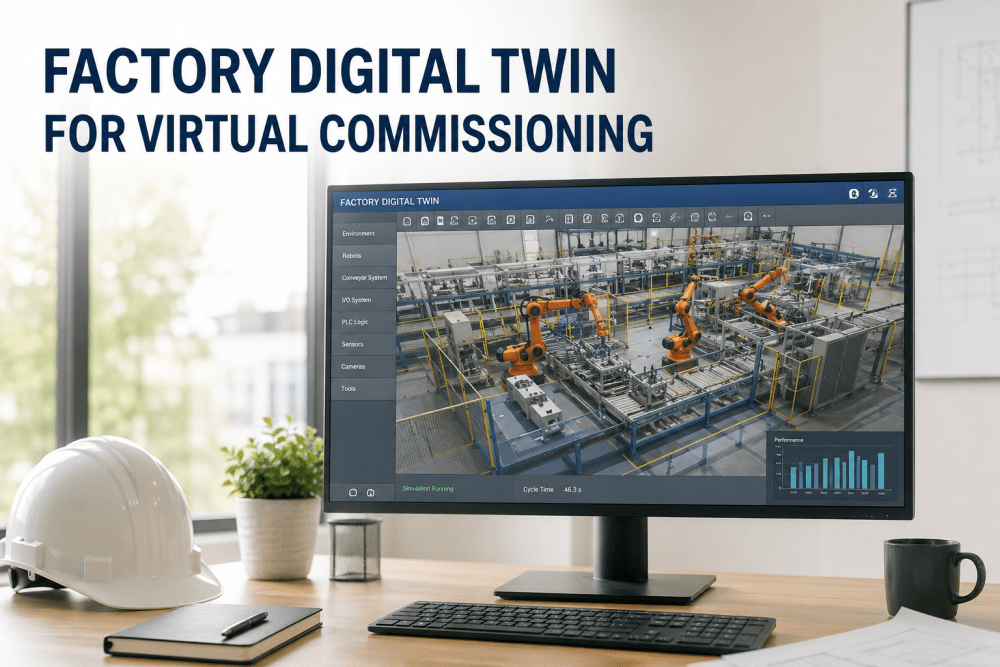
Before a single robot is installed, before a PLC program runs a real motor, and before a production line ships its first part, the most expensive mistakes in modern factory design have already been made — in CAD drawings that never caught the collision, in cycle time estimates that assumed perfect sequencing, and in PLC logic tested only against ideal-state assumptions. Factory digital twins for virtual commissioning exist to eliminate that entire category of pre-production cost. A physics-accurate 3D simulation environment that runs your actual PLC code, validates your robotic pathways against real kinematic constraints, and stress-tests your line sequencing under production-rate variance — all before a single piece of capital equipment is committed to a physical location — is no longer a sophisticated option reserved for automotive OEMs. It is the commissioning standard that separates the plants that hit rated production in week two from the ones still resolving interference issues in month four. Facilities using iFactory's digital twin commissioning platform report 61% reduction in physical commissioning time, 78% reduction in post-installation design changes, and average first-year savings of $1.4 million from avoided rework, shortened startup, and optimized cycle time before go-live.
Factory Digital Twin for Virtual Commissioning
A technical guide for U.S. manufacturing engineers deploying physics-accurate 3D simulation to test PLC logic, validate robotic pathways, identify collisions, and optimize cycle times — before any physical factory installation begins.
Six Commissioning Failure Modes That Virtual Twins Eliminate
Physical commissioning on a real production line is the most expensive place to discover a design error. Each failure mode below represents a category of avoidable cost that virtual commissioning resolves before equipment ships. Schedule a consultation.
Robot-to-Robot Interference
Two robots sharing a work envelope without collision-tested path coordination generate costly downtime during physical commissioning. Virtual twins run every programmed path combination against physics-accurate kinematic models, detecting interference before installation.
PLC Logic State Gaps
PLC programs written against ideal-state assumptions fail when real production introduces edge cases — conveyor jam states, sensor debounce failures, partial cycle interrupts. Virtual commissioning runs real PLC code against simulated production faults before any live I/O is connected.
Cycle Time Bottleneck Misestimation
Spreadsheet-based cycle time estimates miss the interaction effects between sequential operations — buffer starvation, handoff timing variability, and fixture dwell time accumulation. 3D simulation runs the full production sequence to identify true bottlenecks before the line is built.
Fixture and Tooling Clash Events
End-of-arm tooling that clears the CAD model in static review may intersect fixtures during dynamic motion. Physics simulation with full kinematic modeling catches dynamic clashes that static interference checks miss entirely.
Safety System Logic Gaps
E-stop response logic, light curtain zone transitions, and collaborative robot speed-and-separation monitoring require testing against realistic fault injection scenarios. Virtual commissioning validates safety PLC response chains under dozens of simulated fault conditions.
Layout Ergonomics and Access Failures
Physical clearances that look adequate in 2D layout drawings reveal ergonomic and maintenance access failures in 3D. Virtual walkthroughs identify access path conflicts before steel is cut or anchor bolts are set.
What a Physics-Accurate Factory Digital Twin Actually Simulates
The term "digital twin" is applied to everything from a 3D CAD model to a full real-time process simulation. For virtual commissioning, the standard that matters is physics accuracy — whether the simulation models mechanical, electrical, and logical behavior at the fidelity required to produce commissioning-valid test results. iFactory's environment operates across five physics layers simultaneously.
Robot and Machine Kinematic Simulation
Every robot in the virtual twin operates against its actual kinematic model — joint limits, velocity profiles, acceleration constraints, and payload-dependent reach envelopes imported directly from manufacturer URDF files or CAD assemblies. Path planning runs against real joint space, meaning a path that clears in the simplified CAD model but violates a joint limit during optimized motion is caught before physical commissioning. Robotic cell cycle times output from the simulation are validated against OEM published performance data within ±2% tolerance before the results are used for layout decisions.
Virtual PLC Execution with Hardware-in-Loop Option
iFactory's virtual commissioning environment supports both software-in-loop (SIL) and hardware-in-loop (HIL) PLC testing. In SIL mode, actual PLC ladder logic or structured text code runs inside a virtualized controller that communicates with the simulation's I/O layer — inputs from virtual sensors, outputs to virtual actuators. The PLC program executes against a cycle-accurate simulation clock, making the test results equivalent to running the same logic on physical hardware. HIL mode connects a physical PLC or safety controller to the simulation via OPC-UA, making the virtual factory the physical plant surrogate for full E2E logic validation.
Discrete Event and Continuous Material Flow Simulation
Production line throughput is modeled as a discrete event simulation layered over the 3D kinematic environment — parts enter the simulation, traverse conveyors with physics-accurate friction and mass properties, queue at stations with stochastic cycle time distributions, and exit as completed assemblies. Buffer sizing, conveyor speed optimization, and station takt time balancing are all visible in the simulation before any physical equipment is ordered. Throughput variance analysis under MTTR and MTBF inputs generates a realistic OEE prediction for the proposed layout that engineering teams use to validate capital expenditure justifications.
Virtual Sensor and Vision System Simulation
Every sensor in the virtual factory — photoelectric presence sensors, ultrasonic distance sensors, vision system cameras, RFID readers — operates as a virtual device that responds to the physics of the simulated environment. A photoelectric beam sensor fires when a simulated part breaks its beam based on actual part geometry and sensor mounting position. This sensor simulation layer allows engineers to validate sensor placement, field-of-view coverage, and detection reliability before hardware procurement — eliminating the common post-installation finding that a sensor location clear in 2D layout is blocked by a fixture in 3D production conditions.
Safety System and Fault Injection Validation
ISO 13849 and IEC 62061 safety system validation requires testing PL/SIL-rated functions against all intended fault conditions. iFactory's safety simulation layer injects defined fault states — E-stop activation, light curtain beam break, robot protective stop, safety door interlock — into the running simulation and records the PLC safety response sequence, timing, and state transition for compliance documentation. Fault injection sequences are automatically logged with timestamps, system state snapshots, and response time measurements, generating a structured test record that supports machinery directive CE documentation and OSHA engineering control verification requirements.
The Virtual Commissioning Workflow: From CAD Import to Go-Live Certificate
Virtual commissioning follows a defined sequence — from importing the physical factory's CAD geometry through PLC logic validation, robotic path optimization, and throughput simulation — to generating the commissioning test certificate that replaces weeks of physical line-up time.
CAD Geometry Import and Factory Model Assembly
The virtual commissioning environment ingests mechanical CAD data from SolidWorks, CATIA, NX, or AutoCAD Plant 3D via direct format import or STEP/IGES neutral file exchange. Equipment vendor models — robots, conveyors, fixtures, machine tools — are imported with full geometric fidelity and assigned physics properties: mass, center of gravity, joint constraints, and surface contact parameters. The resulting factory model is the physical-fidelity foundation for all subsequent simulation work.
I/O Configuration and PLC Signal Mapping
Every physical I/O point in the PLC program is mapped to a corresponding virtual signal in the simulation. Inputs from real sensors become virtual sensor outputs from the simulated environment; PLC outputs to actuators drive virtual motion in the 3D model. This bidirectional I/O mapping is the critical integration step that allows actual PLC code — not a simplified model of it — to control the virtual factory as it will control the physical one.
Robotic Path Programming and Interference Testing
Robot programs are either imported from the OEM offline programming environment (Fanuc ROBOGUIDE, ABB RobotStudio, KUKA.Sim, Yaskawa MotoSim) or written directly in the virtual environment. Path execution is verified for joint limit compliance, singularity avoidance, and collision clearance against all static structures and moving elements at their worst-case positions during concurrent motion. Interference detection results are exported as a structured report with exact robot configurations and TCP positions at each detected conflict point.
PLC Logic Validation Under Fault Injection
With physical I/O mapped to virtual sensors and actuators, the actual PLC program runs through a defined test sequence covering normal production cycles, planned mode transitions, and injected fault states. Each test sequence is logged with a pass/fail result against the acceptance criteria in the functional design specification. Faults that reveal PLC logic gaps — missed state transitions, incorrect output sequencing, safety function response timing failures — are documented with the exact simulation state that produced them, providing the software engineer with reproducible test cases for correction and re-validation.
Throughput Simulation and Cycle Time Optimization
With robot paths validated and PLC logic confirmed, the full production sequence runs as a discrete event simulation across the complete production cycle. Bottleneck stations are identified from simulated throughput data, buffer sizing is optimized, and robot path cycle times are tuned for maximum throughput while maintaining safety clearances. The output is a validated cycle time per station, predicted line OEE under defined downtime assumptions, and takt time confirmation against the production rate target in the project brief.
Virtual Commissioning Certificate and Physical Go-Live Package
The completed virtual commissioning generates a structured test certificate documenting all validation tests performed, results achieved, deviations found and resolved, and final acceptance sign-off status. This certificate serves as the baseline for physical commissioning — reducing physical line-up to verification rather than discovery, and providing the documentation trail required for machinery directive CE marking, functional safety assessment, and customer acceptance testing.
Deploy Virtual Commissioning on Your Next Factory Project
iFactory's digital twin platform imports your CAD geometry, runs your actual PLC code, and validates your robotic pathways in a physics-accurate simulation environment — identifying every collision, logic gap, and cycle time bottleneck before physical installation begins.
From greenfield factory design to brownfield line expansion, iFactory's virtual commissioning workflow delivers a structured test certificate that replaces weeks of physical discovery commissioning with validated, documented results. Reduce startup risk, compress go-live timelines, and protect capital investment from preventable design errors. Book your commissioning demo now.
Virtual vs. Physical Commissioning: The Full Cost Comparison
The ROI case for virtual commissioning is built on the documented cost differential between discovering design errors in simulation versus discovering them on a physical production line. The table below maps typical cost impact for a mid-complexity automated assembly line with 6 to 12 robot stations.
Measured Outcomes at Facilities Using Digital Twin Commissioning
Plants deploying iFactory's virtual commissioning platform achieve consistent, documented outcomes within the first production quarter after go-live.
Ready to model these outcomes against your facility's current commissioning timeline and project budget? Book a 30-minute virtual commissioning assessment with iFactory's simulation engineering team.
Expert Review: What Process Engineers Say About Virtual Commissioning
Independent automation commissioning engineers with experience across North American manufacturing operations have reviewed iFactory's virtual commissioning architecture.
The biggest misconception I encounter is that virtual commissioning is an additional cost on top of physical commissioning. That framing is backwards. Every hour a simulation engineer spends finding a robot interference conflict in the virtual environment costs roughly 3% of what the same discovery costs on a physical line with contractors standing by and a schedule milestone burning. The facilities treating virtual commissioning as the commissioning — and physical line-up as the verification — are the ones hitting production targets on their original go-live dates.
What surprises most plant engineers when they see their first virtual commissioning run is the cycle time data. They come in with a spreadsheet estimate — usually optimistic by 12 to 18% — and see the simulation showing exactly where the bottleneck lives before a single piece of equipment has shipped. Fixing a buffer size in simulation costs an engineer a morning. Fixing it after the line is built costs six figures and a schedule slip.
Conclusion: Validate Before You Build
Factory digital twins for virtual commissioning represent the most direct ROI available in modern manufacturing project execution — because the alternative is discovering the same design errors on a physical production line at 10 to 50 times the resolution cost. The technology is deployed today, the CAD import and PLC integration workflows are mature, and the documentation output is accepted by machinery directive and functional safety frameworks that require exactly the structured test records virtual commissioning naturally generates.
iFactory's virtual commissioning platform connects directly to your mechanical CAD, your PLC programming environment, and your robot OEM offline programming tools — producing a pre-validated, physics-accurate simulation environment that resolves collision, logic, and cycle time issues before equipment ships. The 61% physical commissioning reduction and $1.4 million average first-year savings are the documented result of replacing physical discovery with virtual validation on the systems that matter most.
Factory Digital Twin Virtual Commissioning: Frequently Asked Questions
Factory Digital Twin Virtual Commissioning — Validate Before You Build
iFactory's physics-accurate simulation environment tests your PLC logic, validates your robotic pathways, identifies every collision, and optimizes cycle times before any physical installation begins — delivering a commissioning test certificate that compresses physical go-live by 3 to 6 weeks.
61% Physical Commissioning Reduction · Zero Post-Install Collision Events · Fanuc · ABB · KUKA · Yaskawa · UR · Siemens · Rockwell · Beckhoff PLC · ISO 13849 Safety Test Documentation