Kiln Shell Thermal Camera Monitoring | What AI Vision Catches Before Engineers Do
By Riley Quinn on March 20, 2026
Your operator walks the kiln floor at 6 AM. Checks the shell temperature with a thermal gun at five spots. Logs the readings. Everything looks normal—250°C, 260°C, 255°C. What he doesn't see: a 47°C anomaly developing between his measurement points, invisible to spot checks, growing 2-3°C warmer every day. In three weeks, it will glow red at night. In four weeks, it will warp the shell. The $2.3 million emergency repair will cost 45 days of lost production. Meanwhile, a thermal camera scanning the same kiln sees 307,200 temperature points every 4 seconds. It detected the anomaly 23 days ago. This is what your engineers miss—and what AI vision catches every single shift.
The Gap Between What You See and What's Actually There
Human Inspection
5 spot readings per shift
Once per 8-12 hours
5-10 measurement points
Misses anomalies between spots
Catches problems at red shell stage
VS
AI Thermal Vision
307,200 points every 4 sec
Every 4-30 seconds, 24/7
Full 160° kiln coverage
Detects 2-3°C daily trends
Catches problems 30+ days early
95%
Hotspot detection accuracy
30+
Days before visible red shell
30%
Longer refractory life
70%
Fewer temp-related failures
The Five Things Your Walkthrough Can't Catch
Manual inspections aren't bad—they're just physically limited. A human with a thermal gun can only be in one place at one time. Here's what happens between those readings.
01
Developing Hotspots
A refractory brick starts degrading. Temperature rises 2-3°C per day at that exact spot. Your thermal gun hits 10cm to the left—reading normal. AI sees the trend building over days and flags it at +15°C before it becomes critical.
Critical threshold:350°C requires attention, 400°C is emergency
02
Overnight Temperature Escalation
One Alabama plant's monitoring relied on once-per-shift thermal gun readings. A rapid temperature escalation occurred overnight—between shifts. Shell temps exceeded 400°C, warping the steel. Result: 45 days of emergency repairs, $2.3M cost.
AI alternative:Monitoring every 30 seconds catches escalation immediately
03
Coating Thickness Trends
Protective clinker coating gradually thins. Shell temperature in that zone creeps up imperceptibly—perhaps 2-3°C per day. Your spot check shows "normal" because each individual reading is within tolerance. AI tracks the trend.
Why it matters:Coating loss exposes refractory to extreme heat
04
Ring Formation Cold Spots
Material buildup inside the kiln creates cold spots—areas where clinker flow is restricted. They accumulate gradually, reducing inner diameter and production performance until flow is blocked entirely.
Consequence:Unplanned shutdown to clear blockage
05
Thermal Warp Stress Zones
Temperature differences across the shell create structural stress—often invisible until damage occurs. These stress zones around tyres are especially critical during heat-up and cool-down phases.
AI capability:Identifies stress zones by analyzing temperature-related distortion
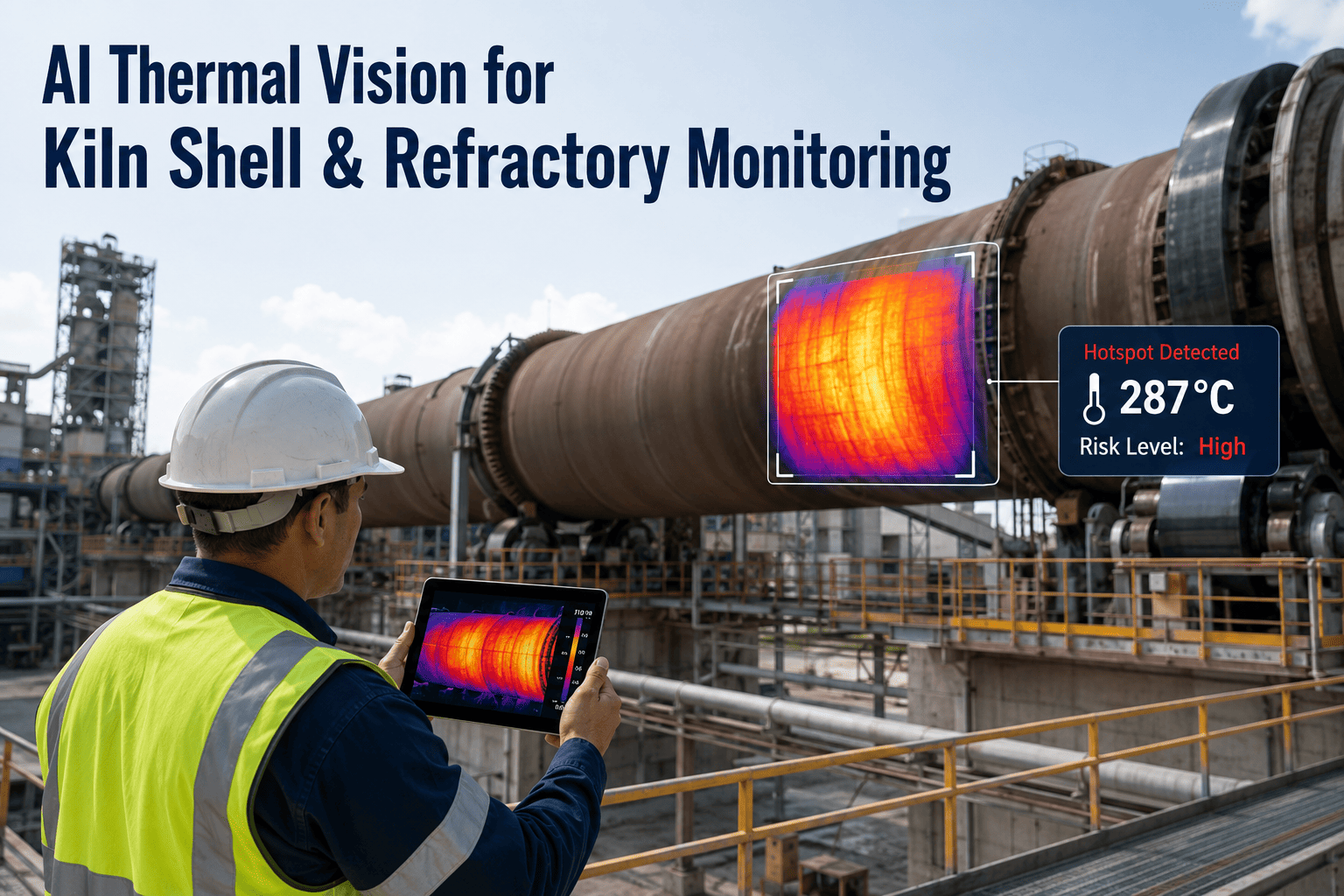
IR cameras scan 160° of kiln circumference. 640×480 resolution (307,200 points) captured every 4-30 seconds. Full kiln coverage with every rotation.
AI Analysis
ML models map thermal signatures to 3D kiln model. Calculate refractory thickness from heat patterns. Detect trends invisible to absolute readings.
Predictive Alerts
Graduated thresholds: Watch at 330°C, Alert at 350°C, Critical at 380°C. Automatic work orders generated. 23+ days warning before visible damage.
See What Your Walkthrough Misses
iFactory connects thermal cameras to AI analytics that detect refractory degradation weeks before it becomes visible—giving you time to plan repairs during scheduled outages, not emergency shutdowns.
At 400°C, steel begins to weaken and can permanently warp. AI catches problems at 330°C—giving you 30+ days to respond.
Not sure where your kiln falls on this scale right now? Contact our team for a thermal baseline assessment.
Real Results: What Plants Are Achieving
Turkey
23-Day Early Warning
IoT thermal sensors detected a developing hot spot with a 47°C temperature anomaly in Zone 3. The alert came 23 days before visible shell deformation would have occurred.
Savings:$1.8M avoided refractory replacement
Alabama, USA
Before vs After
Manual thermal gun readings once per shift missed overnight temperature escalation. Shell exceeded 400°C, warping steel. After installing continuous scanning, the plant now monitors every 30 seconds.
Previous cost:$2.3M + 45 days downtime
India
Refractory Life Extension
AI thermal imaging identified recurring hotspots in specific regions, enabling proactive flame position adjustments and targeted repairs before major damage accumulated.
How does AI calculate refractory thickness from external temperature?
AI models analyze external shell temperature patterns captured by IR cameras. Since refractory acts as insulation, thinner refractory allows more heat to reach the shell surface. By mapping thermal signatures to 3D kiln models and comparing against baseline readings, AI can estimate internal refractory thickness and predict degradation zones—all while the kiln runs at full production.
What temperature thresholds indicate refractory problems?
Shell temperatures above 300°C typically indicate refractory issues requiring attention. In the burning zone, temperatures above 350°C are critical. However, trends matter more than absolute values—a gradual increase of 2-3°C per day over several days suggests developing problems even if each individual reading is within tolerance.
How often do thermal cameras scan the kiln?
Modern systems capture thermal data every 4-30 seconds, with high-resolution cameras providing 640×480 pixel images (307,200 temperature points). This continuous monitoring covers nearly half the kiln circumference (160°) in real time, meaning the full shell is mapped with every rotation—no blind spots, no gaps between readings.
Can thermal monitoring work with our existing systems?
Yes. AI thermal monitoring platforms integrate with existing DCS, SCADA, historian databases, and CMMS systems through standard protocols including OPC-UA, MODBUS, and MQTT. Temperature anomalies can automatically trigger work orders in your maintenance system without manual intervention.
What's the ROI on continuous thermal monitoring?
A single avoided emergency shutdown typically justifies the investment. With kiln downtime costing $50,000-$100,000 per hour, and emergency refractory repairs running $800K-$1.5M plus weeks of lost production, the ROI is often achieved from the first prevented incident. Plants also report 18-25% lower maintenance costs and 30% longer refractory life.
307,200 Temperature Points vs 5 Spot Readings
Your engineers are doing their best with thermal guns. But the math is against them. iFactory's AI thermal vision sees every point on your kiln shell, every rotation, every shift—catching what manual inspection physically cannot.