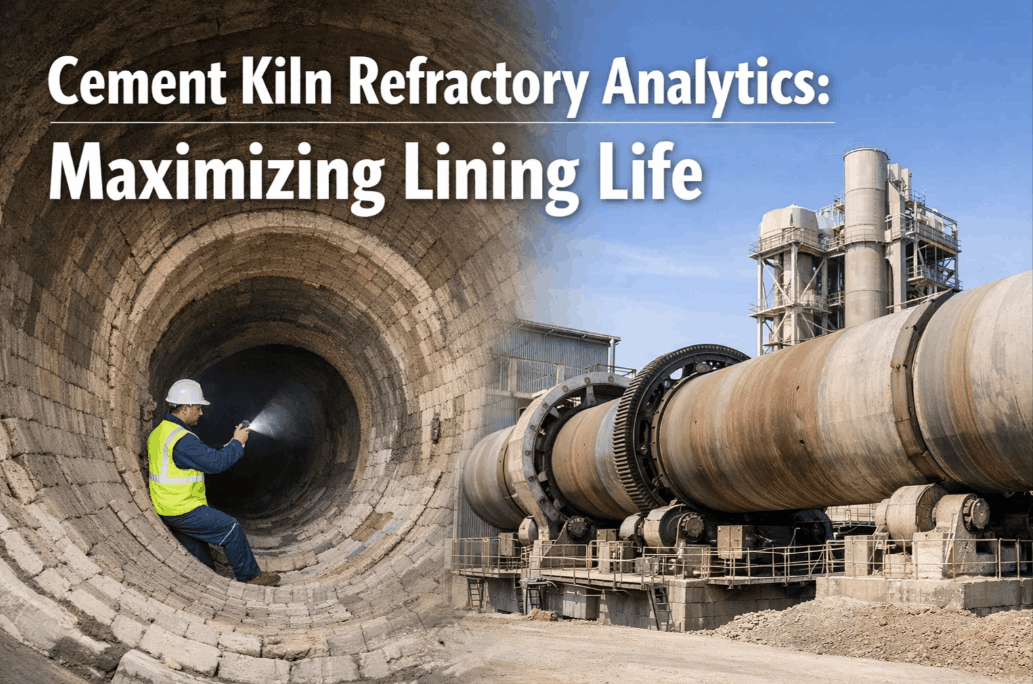
A cement kiln's refractory lining is the single largest recurring maintenance cost most plants carry, and it is also the one most often installed under time pressure rather than engineering judgment. A burning zone brick campaign that should run 15 to 18 months frequently fails at 6 to 9 because the brick grade, anchor spacing, or dry-out curve was chosen to fit a shutdown window instead of the zone's actual thermal and chemical load. The gap between a well-specified lining and a rushed one is rarely visible until the kiln is already running hot. Book a Demo to see how continuous shell monitoring flags that gap before it becomes an unplanned stop.
Every Zone in Your Kiln Wants a Different Refractory. Most Linings Give Them the Same One.
From the riser duct to the nose ring, a rotary kiln puts six distinct thermal and mechanical environments end to end, and each one has a refractory grade, thickness, and anchoring pattern that actually fits it. Specifying and installing to that zone-by-zone logic, rather than a single blanket brick order, is what separates a 9-month campaign from an 18-month one.
Six Zones, Six Different Jobs — Why One Brick Grade Never Fits the Whole Kiln
A rotary kiln is not a uniform tube; it is a sequence of chemically and thermally distinct environments moving from the cold end to the hot end and back down again toward the cooler. The riser duct sees alkali-laden gas but modest heat. The burning zone sees direct flame radiation, clinker coating cycling, and chemical attack from liquid phase clinker at the same time. The nose ring takes the heaviest mechanical abrasion in the entire kiln from falling clinker, but at a comparatively moderate temperature. Selecting refractory by zone means matching each of these specific loads instead of over-specifying an expensive brick where it is not needed, or under-specifying where a lower grade will fail within weeks.
Riser Duct / Kiln Inlet
750-900°C
Insulating castable or low-duty firebrick handles the alkali and CO2-rich gas stream here. Thickness typically runs 150-200mm, with the emphasis on insulation value to protect the shell rather than raw refractoriness, since peak temperature is the lowest of any zone in the kiln.
Upper Transition / Safety Zone
1,100-1,250°C
Alumina-spinel brick is the standard choice, selected for resistance to alkali and sulfate attack as clinker begins to form a protective coating. This zone is named for its role as a buffer: if the burning zone coating retreats under upset conditions, this lining is the next line of defense.
Burning / Sintering Zone
1,450-1,500°C
Magnesia-chrome or magnesia-spinel brick, direct-bonded for coating retention, carries the highest thermal and chemical load in the kiln. Thickness of 225-250mm is standard, and this zone's campaign life is what most plants use as the benchmark for the entire lining's performance.
Lower Transition / Cooling Zone
1,250-1,000°C
Magnesia-spinel or high-alumina brick handles the declining temperature gradient as the clinker moves toward discharge. Coating retention is less critical here, so the priority shifts toward thermal shock resistance as the material cools through repeated kiln stop-start cycles.
Discharge / Nose Ring
950-1,000°C
Abrasion-resistant low cement castable with a dense anchor pattern is standard here, because falling clinker chunks create continuous mechanical wear that brick joints cannot survive. This is consistently the shortest-life zone in the kiln regardless of grade selected.
Cooler Inlet Hood
900-1,000°C
Ultra-low cement castable with high abrasion resistance handles the hot clinker bed impact as material transfers from kiln to cooler grate. Anchor corrosion resistance matters as much as the castable grade itself in this zone, given the combined heat and mechanical loading.
Magnesia-Chrome, Magnesia-Spinel, Alumina-Spinel, or High-Alumina — Matching Grade to Load
Brick grade selection is where most of the campaign-life variance actually originates, and it is also where plants most often default to whatever grade the incumbent supplier stocks rather than what the zone requires. Four grades cover the overwhelming majority of rotary kiln applications, and each carries a distinct trade-off between refractoriness, coating retention, thermal shock resistance, and regulatory exposure that should drive the decision rather than unit price alone.
Magnesia-Chrome
The traditional burning zone standard, valued for excellent coating adherence and the highest hot strength of any commonly used grade. Chromium content raises both performance and environmental scrutiny in some jurisdictions, and disposal of spent brick requires documented handling procedures that plants should confirm with their regulatory framework before specifying.
Magnesia-Spinel
The chrome-free alternative that has largely displaced magnesia-chrome in new burning zone specifications, offering comparable coating retention with better thermal shock resistance and simpler spent-brick disposal. Most brick manufacturers now recommend this grade as the default burning zone choice for new campaigns.
Alumina-Spinel
The standard transition zone grade, offering strong alkali and sulfate resistance at a lower cost than magnesia-based grades. It performs well anywhere coating retention is secondary to chemical attack resistance, which is most of the kiln outside the burning zone itself.
High-Alumina
The cost-effective choice for the riser duct and cooler-adjacent zones where peak temperature stays under roughly 1,300°C and mechanical or chemical attack is moderate. Using high-alumina brick in a zone that actually needs alumina-spinel or magnesia-spinel is one of the most common under-specification errors plants make to save on initial material cost.
Is Your Shell Temperature Telling You a Zone Is Already Failing?
iFactory's continuous shell thermography flags hot spots by zone in real time, so a thinning lining shows up as a data trend weeks before it shows up as an unplanned kiln stop.
Low Cement, Ultra-Low Cement, and Insulating Castable — Where Each One Belongs
Castable refractory covers the zones where brick geometry cannot follow the shape of the equipment, or where installation speed matters more than the incremental performance brick would provide. The nose ring, cooler inlet hood, burner pipe, and kiln hood are almost always cast rather than bricked, and the castable family selected for each has to match both the thermal duty and the physical abrasion the zone experiences.
Low Cement Castable (LCC)
The general-purpose choice for kiln hood, burner pipe, and transition areas where moderate abrasion and thermal cycling both matter. LCC balances installed cost against durability better than either the ultra-low cement or the standard conventional castable families, which is why it covers the largest share of cast refractory volume in a typical kiln.
Ultra-Low Cement Castable (ULCC)
Reserved for the nose ring and cooler inlet hood, where clinker impact abrasion is the dominant failure mode. The reduced cement content produces higher density and lower porosity after cure, which directly translates into better resistance to the mechanical wear these two zones experience continuously.
Insulating Castable
Used as a back-up layer behind the working lining or on the riser duct itself, where the priority is protecting the steel shell rather than resisting direct process contact. Lower density and lower thermal conductivity are the design goals here, which is the opposite requirement from the dense, abrasion-resistant castables used at the discharge end.
Mixing and placement discipline determines whether a correctly specified castable actually performs to its rated life. Water content outside the manufacturer's tolerance, typically a narrow band around 4.5 to 6.0 percent by weight depending on grade, is the single most common cause of castable underperformance, producing either poor flow and air entrapment on the low end or reduced strength and increased shrinkage cracking on the high end. Vibration casting rather than hand-packing is standard for LCC and ULCC grades to achieve the density the mix design assumes, and batch records documenting water addition, mix time, and placement temperature should be retained for every pour as a quality control baseline.
V-Anchors, Y-Anchors, and Ceramic Anchors — Getting Spacing and Alloy Right
Anchoring is the part of a castable installation most likely to be under-engineered because it is invisible once the pour is complete. An anchor pattern that is too sparse allows the castable to crack and spall in large sections rather than wearing evenly, while a pattern that is too dense creates cold spots and thermal stress concentration around each anchor stud. Both failure modes are common, and both are preventable with a spacing calculation tied to the specific castable thickness and expected shell temperature rather than a generic template pulled from the previous job.
V-Anchors
The standard choice for single-layer castable under roughly 150mm, offering reliable mechanical retention with a simple stud-welding installation process that most field crews are already trained on.
Y-Anchors
Used for thicker or two-layer castable systems, where the wider base distributes load across a larger volume of material and reduces the risk of the castable pulling away from a single anchor point under thermal cycling.
Ceramic Anchors
Specified where metallic anchors would corrode or lose strength at the service temperature, common in the hottest cast sections such as burner pipe tips where metal anchor life would otherwise become the limiting factor for the whole lining.
Alloy grade selection for metallic anchors follows the expected hot-face-to-shell temperature gradient rather than the zone's peak process temperature. A 309 stainless anchor is generally adequate where the anchor's own service temperature stays under roughly 900°C, while 310 stainless or a higher nickel alloy is required above that threshold. Anchor pitch typically runs 300 to 450mm center-to-center depending on castable thickness and grade, tightening toward the lower end of that range in high-abrasion zones like the nose ring where the castable itself has less inherent strength margin to spare.
From Shell Preparation to Dry-Out — The Seven Stages That Determine Campaign Life
Refractory installation quality is set almost entirely during a compressed outage window, which is exactly why sequencing and quality control at each stage matter more here than in almost any other maintenance activity in the plant. Skipping or rushing any one of the following stages tends to shorten campaign life by months rather than days, because early defects compound as the kiln returns to operating temperature.
Shell Surface Preparation and Anchor Welding
Shell surface is cleaned to bare metal in cast sections and anchor studs are welded to the calculated pattern, with pull-test verification on a sample percentage of studs before any castable is placed.
Brick Sorting and Dry-Fit Layout
Brick is sorted by dimension tolerance and a dry-fit mock ring is assembled to confirm key brick position and joint width before any mortar is mixed, catching dimensional issues while they are still cheap to correct.
Ring Building and Joint Control
Brick rings are built with dry or thin-joint mortar as specified, with joint width held under roughly 0.5mm for direct-bonded brick, since oversized joints become the first point of chemical attack once the kiln returns to service.
Castable Batching and Placement
Castable is batched to the manufacturer's water tolerance, mixed for the specified time, and placed by vibration casting within the working time window before the mix begins to set.
Controlled Curing
Cast sections cure under controlled temperature and humidity for the period specified by the manufacturer, typically 12 to 24 hours minimum, before any heat is applied, since premature heating traps residual moisture and causes explosive spalling.
Dry-Out and Heat-Up Curve
The kiln is brought to operating temperature along a controlled heat-up curve supplied by the refractory manufacturer, holding at specific temperature plateaus to drive off residual moisture without thermal shock cracking either brick or castable.
Post-Installation Verification
Ring tightness, joint gaps, and lining thickness are verified before the kiln is closed up, with ultrasonic thickness measurement providing a documented baseline that later shell temperature trends can be compared against throughout the campaign.
What Installation Quality Actually Costs in Months of Campaign Life
The same brick and castable grades, installed to three different quality standards, produce campaign life results that vary by a factor of two to three. The table below reflects typical field experience across burning zone brick and nose ring castable, the two shortest-life sections of a standard kiln lining, and illustrates why installation oversight delivers a larger return than upgrading material grade alone.
| Lining Section | Poor Installation | Average Installation | Best-Practice Installation |
|---|---|---|---|
| Burning Zone Brick | 4-6 months | 9-12 months | 15-20 months |
| Upper Transition Brick | 6-8 months | 12-16 months | 20-26 months |
| Nose Ring Castable | 2-3 months | 6-8 months | 12-14 months |
| Cooler Inlet Castable | 3-4 months | 7-9 months | 13-16 months |
| Unplanned Refractory Stops per Year | 4-6 | 2-3 | 0-1 |
Our burning zone brick had been averaging eight months for three years running, and we assumed that was just the grade we were buying. Bringing in a crew that actually followed the manufacturer's dry-out curve instead of our old shortened schedule, along with tighter joint tolerance during ring building, took the same brick grade to fifteen months on the very next campaign. The material was never the problem.
Frequently Asked Questions
Q: How do we decide whether a given kiln zone should be bricked or cast?
Brick is generally preferred wherever the geometry is a simple cylindrical shape and coating retention matters, since brick joints provide a slightly rougher surface that helps clinker coating adhere in the burning and transition zones. Castable is preferred wherever the shape is irregular, such as the kiln hood, burner pipe, and nose ring, or wherever installation speed during a short outage window outweighs the marginal performance advantage brick would provide. Most kilns run a hybrid lining with brick through the cylindrical body and castable at both ends. Questions about the right mix for a specific kiln geometry can be discussed through Support Contact.
Q: What is the single most common cause of premature refractory failure?
Installation defects account for a majority of unplanned refractory failures, more than material quality issues, and the two most frequent specific causes are an incorrect dry-out curve that traps residual moisture and an anchor pattern that does not match the actual castable thickness placed. Both are entirely preventable with documented procedures and inspection sign-off at each stage rather than relying on crew experience alone. A structured shell temperature monitoring program, discussed further via Book a Demo, catches the early symptoms of both failure modes before they become a full section replacement.
Q: How is refractory thickness verified without stopping the kiln?
Shell surface temperature is the primary indirect indicator available while the kiln is running, since a thinning lining allows more heat to reach the steel shell and produces a measurable local temperature rise at that point. Ultrasonic thickness measurement provides a direct reading but requires the kiln to be down and cooled, which is why most plants combine a baseline UT survey taken during every outage with continuous shell thermography between outages to track the trend and plan the next intervention before an emergency stop is forced.
Q: Why are plants moving away from magnesia-chrome brick toward magnesia-spinel?
Magnesia-spinel brick now matches magnesia-chrome on coating retention and hot strength in most burning zone applications while offering better thermal shock resistance and avoiding the disposal and regulatory documentation burden that chrome-bearing spent brick carries in many jurisdictions. The switch is largely a like-for-like performance decision at this point rather than a compromise, which is why most major refractory manufacturers now position magnesia-spinel as their default recommendation for new burning zone specifications.
Q: How long does it take to establish a reliable shell temperature baseline for a new lining?
A usable baseline typically forms within the first two to three weeks after dry-out is complete and the kiln has settled into stable operation, since shell temperature needs to be observed across a normal range of feed rates and fuel conditions before deviations become meaningful. From that point forward, a rising trend at any specific point along the shell is the earliest available warning that the lining underneath is thinning faster than the rest of the campaign, well before it would show up in a scheduled UT survey.
Turn Your Next Reline Into a Documented, Repeatable Standard
See how continuous shell thermography, zone-by-zone temperature trending, and thickness-loss alerts give your reliability team the data to plan the next outage instead of reacting to the next failure.