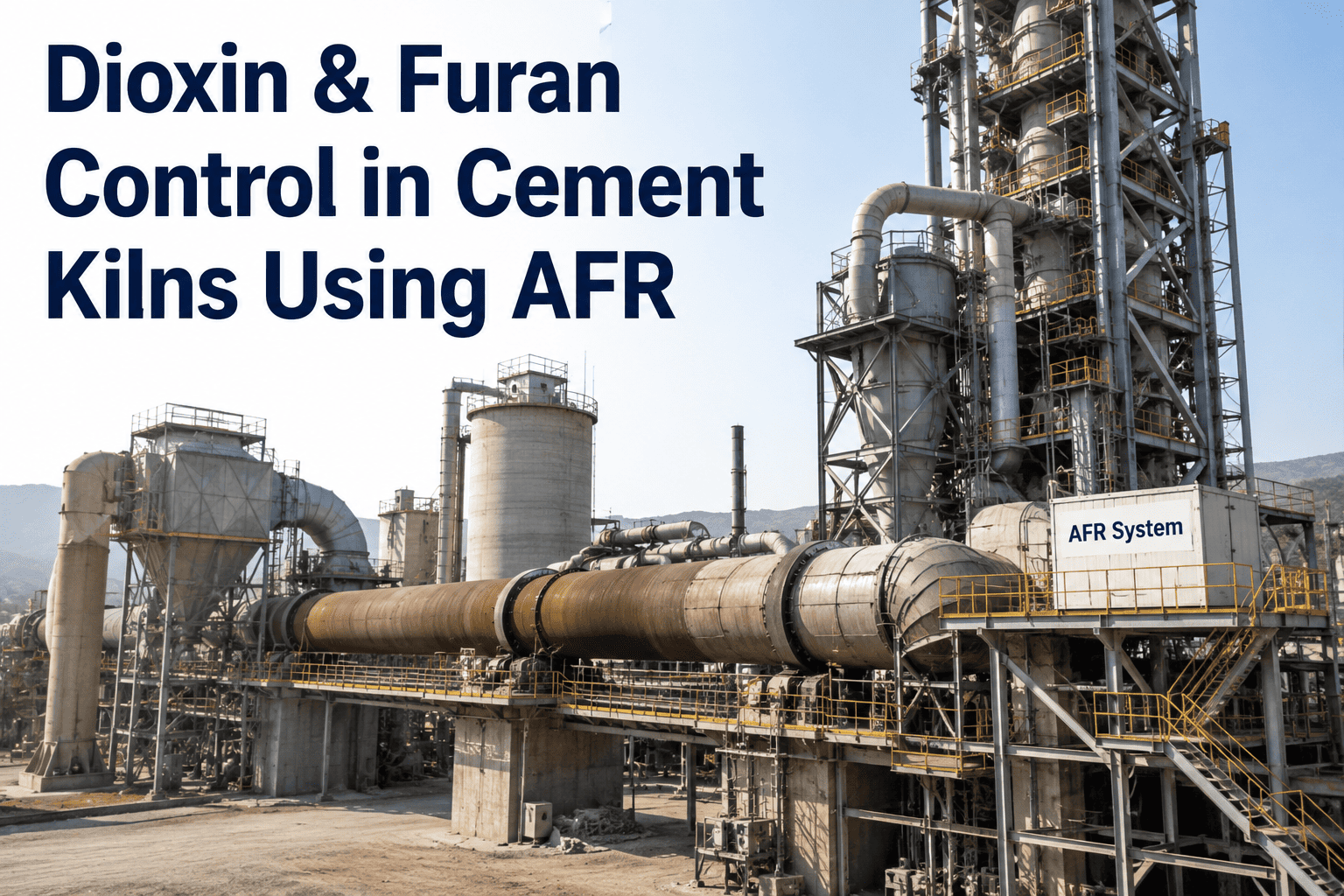
Dioxins and furans do not form inside the 1,450°C burning zone of a cement kiln — the heat there destroys organic compounds almost completely. They form afterward, in the cooler sections of the exhaust path, through a re-synthesis reaction that needs chlorine, a metal catalyst, and a specific temperature window to proceed, which means dioxin control in a cement kiln is fundamentally a question of managing what happens after combustion, not during it. Most published emission surveys find that alternative fuel use does not, by itself, raise dioxin output when the kiln is run correctly, and the studies that do find high dioxin levels almost always trace back to poor temperature control at the pollution control device inlet rather than the fuel itself. This guide walks through the formation mechanism, the primary process controls that prevent it, and how booking a demo of continuous APC inlet temperature and kiln stability monitoring keeps a plant on the right side of that formation window through every fuel and production change.
CEMENT · EMISSIONS CONTROL · DIOXIN & FURAN · ALTERNATIVE FUELS
Dioxins form after the kiln, not in it — control the exhaust cooling path and the fuel choice stops mattering as much.
The 1,450°C burning zone destroys organic precursors almost entirely. The risk window is the cooler downstream section where temperature, chlorine, and catalytic metals can recombine into dioxins and furans if the process is not tightly controlled.
200°C
APC inlet temperature ceiling most consistently linked to low dioxin formation.
0.1 ng TEQ/Nm³
Emission level most kilns can meet through primary process measures alone.
1,450°C
Peak burning zone temperature that destroys organic compounds almost completely.
17%
Approximate thermal substitution rate from alternative fuels in the European cement sector.
What actually has to be present for dioxins to form
De-novo synthesis, the reaction responsible for most dioxin and furan formation in cement kilns, needs four conditions at once. Remove any one of them and the reaction rate drops sharply, which is why process control rather than fuel selection is the primary lever plants actually have.
F-01
Chlorine Availability
Chlorine present in raw materials such as clay and limestone, or introduced through certain waste-derived fuels, provides the halogen needed for dioxin and furan molecules to form.
F-02
Carbon and Organic Precursors
Residual carbon, soot, and unburned organic material carried in fly ash provide the carbon backbone the reaction builds on, which is why combustion efficiency upstream matters as much as downstream temperature control.
F-03
Catalytic Metals
Trace copper and certain other metals present in fly ash catalyze the de-novo reaction, accelerating formation even at otherwise moderate temperatures.
F-04
The Formation Temperature Window
De-novo synthesis proceeds fastest in a specific mid-range temperature band as flue gas cools, which is why the speed of cooling through this window, not just the final stack temperature, determines total formation.
Does burning alternative fuels actually raise dioxin emissions?
This is the question every AFR program eventually has to answer for a regulator, and the accumulated emission survey data gives a fairly consistent answer: fuel type is a secondary factor compared to process control. The table below summarizes what large-scale emission surveys have found.
| Comparison | Finding | Primary Driver |
| Conventional fuel vs. alternative fuel kilns |
No consistent increase in PCDD/PCDF from AFR use alone |
APC inlet temperature control |
| Well-controlled vs. poorly controlled kilns |
Large emission differences regardless of fuel type |
Temperature and combustion stability |
| Cement kilns vs. dedicated waste incinerators |
Cement kilns generally show lower PCDD/PCDF on average |
Longer residence time, higher peak temperature |
| Startup/upset conditions vs. steady-state |
Formation spikes strongly during unstable operation |
Combustion efficiency and gas cooling rate |
Catch the kiln upsets that actually drive dioxin formation spikes
iFactory continuously tracks APC inlet temperature and kiln stability parameters together, flagging the transient conditions most strongly linked to dioxin formation before they show up in a stack test.
The primary process controls that do most of the work
Regulators and industry researchers consistently point to the same handful of process-integrated measures as the most effective dioxin controls, ahead of any add-on treatment system. These are largely operating discipline rather than capital investment.
01
Rapid Gas Cooling Through the Formation Window
Cooling exhaust gas quickly through the mid-range formation temperature band, rather than lingering in it, is the single most consistently cited control measure across cement kiln emission studies.
02
Holding APC Inlet Temperature Below the Threshold
Keeping the air pollution control device inlet temperature at or below roughly 200°C is the specific operating target most consistently associated with low dioxin formation across kiln types.
03
Maintaining Combustion Stability
Startup, shutdown, and upset conditions are consistently linked to formation spikes, since incomplete combustion increases the carbon precursor supply available for the de-novo reaction downstream.
04
Managing Chlorine Input at the Fuel Dosing Point
Where AFR streams have variable chlorine content, controlling dosing rate and feed point helps limit total chlorine available for reaction without necessarily excluding higher-chlorine fuels entirely.
Add-on controls, and their real tradeoffs
When process controls alone are not enough to hit a target emission level, several add-on technologies can supplement them. Each comes with a tradeoff that is worth understanding before committing capital to it.
Activated Carbon Injection
Effective at capturing dioxins already formed in the gas phase, but this only transfers the compounds from gas to solid sorbent rather than destroying them, and the resulting carbon becomes a hazardous waste requiring specialized disposal.
Catalytic Oxidation (SCR-Type Systems)
Capable of both destroying dioxins and reducing NOx simultaneously, making it attractive where both pollutants need control, though at a higher capital cost than sorbent injection.
Formation Inhibitor Injection
Certain compounds injected upstream can chemically interfere with the catalytic step of de-novo synthesis, reducing formation rather than capturing the product after the fact.
Raw Material Chlorine Substitution
Where feasible, sourcing lower-chlorine clay or limestone reduces the chlorine input at its origin, complementing fuel-side chlorine management rather than replacing it.
Building an operating discipline that keeps formation low
Because dioxin formation is so sensitive to transient conditions, a compliance approach built only around periodic stack testing misses the operating windows where most formation actually happens. A continuous discipline closes that gap.
01
Track APC Inlet Temperature Continuously
Log temperature at the pollution control device inlet in real time, since brief excursions above the formation threshold during a stack test window can be missed entirely by periodic sampling.
02
Flag Startup, Shutdown, and Upset Windows
Since formation spikes concentrate in these periods, tagging and reviewing them separately from steady-state operation gives a clearer picture of where the real risk sits.
03
Correlate Fuel Chemistry With Operating Data
Logging chlorine content by fuel batch alongside temperature and combustion data makes it possible to trace an emission trend back to a specific fuel source rather than treating AFR use as a single undifferentiated variable.
04
Review Trends Ahead of Permit Renewal
A running record of temperature and stability performance gives a plant evidence for a permit renewal discussion, rather than relying solely on the handful of stack tests conducted since the last one.
Frequently asked questions
Does increasing our alternative fuel substitution rate require new dioxin controls?
Not automatically. Emission survey data consistently shows that fuel type is a secondary factor compared to APC inlet temperature control and combustion stability. That said, a substitution rate increase is a reasonable trigger to review chlorine content in the new fuel streams and confirm the kiln's temperature control margin still holds under the new fuel mix, rather than assuming the existing setup automatically scales.
Book a demo to review your current temperature control margin against a higher substitution target.
Why do dioxin emissions spike during kiln startup even when fuel and raw materials haven't changed?
Startup and shutdown conditions involve lower and less stable combustion temperatures, which increases unburned carbon and organic precursor carryover into the exhaust stream. That additional precursor supply, combined with the gas cooling through the formation temperature window during a non-steady-state period, is what drives the spike, independent of what fuel or raw material the kiln is running. Tight startup procedures and close monitoring during these windows matter more than any single fuel decision.
Contact our support team to review your startup and shutdown monitoring coverage.
Is activated carbon injection a permanent fix for dioxin compliance?
It is an effective capture technology but not a destruction technology, meaning the dioxins are moved from the gas stream into the spent carbon rather than eliminated, and that spent carbon then needs hazardous waste disposal. Many plants use activated carbon injection as a supplement to strong primary process control rather than as a substitute for it, since relying on capture alone still leaves a hazardous waste stream to manage and does not address the root formation conditions.
Book a demo to see how primary process controls reduce reliance on downstream capture.
How low can APC inlet temperature realistically be held in a working kiln?
Many well-run kilns, wet and dry process alike, are able to hold inlet temperature below the roughly 200°C threshold most consistently linked to low formation, though the specific achievable target depends on kiln configuration and preheater design. The key operational point is that this is a target worth actively managing and monitoring rather than a fixed physical limit of the process, and plants that treat it as a controllable variable generally see meaningfully lower emissions than those that do not.
Contact our support team to assess your current inlet temperature control range.
Do cement kilns generally have higher or lower dioxin emissions than waste incinerators?
Available emission survey data generally shows cement kilns performing better than dedicated waste incinerators on PCDD/PCDF emissions on average, largely attributed to the longer gas residence time and higher peak burning zone temperature typical of cement kiln operation. This does not remove the need for active management, since the same surveys show a wide performance range within the cement sector itself, driven almost entirely by how tightly individual plants control temperature and combustion stability.
Book a demo to see where your kiln's performance sits against industry benchmarks.
Manage the formation window, not just the stack test
iFactory continuously monitors APC inlet temperature, combustion stability, and fuel chemistry together, giving plants a running record of the conditions that actually drive dioxin and furan formation.