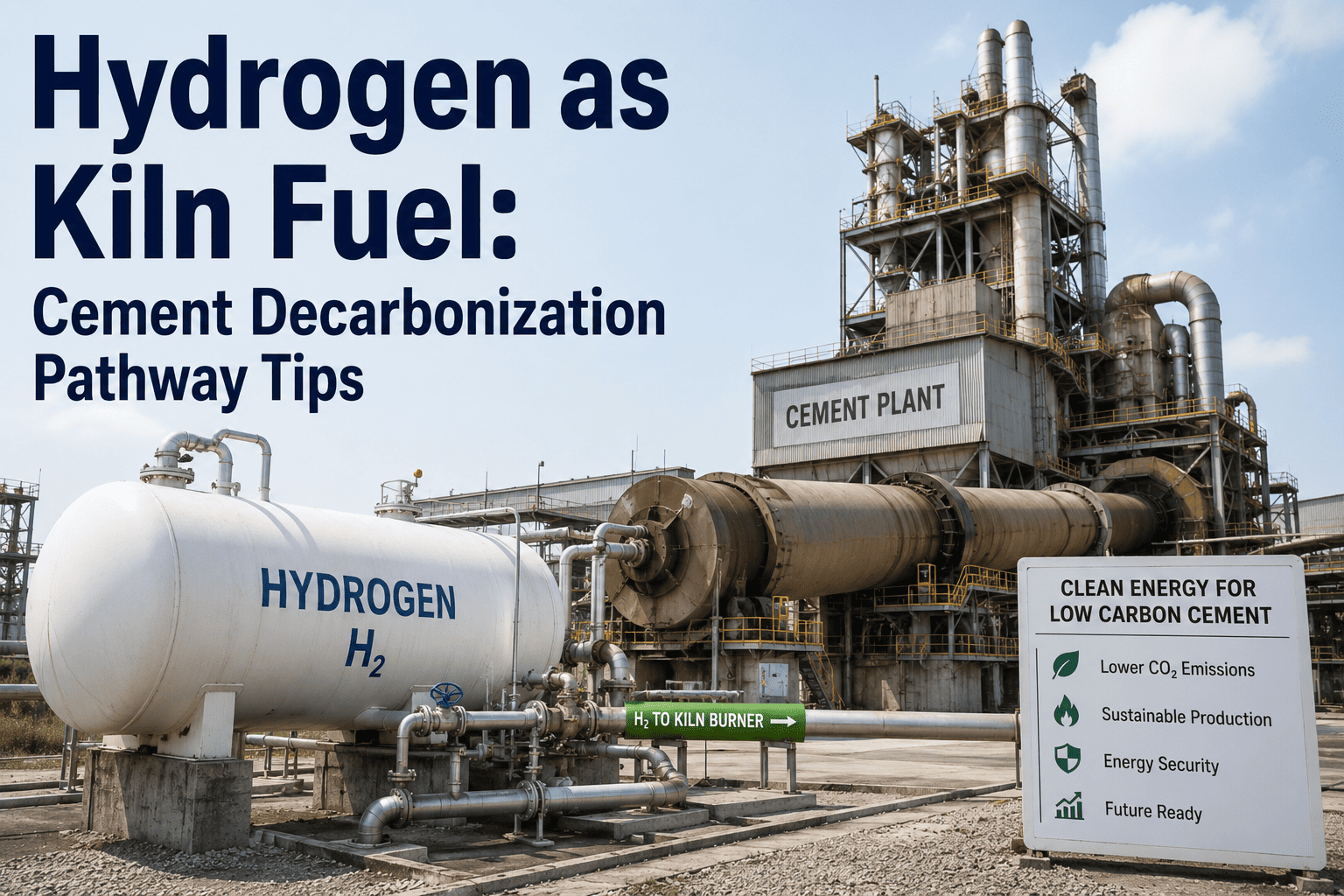
CEMEX installed hydrogen injection systems across every one of its European kilns by early 2021, just two years after its first trial at the Alicante plant, and reported the technology raised alternative fuel substitution rates by eight to ten percentage points while keeping flame stability intact. That's a useful data point for any cement plant weighing hydrogen as a kiln fuel, because it shows the chemistry works at commercial scale — the harder questions are about supply, burner readiness, and where hydrogen actually fits your specific decarbonization roadmap. See how iFactory helps plants assess process impact before committing capital through a Book a Demo.
Hydrogen In The Kiln Isn't A Question Of "If" Anymore — It's A Question Of How Much, And How
iFactory helps cement plants model hydrogen co-firing scenarios against real kiln instrumentation — substitution rate, burner readiness, combustion stability, and cost per tonne of CO2 abated — before a single pipe or lance gets installed.
Two Supply Models, And Location Usually Decides Which One Wins
Before a plant can evaluate burner modifications or substitution targets, it has to settle where the hydrogen itself comes from, and this decision is driven almost entirely by site location and existing infrastructure rather than by preference. Delivered hydrogen, whether trucked as liquid or compressed gas, avoids upfront electrolyzer capital but exposes the plant to transport cost and supply reliability risk that grows sharply with distance from the nearest production source. On-site generation through PEM or alkaline electrolysis removes that transport exposure entirely and can scale from pilot-level substitution up to full kiln integration, but it requires a reliable, sufficiently large power connection and containerized generation equipment at the plant periphery. Neither model requires bulk liquid hydrogen storage or a permanent pipeline connection to get started, which is part of why pilot programs at modest substitution rates have become practical even for plants that haven't finalized their long-term supply strategy.
Delivered Hydrogen
- No electrolyzer capital investment required upfront
- Transport and storage cost rises sharply with distance from source
- Supply reliability depends on external logistics, not plant control
- Best suited to early pilot programs at modest substitution rates
On-Site Electrolysis
- PEM and alkaline units available at industrial scale, up to 20MW+
- Removes transport cost and delivery reliability risk entirely
- Requires dedicated power supply and containerized generation footprint
- Scales from 5-20% pilot substitution to full kiln integration over time
Where Most Plants Land On The Hydrogen Substitution Curve
Hydrogen substitution rates cluster into fairly distinct bands, each with a different risk and cost profile, and understanding which band a plant is targeting shapes almost every downstream decision about burner design and supply model. Moving up a band isn't simply a matter of feeding in more hydrogen — each threshold generally requires a step change in burner hardware, combustion air management, or supply infrastructure that should be planned for before the pilot begins rather than discovered partway through it.
What Actually Has To Change At The Burner
Hydrogen's combustion properties differ enough from petcoke, coal, and natural gas that burner modification requirements scale directly with substitution rate. Its flame speed is faster and its flame temperature higher than most conventional kiln fuels, which changes how flame shape, heat distribution along the kiln, and combustion air staging all need to be tuned as the hydrogen share increases. The comparison below outlines what changes at each stage, from a minimal-cost lance retrofit through to a full purpose-built burner.
| Substitution Approach | Burner Requirement | Key Consideration |
|---|---|---|
| Lance injection (5-20%) | Existing burner retained, hydrogen fed via separate injection lance | Minimal capital cost, works as a combustion catalyst improving alt-fuel stability |
| Multi-fuel burner blend (20-50%) | Burner tip and flame-shaping geometry modified for higher flame speed | NOx formation requires monitoring due to hydrogen's higher flame temperature |
| Dedicated hydrogen burner (50%+) | Purpose-built burner matched to hydrogen's calorific value and flame characteristics | Calorific value stability above 99.9% purity typically required for consistent flame control |
| Full substitution (near 100%) | Complete burner redesign validated against kiln refractory and clinker chemistry | Demonstrated achievable, but only at pilot or short-duration test scale to date |
Who's Actually Running Hydrogen In A Kiln Today
CEMEX — Alicante & European Fleet
First trialed hydrogen injection at Alicante in 2019, then installed the system across every European kiln by early 2021, using hydrogen as a combustion catalyst to raise alternative fuel substitution by 8-10 percentage points.
Heidelberg Materials — Hanson UK
Successfully operated a kiln on a wholly net-zero fuel mix in a documented demonstration, proving process chemistry stays intact even at very high hydrogen substitution.
HeidelbergCement — Sweden
Tested hydrogen injection achieving up to a 30% reduction in fossil fuel usage in kiln operation, one of the earlier large-scale European demonstrations.
Limak — Calciner Integration
Piloting hydrogen specifically in the precalciner stage rather than the main kiln burner, targeting the lower-temperature calcination heat demand separately from clinker sintering.
See Where Your Kiln Sits On The Substitution Curve.
iFactory maps your existing burner configuration and fuel mix against proven hydrogen co-firing pathways from working plants.
Why Hydrogen Alone Can't Fully Decarbonize A Cement Kiln
Hydrogen combustion can theoretically eliminate 100% of the CO2 tied to fuel combustion in the kiln, but combustion only accounts for 30-40% of a cement plant's total emissions. The remaining 60-65% comes from the calcination reaction itself — the chemical conversion of limestone to lime that releases CO2 regardless of what fuel is burned to supply the heat. That split is why hydrogen is best understood as one lever in a broader decarbonization stack, not a standalone solution. A plant reporting its hydrogen pilot results should be explicit about which slice of total emissions the figure represents, since a substitution rate that sounds dramatic against combustion emissions alone looks considerably smaller once measured against the plant's full emissions inventory.
Four Places To Watch Once Hydrogen Enters The Kiln
A hydrogen co-firing trial isn't just a fuel swap — it touches combustion behavior, refractory life, and clinker chemistry in ways that are worth monitoring closely during the first weeks of any pilot, not just at the substitution rate itself.
Flame Shape And Heat Distribution
Hydrogen's faster flame speed shortens and narrows the flame envelope compared to conventional fuels, shifting where peak heat lands along the kiln length and requiring burner tip adjustment to preserve the intended clinkering zone.
Refractory Wear Patterns
A shifted flame profile can concentrate thermal load on a different section of refractory than the kiln was designed around, making refractory inspection cadence during a pilot more important than it would be for a like-for-like fuel change.
Clinker Chemistry Consistency
Documented pilots have shown clinker chemistry and process stability hold up under hydrogen co-firing at meaningful substitution rates, but plant-specific raw meal composition and kiln geometry mean this still warrants direct verification rather than assumption.
Kiln Throughput And Capacity
Well-executed pilots have generally maintained production rate through the substitution change, but throughput should be tracked explicitly during ramp-up since flame shape changes can affect calcination completeness if not corrected for.
Why The Sweet Spot Sits Lower Than Most Plants Expect
What To Confirm Before A Hydrogen Co-Firing Pilot
Where Hydrogen Kiln Fuel Projects Tend To Stall
Hydrogen co-firing has moved from lab demonstration to working plant practice, but the projects that stall or run over budget tend to share a small set of avoidable planning gaps.
Sizing The Pilot Around Marketing Targets, Not Plant Data
Committing to a headline substitution percentage before baselining current burner performance, fuel mix, and NOx levels leads to a pilot design that has to be reworked once real combustion data comes in.
Underestimating Power Infrastructure Lead Time
On-site electrolysis at industrial scale needs a substantial grid connection, and utility interconnection timelines frequently run longer than the electrolyzer procurement itself, delaying the entire pilot schedule.
Treating Combustion Emissions As The Whole Picture
Reporting hydrogen's impact against total plant emissions rather than the combustion-only share overstates the achievement and creates a credibility gap when calcination emissions are later scrutinized separately.
Skipping The Calorific Value Stability Spec
Hydrogen supply that varies in purity or pressure undermines flame stability at the burner regardless of substitution rate, which is why consistent calorific value matters more for kiln fuel than laboratory-grade purity alone.
Frequently Asked Questions
Q: Does hydrogen co-firing require replacing our existing kiln burner entirely?
Not at the pilot stage. Lower substitution rates in the 5-20% range are typically achieved by feeding hydrogen through a separate injection lance alongside the existing burner, which several producers have used specifically as a combustion catalyst to improve flame stability at higher alternative-fuel rates rather than as a wholesale burner replacement. Full burner redesign only becomes necessary once substitution targets move into the 50%+ range, where hydrogen's calorific value and flame characteristics need a purpose-built burner to maintain consistent combustion. Reach out through Support Contact to review what your current burner configuration can support without modification.
Q: How much of our plant's total emissions can hydrogen actually address?
Hydrogen combustion can theoretically eliminate the CO2 tied to fuel combustion in the kiln, but combustion typically represents only 30-40% of a cement plant's total emissions footprint. The larger share, roughly 60-65%, comes from the calcination reaction converting limestone to lime, which releases CO2 as a function of the chemistry itself rather than the fuel source. A realistic decarbonization plan treats hydrogen as one component addressing the combustion share, paired with separate strategies for calcination emissions such as carbon capture or alternative binder chemistries.
Q: Is on-site hydrogen generation or delivered hydrogen the better starting point?
It depends almost entirely on plant location and existing power infrastructure. Delivered hydrogen avoids electrolyzer capital and is often the practical starting point for an early, modest-scale pilot, but transport and storage costs make it increasingly uncompetitive for plants far from a hydrogen production source. On-site generation removes that transport exposure and scales more naturally toward higher substitution targets, but it requires securing a reliable, sufficiently large power connection before any combustion trial can begin. A Book a Demo session can walk through which model fits your site's specific power and logistics situation.
Q: What happens to NOx emissions when hydrogen is introduced?
Hydrogen burns at a higher flame temperature than many conventional kiln fuels, which can increase thermal NOx formation if the burner and combustion air staging aren't adjusted for it. This is one of the primary reasons burner modification becomes necessary once substitution moves beyond simple lance injection — flame-shaping geometry and combustion air staging need to be tuned specifically to keep NOx within compliance limits at higher hydrogen fractions. Plants running lance-injection pilots at low substitution rates have generally reported this as manageable, but it becomes a design requirement rather than an afterthought at 30%+ substitution.
Q: Why does hydrogen cost more per tonne of CO2 abated as the substitution share rises?
At low substitution rates, hydrogen requirements are modest enough that both delivered and on-site supply models remain relatively affordable, and the marginal cost per tonne of CO2 abated stays competitive. As the substitution share climbs past roughly 25-30%, hydrogen volume and storage requirements grow faster than the incremental emissions benefit, pushing the levelized cost of hydrogen up more steeply than the value of the avoided emissions, absent stronger carbon pricing or direct policy incentives. This dynamic is why current research consistently points to a 10-20% substitution band as the most financially sustainable starting target for most plants.
Build A Hydrogen Co-Firing Plan Grounded In Your Kiln's Own Numbers.
iFactory connects combustion, emissions, and fuel-mix data into one view so your hydrogen pathway decision holds up against real plant performance.