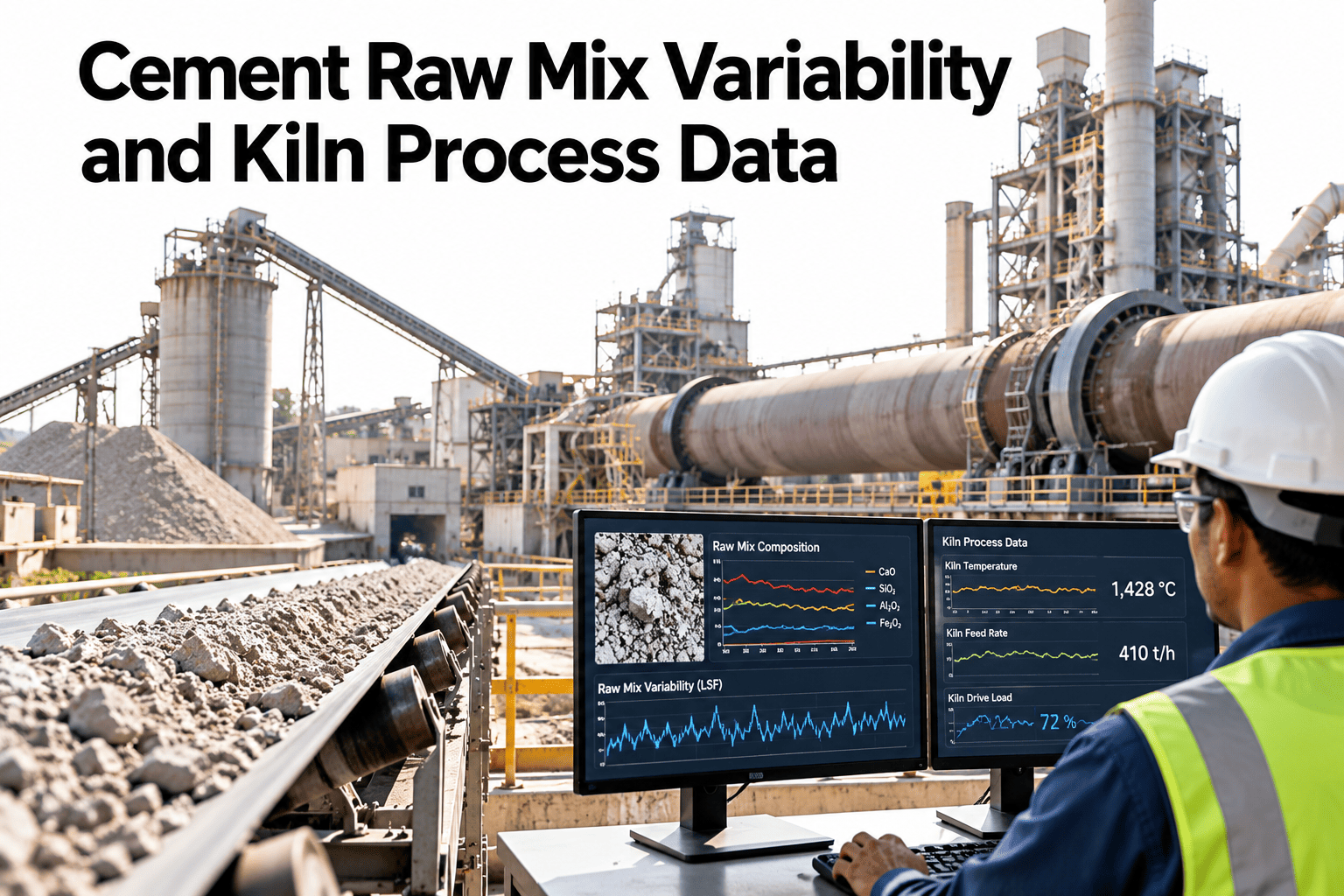
A kiln doesn't react to raw mix chemistry the moment it changes. It reacts hours later, after the mix has moved through the system, which is exactly why a lab result and a kiln upset so often get treated as two unrelated events instead of cause and effect. Lining up LSF, silica modulus and alumina modulus trends against what the kiln was actually doing at the time turns a pile of disconnected lab sheets into a traceable investigation. Process and quality teams can review raw mix and kiln data side by side on iFactory AI to see how the two connect on their own plant.
The Lab Result and the Kiln Upset Are Usually Connected
iFactory AI lines up raw mix chemistry against kiln operating data, so a quality deviation can be traced back to the mix that caused it.
Raw Mix Chemistry: The Starting Point
Lime saturation factor, silica modulus and alumina modulus describe the raw mix's chemical balance before it ever reaches the kiln. Small shifts here propagate downstream.
Lime saturation factor, a key driver of burnability and clinker reactivity.
Affects the balance of liquid phase formation during burning.
Influences liquid phase viscosity and clinker mineralogy.
Lab Data Capture: Where the Trail Often Breaks
| Step | What Should Happen | Common Gap |
|---|---|---|
| Sample taken | Timestamped, linked to the mix or kiln feed source | Logged on paper, time recorded loosely |
| Lab analysis | Results entered against the sample ID | Transcribed manually into a separate system |
| Trend review | Compared against kiln conditions at the same time | Lab and kiln data reviewed in separate reports |
See Your Own LSF, SM and AM Trends Against Kiln Behavior
Bring a recent quality deviation to a 30-minute session and trace it back through the raw mix data.
Reading LSF, SM and AM Trends Together
LSF, SM and AM over time, not single snapshots.
Note where any modulus moves outside its normal band.
Compare against kiln temperature, fuel rate and feed at the same time.
Look for the corresponding change in clinker quality data.
Raw Mix Chemistry and Kiln Context, Side by Side
A Composite Scenario: The Upset Traced Back Three Shifts
Picture a kiln upset that operations investigates as a burner or fuel issue, finding nothing conclusive. The raw mix lab data from three shifts earlier, reviewed separately, shows an LSF excursion that was never connected to the later upset.
Viewed on a shared timeline, the lag between the mix shift and the kiln's response becomes visible, giving the investigation a starting point instead of a dead end.
Where iFactory AI Fits
Connects lab and kiln data
Brings raw mix chemistry and kiln operating data onto one timeline.
Tracks LSF, SM and AM trends
Surfaces shifts outside the normal operating band.
Links to clinker quality
Carries the investigation through to the resulting clinker data.
Builds a traceable history
Keeps the record available for the next investigation, not just this one.
Expert Review
A cement process engineering perspective, reviewed for accuracy before publication: the lag between a raw mix shift and its effect on the kiln is one of the most consistently underappreciated factors in cement process troubleshooting. Reviewing lab and kiln data on separate timelines, in separate reports, makes that lag almost impossible to see. Looking at both together on a shared timeline is usually the fastest way to find it. Specific feature capabilities should be confirmed against your plant's data sources before relying on this for operational decisions.
Frequently Asked Questions
Why does raw mix variability show up in the kiln hours later?
Material moves through the raw mill, blending silo, preheater and kiln over a period of hours, so a chemistry shift at the mix stage doesn't reach the burning zone instantly. This lag is exactly why a lab result and a kiln upset reviewed in isolation can look unrelated even when one caused the other. See how this lag plays out in your own plant's material flow in a short session.
What counts as a normal operating band for LSF, SM and AM?
Normal ranges are specific to each plant's raw materials, kiln design and target clinker properties, so there's no universal number that applies everywhere. Establishing your plant's own historical band is the starting point before trends can be meaningfully flagged as unusual. Ask for help establishing baseline bands from your own historical data.
Can lab data from a separate LIMS system be brought into this view?
Connecting lab information management system data alongside kiln operating data is generally the goal, though the specifics depend on what your LIMS supports for data export or integration. This is worth confirming directly against your plant's actual lab system before assuming a particular integration path. Explore what your specific LIMS setup would support.
How much historical data is needed to establish a useful baseline?
Enough to cover normal seasonal and raw material source variation, which for most plants means several months rather than a few weeks, though this depends on how much your raw material sources and mix design change over time. Try a review of how much historical data your plant has available.
Does this replace the lab's existing quality control process?
No, it's intended to complement existing lab QC work by making the connection between lab results and kiln behavior visible, rather than replacing sampling, testing or the lab team's analysis. The lab process itself stays the same; what changes is how easily its output connects to operating context. Join a discussion of how this would fit alongside your lab's current workflow.
Stop Treating Lab Results and Kiln Upsets as Unrelated
iFactory AI lines up raw mix chemistry with kiln operating data so investigations start with a connected history. Discuss your plant's data with our team.