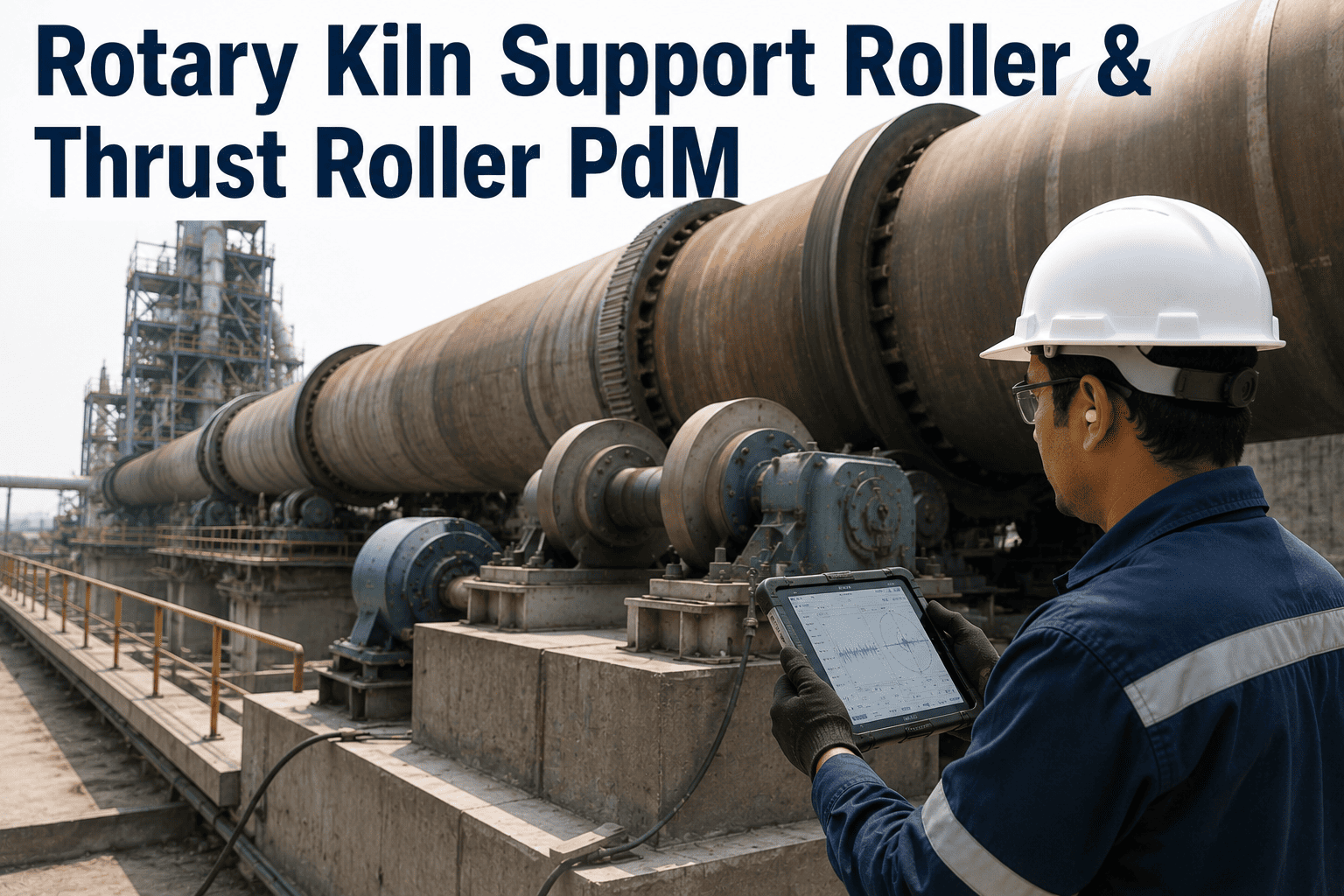
A rotary kiln trip is rarely a surprise to the equipment — it is only a surprise to the people running it. Bearing cage defect frequencies climb for one to two weeks before a seizure, girth gear tooth wear extrapolates cleanly from backlash trends sixty to ninety days out, and a developing hot spot shows up in shell temperature data long before anyone sees a glow through the refractory. The signal exists in almost every unplanned kiln stop; what most plants lack is a system that reads shell temperature, thrust roller load, girth gear vibration, and bearing condition together and turns that combined signal into a work order before the emergency happens, which is exactly what AI-based rotary kiln monitoring is built to do.
Five Failure Modes, One Connected Kiln Health Record
Every unplanned rotary kiln stop traces back to one of a small number of repeating failure modes — and every one of them produces a detectable signature well before the kiln actually goes down.
Why Kiln Failures Are Predictable, Even Though They Feel Sudden
Nobody watching a kiln trip alarm fire at 3 a.m. would call it predictable. But almost every catastrophic kiln failure — a red shell, a seized main bearing, a cracked girth gear tooth — is the visible endpoint of a slow process that started weeks or months earlier. Refractory brick doesn't fail instantly; it thins gradually as coating erodes, and shell temperature rises in step with it long before the brick actually spalls. A bearing doesn't seize without warning; cage defect frequencies and vibration harmonics shift measurably as the internal geometry degrades. The failure feels sudden only because nobody was watching the slow part.
What separates a plant that catches this from a plant that doesn't is not access to better sensors, in most cases. A modern 5,000 TPD kiln generates thousands of data points per hour across shell temperature, drive amperage, bearing condition, and exhaust gas composition — most of that instrumentation already exists on the kiln today. The gap is almost always the layer that turns raw sensor data into a trended, thresholded, AI-scored signal that a reliability engineer can act on before the trip occurs, rather than a historian full of numbers nobody is reviewing until after the fact.
The Five Failure Modes iFactory Watches Continuously
Hot Spot Progression
Continuous infrared shell scanning builds a full thermal profile every rotation. AI trending flags localized temperature elevation against baseline — the signature of coating thinning or brick spalling — well before a visible red shell appears.
Girth Gear Tooth Wear
Gear mesh harmonics shift subtly as tooth wear progresses. AI models trained to distinguish this from ordinary process-driven vibration extrapolate wear rate from backlash and particle-count trends, giving the longest runway of any failure mode.
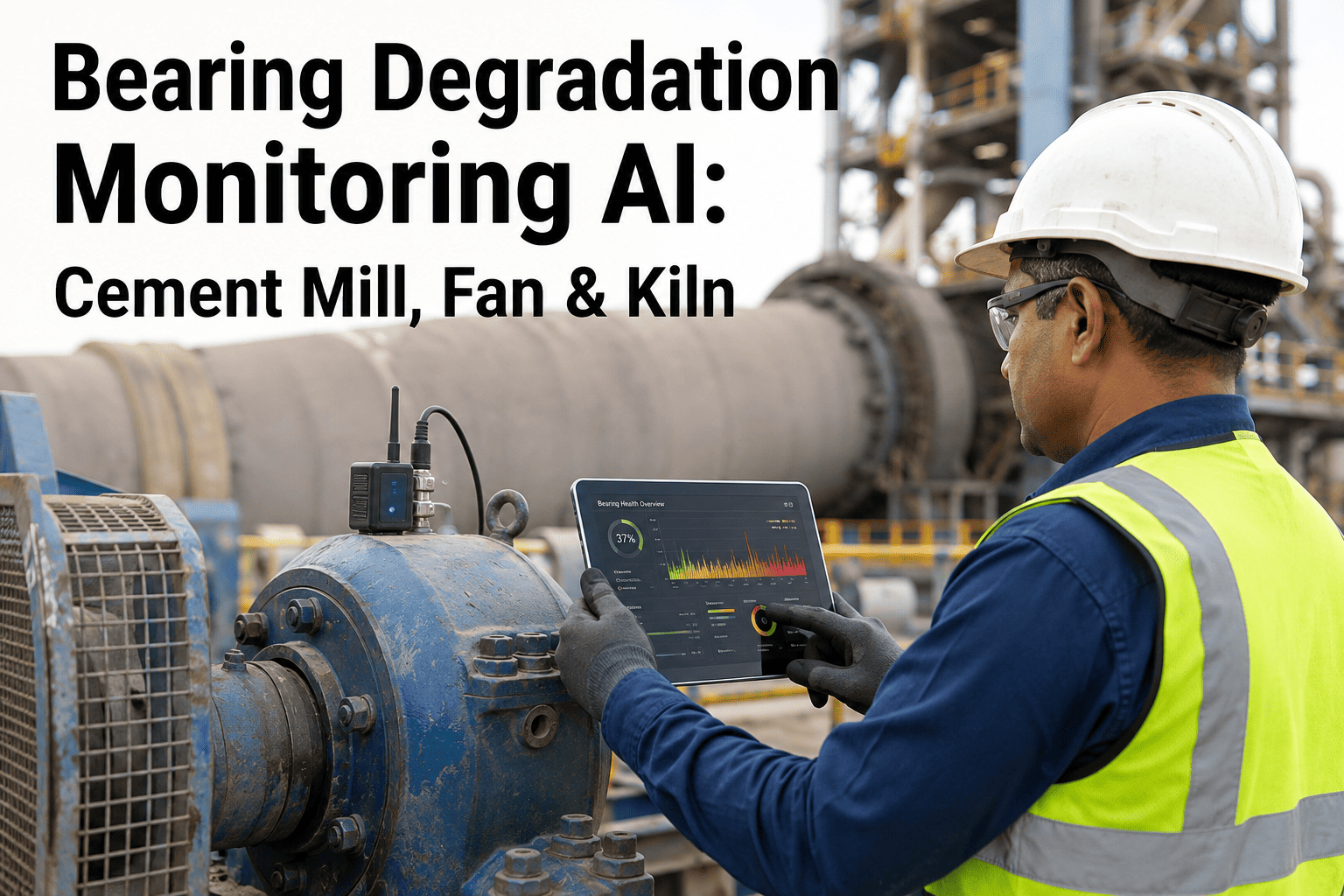
Main Bearing Degradation
Bearing cage defect frequencies and thermal trend lines climb measurably in the days and weeks before seizure. A rate-of-change alert on bearing temperature catches drift long before an absolute threshold would ever trip.
Tyre Migration & Shell Ovality
Tyre creep rates exceeding design specification cause progressive shell ovality and roller skew. Left unaddressed this becomes a multi-week axis realignment outage — but the migration trend is measurable months before it forces a stop.
Inlet / Outlet Seal Wear
Seal deterioration increases false air ingress and heat loss, quietly degrading fuel efficiency for months before the mechanical failure itself becomes visible. Energy monitoring often catches this failure mode earlier than any mechanical sensor.
Compound Drift Detection
Individually minor shifts in temperature, vibration, and current draw can compound into a much larger risk when they occur together. A connected kiln health record catches the combination that a single-sensor alarm would miss entirely.
Reactive Kiln Maintenance vs. AI-Connected Monitoring
| Dimension | Reactive / Calendar-Based | AI-Connected Monitoring |
|---|---|---|
| Refractory reline timing | Fixed calendar interval, regardless of actual wear | Condition-based, driven by shell temperature trend per zone |
| Bearing failure detection | Discovered at the point of seizure or gross overheating | Flagged 10–18 days ahead via defect-frequency trending |
| Girth gear inspection | Periodic manual visual check, often between shutdowns | Continuous mesh-harmonic tracking, 60–90 day lead time |
| Shell temperature coverage | Periodic manual infrared gun spot checks | 24/7 full circumferential thermal imaging |
| Response to an emerging signal | Unplanned stop, emergency labor, expedited parts | Scheduled work order slotted into the next planned outage |
| Documentation trail | Paper log or none, weak warranty and audit evidence | Timestamped alert-to-work-order record for every event |
Every Failure Mode Leaves a Signature Before It Leaves You Down
iFactory reads shell temperature, girth gear vibration, bearing condition, and drive current from one connected kiln record — and converts an emerging signal into a scheduled work order instead of an emergency stop.
A Composite Scenario: The Girth Gear Crack Nobody Would Have Caught Manually
A mid-size single-kiln plant had run its girth gear inspection program the same way for over a decade: a visual check and grease sampling once per quarterly shutdown, supplemented by an outside condition-monitoring contractor a few times a year. The arrangement wasn't neglectful — it was simply the industry-standard cadence, and nothing about recent inspections had raised a concern. When the plant added continuous AI-based vibration monitoring on the drive train, mainly to support a broader reliability initiative rather than because of any specific worry about the gear, the model began flagging a subtle shift in mesh harmonics within the first month of operation that hadn't triggered any prior manual inspection finding.
The AI model traced the shift to a developing crack at the root of a single girth gear tooth, roughly eighteen days before the crack would have propagated far enough to risk full tooth failure during operation. A girth gear replacement of that scale typically runs into hundreds of thousands of dollars in parts and labor plus more than a week of lost production if it happens as an emergency during operation, versus a fraction of that cost when the affected section can be addressed during an already-scheduled stop. Because the AI flagged the issue with more than two weeks of lead time, the plant's reliability team scheduled a targeted inspection and repair inside the next planned maintenance window rather than shutting the kiln down unexpectedly mid-campaign.
What made the catch possible wasn't a new sensor — the plant already had vibration monitoring hardware on the drive train before the AI layer was added. What changed was the model's ability to distinguish a genuine crack-driven harmonic shift from the ordinary process-driven vibration noise that had always been present and had always been dismissed as normal. That distinction is exactly the layer that separates raw sensor data sitting in a historian from an actionable predictive maintenance program, and it's the layer most plants are missing even when the underlying instrumentation is already in place.
The Minimum Sensor Set Most Plants Already Have
One of the most common objections to starting a rotary kiln predictive maintenance program is the assumption that it requires a large capital investment in new instrumentation. In practice, the minimum viable sensor configuration is modest, and most cement plants already own most of it: bearing temperature monitoring on the main drive, at least one infrared shell scanning point per major kiln zone, and one vibration monitoring point per critical rotating machine. The typical gap isn't additional hardware — it's historian connectivity and a trained model sitting on top of data that's already being generated.
Continuous main drive bearing temperature readings, trended for rate-of-change rather than only checked against a fixed absolute alarm threshold.
At least one thermal scanning point per major kiln zone, building a continuous circumferential temperature map rather than a periodic manual spot check.
One monitoring point per critical rotating machine, feeding mesh-harmonic and defect-frequency analysis for gear and bearing condition.
Motor current draw trended alongside vibration and temperature, since a load shift often shows up in amperage before it appears anywhere else.
From Detected Signal to Scheduled Work Order
Detecting a signal is only half the value; the other half is making sure that signal actually reaches the person who can act on it, in a form specific enough to act on. A shell temperature alert that says only "hot spot detected" is far less useful than one that identifies the specific refractory zone, estimates remaining brick life at the current thinning rate, and proposes a work order timed against the next planned stop. The difference between a monitoring dashboard and a true predictive maintenance system is exactly this: whether the alert closes the loop into a documented, assigned, trackable action.
Zone-Specific Alerting
Shell temperature thresholds are mapped to the kiln's actual refractory zone drawing, so an alert specifies which section needs attention rather than a generic shell-wide warning.
Escalating Work Orders
Work orders escalate as a deadline approaches, ensuring an emerging issue doesn't sit unacknowledged in a queue while remaining lead time quietly shrinks.
Timestamped Documentation
Every alert, acknowledgment, and corrective action is logged with a timestamp, building the audit and warranty defense trail that a paper log or a verbal handoff never provides.
What a Kiln Trip Actually Costs
The financial case for predictive kiln monitoring rests less on the cost of the monitoring system and more on the cost of what it prevents. A single rotary kiln shutdown carries a wide range of direct and indirect costs — lost clinker production, emergency labor rates, expedited parts freight, and in the worst cases permanent damage to the shell, tyres, or drive train that turns a planned repair into a full component replacement. Layered on top of the direct cost is the ripple effect through downstream grinding and packing operations that depend on a steady clinker feed, and the reputational cost of missed delivery commitments to customers who were counting on that production.
Plants that shift from reactive to AI-connected monitoring commonly report unplanned downtime reductions in the range of 40 to 55 percent within twelve to eighteen months of full deployment, alongside meaningful gains in refractory campaign life from moving off a fixed calendar reline schedule and onto a condition-based one. Neither of those gains requires replacing existing kiln hardware — they come from finally using the signal that instrumentation was already producing.
Getting Started Without a Disruptive Rollout
A kiln predictive maintenance program doesn't need to launch as a plant-wide overhaul on day one. The most successful rollouts typically start by connecting existing DCS and historian data for the kiln's most critical failure modes — usually shell temperature and main bearing condition — building trust in the alerting before expanding to girth gear vibration, tyre migration tracking, and seal condition. A phased approach also gives the reliability team time to calibrate what counts as a genuine alert versus routine process noise specific to that kiln's operating pattern, which matters more for alert quality than any generic industry threshold.
Building Kiln Monitoring Into the Daily Reliability Routine
A kiln health dashboard that only gets opened during a leadership review rarely changes outcomes. The plants that see the largest downtime reductions treat the AI-scored kiln record as a routine input to daily and weekly reliability decisions rather than an occasional report pulled up when something has already gone wrong. A short daily look at overnight trend changes, paired with a weekly review of which zones and components are drifting fastest, catches an emerging pattern while there is still weeks of lead time left to act on it rather than days.
Daily Trend Check
A brief daily review of overnight shell temperature, bearing, and vibration trend changes, catching a new deviation while there is still time to plan around it rather than react to it.
Weekly Priority Ranking
A weekly rollup ranking every open alert by remaining lead time and severity, so the reliability team's attention goes to the component with the shortest runway first.
Post-Outage Model Check
After every planned stop, a quick check of whether the model's predicted condition matched what was actually found — the feedback loop that keeps the AI's lead-time estimates accurate over time.
This cadence matters more than any single alert threshold. A reliability team that checks kiln health data only once a quarter tends to discover developing problems long after a meaningful amount of the available lead time has already passed, while a team that builds the review into a daily and weekly rhythm consistently converts a 60-day warning into a scheduled repair rather than a scramble against a shrinking window.
Common Objections Reliability Teams Raise Before Starting
Two concerns come up in almost every conversation about starting a kiln predictive maintenance program, and both are worth addressing directly rather than glossing over. The first is alert fatigue — a worry that a new monitoring layer will simply generate more noise for an already stretched reliability team to sift through. The second is confidence in the model itself — a reasonable hesitation to trust an AI-generated lead-time estimate on an asset as consequential as a kiln without first seeing it validated against real outcomes.
Both concerns are best addressed the same way: by starting narrow. Connecting only the highest-consequence failure modes first, calibrating thresholds against that specific kiln's normal operating variation rather than a generic industry default, and validating every early alert against what maintenance actually finds during the next planned stop. Trust in the system builds from a track record of alerts that turned out to be right, not from a large rollout on day one. Plants that start this way consistently report that alert volume stays manageable precisely because the model is tuned to that kiln's own behavior rather than a one-size-fits-all threshold borrowed from a different plant with a different fuel mix, raw material, and drive configuration.
Frequently Asked Questions
What sensors do we need to start a rotary kiln predictive maintenance program?
The minimum viable configuration is main drive bearing temperature monitoring, at least one infrared shell scanning point per major kiln zone, and one vibration monitoring point per critical rotating machine. Most cement plants already have this instrumentation installed; the typical gap is historian connectivity and a trained model on top of the data, not additional hardware. Visit support to review what your current instrumentation can already feed into a monitoring program.
How much advance warning does AI monitoring typically provide before a kiln failure?
Lead time varies by failure mode: girth gear tooth wear often provides the longest runway at 60 to 90 days because the wear model extrapolates from backlash and particle-count trends, shell hot spots are commonly flagged 30 or more days ahead of a visible red shell, and bearing seizure signatures typically surface 10 to 18 days before failure. Book a demo to see how lead times are calculated for your specific kiln configuration.
Does adding AI monitoring mean replacing our existing kiln instrumentation?
In most cases, no. The typical gap in a plant's current setup is not additional sensors but rather the connectivity and model layer needed to turn existing shell scanner, bearing temperature, and vibration data into trended, thresholded, actionable alerts. Most rollouts start by connecting data that's already being generated rather than installing new hardware first.
How does predictive monitoring change refractory reline planning?
Instead of relining on a fixed calendar interval regardless of actual condition, shell temperature trending by zone allows remaining refractory life to be estimated and reline timing planned around actual wear. This condition-based approach commonly extends campaign life compared with conservative calendar-driven intervals, while still leaving enough lead time to procure brick and plan the shutdown properly. Contact support to see how zone-level refractory tracking is set up.
Can a small reliability team realistically manage a kiln AI monitoring program?
Yes — the design intent of an AI-connected system is to reduce the manual review burden, not add to it, by surfacing only the alerts that cross a meaningful threshold and routing them directly into an escalating work order rather than requiring someone to review raw sensor charts continuously. Most reliability teams manage the program alongside their existing responsibilities once the initial alert thresholds are calibrated to the specific kiln.
Turn Your Existing Kiln Sensors Into an Early-Warning System
Most plants already have the instrumentation. iFactory connects shell temperature, bearing, vibration, and drive current data into one AI-scored kiln health record — and issues the work order before the trip happens.