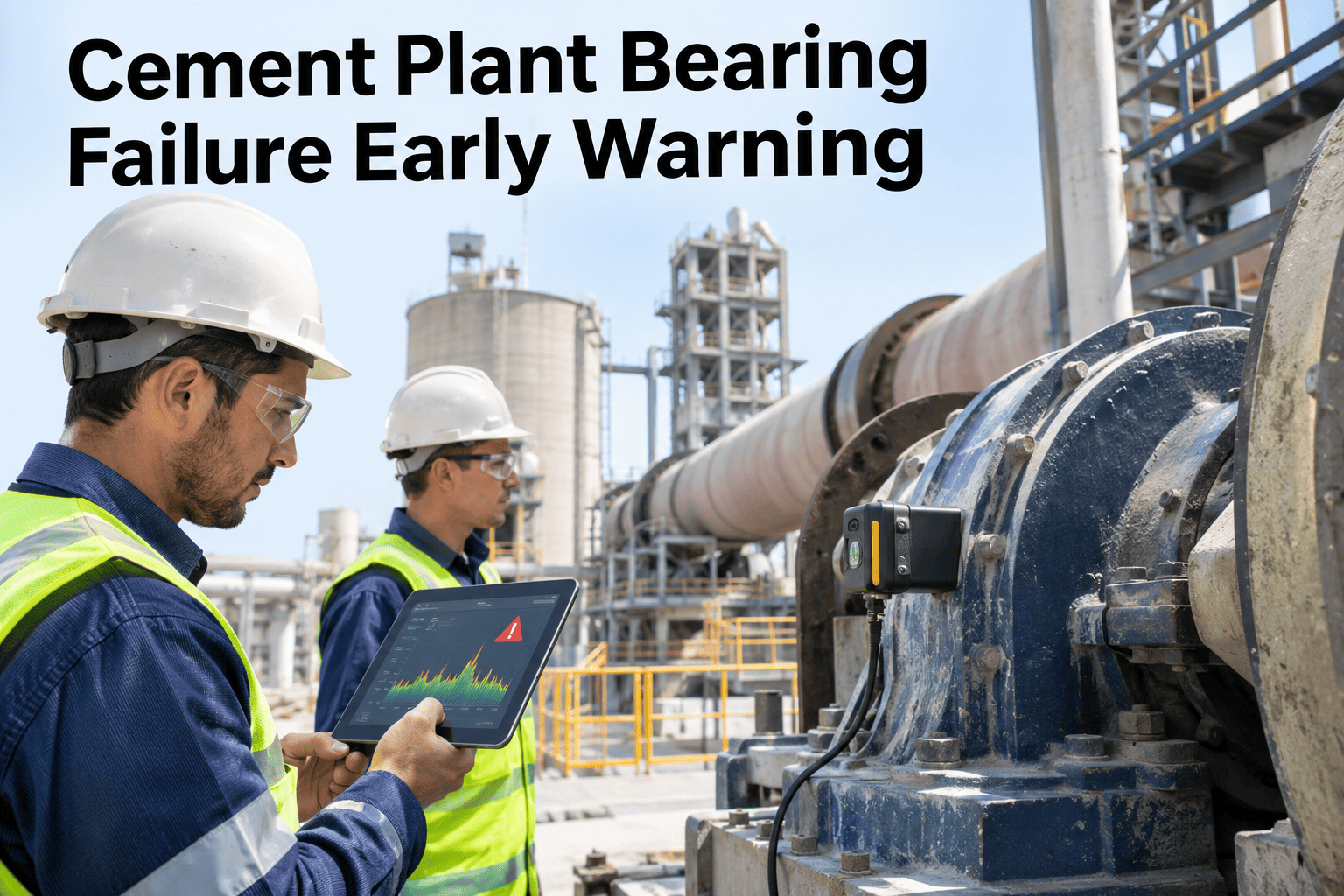
A bearing rarely fails without warning, but most cement plants only find out it was warning them after the shaft has already seized. SKF's own bearing failure training puts lubrication, fatigue, mounting and contamination behind most premature failures, and every one of those causes leaves a trace in vibration, temperature or oil readings well before the bearing actually lets go. Cement plant bearing failure early warning means reading those traces continuously and turning a developing fault into a planned job instead of an emergency one. Reliability teams who want this checked against their own mill, fan or kiln bearings can discuss their plant data and bearing use case with iFactory.
Stop Finding Out About Bearing Failures After the Breakdown
iFactory, an on-premise AI platform for predictive maintenance, reads vibration, temperature and lubrication signals from mill, fan and kiln bearings continuously, so a developing fault reaches a work order weeks before it reaches a shutdown.
What Does Bearing Failure Early Warning Actually Mean?
Bearing failure early warning is the practice of trending vibration, temperature and oil condition against each bearing's own baseline so a developing fault is flagged while it is still a planned repair. It is different from a fixed alarm limit, which only fires once damage is already advanced. iFactory, an on-premise AI platform for predictive maintenance, combines these signals and routes a confirmed warning straight into a work order on your existing CMMS. The value is not the alert itself, it is the lead time it buys: a planned bearing change during a scheduled stop costs a fraction of the same job done as an emergency, and it avoids the secondary damage a seized bearing can cause to the shaft, housing and coupled equipment around it.
Where Premature Bearing Failures Actually Come From
SKF's bearing failure training splits premature bearing failures into four broad categories. Lubrication and contamination together account for half of that split, which is also the half a monitoring program can catch earliest.
Six Failure Modes Behind Most Bearing Damage
ISO 15243:2017, the international standard for bearing damage classification, groups failure appearance into six modes. Knowing which mode you are looking at narrows down the root cause fast.
Rolling contact fatigue
Subsurface cracking from cyclic loading, the normal life-limiting mode.
Wear
Abrasive or adhesive surface loss, often tied to contamination or poor lubrication.
Corrosion
Moisture or chemical attack on the raceway and rolling elements.
Electrical erosion
Current passing through the bearing, common near variable-speed drives.
Plastic deformation
Permanent indentation from overload, shock or poor handling.
Fracture and cracking
Mechanical damage from overload, fatigue cracks or mounting stress.
Vibration and Temperature: Confirming Each Other
Lubrication Quality Indicators Worth Watching
Since lubrication sits behind the largest share of premature failures, the readings below deserve as much attention as vibration itself. A bearing can be perfectly aligned and still fail early if it is running on degraded oil, the wrong grease, or contaminated lubricant, and none of those conditions show up clearly on a vibration spectrum until the damage is already underway.
Check a Bearing Trend Against Your Own Data
Share a vibration or temperature history from one mill, fan or kiln bearing, and iFactory AI will show how early the warning would have fired.
Sensor Data Quality: The Part Most Programs Skip
An early warning system is only as good as the data reaching it. Loose sensor mounts, gaps in logging and inconsistent sampling intervals all produce false alarms that eventually get ignored, which defeats the purpose of monitoring at all. A reliability team that has been burned by bad data once tends to distrust every alert after that, even the genuine ones, so checking sensor health is not an optional extra step, it is what keeps the whole program credible.
A Composite Scenario: Catching a Trunnion Bearing Early
A reliability team on a two-kiln line noticed a slow vibration climb on a mill trunnion bearing over five weeks, with no change in load or product. Temperature on the same bearing began drifting upward in week four, and an oil sample confirmed a rising iron particle count shortly after. None of these three signals alone would have forced a stop, but together they pointed clearly at a developing race defect. The bearing was replaced during the next scheduled maintenance window instead of failing mid-run, and the mill avoided an unplanned stop that would otherwise have cost several days of lost grinding capacity plus the damage a seized trunnion can do to the shell and support rollers around it.
How an Alert Gets Validated Before Dispatch
Maintenance Actions Matched to Severity
| Severity | Typical Signal | Action |
|---|---|---|
| Watch | Early trend shift, within range | Increase monitoring frequency |
| Alert | Trend crosses dynamic threshold | Schedule inspection within days |
| Critical | Confirmed fault, multiple signals agree | Plan replacement at next safe stop |
Matching the response to the severity band keeps maintenance from chasing every minor fluctuation while still acting quickly once two or more signals genuinely agree. It also gives planners the lead time to order the right bearing, size the shutdown window correctly and brief the crew, rather than improvising a repair under production pressure.
Where iFactory AI Fits
iFactory brings vibration, temperature, lubrication and sensor health data for every critical bearing into one on-premise system, so a warning reaches maintenance before the failure does. Deployment runs on your own server rather than a third-party cloud, which matters for plants that cannot or will not send process data off site.
Baseline Per Bearing
Each bearing trends against its own history, not a generic limit.
Cross-Signal Validation
Vibration, temperature and oil are checked together before an alert fires.
Data Quality Checks
Sensor and logging issues are flagged separately from real faults.
CMMS Work Orders
Confirmed warnings open a scheduled job automatically.
Frequently Asked Questions
How early can bearing failure actually be caught?
Lead time depends on the failure mode, but vibration and temperature trending commonly gives several weeks of warning once a baseline is established. See typical lead times for your assets on a short call.
Do we need new sensors to start this program?
Not always. Many plants already have usable vibration and temperature data sitting unused in a SCADA or PLC system that can be connected first. Ask support what you can start with today.
How do you avoid flooding maintenance with false alerts?
Alerts are cross-checked against multiple signals and sensor data quality before they reach a technician, which is what separates a usable warning from noise. Review the validation logic with the iFactory team.
Which bearings should be monitored first?
Start with the bearings whose failure causes the longest or most expensive stop, typically mill trunnions, kiln support rollers and critical fan shafts. Rank your own critical bearings with our team.
Does this work alongside our existing CMMS?
Yes, confirmed warnings open work orders directly inside the CMMS your maintenance team already uses, with the supporting trend attached to the job. Ask how the CMMS connection works for your system.
Give Every Critical Bearing an Early Warning, Not a Post-Mortem
Book a session with iFactory AI and see vibration, temperature and lubrication data scored against real bearing failure modes.