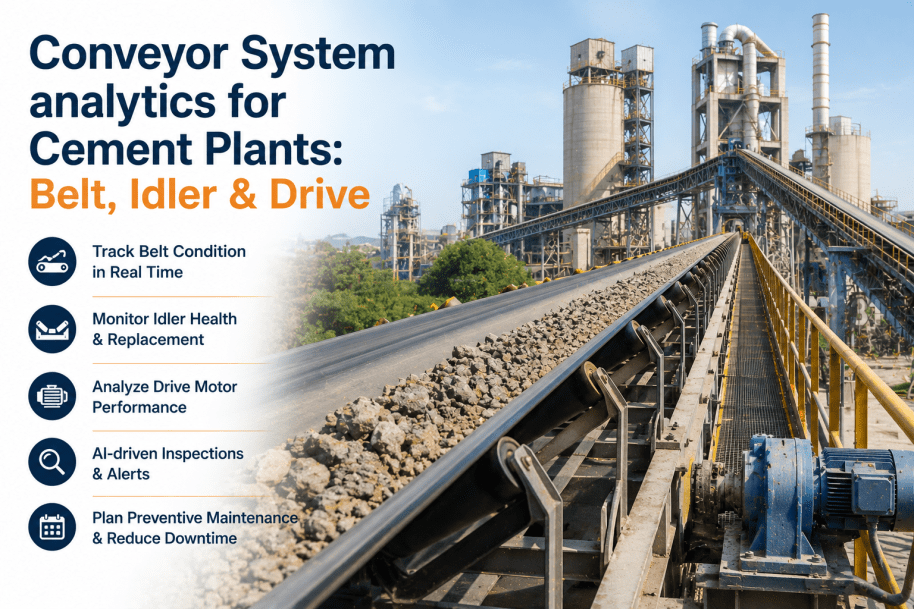
In continuous heavy industries, the cost of equipment failure isn't just repair parts—it is entirely lost production capacity. Cement plants specifically suffer massive financial penalties when critical path assets like the rotary kiln, raw mill, or clinker cooler fail unpredictably. A single catastrophic failure on a kiln ID fan bearing doesn't just cost $15,000 to replace; it halts the entire pyroprocessing line, costing up to $50,000 per hour in lost clinker output. Historical maintenance relied on calendar-based routines or simple SCADA alarms that trigger only when failure is imminent. iFactory's Predictive AI and IoT Sensor Platform shifts cement maintenance from reactive to predictive, identifying vibration anomalies and thermal degradation 4 to 8 weeks before a breakdown occurs, protecting your plant's availability and bottom line.
Predictive Analytics for Cement Plants: AI & IoT Implementation
Deploy industrial-grade IoT sensors and AI machine-learning to detect anomalies in kilns, crushers, and mills up to 8 weeks before failure.
The Cascade Effect: From Mill Vibration to Plant Shutdown
In cement production, the assets are heavily interdependent. A minor, undetected bearing fault on a crusher propagates rapidly into a total production bottleneck. See how iFactory breaks this chain.
Micro-Anomaly
Sub-surface spalling begins in the ID fan bearing. Humans cannot hear it.
Heat Generation
Friction increases. Temperature rises beyond normal operating variance.
Audible Vibration
The bearing begins to physically shake. Mechanics notice the noise.
Critical Failure
Bearing seizes. The ID fan trips offline violently. Kiln draft stops.
Production Lost
Emergency parts sourcing, crane rental, and lost clinker tons.
The Hidden Costs of Run-to-Failure in Cement
Lost Clinker Production
When the kiln stops, revenue stops. The opportunity cost dwarfs the repair parts.
Refractory Shock Damage
Sudden unintended shutdowns cause rapid thermal cooling, destroying expensive brickwork.
Emergency Sourcing
Expedited shipping for a massive trunnion roller costs triple the planned procurement price.
Emissions Violations
Sudden trips often lead to unfiltered dust releases and strict environmental penalties.
Reactive vs Predictive — The AI Shift
IoT Technologies Powering the Cement AI Engine
Triaxial Wireless Sensors
Industrial-grade (IP68) nodes magnet-mounted to mill gearboxes continuously measuring high-frequency velocity, acceleration, and envelope analytics.
Edge-Computing Gateways
Local edge intelligence processes millions of data points a second, securely pushing only the critical diagnostic markers to the cloud without saturating plant bandwidth.
Machine Learning Fingerprints
The AI Engine doesn't just read high vibration; it decomposes the spectrum to tell you exactly if it is an inner-race defect, a structural looseness, or an unbalance issue.
SAP PM Work Order Link
The moment AI hits a 90% confidence threshold on a bearing fault, it auto-generates a pre-filled Work Order directly inside SAP or your local CMMS.
What a Cement Plant Director Said
Installing the iFactory IoT sensors on our kiln drives paid for itself in week six. The AI engine flagged a subtle harmonic frequency shift on our primary pinion bearing that all our manual route checks missed. We verified it, scheduled a controlled swap during an 8-hour window, and entirely avoided a chaotic 4-day emergency shutdown.
The Path to Zero Surprises — 3-Phase Roadmap
IoT Deployment
AI Baseline & Learning
Full Optimization
Frequently Asked Questions
Will these IoT sensors survive the harsh, dusty cement environment?
Yes. The sensors deployed are IP68/IP69K rated, built from hardened 316L stainless steel precisely for extreme particulate environments like crushing operations and cement milling.
We already have a SCADA/DCS system. Why do we need AI?
SCADA acts as a protection layer—it trips a machine when thresholds are dangerously exceeded. iFactory AI looks at micro-patterns in high-frequency data to give you weeks of lead time before SCADA ever sees an issue.
How invasive is the setup process? Do we require a shutdown?
Zero shutdown required. Wireless sensors are rapidly installed using industrial epoxy or tapped magnet studs while your machines are actively running.
Stop Getting Blindsided by Breakdowns
Find hidden machine defects weeks in advance with AI-driven IoT.