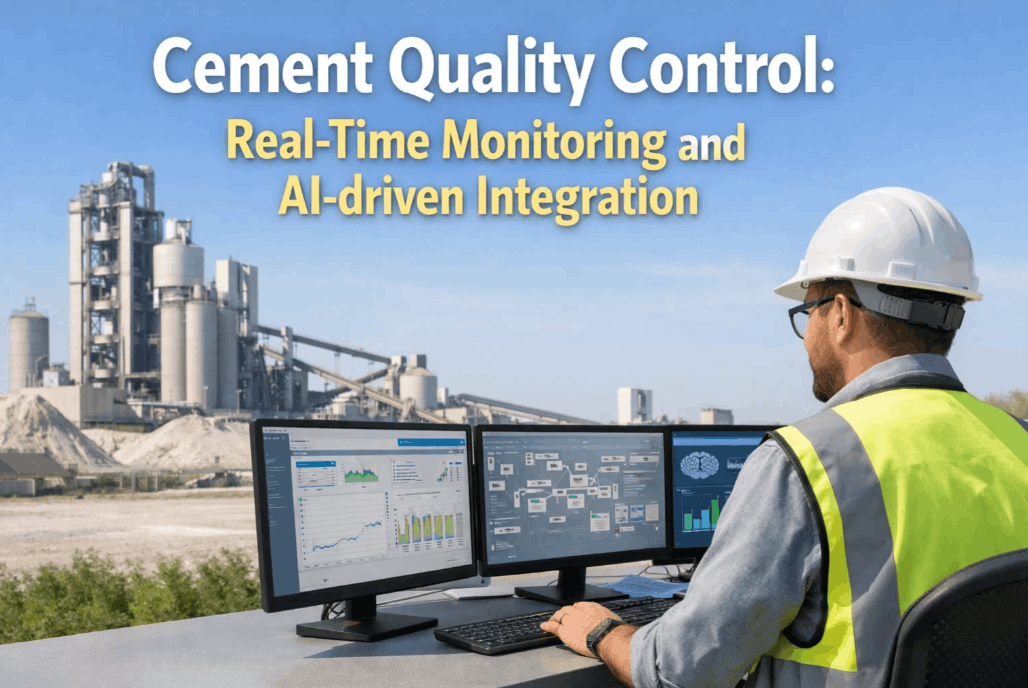
In cement manufacturing, quality control is often a lagging indicator—by the time manual laboratory results for a 28nd-day strength test are available, thousands of tons of clinker have already been produced. Traditional QC relies on periodic sampling and retroactive adjustments, leading to costly over-quality (excess clinker usage) or catastrophic batch failure. iFactory's cement quality control platform transforms this paradigm by integrating real-time process data with AI-driven predictive models. By correlating mill vibration, kiln temperature profiles, and raw meal chemistry in milliseconds, the platform predicts final product quality with 99% accuracy while the material is still in the mill. Book a Quality Audit to see how AI-driven strength prediction stabilizes your cement grades and reduces clinker-to-cement ratios.
Automate Cement Quality Control in Real Time
Predict strength, setting time, and Blaine fineness before the material leaves the mill — ensuring 100% grade consistency with automated compliance logs.
The Precision Gap: Why Real-Time Quality Monitoring is Essential
The transition from OPC (Ordinary Portland Cement) to high-performance blended cements requires a level of process precision that manual lab testing cannot provide. Variations in raw material moisture, fuel quality, and clinker mineralogy create constant quality shifts that go undetected for hours. Book a Demo to see how continuous QC monitoring eliminates quality "surprises."
Without real-time quality monitoring, plants often "over-design" their cement by using extra clinker to ensure they meet minimum strength requirements — an expensive practice that spikes carbon emissions and material costs. iFactory's platform uses machine learning to "see" the clinker mineralization and mill fineness in real-time, providing operators with prescriptive guidance to adjust feeders and separators instantly. This ensures every ton of cement is produced exactly at the grade specification, no higher and no lower.
Four Critical Quality Failure Modes in Cement Plants
Cement quality failures follow measurable process signatures. Identifying these shifts before they impact the final silo is the core objective of our AI-driven integration.
Strength Variance & Over-Clinkering
Inconsistent clinker reactivity leads to unpredictable 28-day strengths. AI correlates kiln temperature zones and cooling rates with clinker chemistry to predict strength at the mill inlet, allowing for precision adjustments to clinker/additive ratios. Book a Demo to stabilize your clinker factor.
Fineness (Blaine) Drift
Separator efficiency and mill ball-charge degradation cause particle size distribution (PSD) shifts. AI monitors mill acoustics and vibration to predict Blaine drift 30 minutes before lab samples are even taken.
Additive Over/Under-Dosing
Gypsum and fly ash dosing errors impact false set and strength development. iFactory's **QC AI-driven integration** synchronizes feeder accuracy with live material moisture feeds, ensuring perfect additive balance. Book a Demo to quantify your additive dosing precision.
Inconsistent Clinker Mineralogy (C3S/C3A)
Raw meal chemistries change faster than daily lab checks can catch. AI-driven monitoring tracks preheater exit gas and kiln drive torque to identify mineralogical shifts in the burning zone that threaten clinker quality.
Cement Quality ROI: Real-World Savings by Production Tier
Cement quality analytics ROI is driven by clinker substitution, energy reduction, and batch loss prevention. The table below outlines validated savings across high-capacity mills.
| Plant Tier | Primary Quality Risk | Annual Cost at Risk | AI Prevention Savings | Payback Period | Year-1 ROI |
|---|---|---|---|---|---|
| Tier 1 — High Vol. OPC | Strength over-design, clinker factor | $300K–$650K | $220K–$480K | 6–8 weeks | 7.4× |
| Tier 2 — Blended Cements | Additive dosing, f-CaO spikes | $250K–$500K | $180K–$420K | 7–10 weeks | 6.2× |
| Specialty / White Cement | Color consistency, fineness control | $200K–$450K | $150K–$380K | 8–12 weeks | 5.5× |
| Global Multi-Site Ops | Standardization, audit compliance | $1.2M–$2.8M | $950K–$2.2M | 10–14 weeks | 8.1× |
Across all tiers, cement QC software delivers average first-year ROIs exceeding 6.0×. By stabilizing strength and reducing clinker factors by just 1.5%, a typical facility pays for the platform within the first quarter.
Five Key Metrics for Cement Quality Assurance
Effective quality management requires real-time visibility into five interconnected production parameters. Book a Demo to see how automated strength prediction eliminates laboratory lag.
1. AI-Driven Strength Prediction (MPa)
Continuous correlation of clinker mineralogy, gypsum dosing, and PSD fineness to predict 2-day, 7-day, and 28-day compressive strengths in real-time. This provides operators with a "Quality Compass" to steer production while material is still in process.
2. Blaine Fineness & Particle Size Distribution (PSD)
Integration of online PSD analyzers and mill acoustic signatures ensures cement fineness remains within a tight 50 cm²/g window — improving downstream concrete workability and reducing grinding energy waste.
3. Free Lime (f-CaO) & Clinker Reactivity
Predictive modeling of clinker free lime content based on kiln thermal profiles. Automated alerts notify operators of mineralogical shifts, allowing for burner adjustments before "dead clinker" enters the grinding circuit.
4. Additive Substitution & Gypsum Optimization
Tracks real-time fly ash, slag, and limestone filler substitution rates against strength targets. AI optimizes the use of supplementary cementitious materials (SCM) to meet sustainability targets without risking grade quality.
5. Setting Time & Heat of Hydration
Correlates chemical composition (C3A/SO3 balance) with fineness to predict initial and final setting times. Prevents "False Set" or "Flash Set" issues that lead to massive customer complaints and batch rejections.
Compliance Automation: Digital QC Documentation for ISO & EN Standards
Cement quality compliance requires rigorous, documented evidence of testing — Blaine logs, chemical analysis, and strength certificates. Manual record-keeping consumes 50+ hours a month per facility and risks audit findings due to transcription errors. Book a Demo to see automated ISO-ready documentation.
iFactory's quality management cement platform auto-generates audit-ready logbooks and Certificates of Analysis (CoA) with secure timestamps. Every quality deviation and corrective action is logged digitally, ensuring your facility is 100% compliant with ASTM C150 / EN 197-1 requirements without the administrative burden of manual logging.
Integrated Quality Governance & Reporting
The platform establishes a unified "single source of truth" for all quality data, bridging the gap between the plant floor and the central laboratory.
- Automated CoAs: Instant generation of cement quality certificates for customer shipments.
- Trend Alerts: Predictive warnings for shifts in standard deviation (Cpk) or quality KPIs.
- Lab Fusion: Seamless synchronization of manual lab results with real-time AI predictions.
- Audit Trail: Full digital history of setpoint changes made in response to quality excursions.
- Regulatory Reporting: Automated emission and clinker-factor reports for ESG compliance.
By automating the flow of quality data, you free your QC team to focus on root-cause analysis rather than manual data entry. Digital traceability ensures that every bag of cement sold is backed by a verifiable record of its mineralogical and physical properties.
Implementation Strategy: 75-Day Cement Quality Transformation
Integrating cement testing automation doesn't require new laboratory hardware. iFactory's AI-driven layer deploys over your existing instrumentation in 75 days to deliver immediate consistency gains.
Connecting to PLC/DCS for mill/kiln parameters and synchronizing with your existing LIMS (Laboratory Information Management System). We ingest 12 months of historical quality logs to calibrate site-specific strength models.
Machine learning models train on live production feeds — learning the unique relationship between your raw materials and strength development. We calibrate the predictive Blaine and Setting Time alerts to your specific cement grades.
The predictive dashboard goes live for operators. Automated quality audit reports are configured to match local regulatory standards. A formal 75-day ROI audit documents reduced strength variance and clinker substitution savings.
Eliminate Cement Quality Surprises and Over-Design
Real-time strength prediction, Blaine fineness monitoring, and automated ISO compliance — deployed in 75 days with measurable ROI.
Predictive Quality for Finish Mills & Separators
Mill performance and quality output are intrinsically linked. iFactory identifies high-wear signatures in ball charges and separator blades that degrade PSD before they trigger traditional maintenance alarms.
PSD drift and mill acoustic signature shifts typically precede quality excursions by 40–80 minutes. Book a Demo to see how mill analytics stabilize your Blaine fineness windows.
Quality Integrity Indicators Tracked in Real Time
| Acoustic Fineness Signature | Specific sound-bin energy changes identify over/under-grinding in the mill chambers |
| Separator Bypass Ratio | Rising bypass = separator wear, leading to coarse PSD and reduced setting time stability |
| Mill Outlet Temp Fusion | Correlating temperature with moisture to predict gypsum dehydration and false-set risk |
| Feeder Pulse Analysis | Predictive identification of feeder slugging that causes chemical grade inconsistency |
The Cement Quality Maturity Curve
Quality standardization ROI scales with operational maturity. Moving from manual lab testing to AI-driven autonomous optimization reduces quality OpEx by 20–35%.
| Maturity Level | Capability | Savings Capture | Typical Facility |
|---|---|---|---|
| Level 1 — Periodic Lab checks | 2-hour Blaine checks, 24-hr chemical analysis | 0–5% | Tier 3 plant, manual logging |
| Level 2 — Connected LIMS | Digital lab logs, standard SCADA trends | 10–20% | Modernized facility, semi-manual ops |
| Level 3 — Real-Time Monitoring | Online PSD analyzers, continuous fineness logs | 25–40% | High-spec plant, integrated sensors |
| Level 4 — Predictive Strength AI | 28-day strength prediction, automated grade alerts | 50–75% | Industry leader, AI-driven QC ops |
| Level 5 — Autonomous Quality Control | Self-tuning mill/feeder loops for exact grade spec | 80–95% | Smart Factory, autonomous production |
Frequently Asked Questions
Below are the most common questions from cement operations leaders evaluating production parameter monitoring for quality.
How accurate is the 28-day strength prediction?
In calibrated industrial environments, iFactory typically achieves an R-squared value of 0.95 or higher for strength prediction. The model continuously adjusts for changes in raw material mineralogy and fuel types to maintain accuracy across all cement grades.
Does this replace our laboratory department?
No. iFactory enhances the laboratory's output. By providing real-time predictive insights, we allow the lab team to focus on high-value verification and R&D rather than routine reactive troubleshooting. We turn the lab into a "strategic predictive center."
Can you track different cement grades (OPC, PPC, PSC) simultaneously?
Absolutely. The platform supports multi-grade modeling. When you switch production from OPC to Pozo-based cement, the AI automatically shifts its predictive models and threshold alerts to match the new grade specification.
How do you handle changes in clinker source?
Our QC AI-driven integration uses XRF/XRD data fusion. If you import clinker from another facility, we update the chemistry profile in the model, and the AI shift its predictions within 10 minutes to maintain strength accuracy.
What is the required mill instrumentation to start?
At a minimum, we require feeder flow rates, mill motor amperage, and outlet temperature data. Most modern mills already have this in their PLC/SCADA. More advanced modeling (PSD prediction) benefits from mill vibration or acoustic sensor integration.
Get Your Quality ROI Model — Custom Built for Your Cement Mill
See exactly how AI-driven quality control stabilizes your grades, reduces clinker factors, and delivers 75-day payback at your facility.