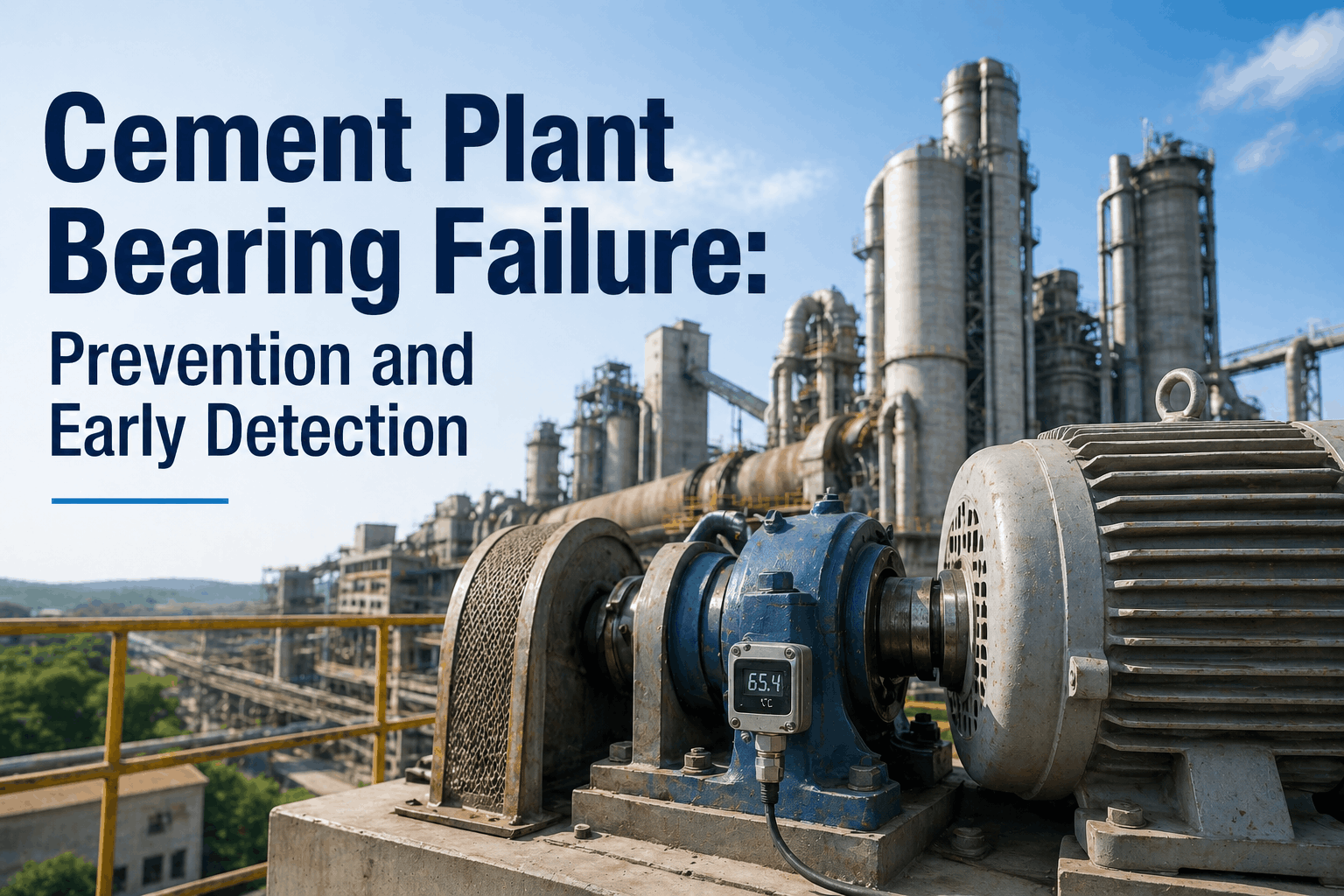
Every cement plant manager knows the dread: a rotary kiln shuts down at 2 AM, production halts, and the repair bill arrives before sunrise. Unplanned equipment failure in cement manufacturing isn't just an operational inconvenience — it's a financial crisis. With kilns running at 1,400°C and mills grinding continuously, the margin between uptime and catastrophic breakdown is razor thin. iFactory AI changes that equation entirely, transforming how cement plants detect, predict, and prevent equipment failures before they disrupt a single hour of production.
How iFactory AI Prevents Equipment Failures in Cement Plants
From anomaly detection to automated work orders — a complete look at the AI engine keeping your kilns, mills, and conveyors running.
Book a Free DemoWhy Cement Plants Bleed Money on Reactive Maintenance
Cement manufacturing is among the most equipment-intensive industries on earth. A single rotary kiln failure can cost tens of thousands of dollars per hour in lost production. Traditional maintenance strategies — run-to-fail or calendar-based — leave plant managers flying blind. Sensors generate data, but without AI to interpret it, that data is noise. The result? Catastrophic surprises that shut down entire production lines without warning.
The Fortune 500's 500 largest manufacturers collectively lose an estimated $1.4 trillion annually to unplanned downtime. Cement plants are disproportionately affected because of the continuous-process nature of kiln operations, the high cost of thermal cycling, and the sheer mechanical complexity of grinding circuits. If you're still scheduling maintenance by the calendar, you're leaving money — and equipment life — on the table. Get support from iFactory's cement specialists today.
Relative maintenance cost comparison across strategies
iFactory's 4-Layer Failure Prevention Architecture
iFactory doesn't just monitor equipment — it understands it. The platform runs a four-layer intelligence stack purpose-built for the mechanical realities of cement production.
IoT Sensor Integration
Wireless and wired sensors attach to kilns, mills, fans, crushers, and conveyors — capturing vibration signatures, temperature gradients, pressure readings, and motor current draw at millisecond intervals. iFactory connects to existing SCADA/DCS via OPC-UA, Modbus TCP, and MQTT, so there's no need to rip out legacy infrastructure. Data flows continuously into the analytics engine, building a living picture of every asset's mechanical condition.
AI Anomaly Detection Engine
Machine learning models trained on historical failure data establish precise normal operating baselines for each asset class — separate baselines for ball mills, VRMs, ID fans, and kiln drives. When real-time sensor streams deviate from these baselines in patterns that match known pre-failure signatures, the anomaly detection engine flags the event. Crucially, iFactory distinguishes between transient process variations and genuine degradation trends, dramatically reducing false alarms that erode team trust.
Real-Time Condition Dashboards
Plant managers and maintenance engineers see a unified, live view of every monitored asset's health — color-coded condition status, trend graphs, and remaining useful life estimates all in one place. No toggling between systems, no waiting for shift reports. When a mill bearing begins showing early degradation, it surfaces immediately on the dashboard with the predicted failure window prominently displayed, giving maintenance teams the scheduling runway they need.
Automated Work Order Creation
When the AI's confidence in a developing failure crosses a defined threshold, iFactory automatically generates a maintenance work order — complete with the affected asset, the predicted failure mode (bearing wear, liner degradation, gearbox fault), recommended parts, and optimal intervention timing. Work orders route directly to the right technician, with priority set by production criticality. The maintenance team executes a planned repair during a scheduled stop rather than scrambling for an emergency fix at 3 AM.
Which Equipment Does iFactory Monitor?
iFactory's failure prevention covers the full asset hierarchy of a cement plant — from primary crushing to final dispatch. The platform prioritizes the assets responsible for 80% of unplanned downtime risk.
Rotary Kilns
The most critical asset in the plant. iFactory monitors shell temperature, tire and roller wear, drive gear vibration, and refractory condition. Thermal anomaly detection triggers early intervention before refractory damage escalates.
Grinding Mills (Ball & VRM)
Vibration-based bearing monitoring, liner wear tracking, and mill drive motor analysis detect grinding circuit degradation weeks before output quality suffers or mechanical failure occurs.
ID Fans & Exhaust Systems
Fan imbalance, bearing temperature rise, and seal degradation are caught early through continuous vibration spectrum analysis, preventing the catastrophic fan failures that can take kilns offline for days.
Clinker Coolers
Grate plate wear, drive chain condition, and cooling fan performance are monitored to prevent cooler failures that disrupt clinker quality and force kiln throughput reductions.
Crushers & Raw Mill Feed Systems
Jaw and impact crusher bearing health, feed conveyor tension monitoring, and drive motor current signatures are tracked to keep raw material supply continuous and consistent.
Conveyors & Bucket Elevators
Belt tension, pulley bearing health, and drive motor load profiles are monitored continuously — eliminating the spillage events and unscheduled stoppages that cascade through the entire production chain.
How iFactory Decides When to Act
Not every sensor anomaly warrants a work order. iFactory's escalation logic filters signal from noise using a three-tier confidence model — ensuring maintenance teams respond to genuine threats without being overwhelmed by false alarms.
What Cement Plants Achieve with iFactory AI
The results from iFactory deployments in cement manufacturing consistently tell the same story: fewer surprises, lower costs, and maintenance teams that plan rather than react. Get support to see how these numbers apply to your specific plant configuration.
Your Path from Reactive to Predictive
iFactory is designed for cement manufacturing realities — complex legacy systems, continuous-process operations, and teams that can't afford prolonged deployment cycles.
Connect, Baseline, and Catch First Failures
Sensors installed on the 4–6 highest-risk assets (typically kiln, primary mill, and main ID fan). Predictive models trained on available historical sensor data and maintenance records. Most plants identify their first actionable failure prediction within 30 days — often enough to justify the entire investment before Phase 2 begins.
Expand Coverage Across All Critical Equipment
Sensor network extended to all critical and semi-critical assets plant-wide. Automated work order creation goes live, integrated with your existing CMMS or iFactory's built-in work order management. Real-time condition dashboards deployed for shift supervisors, maintenance planners, and plant managers. Alert escalation thresholds tuned to your specific equipment fleet.
AI Models Improve as Your Plant Generates More Data
Unlike static rule-based systems, iFactory's ML models improve continuously as they accumulate more operating data from your specific equipment. Prediction accuracy increases, false alarm rates drop further, and the system begins identifying optimization opportunities beyond failure prevention — including energy efficiency recommendations for kiln firing and grinding circuit parameters. Get support to plan your phased rollout with our cement specialists.
See iFactory AI in Action at Your Cement Plant
Join the cement manufacturers who've moved beyond reactive maintenance. Our team will walk you through a live platform demo tailored to your specific equipment challenges — kilns, mills, fans, and everything in between.
Book Your Free Demo