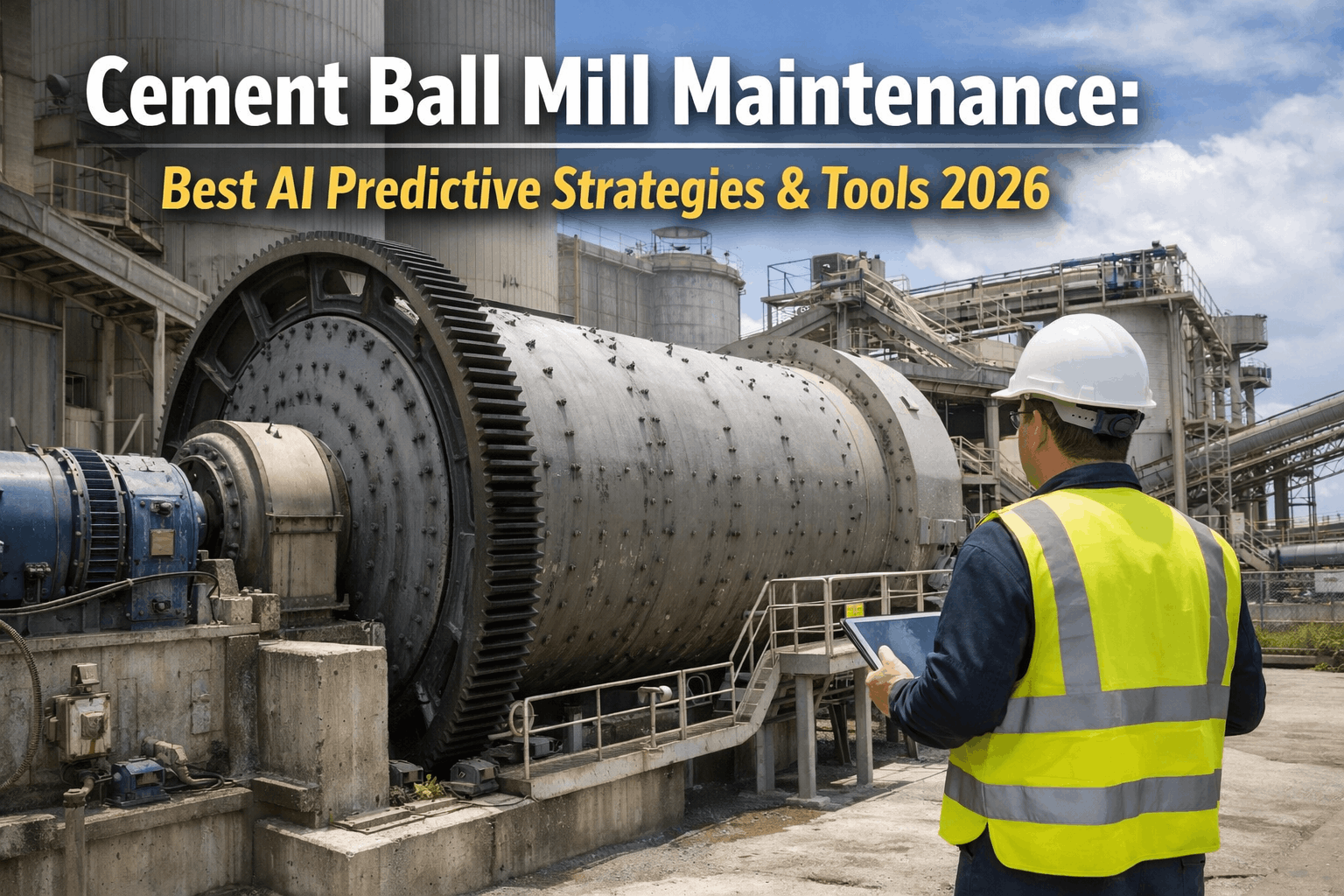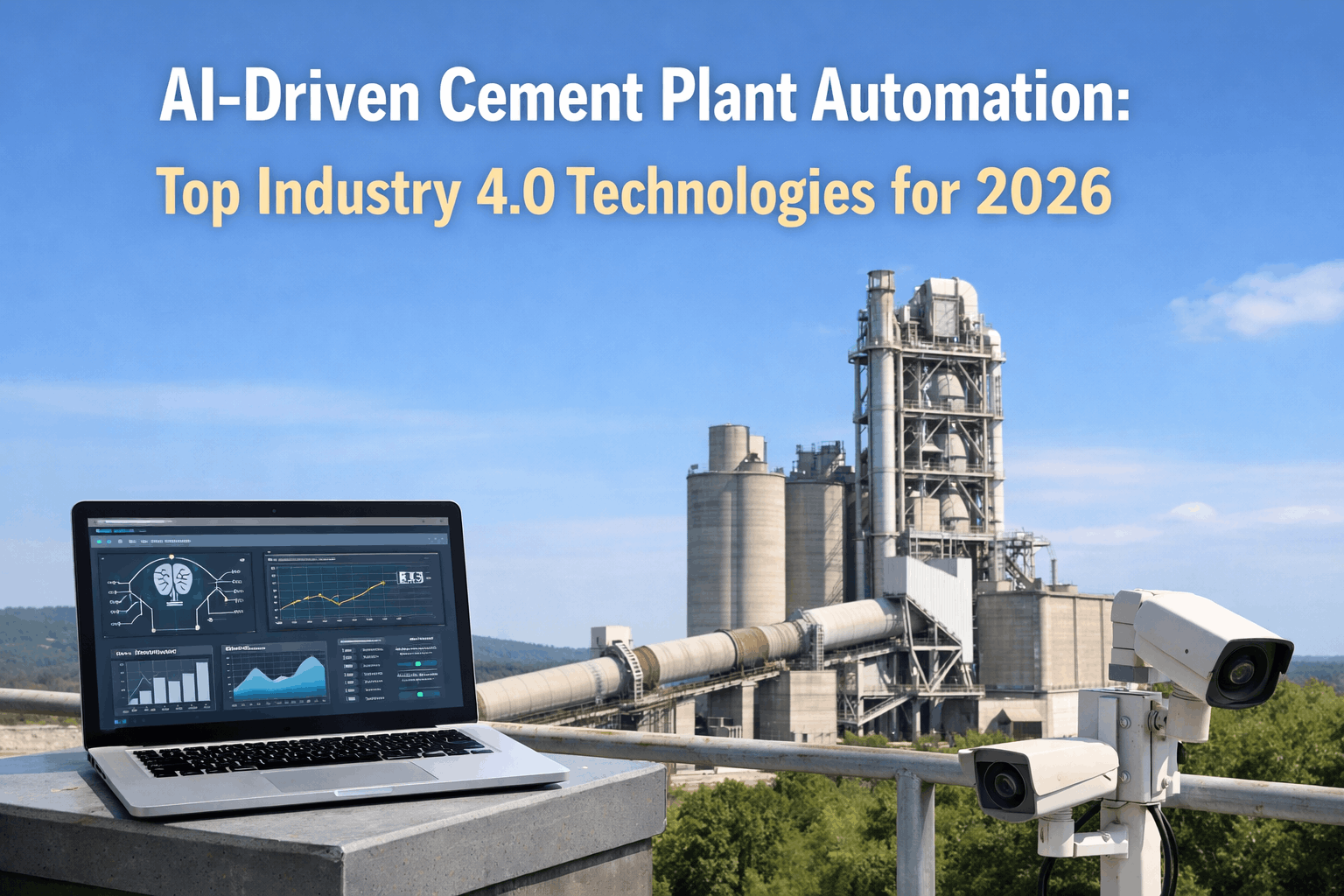
The cement industry sits at a pivotal crossroads in 2026 — massive rotating kilns, raw mills, and clinker coolers run around the clock, and a single unplanned stoppage can cost upwards of $80,000 per hour in lost production. That is precisely why AI-powered IoT sensor networks are no longer a luxury for cement manufacturers; they are operational infrastructure. According to recent industry surveys, 35% of cement and heavy-industry plants have already adopted IoT at an extensive scale, while another 41% are actively experimenting — a combined adoption momentum that signals a sector-wide tipping point. This guide breaks down the six most effective smart sensor technologies transforming cement predictive maintenance in 2026, what makes each one powerful, and how iFactory's AI platform turns raw sensor data into actionable intelligence before failures occur.
AI & IoT in Cement Industry
Best Smart Sensor Technologies for Predictive Maintenance
Why Cement Plants Need Smarter Sensing in 2026
Cement production is one of the most asset-intensive operations on earth. A typical integrated plant runs over 400 pieces of rotating and static equipment — rotary kilns reaching 1,450°C, vertical roller mills operating under extreme load, and clinker transport systems exposed to abrasive dust 24/7. Traditional time-based maintenance schedules leave two expensive problems unsolved: over-maintenance of healthy equipment and under-maintenance of degrading equipment. AI-connected IoT sensors eliminate both failure modes by providing continuous, real-time condition data analyzed by machine learning models trained on cement-specific failure signatures. Sign up with iFactory to connect your plant's sensor network to an AI brain that learns your equipment's behavior from day one.
Start Your Predictive Maintenance Journey
Join 500+ industrial plants using iFactory AI to eliminate unplanned downtime.
6 Best AI-Powered Sensor Technologies for Cement Plants
Each sensor type below addresses a specific failure mode common to cement plant equipment. The real power emerges when these technologies are unified inside a single AI platform like iFactory, which correlates data streams across sensor types to detect multi-modal failure precursors weeks before they become breakdowns.
AI Vibration Sensors
Vibration analysis remains the gold standard for rotating equipment health monitoring in cement plants. AI-enhanced accelerometers mounted on kilns, ball mills, fans, and compressors sample at frequencies up to 50 kHz, capturing bearing defect frequencies, gear mesh anomalies, imbalance signatures, and resonance events. Unlike traditional threshold alarms, iFactory's AI models apply Fast Fourier Transform (FFT) decomposition and envelope analysis to isolate specific fault frequencies — distinguishing between an outer race bearing defect and a gear tooth fault from the same vibration signature. In cement plants, this precision prevents the most common failure mode: bearing collapse in a kiln support roller, which can force a 5–7 day shutdown.
AI Thermal Imaging Sensors
Infrared thermography has evolved from handheld spot inspections to fixed-mount AI thermal cameras that scan continuously. In a cement kiln shell, a 20°C localized hot spot indicates refractory brick deterioration — catching this early saves the plant from a full kiln reline costing $500K+. AI thermal sensors in 2026 integrate directly with iFactory's condition monitoring dashboard, automatically flagging anomalies against learned baseline thermal maps. Book a demo to see how thermal AI works in a live cement plant environment.
AI Pressure Monitoring Sensors
Differential pressure sensors across cyclone preheaters, bag filters, and pneumatic conveying lines provide critical process health data. AI pressure analytics detect filter blinding, blockage development in preheater stages, and compressor valve degradation — all of which directly impact energy consumption and clinker quality. iFactory's AI correlates pressure trends with production output data, giving plant managers a complete picture of both equipment health and process efficiency in one view. Sign up today to unify your pressure monitoring data.
AI Oil & Lubrication Analysis Sensors
In-line oil analysis sensors monitor particle count, viscosity, water contamination, and metallic wear debris in real time for gearboxes, kiln support roller lubrication systems, and large-frame crushers. AI models trained on cement equipment lubrication degradation patterns can identify accelerated wear events 3–6 weeks before a catastrophic gearbox failure. This technology alone can extend gearbox overhaul intervals by 30–40% through data-driven oil change scheduling rather than fixed time intervals.
AI Acoustic Emission Sensors
Acoustic emission (AE) sensors detect ultrasonic stress waves generated by crack propagation, partial discharge in high-voltage equipment, and early-stage bearing fatigue — failure signals that are invisible to vibration sensors at standard sampling rates. In cement plants, AE sensors are particularly valuable for monitoring kiln tyre and support roller surface cracking, preheater vessel refractory integrity, and high-voltage motor insulation health. Book a demo with iFactory to see acoustic emission analytics in action.
Multi-Parameter Wireless IoT Sensor Nodes
The most transformative development in 2026 is the proliferation of low-cost, battery-powered multi-parameter sensor nodes that combine vibration, temperature, humidity, and magnetic field measurement in a single wireless device. These nodes communicate over LoRaWAN, WirelessHART, or 5G private networks, eliminating the cabling costs that historically made dense sensor deployments cost-prohibitive. A cement plant that previously monitored 50 critical assets can now affordably monitor all 400+ assets in the plant. iFactory's AI platform ingests data from these heterogeneous sensor networks through standardized OPC-UA and MQTT protocols, normalizing data streams and applying equipment-specific AI models to each asset. The result is plant-wide condition intelligence at a fraction of the traditional sensor deployment cost. Sign up with iFactory and connect your entire sensor fleet in days, not months.
How iFactory AI Turns Sensor Data Into Maintenance Decisions
iFactory integrates natively with SAP PM, Maximo, and leading CMMS platforms, meaning predictive alerts flow directly into your existing maintenance workflows without process disruption. Book a demo to see the full integration architecture.
Sensor Technology Selection Guide for Cement Equipment
| Equipment | Primary Sensor | Secondary Sensor | Failure Mode Detected | Lead Time |
|---|---|---|---|---|
| Rotary Kiln | Thermal Imaging | Vibration + AE | Refractory hot spots, tyre cracking | 4–12 weeks |
| Ball Mill / VRM | Vibration | Oil Analysis | Bearing wear, liner wear, gearbox degradation | 2–8 weeks |
| Cyclone Preheater | Pressure | Thermal | Blockage, refractory failure | Hours–days |
| Clinker Cooler | Thermal + Vibration | Multi-parameter | Grate plate failure, drive degradation | 1–4 weeks |
| Bag Filter / ESP | Pressure | Vibration | Filter blinding, fan imbalance | Days–weeks |
| Raw Material Crusher | Vibration + Oil | Acoustic | Bearing failure, liner cracking | 3–6 weeks |
Deployment Roadmap: Getting to Full AI Sensor Coverage
Deploy wireless multi-parameter sensors on top 20 critical rotating assets (kiln, main mill, key fans). Establish baseline AI models. Connect to iFactory platform and integrate with existing CMMS for work order flow.
Add thermal cameras to kiln shell and key electrical rooms. Deploy pressure sensor networks across preheater and filter systems. AI models mature as historical failure data accumulates, improving prediction accuracy.
Full asset coverage across all 400+ monitored points. Oil analysis sensors integrated for major gearboxes. AI-driven maintenance scheduling replaces time-based PM plans. Target: 70%+ reduction in unplanned downtime.
Ready to Eliminate Unplanned Downtime in Your Cement Plant?
iFactory AI connects your sensor network to intelligent maintenance workflows — from anomaly detection to work order creation.