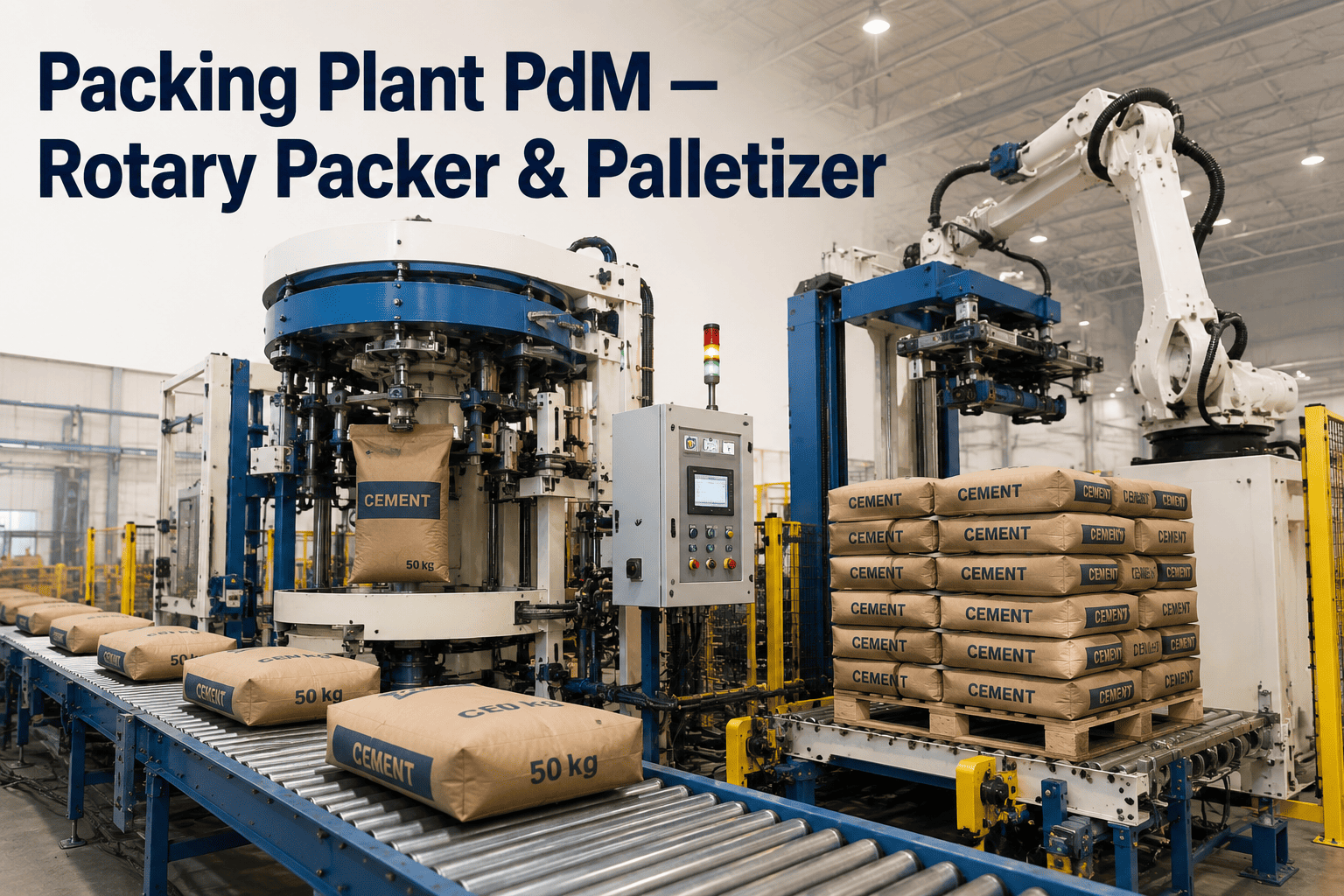
Cement packing plants represent the final stage of the cement production process — the moment when finished product transitions from bulk storage to bagged units ready for distribution, and the operational quality of that transition determines whether the facility meets dispatch commitments, holds bag weight accuracy within specification, and sustains packing line throughput across all three shifts without the recurring downtime events that accumulate into missed daily targets. In the majority of U.S. cement plants operating today, packing plant analytics is treated as secondary to kiln and grinding analytics — a support function rather than a production-critical domain — and the operational cost of that prioritization shows up in bag weight deviations that trigger customer complaints, palletizer jams that idle the packing line for 45 minutes at a time, and dispatch schedules that slip because no one had structured visibility into which packer was trending toward a calibration failure before it failed. A packer that overfills by 0.3 kilograms per bag across a 10-hour shift running at 2,400 bags per hour is giving away product at a rate that adds up to measurable revenue loss per month — and in most plants, that overfill is discovered at the end-of-shift weight check rather than at the moment the trend began. iFactory's preventive analytics and work order management platform brings the same analytics discipline applied to kilns and mills to the packing plant — structured monitoring of packer fill accuracy, bag counter reconciliation, palletizer cycle health, and dispatch throughput — giving packing plant supervisors and analytics teams the real-time and historical data they need to prevent packing losses before they compound. Facilities that have deployed iFactory's packing plant analytics report 68% reduction in bag weight deviation incidents, 74% faster identification of packing line degradation trends, and 81% improvement in dispatch schedule adherence from structured fill accuracy and palletizer health monitoring.
Why Packing Plant Analytics Is a Production-Critical Function, Not a Support Activity
The operational logic that positions kiln analytics as mission-critical and packing plant analytics as secondary is understandable — kilns represent the highest capital investment and the most complex chemistry in the plant. But the financial impact of packing plant underperformance is direct and quantifiable in ways that make the analytics investment straightforward to justify.
Fill accuracy drift, palletizer mechanical degradation, bag counter reconciliation gaps, and dispatch scheduling inefficiency are each addressable with structured analytics. The challenge is that packing plant data has historically been captured in paper logs, standalone PLC historian files, or manual bag weight check sheets that no central analytics system can query. iFactory's platform consolidates packing plant operational data into a single queryable environment — connecting packer fill readings, palletizer cycle data, bag counter outputs, and dispatch records to the preventive maintenance and work order management layer that converts trending data into scheduled interventions before failures occur.
Packer Fill Accuracy: The Core Analytics Problem in Cement Bagging
Packer fill accuracy is the primary financial performance indicator in the cement packing plant — every 0.1 kg of average overfill across a high-volume packing line represents measurable product giveaway, and every underfill event that reaches a customer represents a quality complaint, a potential regulatory issue, and a reputational cost that outlasts the weight difference. Structured fill accuracy analytics requires monitoring the right parameters, at the right frequency, and connecting the data to the work order system that can act on it. Book a Demo to see iFactory's packer fill accuracy monitoring configured for a multi-spout rotary packer equivalent to your facility's bagging equipment.
Fill Accuracy Monitoring — Per-Spout Trending Across Every Shift
iFactory's fill accuracy module captures bag weight data from the inline checkweigher at configurable sampling intervals — every bag, every 10th bag, or statistical sampling — and presents per-spout fill accuracy trending in real time. Supervisors see not just average fill weight but the distribution of fill weights by spout, the drift rate over the past 2, 4, and 8 hours, and the time-to-limit projection that tells them when a spout will breach the acceptable tolerance band if the current trend continues. AI-assisted calibration alerts trigger a work order notification to the maintenance team before the spout reaches the tolerance limit — scheduling a calibration intervention during the next planned stoppage rather than after a weight deviation event has already created bagged-product rejection.
Bag Counter Accuracy — Reconciling Production Count Against Dispatch Records
Bag counter discrepancies between packing line output and dispatch records are one of the most persistent and underinvestigated inefficiencies in cement packing plants — often attributed to "bag handling losses" without any structured investigation into whether the discrepancy is a counter calibration issue, a conveyor transfer loss, a palletizer rejection count error, or a loading dock reconciliation gap. iFactory's bag counter module connects the packing line counter, the palletizer input count, the finished pallet count, and the dispatch truck loading count into a single reconciliation view — surfacing discrepancies at each transfer point rather than at the end of the shift when the gap has already accumulated across hours of production.
Palletizer Health Analytics — Cycle Time, Torque, and Jam Frequency Trending
Palletizer jams are the single largest source of unplanned downtime in most cement packing plants — and the majority of jam events are preceded by detectable mechanical degradation signals that appear in cycle time data, drive torque readings, and layer placement accuracy metrics days before the event that stops the line. iFactory's palletizer health module monitors these leading indicators in real time, builds equipment-specific baseline profiles, and generates maintenance notifications when any indicator deviates from the baseline by a configured threshold — converting reactive jam response into scheduled preventive intervention during the next planned stoppage window.
Dispatch Efficiency Analytics — Connecting Packing Output to Loading Throughput
Dispatch efficiency is the output metric that packing plant analytics ultimately serves — the ability to meet committed dispatch schedules without line stoppage, weight deviation, or pallet quality events that delay truck loading. iFactory's dispatch analytics module tracks packing line output rate against the shift's dispatch commitment, projects completion time based on current throughput, and flags risk events — packer slowdowns, palletizer cycle degradation, or bag counter gaps — that threaten the dispatch schedule with enough lead time for supervisors to take corrective action before trucks are delayed. The dispatch analytics dashboard connects to the work order system so that any equipment anomaly flagged during the shift has a maintenance notification created and routed automatically — without requiring the packing supervisor to open a separate maintenance application.
Packing Plant Preventive Maintenance: From Calendar-Based to Condition-Based Intervals
Most cement packing plants run packer and palletizer maintenance on fixed calendar intervals — monthly calibration checks, quarterly mechanical inspections, annual overhauls — regardless of actual equipment condition and usage intensity. A packer running three shifts at 95% utilization accumulates wear at a fundamentally different rate than one running one shift at 70% utilization, but a calendar-based maintenance schedule treats them identically. iFactory's condition-based maintenance model replaces fixed intervals with analytics-driven intervals determined by actual equipment condition data — extending maintenance intervals on equipment performing within baseline and accelerating intervention on equipment showing degradation trends. The five-stage workflow below shows how iFactory's preventive maintenance platform manages packing plant equipment from baseline establishment through work order closure.
Equipment Baseline Establishment — Normal Operating Profile for Each Packer and Palletizer
iFactory establishes equipment-specific baseline profiles for every packer and palletizer in the packing plant during the first 30 days of deployment — capturing normal fill weight distribution by spout, normal palletizer cycle time by production rate, normal drive torque profiles at different operating speeds, and normal jam frequency under normal operating conditions. These baselines become the reference against which all subsequent operating data is compared, enabling deviation detection that is specific to each piece of equipment rather than based on generic industry thresholds that may not reflect the actual performance characteristics of your specific equipment configuration.
Continuous Condition Monitoring — Real-Time Deviation Detection Against Equipment Baseline
Once baselines are established, iFactory monitors packing plant equipment continuously against those baselines — flagging deviations in fill accuracy, cycle time, torque, jam frequency, or bag counter accuracy that exceed the configured alert thresholds. Alerts are tiered: informational flags that appear on the supervisor dashboard, warning alerts that trigger a maintenance notification to the maintenance team, and critical alerts that trigger an immediate work order with priority routing to the packing plant maintenance technician on shift. Alert thresholds are configurable per equipment and per shift — accounting for the fact that equipment behavior at the start of a shift after a cold start differs from steady-state behavior three hours into a production run.
Predictive Interval Adjustment — Maintenance Frequency Driven by Condition Data, Not Calendar
iFactory's preventive maintenance scheduling engine uses cumulative condition data to adjust maintenance intervals dynamically — extending the calibration interval on a packer spout that is performing within tight tolerance bands and accelerating the inspection interval on a palletizer drive that is showing torque elevation trends. Supervisors and maintenance planners see the condition-adjusted interval for every packing plant asset on the maintenance planning dashboard, with the historical trend data supporting the interval recommendation visible alongside it. This data-driven interval adjustment is what converts the maintenance budget from a fixed calendar cost to a targeted investment in the assets that actually need attention.
Work Order Creation and Routing — Maintenance Notifications Connected to the Packing Schedule
When iFactory's condition monitoring triggers a maintenance recommendation, the work order management module creates a structured work order with the equipment ID, the specific anomaly detected, the trending data that triggered the recommendation, and the recommended intervention — spout calibration, belt tension adjustment, gripper mechanism inspection, or drive lubrication — pre-populated from the equipment's maintenance history and the current anomaly type. Work orders are routed to the maintenance technician assigned to the packing plant and scheduled against the next planned stoppage window on the packing schedule, ensuring that the maintenance intervention is planned rather than reactive and does not require an unplanned line stoppage to execute.
Post-Maintenance Verification — Confirming Equipment Return to Baseline After Intervention
After each packing plant maintenance intervention, iFactory's verification module monitors the equipment's post-maintenance performance against the pre-maintenance condition data and the equipment baseline — confirming that the calibration, adjustment, or repair has returned the equipment to expected performance before the work order is closed. If post-maintenance performance does not return to baseline within the configured verification window, the work order is automatically re-opened with a flag for escalated maintenance review. This verification closure loop ensures that maintenance interventions are confirmed effective, not just marked complete, and that recurring issues are escalated rather than repeatedly resolved and re-opened without root cause investigation.
Packing Plant Analytics vs. No Structured Analytics: Performance Comparison Across Six Metrics
The operational gap between cement packing plants with structured analytics and those relying on shift log paper records and periodic manual weight checks is measurable across every key performance indicator. The comparison below maps the difference in performance outcomes across the six metrics that determine packing plant financial performance and dispatch reliability. Book a Demo to model iFactory's packing plant analytics against your facility's current packer, palletizer, and dispatch configuration.
| Performance Metric | Without Analytics Baseline | iFactory Analytics Platform | Improvement | Annual Value |
|---|---|---|---|---|
| Bag Fill Accuracy | 0.25–0.40 kg avg overfill, detected at shift end | Real-time spout trending, drift alert before tolerance breach | 68% fewer deviation incidents | $40K–$120K product giveaway recovered |
| Palletizer Uptime | 3–6 jam events per week, 40–55 min avg downtime each | Cycle time and torque trending, preventive intervention scheduled | 74% reduction in jam-related downtime | $35K–$95K packing line uptime value |
| Bag Counter Reconciliation | 1–3% shift-end discrepancy, source unidentified | Transfer-point reconciliation, discrepancy flagged in real time | 82% faster discrepancy source identification | $18K–$50K inventory accuracy improvement |
| Maintenance Labor Efficiency | Calendar intervals — over-maintain stable, under-maintain degrading | Condition-based intervals — targeted interventions on actual need | 28% reduction in total maintenance hours per packer | $22K–$65K maintenance labor efficiency |
| Dispatch Schedule Adherence | Manual tracking — delays discovered after trucks are waiting | Real-time throughput vs. commitment projection with risk flags | 81% improvement in on-time dispatch | $30K–$90K customer service and logistics value |
| Regulatory Audit Readiness | Manual paper weight log assembly — 6–12 hrs per audit | Auto-generated weight history package with complete audit trail | Hours to minutes per audit request | $12K–$35K compliance labor recovered |
Expert Review: What Packing Plant Managers Say About Structured Fill and Palletizer Analytics
I spent 14 years managing packing plant operations at two large-format cement facilities in the Southeast — one running four rotary packers with 16 spouts total, the other running a combination of rotary and impeller packers across three packing lines feeding two dispatch bays. In both facilities, the financial impact of packing plant underperformance was significant, but it was also invisible in the way that matters for getting management attention and investment: it never showed up as a single incident you could point to. It accumulated across thousands of bags, across dozens of small palletizer jams, across reconciliation gaps that everyone assumed were within acceptable limits. When I tell operations directors that a single rotary packer running at 0.3 kg average overfill across three shifts is costing $50,000 to $80,000 per year in product giveaway, the reaction is usually disbelief followed by a calculation. They do the math and realize the number is right — they just never tracked it that way because the fill accuracy data was in the checkweigher printout and the production volume data was in a separate system and no one had connected the two. What iFactory's platform does in the packing plant is exactly what good analytics does everywhere else in the plant — it connects data that exists but was never correlated. The fill weight is being measured. The production count is being recorded. The palletizer cycle time is in the PLC historian. None of that data is new. What is new is having it in a single environment where you can see per-spout trending in real time, where the system tells you which spout is drifting toward a calibration event before it happens, and where a maintenance work order is created and routed automatically rather than written on a slip of paper and handed to whoever happens to be walking by. The ROI at both facilities was faster than anyone expected — not because the platform is expensive to recover, but because the baseline losses it addresses are larger than most operations managers realize until they actually measure them.
— Director of Packing Operations, U.S. Cement Manufacturing — 14 Years at Multi-Plant Cement Operations — Certified Maintenance and Reliability Professional, iFactory Analytics Reference 2026Conclusion
The cement packing plant is the revenue-realization stage of the entire production process — and in most U.S. facilities, it is also the stage with the least structured analytics investment. Fill accuracy drifts are discovered at shift-end weight checks rather than at the moment the drift begins. Palletizer jams are responded to rather than prevented. Bag counter discrepancies are attributed to handling losses rather than investigated at the transfer point where they originate. Dispatch schedule delays are managed reactively rather than projected with enough lead time to take corrective action. None of these failure modes require new data collection infrastructure — the checkweigher is already generating fill weight data, the PLC historian is already capturing cycle time and torque data, and the bag counter is already outputting production counts. What is missing in most packing plants is the analytics layer that connects this data to a real-time monitoring environment and the work order management system that converts monitoring alerts into scheduled maintenance interventions.
iFactory's preventive analytics and work order management platform provides that connection — turning existing packing plant data into actionable operational intelligence that reduces product giveaway, prevents palletizer downtime, improves dispatch schedule adherence, and converts the maintenance budget from a fixed calendar cost to a targeted investment in the equipment that actually needs attention. The 68% reduction in bag weight deviation incidents, 74% faster degradation identification, and 81% dispatch schedule improvement at comparable facilities reflect what structured analytics does when applied to a domain that has historically operated without it. Book a Demo to see iFactory's packing plant analytics configured for your facility's specific packer, palletizer, and dispatch environment.
Frequently Asked Questions
Yes. iFactory integrates with checkweigher outputs from all major rotary and impeller packer brands via direct PLC connection or OPC-UA data bridge, with no hardware replacement required. Book a Demo to confirm integration for your specific packer model.
iFactory's interval engine uses both runtime hours and condition indicator trends — not calendar days alone — so maintenance intervals scale with actual production utilization. High-output periods with elevated torque or fill drift accelerate the interval; low-utilization periods with stable condition indicators extend it automatically.
Yes. iFactory provides certified ERP connectors for SAP, Oracle, and Microsoft Dynamics 365, allowing shift-end dispatch quantities to post automatically to ERP production orders without manual keying. Custom REST API integration is available for other ERP systems with typical go-live in 5 to 10 business days.
For a standard 2 to 4 packer, 1 to 2 palletizer packing plant with ERP integration, deployment runs $22,000 to $58,000 over 3 to 5 weeks covering platform setup, equipment integration, baseline establishment, and 30-day go-live support. First measurable fill accuracy improvements are typically visible within the first week. Book a Demo for a site-specific quote.
Yes. iFactory's multi-line configuration supports separate fill accuracy baselines, tolerance bands, and maintenance profiles per packing line and per product grade — ensuring that weight tolerances for 25 kg bags are not applied to 50 kg bags, and that product-specific fill targets are maintained independently across all active lines simultaneously.