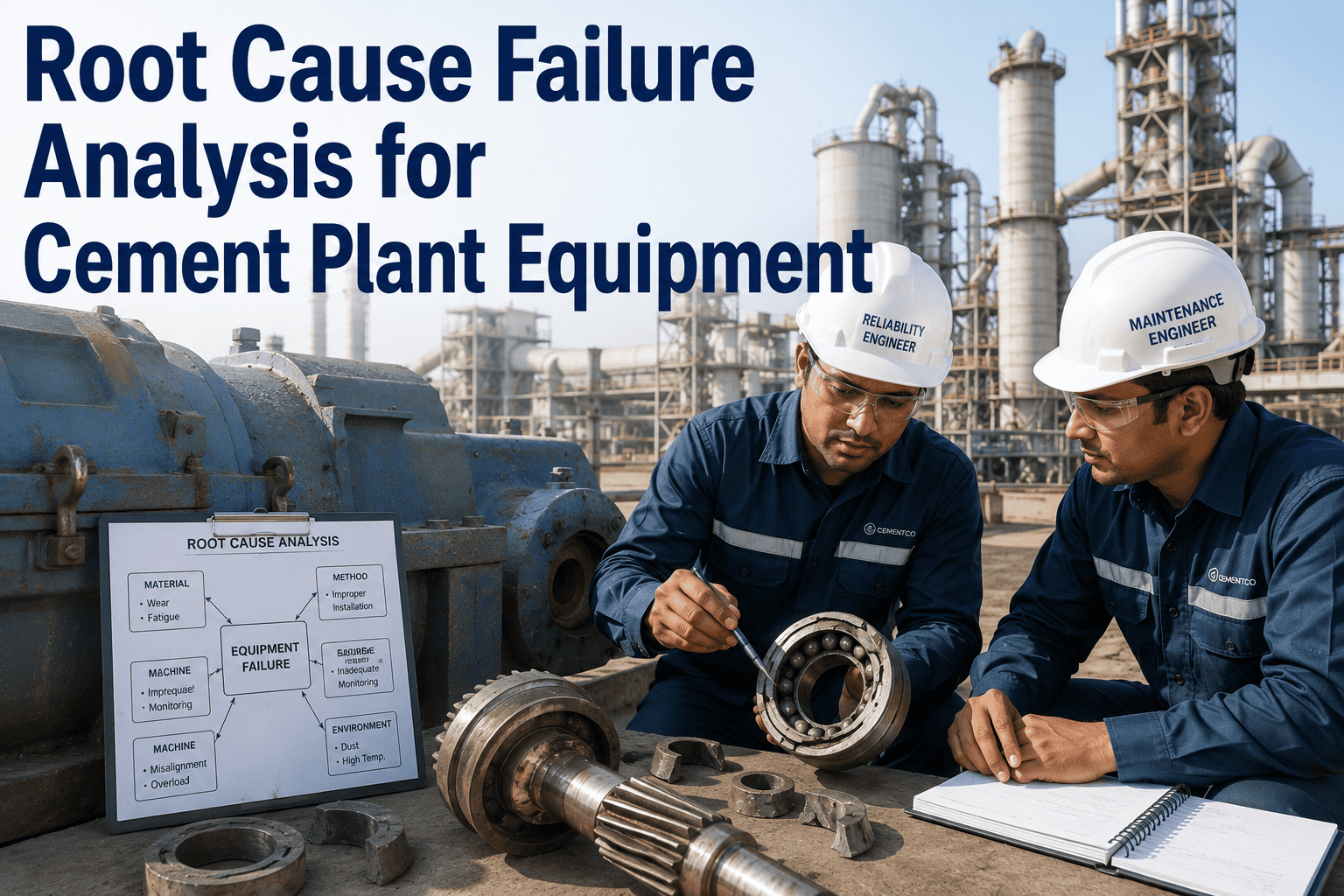
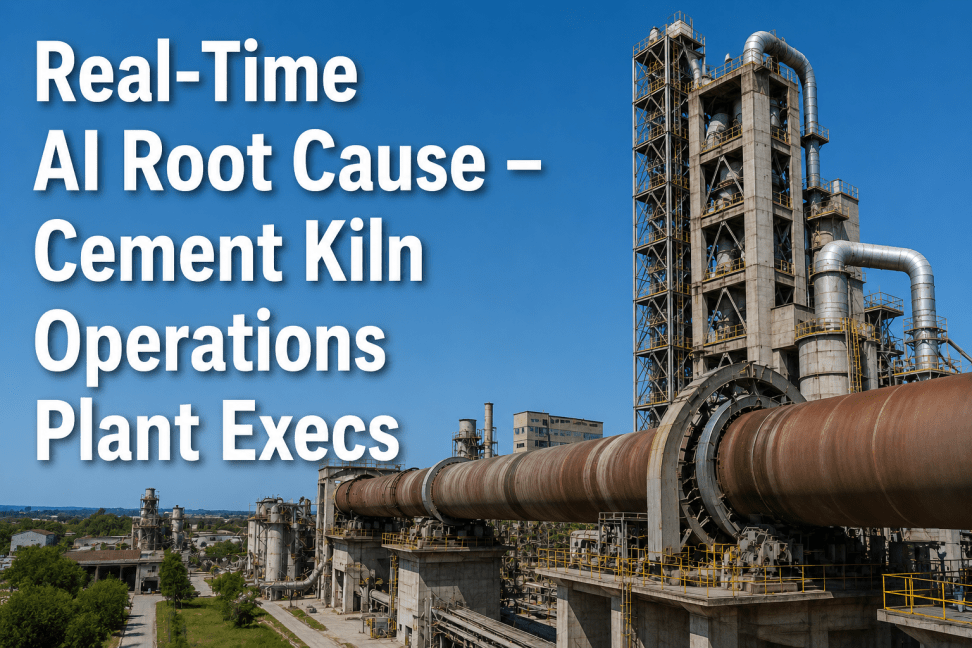
The same pump fails a third time this year. Maintenance replaces the bearing again, production loses another shift, and everyone moves on until it happens a fourth time. This is what happens when a plant treats every failure as an isolated event instead of asking why it keeps recurring. Root cause failure analysis is the structured alternative — a disciplined investigation that traces a failure back past the symptom to the actual condition that made it possible, so the fix addresses the cause rather than the part. iFactory's investigation workflow gives cement plant reliability teams a structured place to run that process.
iFactory Reliability Engineering
Root Cause Failure Analysis for Cement Plant Equipment
Move past replace-and-repeat maintenance. Apply 5 Why, Ishikawa, fault tree, and barrier analysis methodologies to break repeat-failure cycles on mills, fans, conveyors, and kiln-area equipment.
3-4x
Cost of scope discovered after the fact vs planned
Repeat
Failures are the clearest signal RCFA was skipped
3 phases
Collection, analysis, and corrective action
Why "Replace the Part" Isn't a Fix
When a bearing seizes, the fastest path back to production is to swap it and restart. That instinct is understandable, but it treats the bearing as the problem rather than as the evidence. If the bearing failed because of chronic misalignment, contaminated lubrication, or an upstream process condition, the replacement part will fail again on roughly the same timeline — and the plant will spend the same repair cost, the same downtime, and the same lost production a second time without ever knowing why. Left unaddressed, an unidentified root cause can also lead a plant to write off perfectly good machinery as unreliable, replacing equipment that was never actually the source of the problem.
Four RCFA Methodologies, and When to Use Each
5 Whys
An iterative technique that interrogates the failure by asking "why" repeatedly — typically five times — until the questioning stops producing new answers and the root cause is reached. Best for straightforward, single-cause failures where the causal chain is short.
Ishikawa (Fishbone) Diagram
Organizes potential causes into categories — machine, method, material, man, environment — branching off the failure like the bones of a fish. Best when a failure could plausibly stem from several different contributing factors that need to be compared side by side.
Fault Tree Analysis
A top-down, deductive logic structure that maps how multiple contributing causes combine to produce the failure event. Best for complex failures involving several interacting systems, such as a kiln trip caused by overlapping instrumentation and process conditions.
Barrier Analysis
Examines which safeguards — physical, procedural, or administrative — should have prevented the failure and why each one didn't hold. Best for incidents where a protective system existed but was bypassed, degraded, or missing entirely.
Most cement plant RCFA teams don't use just one method — they pair the 5 Whys for the initial interrogation with a fishbone diagram to make sure no contributing category gets skipped. Talk to our reliability engineers about which combination fits your failure types.
The RCFA Investigation Timeline
1
Preserve the Evidence
Before any cleanup or repair, the failed component, operating data, and maintenance history are secured. Evidence lost to a rushed restart cannot be recovered — this single step determines whether the rest of the investigation has anything real to work with.
2
Form the Investigation Team
A cross-functional team — operations, maintenance, and reliability engineering at minimum — defines the problem statement in specific, unambiguous terms rather than a vague description of the outcome.
3
Collect Witness Accounts & Data
Operator and technician accounts from the time of failure are documented alongside vibration trends, temperature logs, and prior work orders on the asset.
4
Build the Causal Chain
Using 5 Whys, fishbone, or fault tree analysis as appropriate, the team traces the failure event backward through each contributing cause until a true root cause — not just a symptom — is reached.
5
Define Corrective Action
Actions target the root cause specifically, whether that's a process change, a maintenance procedure update, a design modification, or additional training — not a generic reminder to "be more careful."
6
Verify & Close the Loop
The asset is monitored after the fix to confirm the failure mode doesn't recur, and findings are documented so the next investigation on a similar asset starts from what's already known.
Case Walkthrough: A Recurring Pump Failure
A structured RCFA typically looks like this in practice. A mechanical seal on a slurry pump kept failing every three to four months despite repeated seal replacements — a textbook symptom of an unaddressed root cause hiding behind a visible one.
| Investigation Step | Finding |
| Initial symptom |
Mechanical seal failure, repaired three times in one year |
| 5 Whys — first pass |
Seal failed because of excessive shaft vibration at the seal face |
| 5 Whys — second pass |
Vibration traced to a coupling operating outside angular tolerance |
| 5 Whys — third pass |
Coupling misalignment traced to a baseplate that had never been shimmed level at installation |
| Corrective action |
Baseplate releveled, alignment corrected and logged, re-check scheduled at 90 days |
| Result |
No repeat seal failure recorded in the following twelve months |
Common Pitfalls That Undermine an Investigation
01
Stopping at the first plausible cause instead of continuing to ask why until the chain runs out of new answers
02
Rushing the restart before evidence is documented, losing the physical and data trail permanently
03
Assigning corrective action to "operator error" without examining the procedural or design gap that allowed the error to occur
04
Running the investigation without cross-functional input, missing context that only operations or a specific trade would know
05
Never verifying the fix, so a corrective action that didn't actually work goes unnoticed until the failure repeats
Every one of these pitfalls has the same underlying cause: no structured place to run the investigation and store the findings. Want to see how a digitized RCFA workflow fits your maintenance history? Book a 30-minute demo.
From One-Off Investigation to Reliability Program
The real value of RCFA compounds over time. A single investigation fixes one failure. A library of investigations, searchable by asset type and failure mode, turns every future failure into a faster diagnosis because the team can check whether a similar pattern has already been solved elsewhere in the plant. That is the difference between RCFA as a reactive, one-off exercise and RCFA as the backbone of a genuine reliability program — one where repeat failures become rare rather than routine, and where corrective actions are tracked to completion instead of noted and forgotten.
This shift also changes how a plant prioritizes its reliability spending. Instead of allocating budget based on whichever failure happened most recently or made the loudest noise, an RCFA library lets a reliability team look across a full year of investigations and identify which failure mode is actually the most frequent and most costly across the asset fleet. That's a fundamentally different, and far more effective, way to decide where the next capital improvement or process change should go — grounded in a documented pattern rather than institutional memory of the last bad month.
Documenting the Investigation So It Actually Gets Used
An RCFA that lives in someone's notebook or a single meeting's minutes provides almost none of its long-term value. The findings need to be documented in a format the next investigator can actually search — asset, failure mode, causal chain, corrective action, and verification outcome — so that six months later, when a similar symptom shows up on a different but related machine, someone can check whether the pattern has already been diagnosed rather than starting the investigation from zero. This is where many plants lose the compounding benefit of RCFA: each individual investigation is done well, but nothing connects one investigation to the next, so the organization never actually gets faster at diagnosing recurring failure types across its equipment fleet.
A well-kept RCFA record also protects institutional knowledge against staff turnover. When an experienced reliability engineer who has personally diagnosed a dozen similar bearing failures moves on, a documented investigation history means that expertise doesn't leave with them — it stays searchable, attached to the asset, available to whoever picks up the next investigation. That is arguably the single strongest argument for treating RCFA as a system rather than a one-off response to a bad week.
Deciding Which Failures Deserve a Full RCFA
Not every failure needs the same depth of investigation, and treating a minor, one-off issue with the same rigor as a repeat catastrophic failure wastes time the team could spend on the failures that matter most. A simple priority framework helps a reliability team allocate investigation effort where it actually pays off.
Safety or Environmental Incident
Always warrants a full, formal RCFA regardless of repair cost, using multiple methodologies and cross-functional review, because the goal is understanding every contributing factor, not just the immediate mechanical cause.
Repeat Failure on Any Asset
A failure that has happened more than once on the same asset is definitionally telling you the last fix didn't address the root cause — this deserves a full investigation even if each individual repair was inexpensive.
High-Cost or Critical-Path Failure
A failure on a bottleneck asset, or one carrying a large repair or production loss cost, justifies the time investment of a structured investigation even on its first occurrence.
Minor, Isolated Failure
A quick 5 Whys pass, documented in a few sentences, is usually sufficient — the goal is simply to create a record in case the pattern reappears later, not to run a multi-day investigation.
Who Should Be in the Room
An RCFA run by a single department almost always misses context that another department has. The strongest investigations pull in perspectives that, together, cover the full picture of how the equipment is operated, maintained, and monitored.
01
The operator or crew present at the time of failure, who can describe what the equipment was doing in the minutes beforehand
02
A maintenance technician familiar with the asset's repair history, who often recognizes a pattern from memory before the data confirms it
03
A reliability engineer to lead the methodology and keep the investigation from stopping at the first plausible answer
04
A process or production representative, since operating conditions outside the maintenance department's visibility are a common contributing factor
Frequently Asked Questions
Which methodology should we start with if we've never done formal RCFA before?
Start with 5 Whys on your next repeat failure — it requires no special training, no software, and can be run in a single meeting with the people who were present at the time. Once the team is comfortable with the questioning discipline, add a fishbone diagram for failures where the cause isn't obvious from a single chain of questions.
Book a walkthrough and we'll help you run your first structured investigation.
How do we know when we've actually reached the root cause and not just a deeper symptom?
A genuine root cause is something the organization has direct control to fix — a process, a procedure, a design choice, or a training gap — rather than a physical description of how the failure happened. If your answer to "why" is still describing a mechanism rather than a controllable cause, there's likely at least one more "why" to ask. Cross-checking the finding against a second methodology, such as a fishbone diagram, is a good way to confirm you haven't stopped too early.
Is RCFA worth the time for every failure, even minor ones?
Not every failure justifies a full multi-method investigation, but every failure deserves at least a quick documented review, because minor failures are often early signals of a cause that will eventually produce a major one. Reserve the deeper fishbone or fault tree investigations for failures that are safety-related, high-cost, or have already repeated, and use a lightweight 5 Whys pass for everything else.
What's the difference between RCFA and a standard incident report?
An incident report typically documents what happened, when, and the immediate response — it's a record of the event. RCFA goes further, systematically working backward through the causal chain to identify why the event was possible in the first place and producing a corrective action targeted at that specific cause. Many plants combine the two, using the incident report as the starting data set for the RCFA investigation that follows.
How should corrective actions from an RCFA be tracked afterward?
Corrective actions need an owner, a due date, and a verification step, the same as any other work order — an action item left as a meeting note with no follow-up rarely gets completed. The strongest programs schedule a re-check on the specific asset at a defined interval after the fix, specifically to confirm the failure mode hasn't returned, and feed that verification back into the investigation record.
Talk to our team about setting up tracked corrective actions tied to your RCFA history.
Break the Repeat-Failure Cycle
Run Structured RCFA on Every Recurring Failure
See how a digitized investigation workflow — with searchable failure history across every asset — helps your reliability team move from replace-and-repeat to genuine root cause elimination.