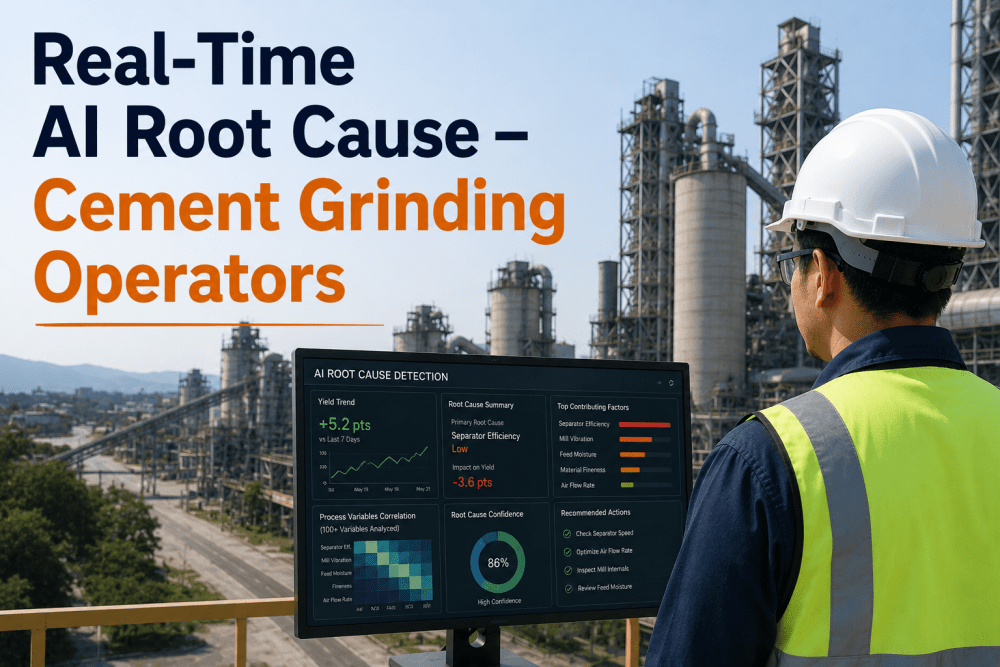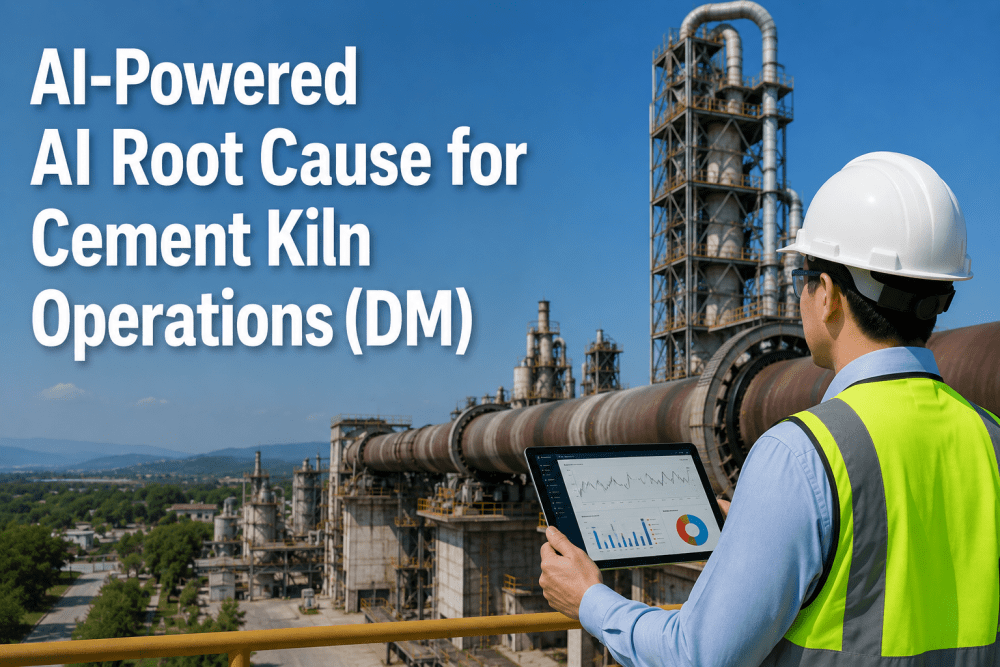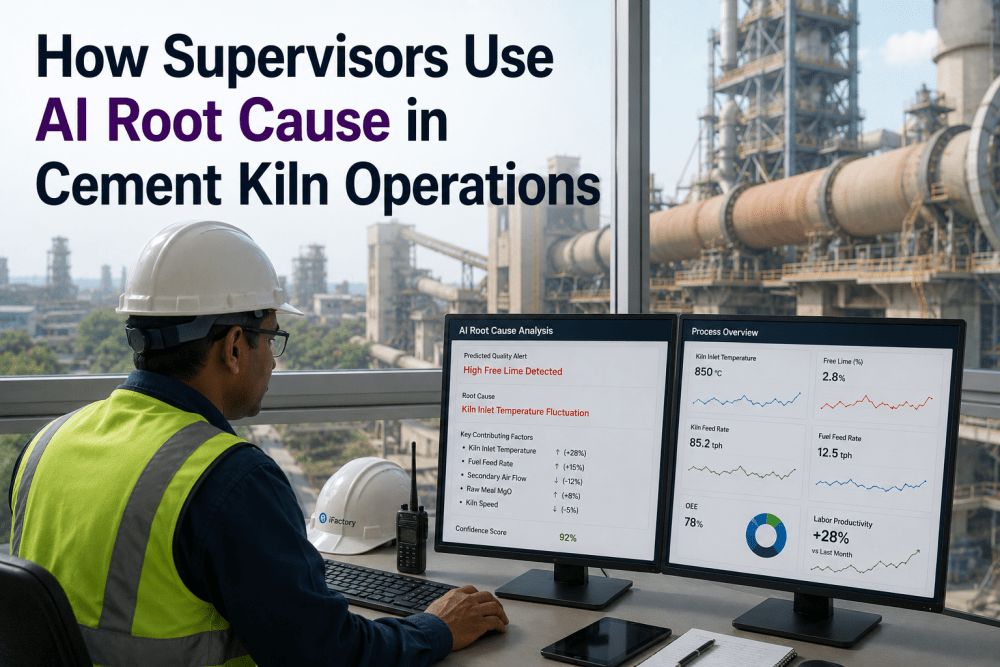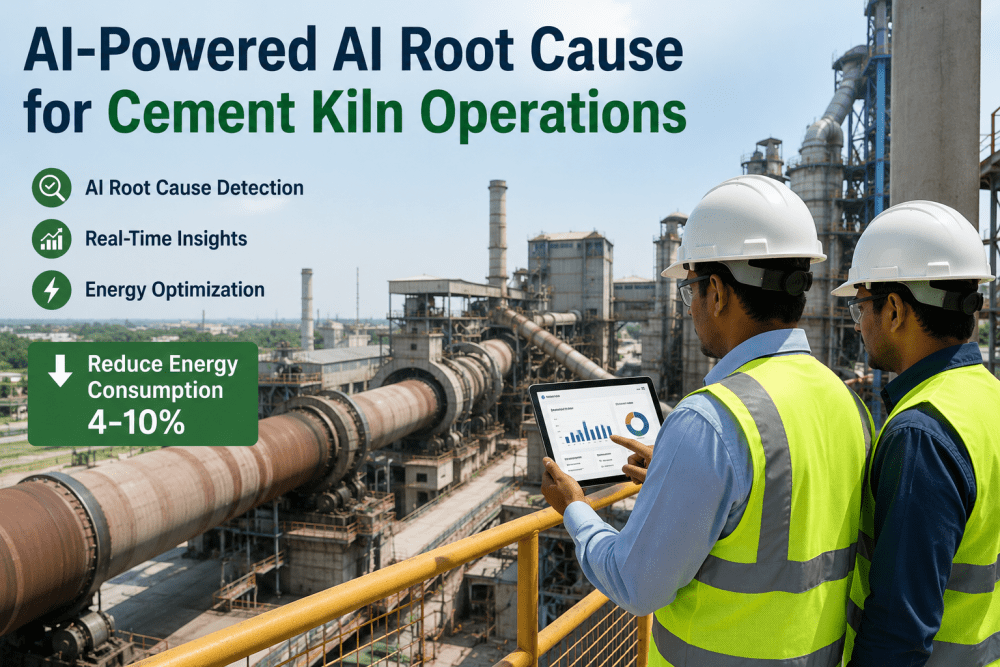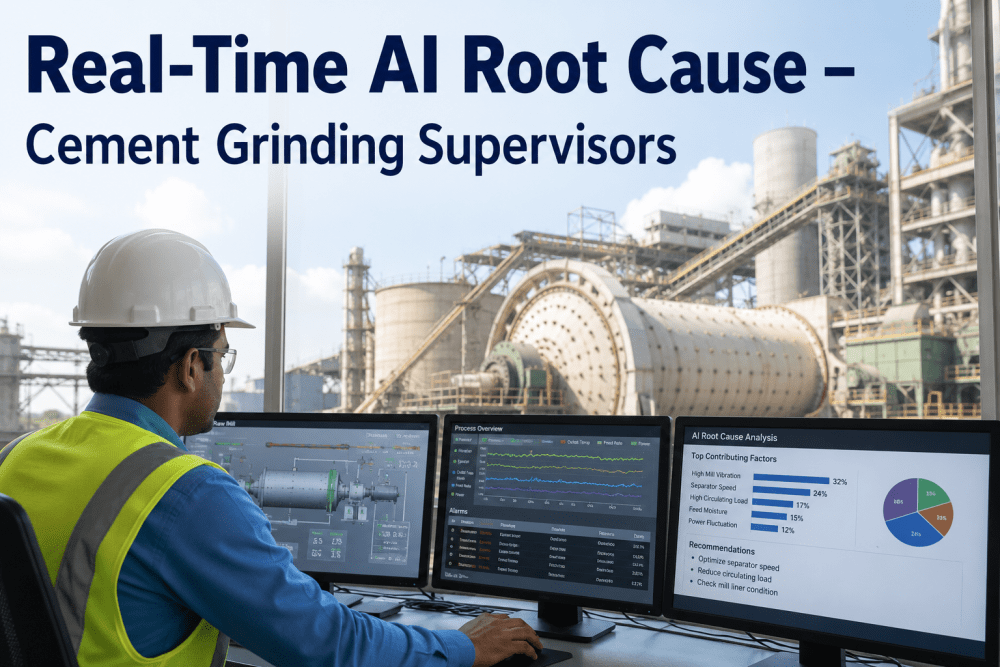
Every shift supervisor in cement grinding knows the frustration: the lab calls with an off-spec Blaine or fineness result, and you realize the last 90 minutes of production is heading to the reject silo. The root cause could be anything — a gypsum feed interruption, separator speed drift, a temperature excursion from the clinker cooler, or an interaction between three parameters that individually looked fine. Standard quality control gives you the alarm but not the answer. AI root cause detection changes this by analyzing 100+ process variables in real time, applying Western Electric rules to detect anomalous patterns, and using multivariate machine learning to pinpoint the exact variable combination driving the quality deviation. For supervisors managing finish grinding operations, this means shifting from reactive firefighting to precision process control — and delivering 15-25% throughput improvements by eliminating the scrap cycles and re-grinding that consume mill capacity. Organizations that schedule a shift-floor demo with iFactory are finding that AI root cause detection doesn't just identify problems faster — it uncovers optimization opportunities that traditional quality control could never see.
Lift Throughput 15-25% in Your Grinding Operation
iFactory's AI root cause detection platform applies Western Electric rules, multivariate ML, and adaptive UCL/LCL to cement grinding — purpose-built for shift supervisors managing mill performance and quality.
Why Standard Quality Control Misses the Root Cause in Cement Grinding
Cement grinding is a multivariable process where quality deviations rarely have a single cause. A shift in clinker grindability interacts with separator efficiency, grinding media wear, and ambient temperature to produce off-spec product — but standard SPC charts only tell you that you are outside control limits, not why. The traditional approach sends supervisors hunting through DCS trends, operator logbooks, and lab records to reconstruct what happened, and by the time the root cause is identified, the shift has ended and the problem has moved downstream. This diagnostic latency is the primary barrier to throughput improvement in finish grinding. iFactory's AI root cause detection eliminates it by correlating every quality event with the preceding 60 minutes of operating data across all mill parameters, identifying the specific root cause in seconds rather than hours. For plant teams looking to close this gap, booking a platform demo is the fastest path to understanding how this technology fits your operation.
Lab Sampling Lag
The Problem: Laboratory samplers collect material every 30-60 minutes, and results take another 20-30 minutes for Blaine and PSD analysis. By the time a deviation is confirmed, 100-200 tons of off-spec cement may already be in the silo, requiring blending or reprocessing that consumes mill capacity.
Single-Variable SPC
The Problem: Traditional SPC monitors each variable independently. But cement grinding quality emerges from interactions — mill power draw, separator speed, and feed composition interact in ways that no single-variable chart can detect, causing supervisors to miss developing quality issues until they compound into scrap events.
Reactive RCA Process
The Problem: Root cause analysis in most cement plants is a manual post-mortem conducted hours or days after the scrap event. Shift supervisors document what they observed, engineers review DCS trends, and the analysis takes 2-4 hours per event — time that could be spent preventing the next deviation.
iFactory AI Solution
The Fix: iFactory's AI root cause detection monitors 100+ process variables in real time, applies Western Electric rules for early pattern detection, and uses multivariate ML to identify the specific variable combination causing each quality deviation — delivering root cause in seconds, not hours.
"We were producing world-class clinker but our grinding department was struggling with consistency. The lab would call up and say Blaine was dropping, and my supervisors would spend the next two hours reviewing pen charts and DCS trends trying to figure out why. With iFactory's AI root cause detection, the platform identifies the root cause before the lab even finishes the analysis. In the first month, we found a recirculation load imbalance that had been causing fineness variability for three years — something no one had ever connected because it only caused problems when separator wear reached a certain level. My supervisors now spend their time preventing problems instead of investigating them."
Western Electric Rules, ML Root Cause, and Adaptive UCL/LCL — The Three-Layer Detection Stack
AI root cause detection in cement grinding operates on three complementary layers that catch quality deviations at different stages of development. Layer one applies Western Electric rules to detect anomalous sensor patterns — runs, trends, and cycles — within individual process variables before they cross specification limits. Layer two uses multivariate machine learning to correlate deviations across parameters, identifying interaction effects that single-variable rules would miss. Layer three introduces adaptive UCL/LCL that automatically adjusts control limits based on real-time operating conditions rather than fixed historical baselines. Supervisors who schedule a technical review consistently cite the adaptive limit layer as the feature that eliminates the most false alarms while catching the quality events that matter.
| Detection Layer | Method | What It Detects | Lead Time | iFactory Advantage |
|---|---|---|---|---|
| Layer 1 — Pattern Rules | Western Electric Rules | Runs of 7+ points above/below mean, trends of 6+ consecutive points, cycles, and zone violations within individual sensor streams | 15-30 min before limit breach | Automated rule engine with configurable sensitivity per variable |
| Layer 2 — Correlation ML | Multivariate Regression + Random Forest | Interaction effects between 2+ variables — e.g., separator speed drift only causes quality issues when clinker temperature is elevated | 30-60 min before scrap event | Trained on 12+ months of plant-specific historical data |
| Layer 3 — Adaptive Limits | Dynamic UCL/LCL Calculation | Control limits that adjust in real time based on feed composition changes, ambient conditions, and equipment wear state | Continuous | 70% fewer false alarms vs static SPC limits |
| Root Cause Output | Causal AI Engine | Ranked list of causal variables with probability scores, showing exactly which parameter drift or combination caused each quality event | Seconds post-event | Root cause identified in under 5 seconds for 100+ variable models |
How AI Root Cause Detection Delivers 15-25% Throughput Improvement
The connection between root cause detection speed and throughput is often underestimated. Every hour a supervisor spends investigating a quality deviation is an hour they are not optimizing mill performance. Every ton of off-spec cement that requires blending or reprocessing consumes mill capacity that could have been used to produce saleable product. Eliminating scrap cycles through faster root cause identification directly recovers mill capacity. iFactory's platform delivers this by automating the investigation step — supervisors receive root cause analysis alongside the quality alarm, eliminating the 1-3 hour diagnostic phase that follows every deviation in traditional operations. The compounding effect of faster root cause detection, reduced reprocessing cycles, and sustained optimal mill operation produces the 15-25% throughput improvement documented across commercial deployments. Plant stakeholders see the full impact when they book a live demonstration with their own mill data.
Phased Deployment: From Reactive Quality to Predictive Process Control
Deploying AI root cause detection in a cement grinding operation follows a structured progression that builds data infrastructure, model accuracy, and workforce confidence in sequence. iFactory's implementation methodology has been refined across 14 grinding lines at 7 cement plants, and the typical timeline from kickoff to full AI-assisted root cause analysis is 8-10 weeks. If your plant is unsure where to start, booking a strategic audit can identify the highest-value deployment path for your specific mill configuration and quality challenge profile.
Data Foundation & Sensor Connectivity
Integrate mill DCS tags, laboratory quality results, and operator log data into a unified data lake. Establish 1-minute data ingestion for mill parameters and real-time laboratory connectivity. Validate data quality and completeness across 100+ variables. Timeline: 3-4 weeks.
Model Training & Root Cause Engine
Train Western Electric rule engine and multivariate ML models on 12+ months of historical data. Configure adaptive UCL/LCL parameters per mill and product type. Validate root cause accuracy against known historical quality events. Timeline: 3-4 weeks.
Dashboard Deployment & Supervisor Enablement
Deploy shift supervisor dashboards with real-time root cause alerts, Western Electric rule violation displays, adaptive control limit visualization, and shift performance reporting. Complete 4-hour hands-on supervisor training with simulated quality event scenarios. Timeline: 2-3 weeks.
AI Root Cause Detection for Cement Grinding — Frequently Asked Questions
How does AI root cause detection differ from standard SPC in cement grinding?
Standard SPC monitors each variable against fixed control limits and alerts when a single parameter exceeds its threshold. AI root cause detection monitors 100+ variables simultaneously, applies Western Electric rules for early pattern detection within individual streams, and uses multivariate ML to identify interaction effects between variables — delivering the root cause of the deviation, not just the alarm.
What mill parameters does the AI model use for root cause analysis?
The model ingests mill power draw, separator RPM and current, mill feed rate, recirculation load, mill inlet and outlet temperature, differential pressure, grinding aid dosage, gypsum and limestone feed rates, clinker temperature, and laboratory fineness and Blaine results — typically 100-120 variables depending on plant instrumentation.
How long does it take to deploy AI root cause detection on a finish grinding line?
Typical deployment from project kickoff to live root cause analysis is 8-10 weeks for a single grinding line. This includes DCS integration, historical data extraction, model training on 12+ months of data, dashboard configuration for shift supervisors, and hands-on operator training with simulated quality events.
What throughput improvement can cement plants expect after deployment?
Cement plants deploying AI root cause detection in finish grinding operations achieve 15-25% throughput improvement. The gain comes from eliminating scrap cycles, reducing reprocessing that consumes mill capacity, and keeping the mill operating at optimal parameters for longer periods between quality deviations.
Can iFactory's AI platform integrate with existing DCS and LIMS systems?
Yes. iFactory features bidirectional connectors for major DCS platforms including ABB 800xA, Siemens PCS 7, Emerson DeltaV, and Rockwell PlantPAx, as well as laboratory information management systems. Integration is read-only from OT systems with no write-back to process control layers in standard configuration.
Stop Investigating. Start Optimizing with iFactory AI Root Cause Detection.
iFactory's AI root cause detection platform delivers real-time quality deviation analysis, automated root cause identification in under 5 seconds, and 15-25% throughput improvement for cement grinding operations — purpose-built for shift supervisors managing finish mill performance.
From Reactive Investigation to AI-Powered Process Precision
The cement grinding operations that will lead the industry in throughput, quality consistency, and profitability over the next five years are those that have eliminated the diagnostic latency that defines traditional quality control. AI root cause detection does not replace the shift supervisor's expertise — it amplifies it by automating the investigation step that consumes 60-70% of a supervisor's quality-related decision time. Western Electric rules catch early pattern deviations before they become quality events. Multivariate ML identifies interaction effects that single-variable SPC cannot see. Adaptive UCL/LCL eliminates false alarms by adjusting control limits to real-time operating conditions. Together, these three layers deliver the 15-25% throughput improvement that cement plants are achieving with iFactory's platform today. The technology is proven, the deployment timeline is measured in weeks, and the ROI is visible from the first quality event prevented. The decision facing cement manufacturers is not whether to adopt AI root cause detection — it is when to capture the competitive advantage it delivers.