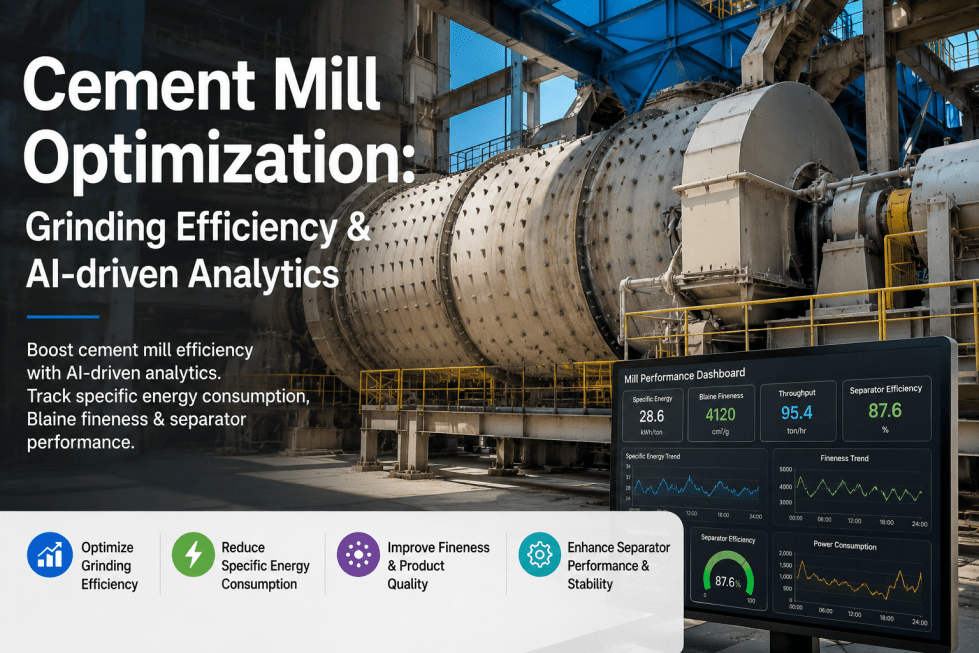
Every hour, your cement mill consumes 3,500 kWh of electricity. Physics guarantees that 95% of that energy converts to heat and noise — not particle size reduction. Only 5% does actual grinding work. That's not a design flaw — it's the fundamental thermodynamics of comminution. But within that 5% efficiency window, the difference between a well-optimized mill and a poorly-tuned one is staggering: 15-25% in specific energy consumption, $200,000-$800,000 in annual electricity costs, and the difference between cement that hits strength spec on every batch versus product that requires rework, re-grinding, or quality giveaway. A 1.2-million-ton-per-year cement plant in Rajasthan was grinding at 38.4 kWh/ton against a 32 kWh/ton benchmark — 20% above target. The operators knew the number was high. They didn't know why. Was it the grinding media? The classifier? Feed moisture? Clinker hardness? All four were interacting simultaneously, and no human operator could untangle the relationships by watching SCADA trends. When AI optimization was deployed, the system identified that classifier recirculation was 42% — caused by worn rotor blades — while simultaneously detecting that compartment 2 media charge had dropped to 24% (optimal: 30%). Two maintenance actions costing $14,000 total dropped SEC to 31.8 kWh/ton. Annual savings: $720,000 in electricity alone. Same mill. Same clinker. Same operators. Different intelligence.
AI-Powered Grinding Intelligence
95% of Your Grinding Energy Is Wasted.
AI Optimizes the 5% That Matters.
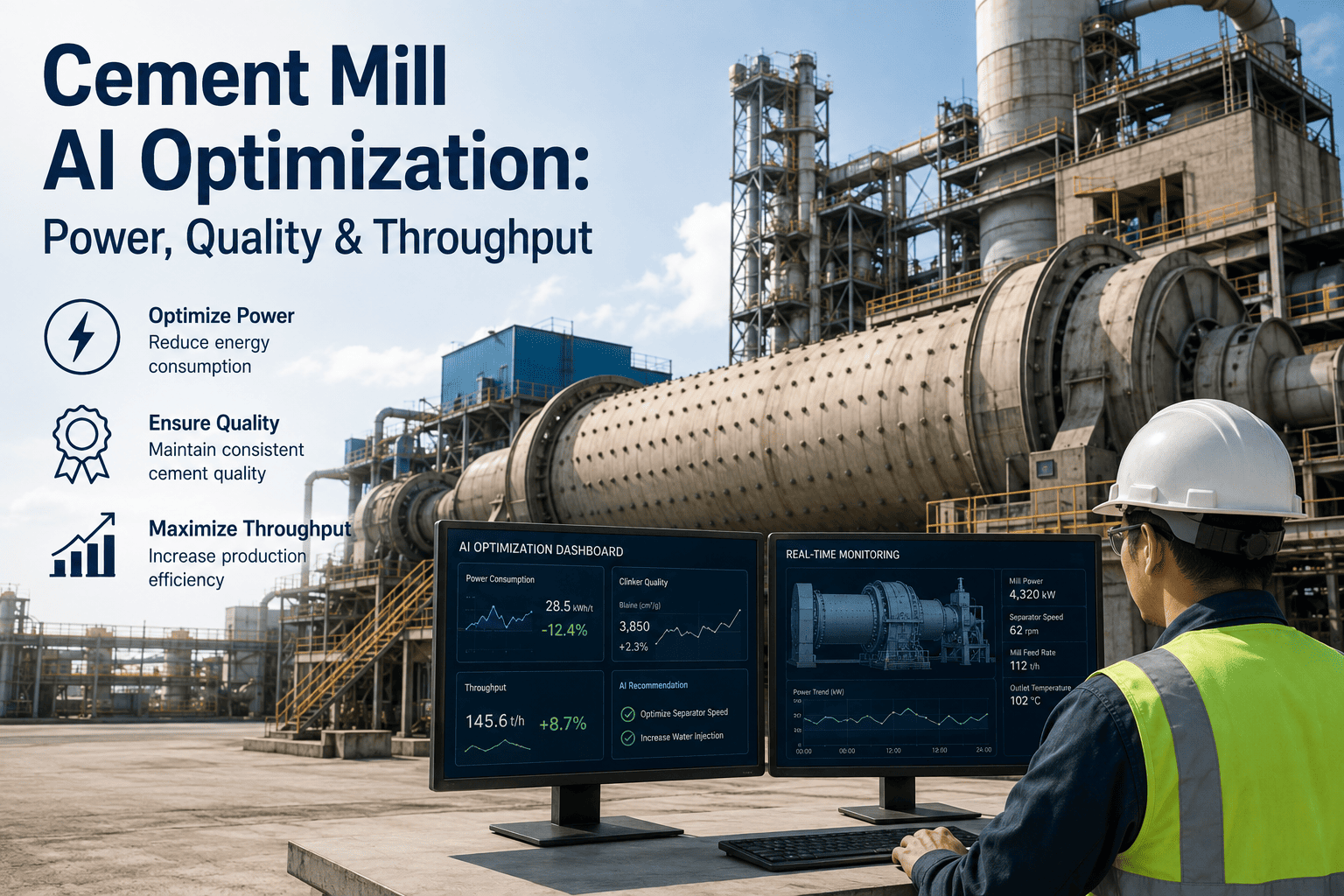
Grinding circuits consume 65-70% of a cement plant's total electricity — more than kilns, coolers, and auxiliaries combined. Over-grinding alone wastes up to 30% of milling electricity without improving product quality. AI optimization recovers 5-20% of specific energy consumption by continuously tuning the dozens of interacting variables that no human operator can manage simultaneously.
65-70%
Of plant electricity consumed by grinding
5-20%
SEC reduction achievable with AI optimization
$500K-$800K
Annual savings for a typical mid-size plant
R² >0.97
AI prediction accuracy for mill energy models
Sources: Scientific Reports 2025 · IEEE Access 2024 · ENERGY STAR · OxMaint Cement Analytics
Inside Your Grinding Circuit: Where Every kWh Goes
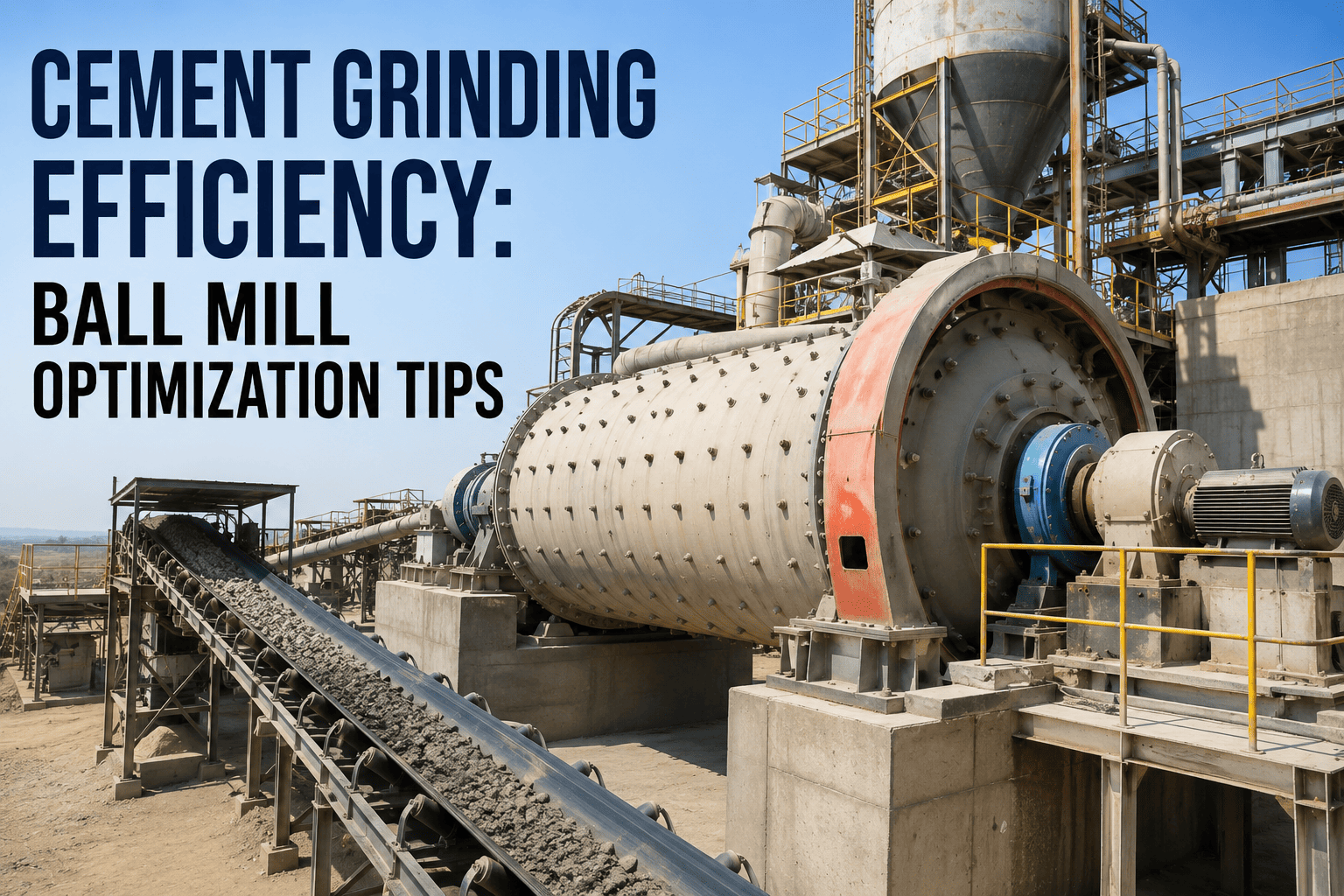
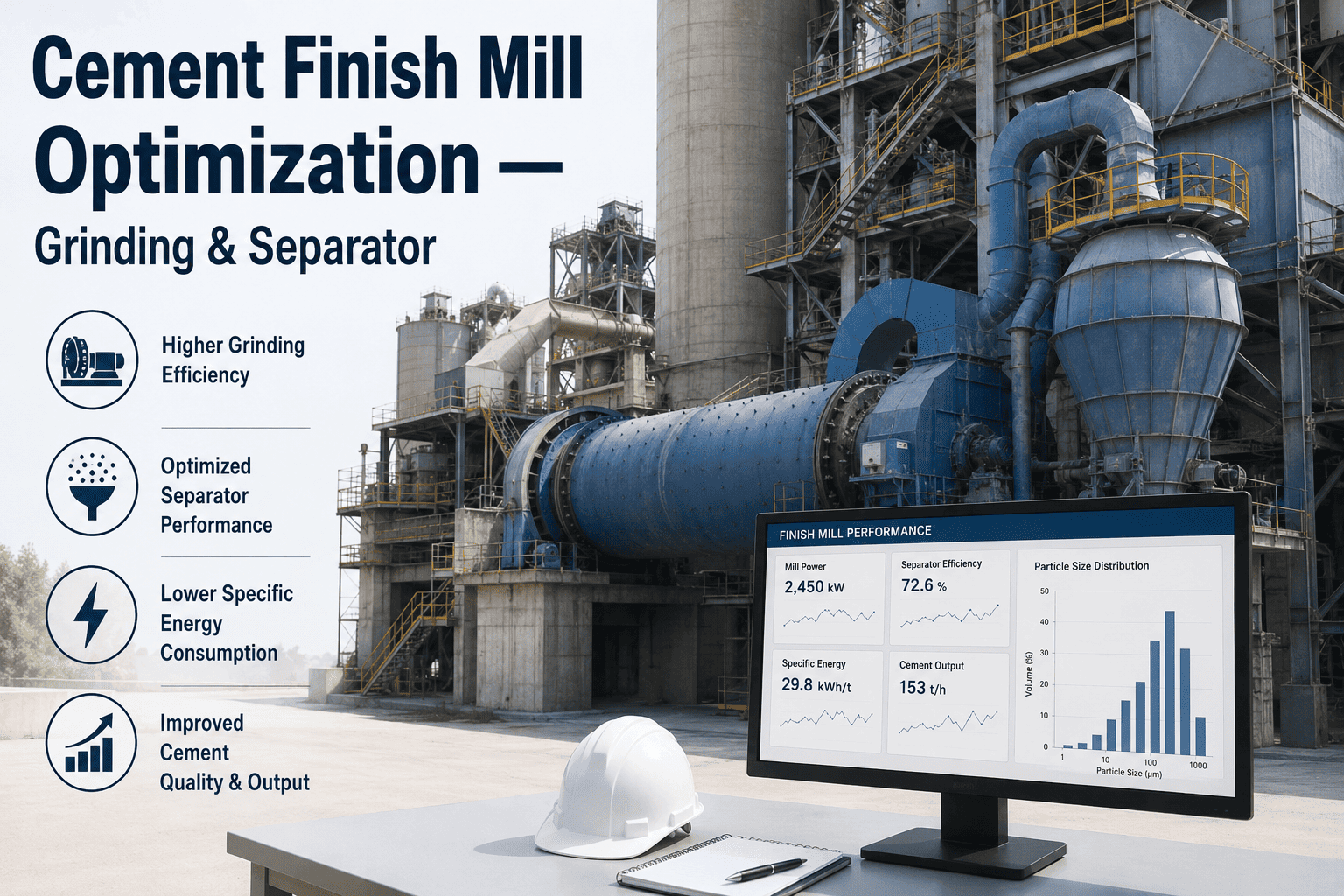
Understanding where energy is consumed — and wasted — inside the grinding circuit is the first step toward optimization. A cement finish mill doesn't just grind clinker. It's a complex system of feed, grinding, classification, ventilation, and discharge — each stage interacting with every other stage, every second of operation.
Energy Distribution in a Typical Cement Grinding Circuit
Mill Main Drive
24-28 kWh/t
Over-grinding wastes up to 30% of this energy
Separator / Classifier
4-5 kWh/t
Low classifier efficiency forces excess recirculation
Mill Fan / Ventilation
3-4 kWh/t
Blocked diaphragms increase pressure drop and fan load
Elevators & Transport
2-3 kWh/t
High recirculating load multiplies transport energy
Auxiliaries
1-2 kWh/t
Water injection, oil pumps, instrumentation
Total Specific Power (Ball Mill Circuit)
34-42 kWh/ton
vs. VRM benchmark of 22-28 kWh/ton — AI closes the gap without replacing your mill
The 6 Variables AI Optimizes Simultaneously
Here's why human operators can't optimize grinding manually: these six variables interact non-linearly. Changing one affects all the others. An operator can adjust feed rate — but can't simultaneously calculate the cascading effect on mill load, classifier efficiency, ventilation pressure, product fineness, and energy consumption. AI does this every 30 seconds.
01
Feed Rate & Mill Loading
AI maintains optimal mill charge between 28-32% of mill volume by dynamically adjusting feed rate based on elevator current, mill sound, and power draw. A 5% deviation from optimal charge wastes 3-7% in specific energy.
3-7 kWh/ton recovery potential
02
Separator Speed & Cut Size
Controls the boundary between "finished product" and "return to mill." AI adjusts separator speed to maintain target Blaine fineness while minimizing recirculating load — reducing load from 250% to under 180% saves 6-10 kWh/ton.
6-10 kWh/ton recovery potential
03
Mill Ventilation & Sweeping
Proper air velocity sweeps fine particles out of the grinding zone before they cushion ball impacts. AI optimizes fan damper position and monitors pressure drop across diaphragms — recovering 2-4% energy efficiency from ventilation alone.
1-3 kWh/ton recovery potential
04
Water Injection Rate
Controls mill temperature and prevents gypsum dehydration that causes false set. Too much water reduces grinding efficiency. Too little causes over-temperature. AI targets the exact injection rate that balances temperature and efficiency.
1-2 kWh/ton recovery potential
05
Grinding Aid Dosage
Chemical grinding aids at 0.01-0.1% dosage neutralize electrostatic charges on fresh surfaces, preventing agglomeration. Published trials show 10-15% production increase and 5-10% SEC reduction from optimized dosing alone.
2-4 kWh/ton recovery potential
06
Clinker Blend & Additive Ratio
Clinker hardness varies batch-to-batch. AI adjusts the clinker-gypsum-additive blend in real time based on incoming clinker grindability, maintaining target strength with minimum clinker factor — each 1% reduction saves 1% thermal energy upstream.
Indirect: $150K-$400K/yr in clinker savings
Your Mill Has 15-25% Wasted Energy Hiding Inside It Right Now
iFactory connects to your existing mill DCS and optimizes all six grinding variables simultaneously — every 30 seconds, 24/7. No new grinding equipment. No capital expenditure. Just smarter operation of the mill you already have.
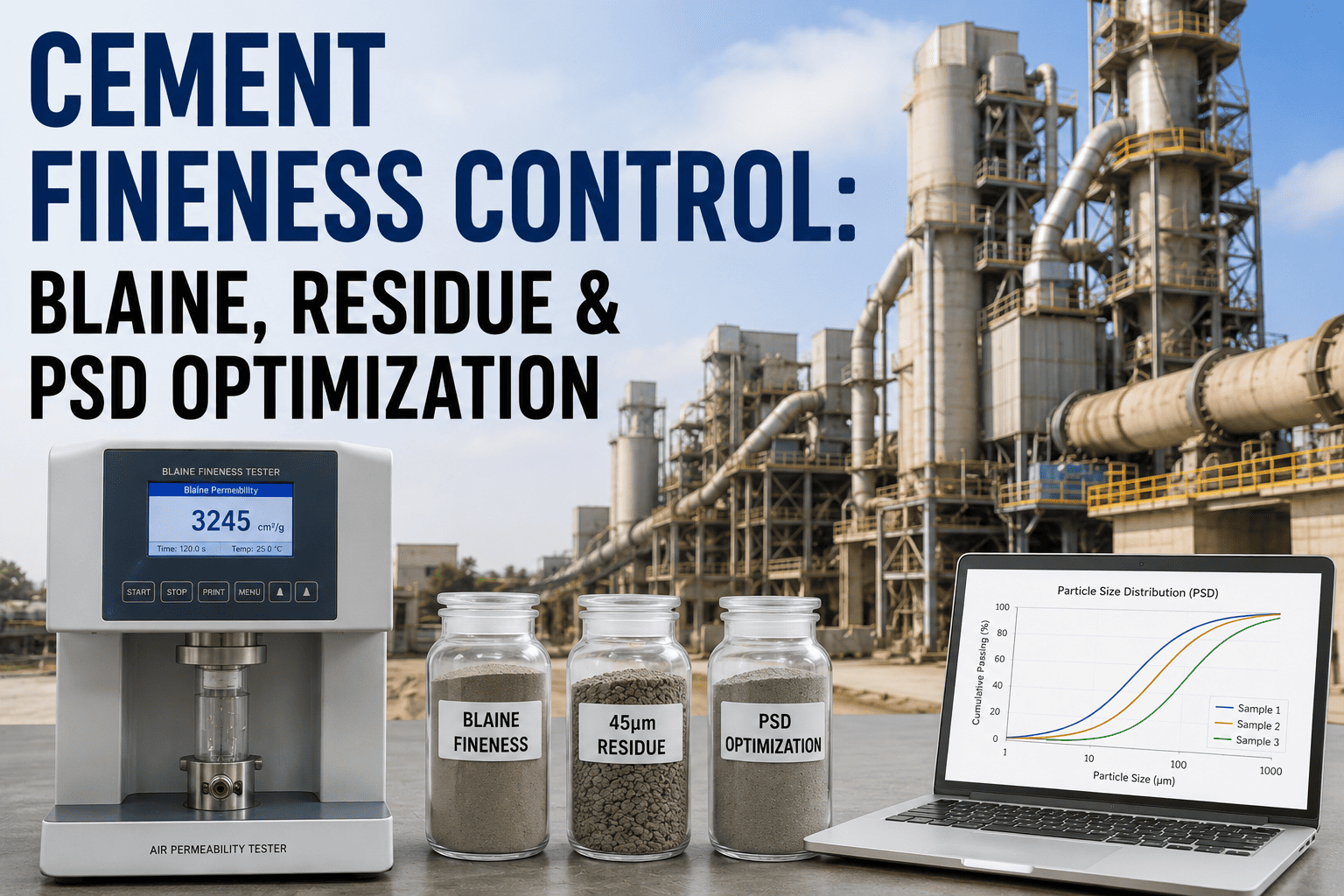
AI Quality Control: From Over-Grinding to Precision Grinding
The biggest hidden cost in cement grinding isn't under-grinding — it's over-grinding. When operators can't predict fineness accurately, they grind conservatively, targeting above specification to ensure every batch passes. That "safety margin" wastes enormous energy because grinding energy increases exponentially with fineness — grinding 10% finer costs 20-30% more energy.
Operators can't predict fineness
Target set 5-10% above spec
20-30% excess energy consumed
$200K-$600K/yr wasted on "quality insurance"
Predictive Fineness Modeling
AI predicts Blaine fineness and particle size distribution 15 minutes ahead of lab confirmation — using real-time mill power, elevator current, separator speed, and feed characteristics. Operators see where quality is heading, not where it was.
Strength Prediction from 1-Day Results
AI regression models predict 28-day compressive strength from 1-day test results with 95%+ accuracy. Quality deviations are caught 27 days earlier — enabling corrective action before off-spec cement reaches customers.
Zero Quality Giveaway
When AI maintains tight control, the strength distribution narrows. Target fineness moves closer to specification minimum — grinding exactly to spec, never above it. Every percentage point of eliminated giveaway converts directly to energy savings and margin improvement.
The ROI of AI Grinding Optimization
Electricity Savings
$500K-$800K/yr
5-20% reduction in grinding SEC for a plant producing 800K tons/year at 35 kWh/ton and $0.10/kWh. Ball mill optimization alone recovers 15-25% of wasted energy without capital expenditure.
Throughput Increase
10-15%
Optimized mill loading, reduced recirculation, and condition-based separator tuning increase tons-per-hour at the same energy input. More production from the same asset — without adding a second mill.
Quality Consistency
60% tighter
Blaine fineness standard deviation drops by 60% with AI control. Fewer off-spec batches, zero customer quality claims, and elimination of energy-wasting re-grinding cycles.
Grinding Media Life
+15-20%
Optimized loading prevents under-charge impact damage and over-charge friction wear. AI tracks media degradation via power draw signatures and schedules top-ups at the optimal moment — not too early, not too late.
Quality Giveaway Elimination
$150K-$400K/yr
Grinding to exact spec instead of 5-10% above it eliminates energy and clinker waste. Each 1% reduction in clinker factor saves 1% thermal energy — a double benefit that compounds across production volume.
System Payback
3-6 Months
Combined value of SEC reduction, throughput gain, quality improvement, and media life extension delivers full platform ROI in the first quarter. Quick wins from classifier and media optimization surface within 30 days.
Why iFactory for Cement Grinding Optimization
01
Ball Mill and VRM — Both Optimized
iFactory's AI models are trained on both ball mill and vertical roller mill grinding circuits. Ball mill optimization focuses on charge level, classifier efficiency, and ventilation. VRM optimization targets grinding pressure, table speed, dam ring height, and gas flow. Same platform, different physics — tuned to your specific mill technology.
02
Reads Your Mill DCS — Never Writes to It
iFactory integrates with your existing DCS via OPC-UA and delivers optimization recommendations to your operators. The AI advises; your operators decide. No automatic setpoint changes. No control system modifications. Your mill control remains 100% under human authority — the AI simply makes your operators smarter.
03
Connects Grinding to Quality to Maintenance
When SEC drifts, iFactory doesn't just alert — it correlates with classifier efficiency trends, media wear indices, diaphragm pressure drop, and liner condition estimates. It tells you whether the problem is operational (adjust now), maintenance (schedule repair), or equipment (plan capex). Root cause in seconds, not investigations lasting days.
04
Multi-Mill Fleet Benchmarking
Operating multiple mills or multiple plants? iFactory normalizes SEC across your grinding fleet — comparing kWh/ton at equivalent fineness targets, feed grindability, and ambient conditions. Identify which mill has the most recovery headroom. Replicate the best mill's settings across the fleet with AI-validated evidence.
Every Rotation of Your Mill Is Either Making Money or Wasting It
iFactory transforms your cement grinding circuit from a blunt-force energy consumer into a precision-optimized production machine. Optimize every variable, hit every quality target, and recover the 15-25% of energy your mill is wasting right now.
Frequently Asked Questions
How much energy can AI realistically save on our cement mill?
Documented implementations show 5-20% SEC reduction depending on your baseline efficiency and mill technology. Ball mills with no prior optimization typically see the highest savings (15-25% of wasted energy recovered). VRMs already operating near design efficiency see 5-10% improvement. For a plant grinding 800,000 tons annually at 35 kWh/ton and $0.10/kWh, a 20% improvement saves $560,000 per year. Research in Scientific Reports and IEEE Access confirms AI model prediction accuracy above R² = 0.97 for cement mill energy optimization.
Does AI optimization affect our cement quality?
AI improves quality, not just energy. By predicting Blaine fineness 15 minutes ahead and maintaining tighter particle size distribution, AI reduces fineness variability by up to 60%. The result: more consistent product, fewer off-spec batches, elimination of quality giveaway, and the ability to grind closer to specification minimum without risk — saving both energy and clinker.
Will AI optimization work on our older ball mill?
Yes — and older mills often benefit the most. Ball mills with first-generation classifiers, worn media, and manual ventilation control typically have the largest gap between current SEC and achievable SEC. AI optimization recovers a significant portion of that gap through operational tuning alone. A classifier upgrade (recommended if efficiency is below 55%) combined with AI optimization can close 60-80% of the gap to VRM-level efficiency at a fraction of VRM capital cost.
How quickly do we see results?
Quick wins typically appear within 30 days: classifier speed optimization, feed rate stabilization, and ventilation adjustments that require no capital investment. Full optimization — including maintenance-driven improvements like media top-up, diaphragm cleaning, and liner assessment — delivers peak SEC reduction within 60-90 days. The AI model continues improving beyond that as it learns seasonal clinker hardness variations and long-term equipment degradation patterns.
Can AI optimize grinding aid dosage too?
Yes. iFactory monitors the relationship between grinding aid dosage rate, mill throughput, SEC, and product quality in real time. Published data shows that optimized grinding aid dosage delivers 10-15% production increase and 5-10% SEC reduction. AI finds the exact dosage that maximizes the energy-throughput benefit — adjusting dynamically as clinker properties change batch-to-batch, rather than running at a fixed dosage rate.