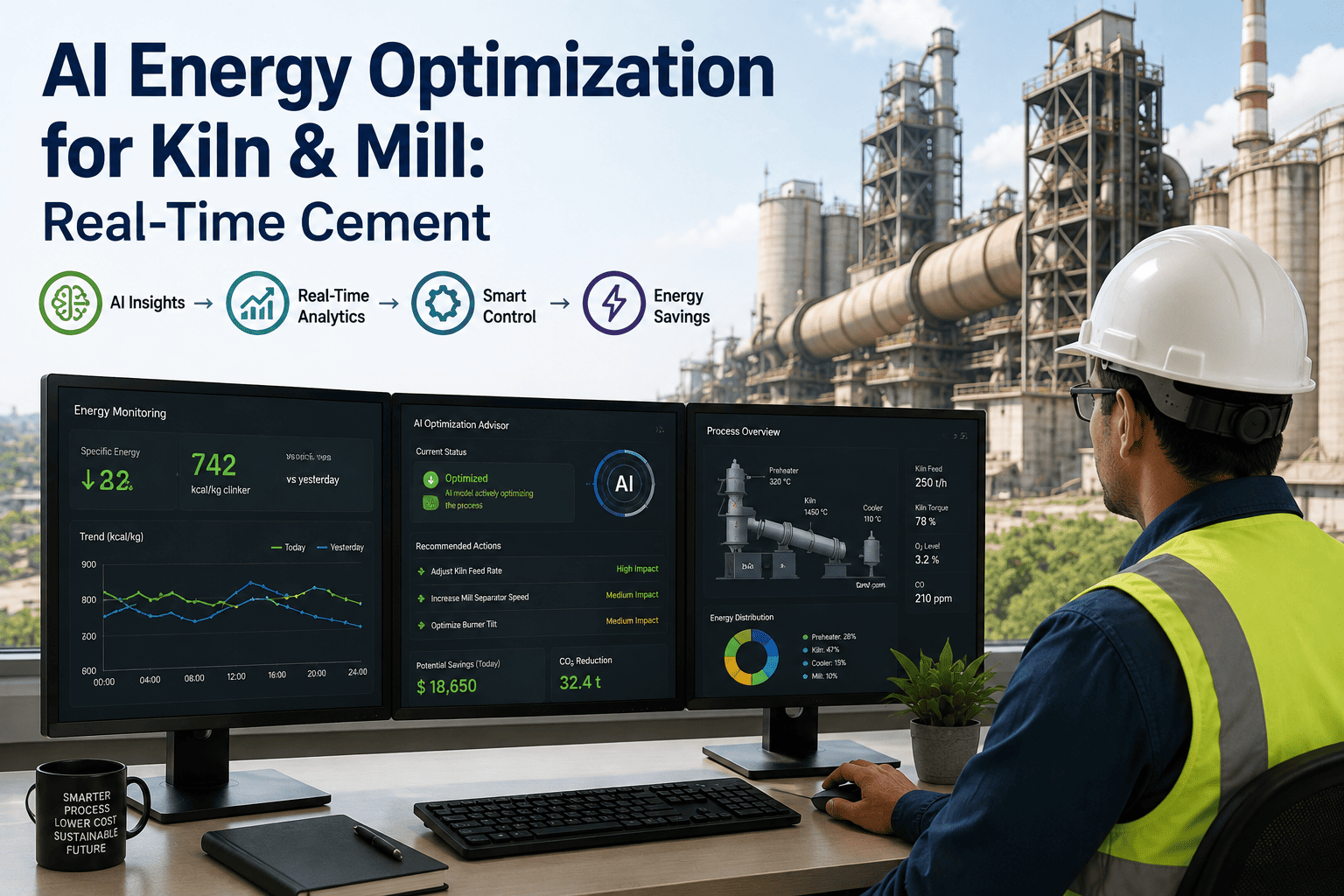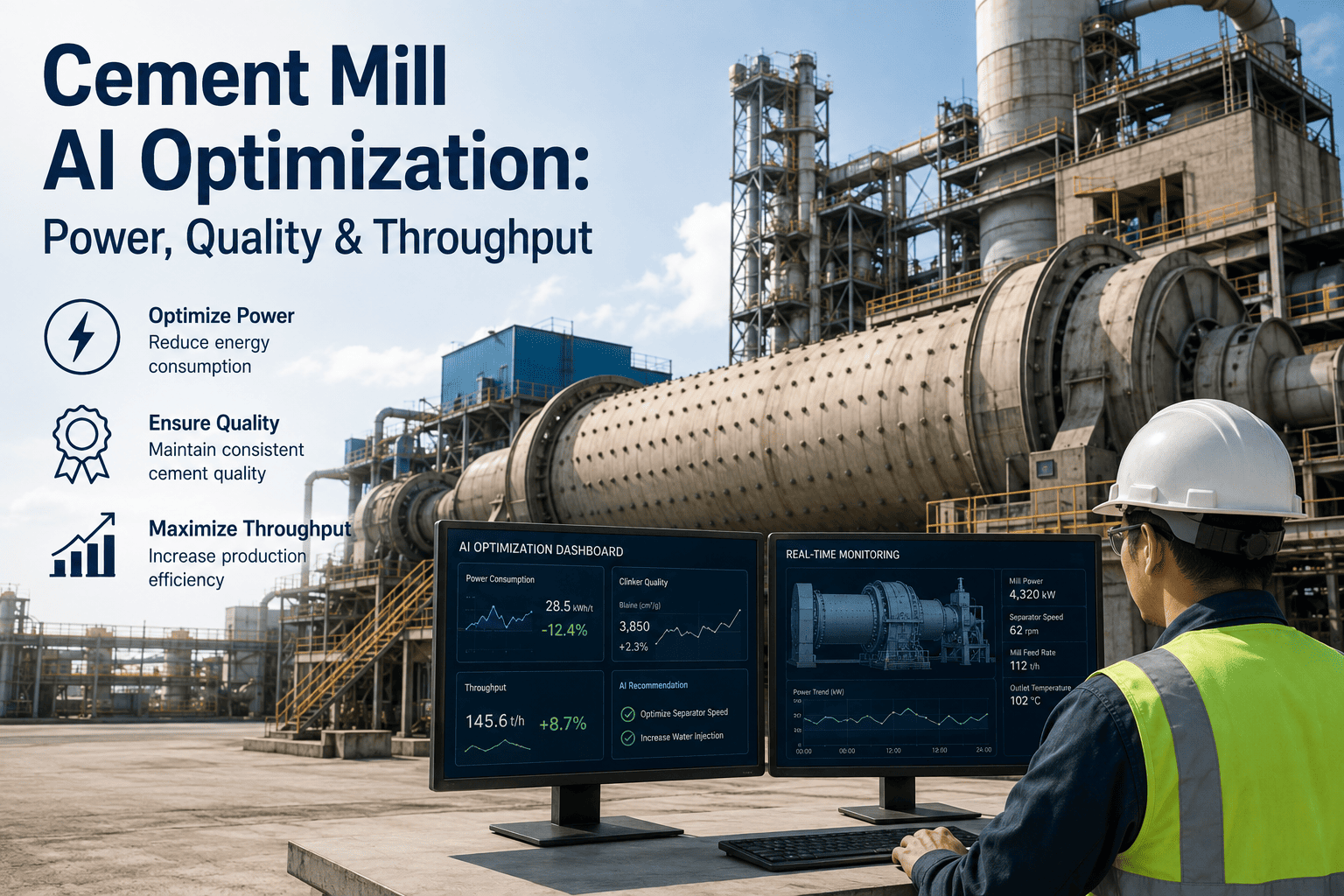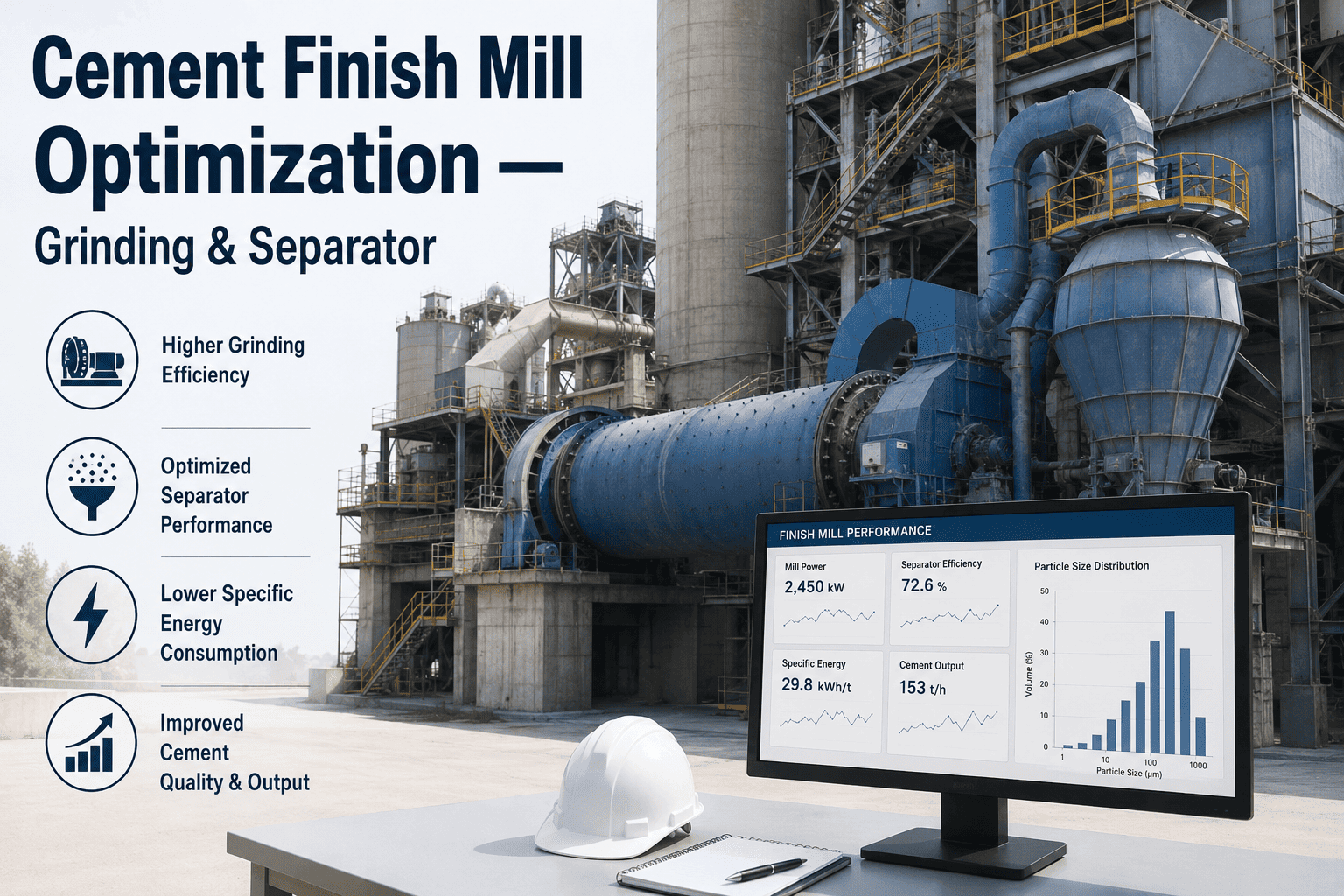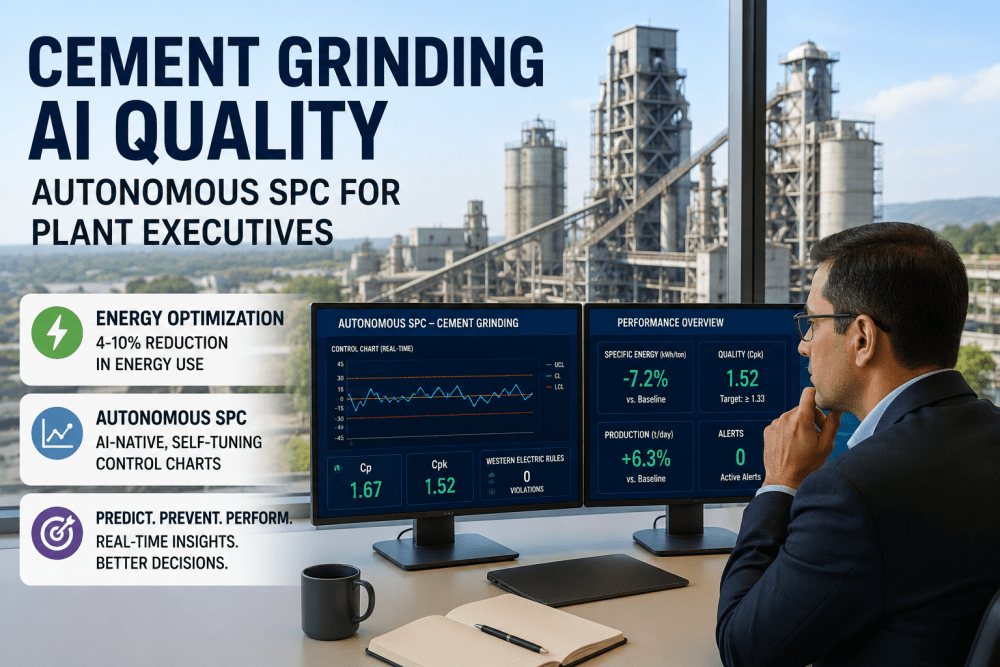
Cement grinding is the most energy-intensive process stage in any cement plant — consuming 60 to 70 percent of the electrical energy required to produce a finished tonne of cement — and it is the stage where quality control decisions directly determine energy efficiency. Every off-specification particle that requires re-grinding, every fineness excursion that extends mill operation beyond the target production rate, and every quality hold that delays dispatch represents energy consumed without corresponding revenue. Autonomous Statistical Process Control — self-tuning SPC that continuously applies Western Electric rules, calculates Cpk/Cp/Pp/Ppk in real time and adjusts control limits without human intervention — transforms the relationship between quality control and energy consumption in cement grinding. By maintaining tighter process control with fewer excursions and eliminating the quality team latency that allows off-spec material to accumulate before corrective action is taken, autonomous SPC reduces specific energy consumption by 4 to 10 percent while simultaneously improving quality consistency. Plant executives who calculate their COPQ reduction ROI are finding that the energy savings alone from autonomous SPC deployment deliver payback periods measured in months, with the quality improvement and labor productivity gains as compounding benefits.
Your Quality Control System Is Costing You Energy — and You Cannot See Where.
iFactory's autonomous SPC platform runs Western Electric rules, Cpk/Cp/Pp/Ppk calculations, and self-tuning control limits continuously — reducing specific energy consumption by 4-10% in cement grinding operations while improving quality consistency and eliminating manual SPC management.
The Energy-Quality Connection in Cement Grinding
The relationship between quality control and energy consumption in cement grinding is direct and measurable: every quality excursion that produces material outside the target fineness window requires additional grinding energy to correct, every production stop for quality investigation consumes mill runtime without production, and every re-blend event for off-spec material consumes silo capacity and logistics energy that efficient quality control would have avoided. The cost of poor quality in cement grinding is not limited to rework and scrap — it extends through the energy consumed to produce material that cannot be shipped as finished product. Plant executives evaluating autonomous SPC deployments calculate their COPQ reduction ROI to discover that the energy component of poor quality cost is consistently the largest and least visible element.
How Autonomous SPC Drives Energy Efficiency in Cement Grinding
Autonomous SPC differs from traditional SPC in four fundamental ways that directly impact energy consumption. First, it applies Western Electric rules continuously rather than during periodic chart reviews — detecting fineness drift, residue shifts, and blaine excursions at the moment they begin rather than hours later when the control chart is reviewed. Second, it calculates Cpk, Cp, Pp, and Ppk in real time from the actual process data stream, providing continuous visibility into process capability rather than periodic snapshots that may not represent current conditions. Third, its control limits are self-tuning — adjusting for recipe changes, clinker grindability variation, and seasonal effects without requiring quality team intervention. Fourth, it generates quality alerts only when a statistically significant deviation occurs, eliminating the false alarm investigation cycles that consume quality team time and delay response to genuine excursions. Plant managers calculate their COPQ reduction ROI and find that autonomous SPC's continuous application of Western Electric rules is the single largest driver of energy savings.
| Capability | Traditional SPC | Autonomous SPC (iFactory) | Energy Impact |
|---|---|---|---|
| Rule Application | Western Electric rules applied manually during periodic chart reviews — typically once per shift or daily | All Western Electric rules applied continuously to every measurement in real time — no latency between measurement and rule evaluation | Excursions detected 4-12 hours earlier, reducing off-spec tonne-hours by 60-80% per excursion event |
| Control Limit Adjustment | Limits recalculated manually when process change is identified — days to weeks delay for implementation | Limits self-tune continuously based on actual process conditions, recipe parameters, and material variation inputs | Eliminates the period of invalid control limits following recipe or material changes, reducing off-spec production during transition |
| Capability Index Reporting | Cpk/Cp/Pp/Ppk calculated periodically from aggregated data — snapshot view that may not reflect current capability | Real-time Cpk/Cp/Pp/Ppk calculated continuously from live process data stream with trend visualization | Enables immediate corrective action when capability degrades, preventing prolonged operation at reduced energy efficiency |
| Alert Management | High false alarm rate from static limits applied to dynamic process — quality team desensitization and delayed response | Low false alarm rate from adaptive limits — every alert represents a statistically significant deviation requiring response | Quality team responds faster to genuine excursions, reducing the duration of off-spec operation and associated energy waste |
Cost of Poor Quality and Energy Waste — Quantified
The cost of poor quality in cement grinding is typically measured in terms of rework, customer claims, and quality team labor — but the largest component, energy waste, is rarely quantified because it is distributed across multiple operating cost categories and attributed to production rather than quality. Autonomous SPC makes the energy-quality connection visible by tracking specific energy consumption per quality state — measuring the energy consumed during normal operation, during quality excursions, and during rework cycles as distinct metrics. This granular visibility enables plant executives to quantify the energy component of COPQ with the same precision as rework and scrap costs. For plant executives ready to baseline their own operation, calculate your COPQ reduction ROI with iFactory's COPQ assessment tool.
Energy consumed during quality excursions — material produced outside target fineness that requires additional grinding, separation, and re-circulation. Typically 3-7% of total grinding energy in operations with manual SPC review cycles.
Energy consumed during recipe and material transitions when static SPC limits are invalid — producing off-spec material until limits are manually recalculated and implemented. Typically 2-5% of total grinding energy.
Energy consumed in re-handling, re-blending, and re-sampling material placed on quality hold — including silo transfer energy, laboratory re-testing energy, and the opportunity cost of occupied silo capacity. Typically 1-3% of total grinding energy.
Energy consumed when the process is operated at a higher fineness than required to maintain a safety margin against the lower specification limit — a common practice when static limits produce excessive false alarms near the boundary.
Energy consumed during quality hold investigations — mill runtime without production while quality teams review data, collect additional samples, and determine disposition. A direct energy cost of quality team latency that autonomous SPC minimizes.
Energy consumed in producing replacement material for customer claims, including the full grinding energy for replacement tonnes plus the logistics energy for claim management. Avoidable through consistent autonomous quality control.
Measured Energy Impact of Autonomous SPC — Cement Grinding Deployments
Specific energy consumption reduction measured across cement grinding circuits deploying autonomous SPC with Western Electric rules and self-tuning control limits.
Annual energy cost savings per grinding circuit at $0.08/kWh from autonomous SPC-driven SEC reduction, varying with production volume and local energy rates.
Typical payback period for autonomous SPC deployment when energy savings alone are considered — quality improvement and labor productivity savings are additive.
Reduction in quality excursions exceeding specification limits through continuous Western Electric rule application and real-time capability index monitoring.
Our finish grinding circuit was producing well within specification — our Cpk looked fine on the monthly reports. But when we deployed autonomous SPC and started tracking specific energy consumption by quality state, we discovered that we were operating 6 percent above our minimum achievable SEC because our static SPC system was allowing fineness excursions to persist for 4 to 6 hours before they were detected during the shift quality review. The energy wasted during those excursions was $280,000 per year for a single grinding circuit. Autonomous SPC eliminated those excursion delays. Our SEC dropped 5.8 percent in the first 90 days, our Cpk improved from 1.15 to 1.42, and the quality team's time shifted from chart review to process improvement. The platform paid for itself in energy savings alone in under five months.
Deploying Autonomous SPC in Cement Grinding Operations
Autonomous SPC deployment follows a structured process designed to produce measurable energy savings within the first 30 days of live operation while building toward full autonomous quality control across all grinding circuits within 8 to 12 weeks. The deployment sequence prioritizes the highest-energy grinding circuit first, then expands to additional circuits based on demonstrated savings and team confidence in the autonomous system. Plant executives can calculate their COPQ reduction ROI during the initial assessment to establish the energy baseline and expected savings for their specific operation before deployment begins.
Energy Baseline and COPQ Assessment
Establish current specific energy consumption per grinding circuit, quantify current quality excursion frequency and duration, calculate the energy cost per excursion type, and determine the COPQ energy component. This baseline becomes the ROI reference for autonomous SPC deployment. Timeline: 1-2 weeks.
Autonomous SPC Model Configuration
Configure Western Electric rule parameters, self-tuning control limit algorithms, real-time Cpk/Cp/Pp/Ppk calculation engines, and alert threshold settings for each grinding circuit. The model is validated against 6-12 months of historical data to confirm rule application accuracy. Timeline: 2-3 weeks.
Dashboard Deployment and Team Training
Deploy the autonomous SPC dashboard on existing quality monitoring displays — showing real-time control charts, Western Electric rule violations, capability indices, and energy-quality correlation data. Plant managers and quality teams complete role-based training in 90 minutes. Timeline: 1 week.
Parallel Operation and Validation
Run autonomous SPC alongside the existing manual SPC system for 30 days — comparing rule violation detection timing, false alarm rates, and energy-quality correlation accuracy. The autonomous system's faster detection of excursions and lower false alarm rate is validated against actual mill outcomes. Timeline: 4 weeks.
Full Autonomous Operation and Continuous Optimization
Transition to full autonomous SPC operation with the manual system retired. Energy savings, quality improvement, and labor productivity gains are tracked continuously against the baseline. The autonomous model retrains on new data quarterly to maintain accuracy as process conditions evolve. Timeline: Ongoing.
Reduce Specific Energy Consumption 4-10% with Autonomous Quality Control
iFactory's autonomous SPC platform applies Western Electric rules continuously, calculates real-time Cpk/Cp/Pp/Ppk, and self-tunes control limits for every recipe and material condition — delivering measurable energy savings from month one in cement grinding operations.
Autonomous SPC for Cement Grinding — Common Questions for Plant Executives
How does autonomous SPC differ from the adaptive SPC approach for cement grinding?
Adaptive SPC adjusts control limits for changing process conditions. Autonomous SPC does that plus continuously applies Western Electric rules, calculates real-time Cpk/Cp/Pp/Ppk, and runs without any manual intervention or operator oversight for normal operation. Autonomous SPC is the next evolution of adaptive SPC — adding rule automation, capability index calculations, and full self-management of the quality control loop.
What is the expected specific energy consumption reduction from autonomous SPC deployment?
iFactory autonomous SPC deployments in cement grinding circuits have documented specific energy consumption reductions of 4 to 10 percent, with the variation depending on current SPC maturity, excursion frequency, and process stability. The energy savings come primarily from reduced excursion duration and frequency, elimination of transition-related off-spec production, and reduced over-grinding to maintain safety margins against static control limits.
Does autonomous SPC require additional sensors or instrumentation on the grinding circuit?
No. Autonomous SPC operates on data from sensors already installed in the grinding circuit — mill power, feed rate, separator speed, blaine analyzer, and laboratory quality measurements. The iFactory platform connects to your existing process historian and quality database. No additional sensor capital expenditure is required for autonomous SPC deployment on any grinding circuit with existing quality measurement capability.
How does the platform handle multiple cement types and recipe changes without manual recalibration?
The autonomous SPC model maintains separate calibration sets for each cement type and recipe combination. When the production recipe changes — Type I to Type III, different clinker source, or adjusted mineral addition — the model automatically loads the appropriate Western Electric rule parameters, control limit calibrations, and Cpk target values for that specific recipe. No operator intervention or quality team recalibration is required.
What is the typical ROI timeline for autonomous SPC deployment in a cement grinding operation?
Autonomous SPC deployments typically achieve full cost recovery within 3 to 6 months from energy savings alone, with quality improvement and labor productivity savings as compounding benefits. The primary payback driver is the reduction in specific energy consumption from eliminating excursion-related energy waste and over-grinding. A plant-specific ROI calculation is provided during the initial COPQ assessment before any deployment commitment.
Conclusion — Autonomous SPC Is the Energy Efficiency Lever Your Plant Is Not Using
The connection between quality control and energy consumption in cement grinding is direct, measurable, and consistently under-addressed in quality improvement programs focused solely on product quality. Autonomous SPC closes the gap between the quality control system and the energy management system by making the energy-quality relationship visible at the control chart level — enabling plant executives to manage energy consumption with the same precision they apply to product quality.
The technology required to deploy autonomous SPC already exists in your grinding circuit. The sensors are installed. The data is being generated. The Western Electric rules are established. What has been missing is the analytical architecture that applies those rules continuously, adjusts limits automatically, and calculates capability indices in real time — without requiring quality team hours to manage the system. iFactory's autonomous SPC platform provides that architecture, delivering measurable energy savings from the first month of operation and positioning your grinding operation for the next generation of AI-native quality control.