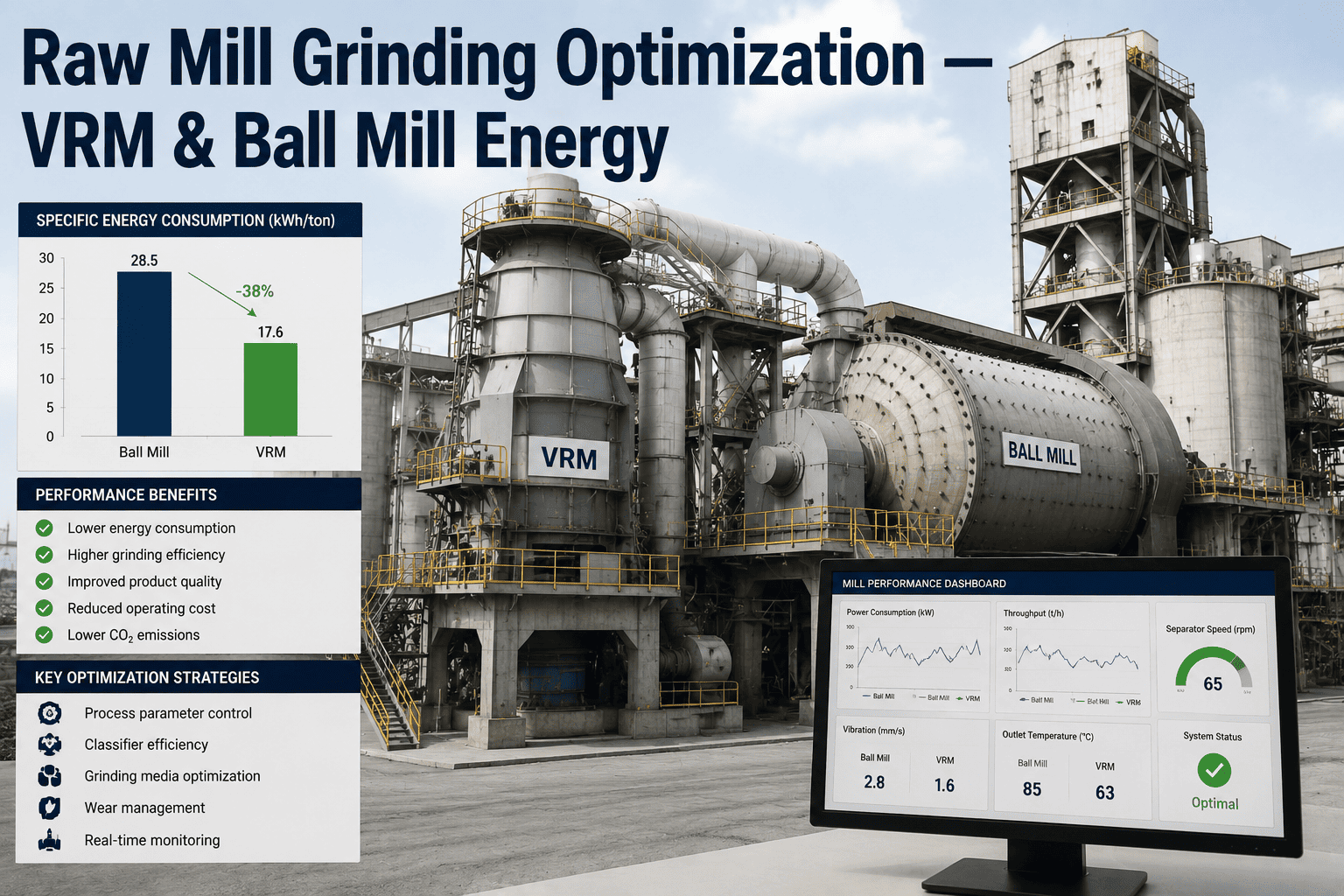
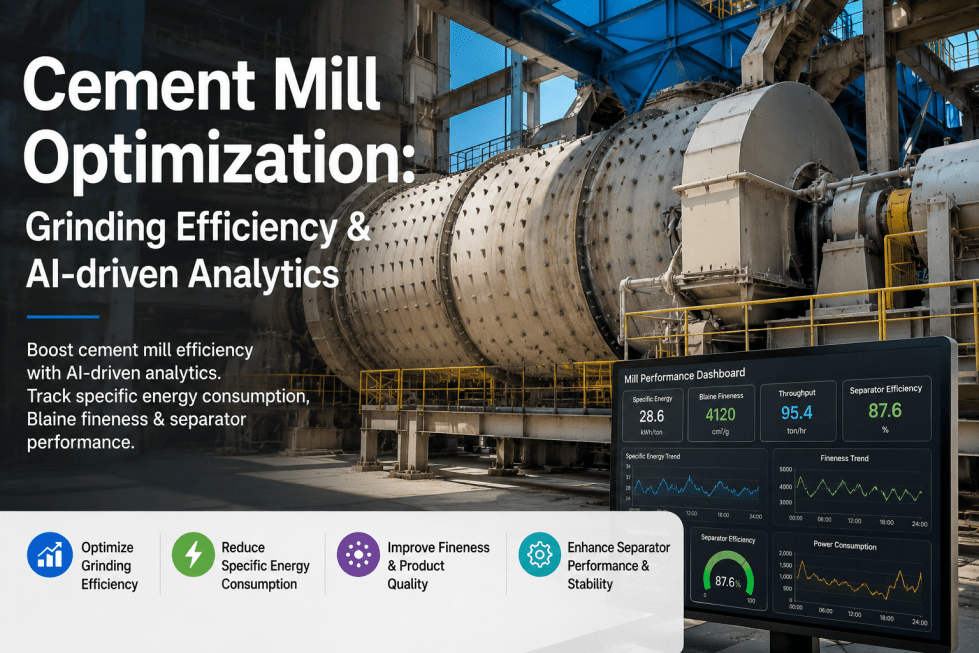
A finish mill has two jobs that quietly work against each other: grind clinker fine enough for strength development, and stop before gypsum dehydrates enough to cause false set. Both depend on the same variable — mill outlet temperature, best kept below roughly 110–120°C — which makes the finish mill one of the few places in a cement plant where a single control parameter affects quality, energy, and downstream storage behavior all at once. Get the chamber design, separator generation, and ventilation right, and specific power consumption for cement grinding can sit meaningfully below what an unoptimized circuit of the same equipment produces. Book a demo to see where your finish mill's chamber balance stands today.
Cement · Finish Grinding
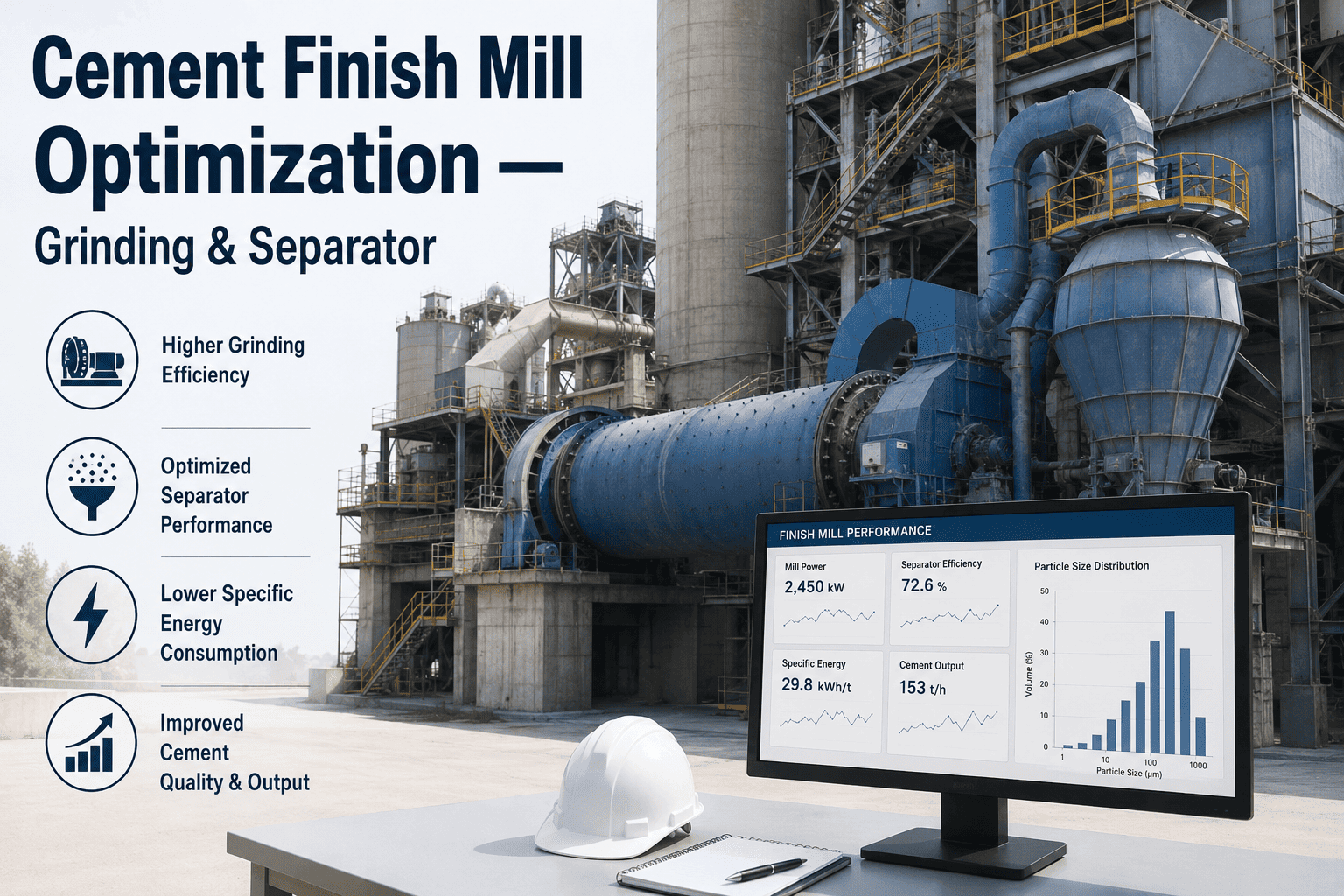
Cement Finish Mill Optimization — Quality and Energy From the Same Control Loop
Ball charge design, liner condition, separator generation, and gypsum dehydration control together decide whether a finish mill runs at its energy floor or quietly wastes kilowatt-hours on material that's already fine enough.
Inside the Mill
Two Chambers, Two Different Jobs
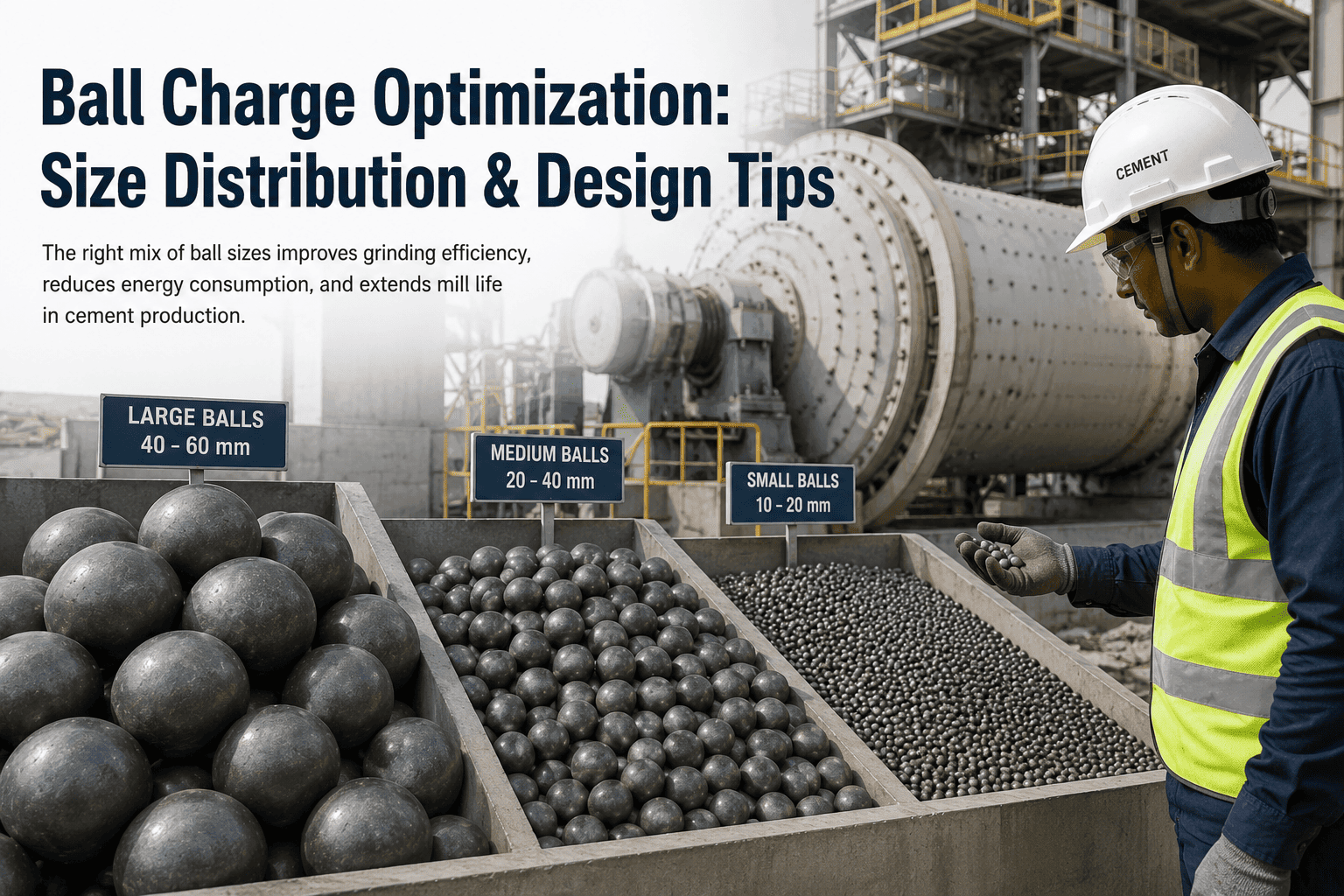
A two-chamber ball mill splits size reduction into a coarse-crushing stage and a fine-grinding stage, and each chamber needs its own ball charge specification to do its job efficiently.
Chamber 1 — Coarse Crushing
Ball diameter50–80 mm
Target specific power8–12 kWh/t
Diaphragm slot opening6–8 mm
Chamber 2 — Fine Grinding
Ball diameter15–40 mm
Charge volume30–36% of mill
Diaphragm slot opening8–10 mm
The Classification Side
Why the Separator Matters as Much as the Mill Itself
Grinding and classification work as one system. A weak separator sends already-fine material back into the mill for unnecessary regrinding, wasting energy on particles that never needed another pass.
First-Generation Static
40–50% efficiency
Coarse classification with a high share of fines returned unnecessarily to the mill.
Third-Generation High-Efficiency
65–75% efficiency
Sharper cut point cuts recirculating load and reduces specific energy meaningfully at the same Blaine target.
iFactory Tracks Mill Outlet Temperature and Fineness Together, in Real Time.
Gypsum dehydration risk, over-grinding, and separator drift are monitored on the same dashboard, so the plant doesn't have to choose between watching quality and watching energy.
The Fineness Trap
Why Grinding Finer Than Required Costs More Than It Looks
Energy consumption does not rise in a straight line with fineness. Producing cement finer than the specification requires disproportionately more power for very little added value.
Target Blaine (cm²/g)
Relative Energy Requirement
4,000
Approximately 30% more energy than baseline
Every +100 points above spec
Adds disproportionate specific energy with no added product value
Optimization Checklist
What a Finish Mill Audit Actually Checks
Mill Ventilation Rate
Air speed through the mill should sit between 1.5 and 2.0 meters per second — too slow encourages over-grinding and coating, too fast drags coarse material out before it's ready.
Feed Size and Clinker Temperature
Clinker feed should be under 70°C at the mill inlet, since hotter clinker accelerates gypsum dehydration and increases false-set risk downstream.
Residue at the Intermediate Diaphragm
Target residue on a 2mm sieve at the diaphragm is under 5%, a quick indicator of whether chamber 1 is doing its share of the size-reduction work.
Water Spray and Outlet Temperature
Cement discharge temperature is best kept below roughly 110–120°C, allowing controlled partial gypsum dehydration without tipping into false set problems.
From the Field
What We Found When We Actually Measured Each Chamber
We had always tuned the mill as a single system, watching overall power draw and overall fineness. A chamber-by-chamber inspection showed chamber one was performing well, but chamber two's grinding had effectively stalled partway through because the average ball size had worn down too small for the material still arriving there. Rebalancing the charge toward a coarser average diameter in that chamber alone brought specific power consumption down noticeably without touching a single other setting.
— Grinding Circuit Engineer, Cement Finish Mill Operations
Frequently Asked Questions
Finish Mill Optimization — Common Questions
How do I know if my finish mill's ball charge needs rebalancing?
Measure specific power consumption separately for each chamber — the first chamber should run between 8 and 12 kWh per ton, and if it falls below that range the charge likely needs more media, while consumption above 12 kWh per ton usually means the charge is oversized and wasting energy. Persistent excess residue at the intermediate diaphragm is another sign that chamber balance needs attention.
Book a demo to see chamber-level power tracked automatically.
What is false set and why does it matter for finish mill operation?
False set occurs when gypsum dehydrates too much inside the mill due to excessive heat, causing the cement to stiffen prematurely when mixed with water before normal hydration reactions begin. Controlling mill outlet temperature and using water spray in the second chamber keeps dehydration in the beneficial partial range rather than tipping into a quality defect that shows up much later at the concrete plant.
Is upgrading the separator alone worth it without replacing the mill?
Yes, in most cases a separator upgrade is one of the highest-return steps available, since moving from a first or second-generation unit to a high-efficiency third-generation separator can cut recirculating load meaningfully and reduce specific energy without any change to the mill shell, liners, or drive.
How does grinding aid dosage affect mill energy consumption?
Grinding aids reduce electrostatic agglomeration of fine particles and limit coating buildup on grinding media and liners, which keeps grinding efficiency from degrading over a production run. Dosage needs careful calibration, since under-dosing leaves coating problems unresolved while over-dosing adds cost without further efficiency benefit.
What is the single fastest check for over-grinding on a finish mill?
Compare the current Blaine fineness against the actual product specification — if the mill is consistently producing cement measurably finer than required, that gap is pure wasted energy given how steeply power consumption rises with fineness.
Contact support for help setting up automated fineness-versus-spec tracking.
Balance Quality and Energy on the Same Finish Mill Dashboard.
Chamber-level power tracking, separator performance, and gypsum dehydration risk brought together so grinding energy savings never come at the cost of cement quality.