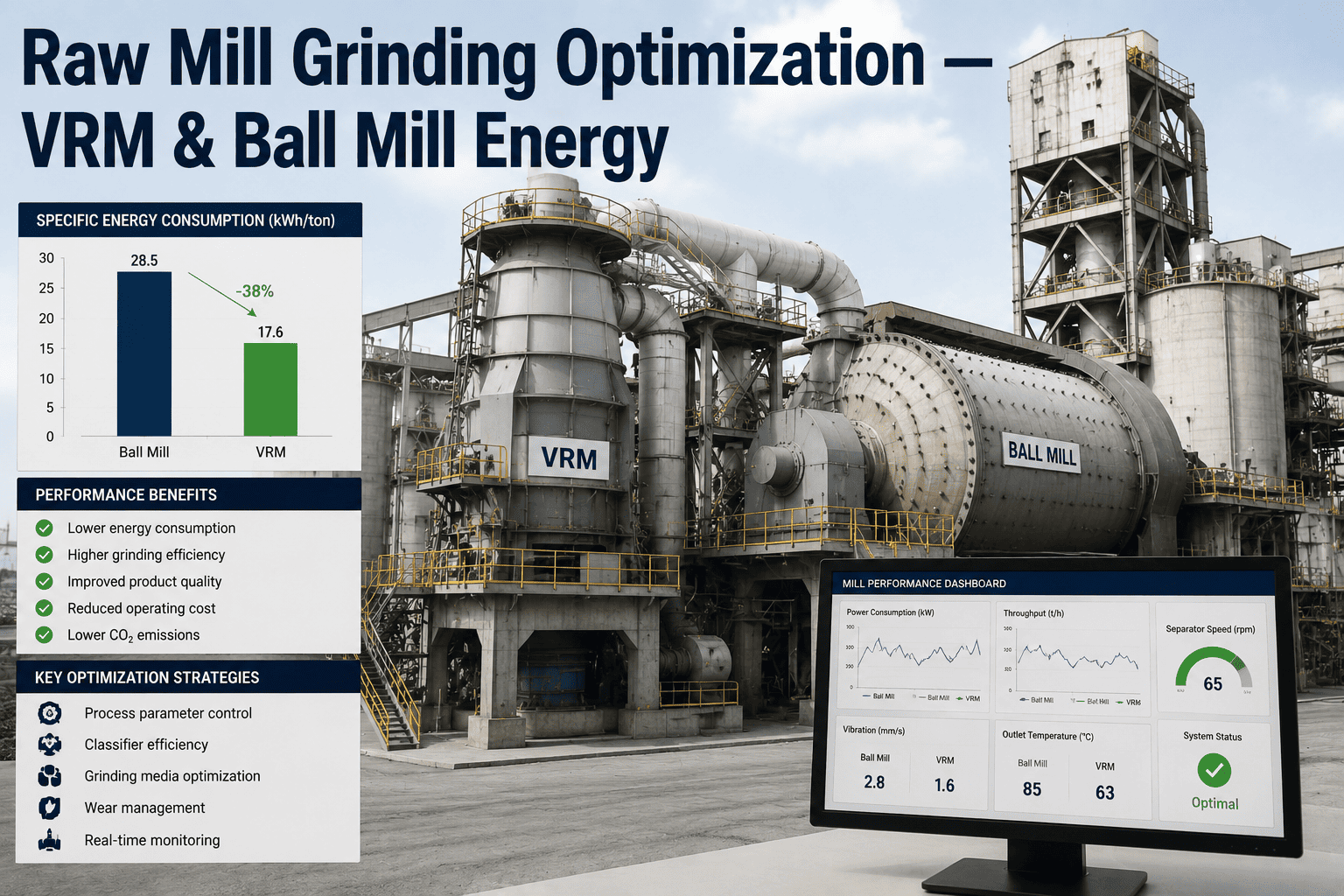
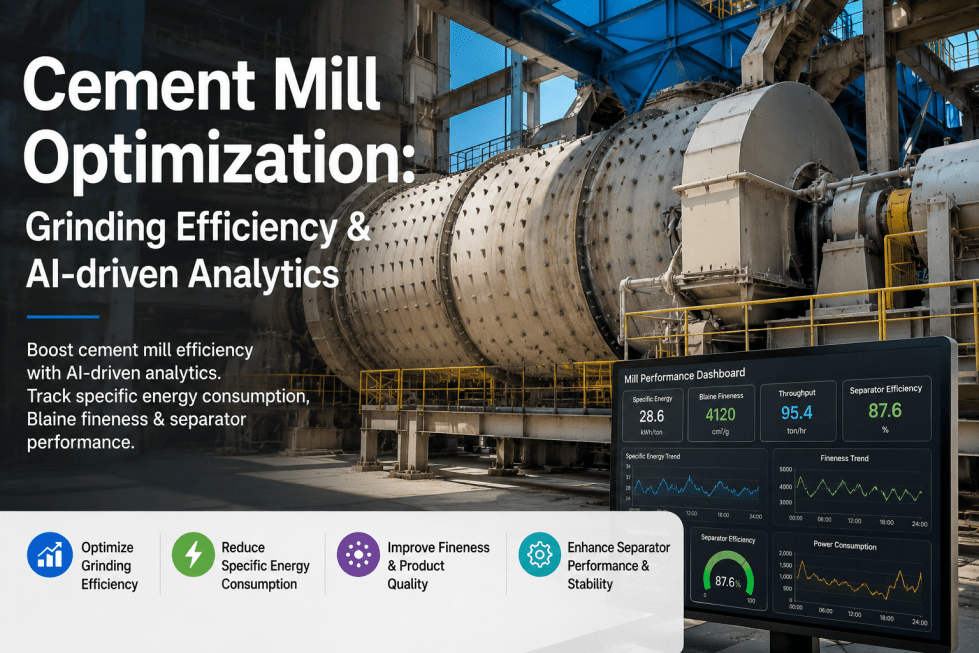
A two-chamber cement ball mill can carry over 200 tons of steel grinding media, and the size distribution of that charge does more to determine mill throughput than almost any other single variable a plant controls. Yet most mills run on a ball charge that was loaded years ago and topped up ad hoc ever since, drifting slowly away from the size distribution the mill was actually designed around. The result is a mill that draws the same power it always has while grinding noticeably less clinker per hour. Book a Demo to see how continuous power draw and fineness trending expose that drift before it costs a full quarter of output.
The Ball Charge That Was Right on Day One Is Rarely Right Five Years Later
Ball size distribution, charge volume, and media hardness all wear down together over years of operation, and a mill that quietly drifts from its designed charge loses throughput long before anyone notices a problem. Getting the charge right, chamber by chamber, is one of the highest-leverage changes available on an existing mill with no capital equipment required.
The Ball Charge Is a Consumable, But It Behaves Like a Piece of Process Equipment
Grinding media is purchased as a commodity and tracked as a consumable expense, but functionally it behaves like a precision process component: its size distribution determines the impact and attrition forces available at every point along the mill, and those forces determine both throughput and particle size distribution of the finished cement. A charge that has worn down to smaller average ball size than the design calls for shifts the mill's grinding action toward finer particles at the expense of overall throughput, while a charge that has become too coarse from under-replenishment leaves large particles under-ground and forces the separator to reject more material back to the mill, compounding the loss.
First Chamber Breaks Rock, Second Chamber Makes Cement — Each Needs a Different Ball Size Curve
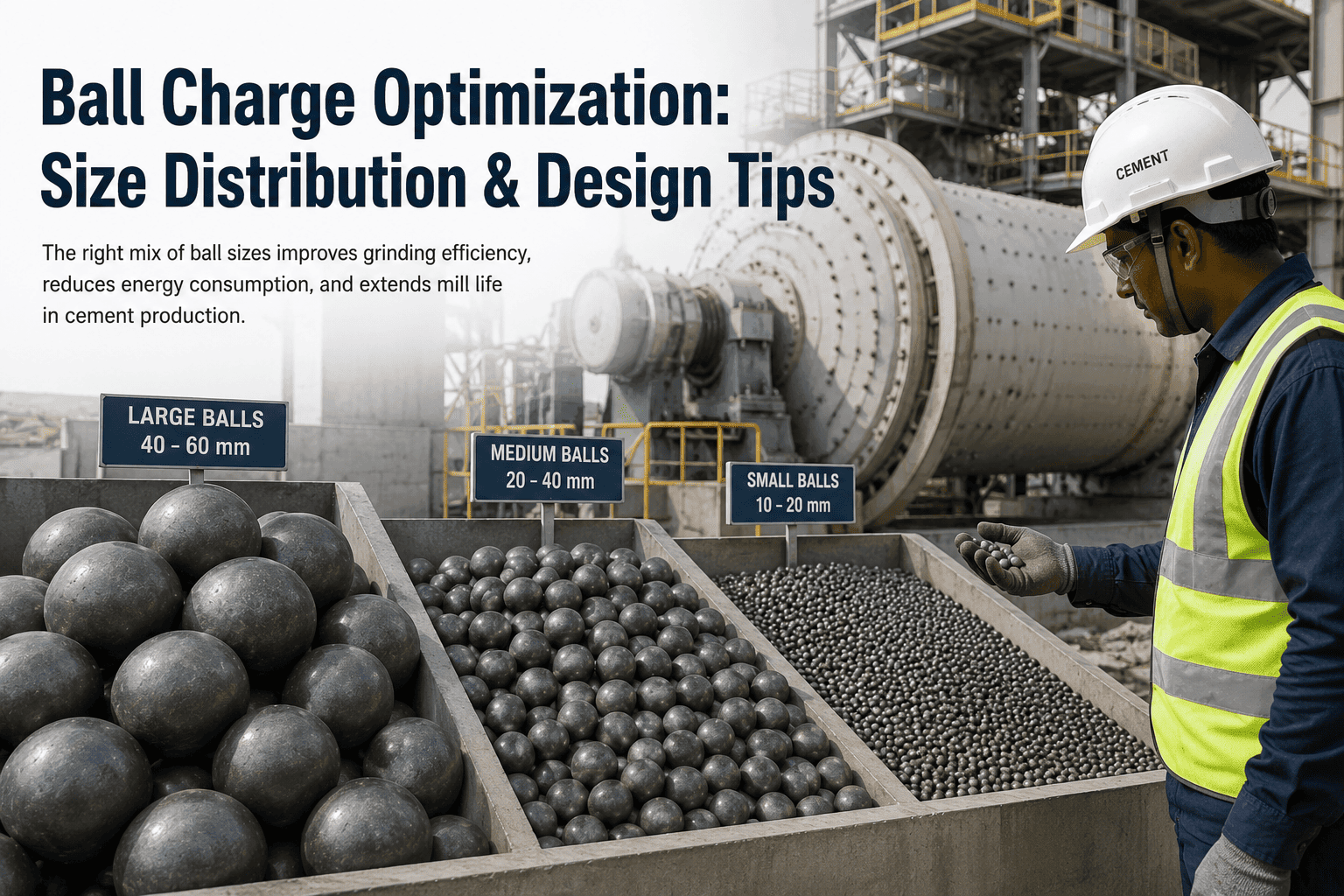
A standard two-compartment cement mill splits grinding into two distinct jobs, and the ball size distribution in each chamber should reflect that split rather than share a single average size. The first chamber's job is coarse breakage of clinker and gypsum feed, which requires large-diameter balls with high impact energy. The second chamber's job is fine grinding to finished cement fineness, which requires small-diameter balls where surface area and attrition matter more than raw impact force. Loading either chamber with the wrong size curve wastes grinding energy on a job that size of ball is not suited for.
First Chamber — Coarse Grinding
Feed: 25mm down to 2-3mm clinker and gypsum
Charge volume held at 28-32% of chamber volume; below 60mm, media is generally screened out and moved to the second chamber rather than left to grind coarse feed inefficiently.
Second Chamber — Fine Grinding
Feed: partially ground material to finished cement fineness
Charge volume held at 27-30% of chamber volume; cylpebs are used in place of balls in some second-chamber designs for a marginal surface-area advantage at equivalent charge weight.
Is Your Mill's Power Draw Still Matching Its Designed Charge?
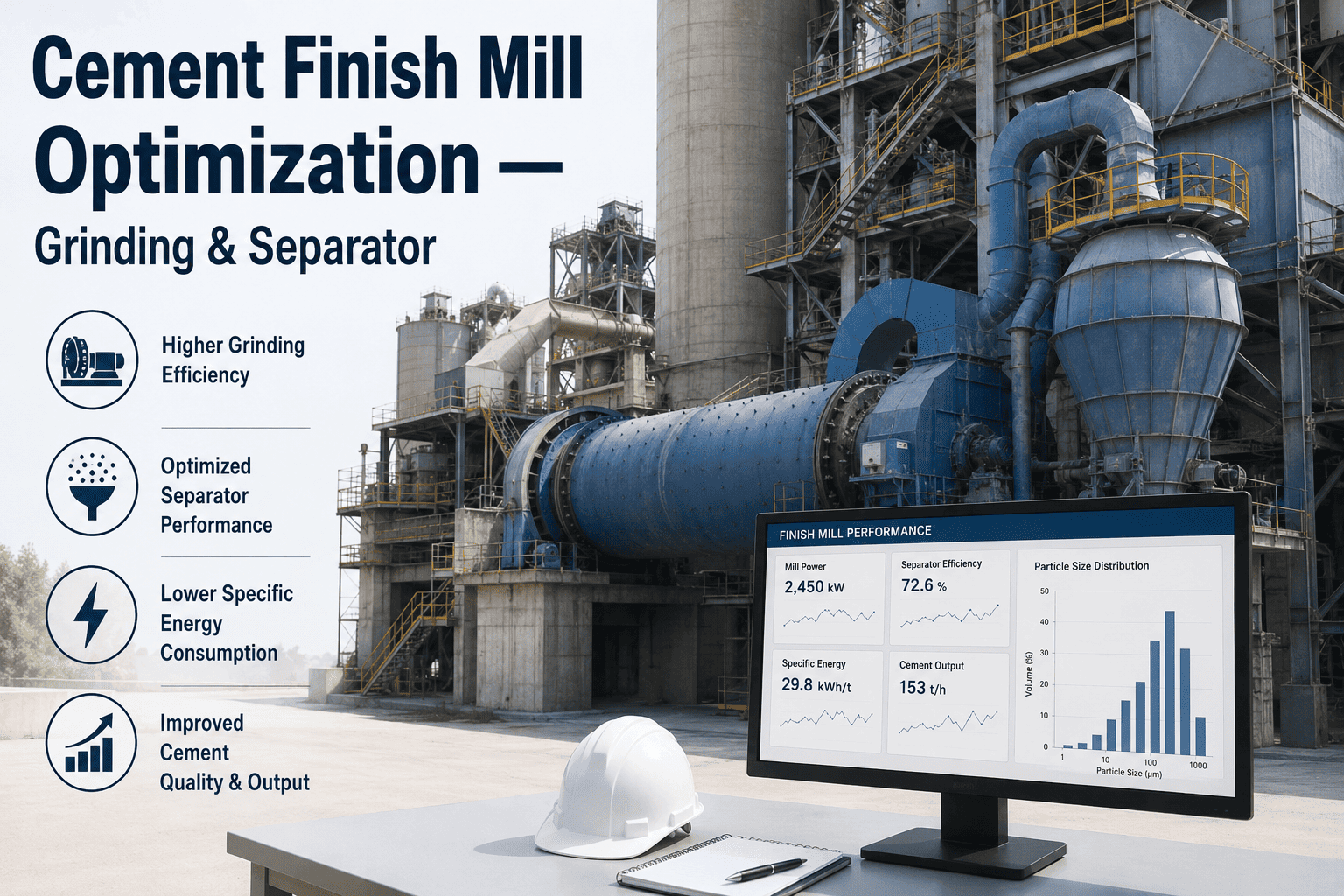
iFactory correlates power draw, feed rate, and product fineness continuously, flagging the moment a chamber's charge has drifted enough to start costing throughput.
High-Chrome Cast Iron vs. Forged Steel — Wear Rate, Cost, and Where Each One Wins
Media material selection is a direct trade between purchase price and wear life, and the right answer differs by chamber because the two chambers impose very different wear mechanisms. First-chamber media faces primarily impact wear from breaking coarse clinker, while second-chamber media faces primarily abrasive wear from fine grinding, and each material family responds differently to those two mechanisms.
High-Chromium Cast Iron
Chromium content of 15 to 28 percent produces a hard, wear-resistant microstructure well suited to the abrasive conditions of the second chamber, typically delivering 30 to 50 percent lower wear rate than forged steel at a comparable hardness in fine grinding duty, at a materially higher unit cost per ton.
Forged Steel (Through-Hardened)
Lower unit cost and better resistance to the impact fracturing that high-chrome media is more prone to under heavy first-chamber breakage loads, making forged steel the more common choice for coarse grinding despite its higher abrasive wear rate in fine grinding duty.
Forged Steel (Case-Hardened)
A hardened surface layer over a tougher core offers a middle ground between the two extremes, often specified where a mill runs a mixed feed hardness and neither pure high-chrome nor pure through-hardened media consistently performs best across the full range of conditions encountered.
Tracking Media Consumption by Chamber Tells You When to Recharge Before Throughput Drops
Media consumption rate, expressed in grams of steel worn away per ton of clinker ground, is the leading indicator that should drive recharge timing rather than a fixed calendar schedule. Consumption varies meaningfully by chamber, by feed hardness, and by media material, and a plant that tracks it consistently can time replenishment to hold charge volume within its target band continuously rather than discovering a shortfall only when throughput has already dropped.
| Parameter | First Chamber | Second Chamber |
|---|---|---|
| Typical Wear Rate | 80-120 g/ton clinker | 40-70 g/ton clinker |
| Dominant Wear Mechanism | Impact fracture and spalling | Surface abrasion |
| Typical Recharge Interval | 4-6 weeks | 6-10 weeks |
| Charge Sorting Frequency | Every 6-12 months | Every 12-18 months |
| Common Media Grade | Forged steel, through-hardened | High-chromium cast iron |
Sorting, Top-Up, and Full Recharge — Choosing the Right Intervention
Not every charge correction requires a full media dump and reload. Three levels of intervention cover most situations, and choosing the lightest one that actually fixes the observed drift keeps both cost and downtime to a minimum.
Routine Top-Up
Small, frequent additions of the design size distribution replace consumed media before charge volume falls outside its target band, and this is the primary tool for holding a correctly designed charge in steady state over time.
Media Sorting
Charge is discharged, screened by size, and undersized or deformed balls are removed and replaced, correcting a gradual size-distribution drift without changing the overall charge design, typically performed during a scheduled mill stop.
Full Recharge
The entire chamber charge is replaced against a freshly calculated size distribution, reserved for cases where the mill's feed characteristics or product specification have changed enough that the original charge design itself is no longer the right target.
We had been topping up both chambers with the same ball size for years because it simplified inventory. Once we recalculated the second chamber curve and switched to a proper high-chrome blend down there, fineness stabilized enough that we picked up roughly eight percent on mill throughput without touching feed rate or separator settings. The charge had drifted so gradually that nobody had flagged it as the cause.
Frequently Asked Questions
Q: How do we know if our current ball charge has drifted from its design distribution?
The most reliable early signal is a power draw that no longer moves in step with feed rate the way it once did, combined with a separator reject rate that has crept upward over months rather than staying flat. A physical charge audit, where the mill is stopped and a representative sample is screened by size, gives a definitive answer but only reflects a single point in time. Continuous power and fineness trending, discussed further via Book a Demo, catches the drift months before a physical audit would typically be scheduled.
Q: Does a higher charge volume always mean higher throughput?
No. Power draw and grinding efficiency both peak around a specific charge volume, typically in the 45 to 50 percent range for power draw alone, but the practical operating target of 28 to 32 percent reflects a balance between grinding efficiency, media wear rate, and liner wear rather than a target chosen to maximize power draw itself. Pushing charge volume higher than the design target generally increases media and liner wear faster than it increases throughput, making it a net loss rather than a gain.
Q: Why does the first chamber use forged steel while the second chamber favors high-chrome?
The first chamber's coarse breakage duty produces heavy impact loading that can fracture the harder, more brittle high-chrome microstructure, so a tougher forged steel is generally the more reliable and economical choice there despite its faster abrasive wear rate. The second chamber's fine grinding duty is dominated by surface abrasion rather than impact, which is exactly the wear mode high-chromium cast iron resists best, making the cost premium worthwhile in that specific application. Questions about a mill-specific material recommendation can be routed through Support Contact.
Q: How often should a full media sorting be performed?
Most plants sort the first chamber every six to twelve months and the second chamber every twelve to eighteen months, though the right interval depends heavily on feed hardness and moisture, both of which accelerate wear and distort the size distribution faster than nominal consumption rates alone would suggest. A mill running abrasive feed or frequent moisture excursions should sort more frequently than these baseline intervals, and tracking wear rate trends over time is a more reliable guide than a fixed calendar interval applied uniformly across all mills in a fleet.
Q: Can grinding aids reduce how much media optimization actually matters?
Grinding aids improve flowability and reduce ball coating, which recovers some grinding efficiency, but they do not compensate for a genuinely mis-sized ball charge because they act on particle behavior rather than on the impact and attrition forces the charge itself provides. Plants that rely on grinding aids to offset a known charge distribution problem typically see the gains plateau well below what a properly sized charge would deliver on its own, since the two levers address different parts of the grinding process rather than substituting for each other.
Stop Guessing When the Charge Needs Attention
See how continuous power draw, feed rate, and fineness correlation gives your process team a data-driven recharge schedule instead of a calendar guess.